Quick Answer
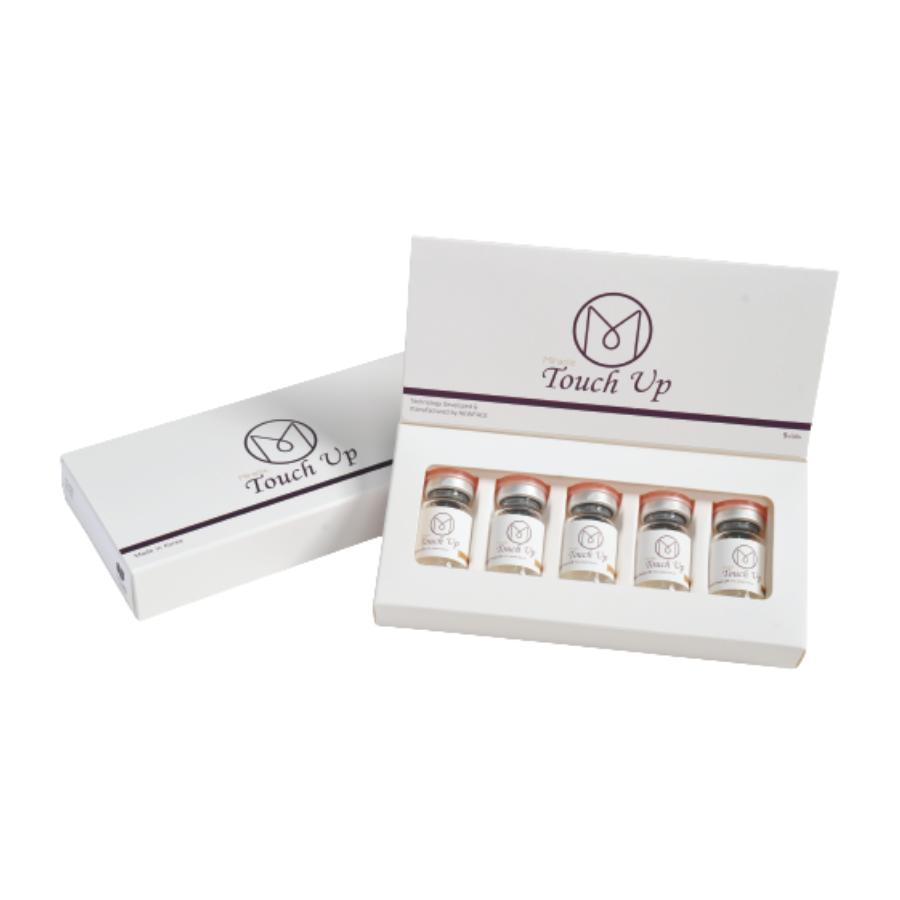
Miracle Touch Up is a Korean PCL-based skin booster from Dexrevo, supplied as 5 × 2 mL vials. PCL (polycaprolactone) is a biodegradable polymer that the body responds to with new collagen formation — the same mechanism used by PCL-based fillers (Ellanse). Touch Up combines PCL microspheres with HA and pyroglutamic acid for delivery. Standard protocol is three sessions four weeks apart, with effects building over 6–8 weeks.
Why This Skinbooster Is Different
Miracle Touch Up brings a PCL biostimulator mechanism into the skinbooster category — most skin boosters work through HA hydration, nucleotide signalling, or coenzyme delivery. PCL is a foreign-body-response polymer (the same molecule used in Ellanse fillers and dissolvable sutures). The booster format places PCL in the dermal plane rather than the structural subcutaneous plane, producing diffuse skin tightening rather than focal volume.
Mechanism of Action
PCL biostimulator (biodegradable polymer collagen induction). PCL microspheres trigger a controlled foreign-body response in dermal tissue. Macrophages encapsulate the microspheres; fibroblasts are recruited; collagen is deposited around the polymer over weeks. As PCL slowly degrades (months), the new collagen scaffold persists — that is the source of the sustained, biostimulator-class effect.
Frequently Asked Questions
What is PCL and how does it work in the skin?
PCL stands for polycaprolactone — a biodegradable synthetic polymer. The PCL microspheres trigger a controlled foreign-body response: macrophages encapsulate the microspheres, fibroblasts are recruited, and new collagen is deposited around the microspheres over weeks. As the PCL slowly degrades (over months), the new collagen remains — that is the source of the sustained effect.
How is Touch Up different from a PCL dermal filler (Ellanse)?
Both use PCL but at very different concentrations and placement. Ellanse is a dermal filler — high PCL concentration, placed in the subcutaneous or deep dermal layer for structural volume correction. Touch Up is a booster — lower PCL load, placed in the dermal plane via multi-point microinjection for diffuse skin tightening. Different objective, different injection technique.
How is Touch Up different from PLLA (Sculptra)?
Both PCL and PLLA are biodegradable polymers that trigger collagen induction. PCL degrades more slowly than PLLA, giving a longer in-situ residence — published durations of up to 24 months for PCL fillers vs ~24 months for PLLA. For Touch Up's booster application, the effect duration is ~12 months. Selection between PCL and PLLA is at practitioner discretion.
Is it reversible if there's a complication?
No. Unlike HA-based products (which can be dissolved with hyaluronidase), PCL is not reversible — once injected, the body's response cannot be reversed pharmacologically. This is a key clinical consideration. The trade-off is longer-lasting effect with less correction flexibility.
How many sessions are needed?
The standard protocol is three sessions, four weeks apart. Effects build over 6–8 weeks after each session as the collagen response matures. Patients typically reach peak benefit 12–16 weeks after the third session, with effects sustained up to ~12 months from the completed course.
Is it suitable for patients with HA fatigue or HA hypersensitivity?
Yes — this is one of the most clinically relevant indications. Patients who cannot tolerate HA (true hypersensitivity, delayed-onset nodules) or who have reached HA-fatigue (diminished response after repeated HA filler) benefit from a non-HA biostimulator route. Touch Up provides that pathway.
What injection technique is used?
Multi-point intradermal placement is most common: 0.05–0.1 mL per point at ~1 cm spacing. Linear retrograde subdermal technique can be used for larger areas. Gentle post-injection massage helps distribute the PCL evenly through the field. Patient repositioning and immediate post-injection assessment are essential.
Does it produce immediate volume effect?
No — and patients should be counselled accordingly. Unlike HA fillers, PCL-based products produce no immediate volume change. The visible benefit is delayed, building over 6–8 weeks as the collagen response matures. This is important for managing patient expectations.
Are there contraindications?
Standard injectable contraindications apply: pregnancy and lactation, active infection at the treatment site, severe coagulopathy, hypersensitivity to PCL or HA, history of keloid formation. Patients with a history of granulomatous reactions to dermal fillers should not receive PCL-based products.
What downtime should patients expect?
Mild swelling, redness, and small papules at injection points are normal and resolve within 24–72 hours. Bruising may occur and typically resolves within a week. Patients can usually return to social activity the day after treatment. Heat exposure (sauna, sun) should be avoided for 48 hours.




Reviews
There are no reviews yet.