Quick Answer: What Post-Laser Skin Actually Needs
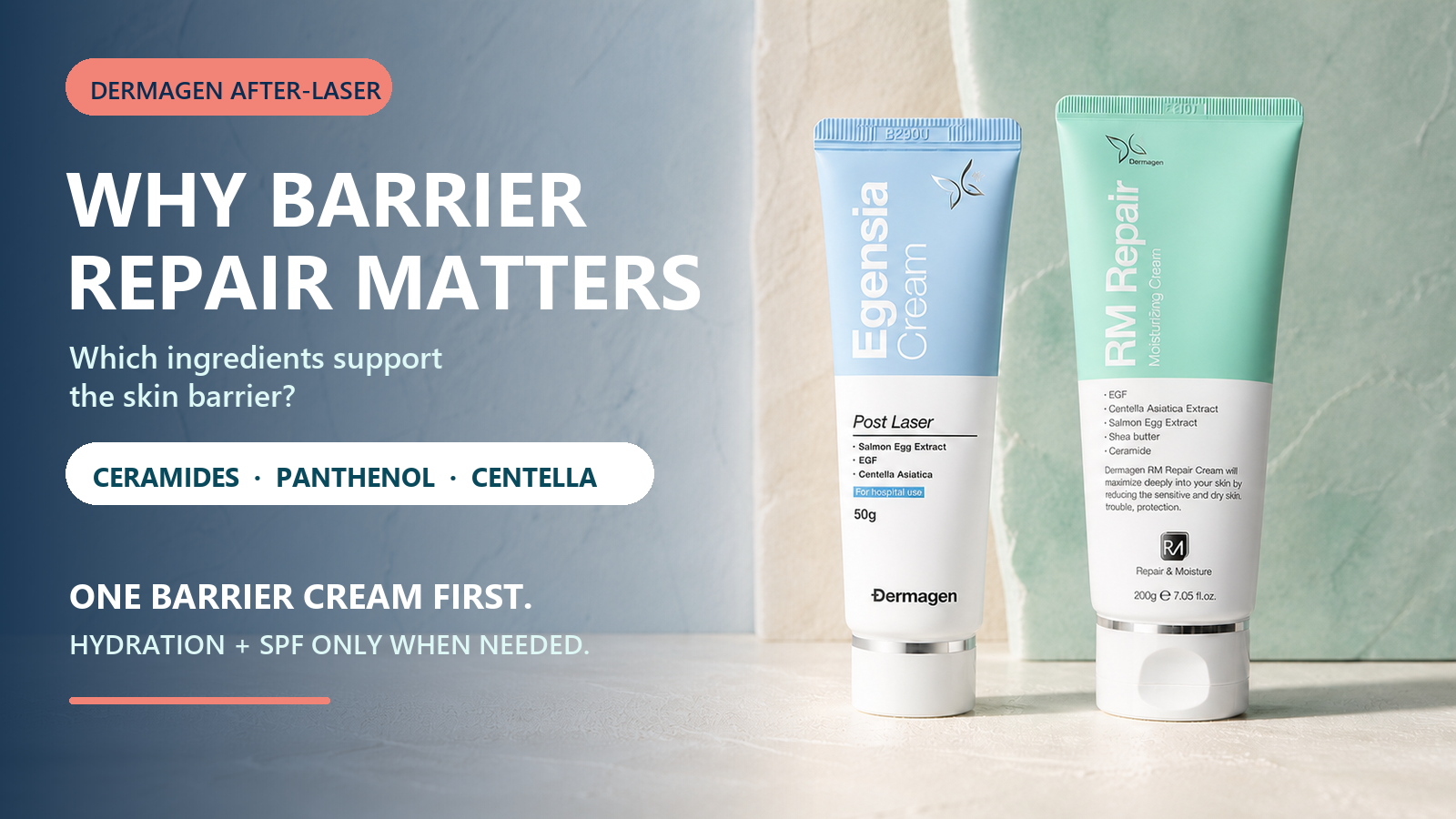
Start with one barrier-support cream, not a four-product bundle. Laser and other energy-based procedures can temporarily disturb the skin barrier, so the first practical goal is to support barrier lipids, hold water in the outer skin, and keep the routine comfortable. Within the verified DERMAGEN range, Egensia Cream is the most direct first option because it combines ceramide, D-panthenol, and Centella asiatica. If the priority is a richer emollient feel, RM Repair Cream pairs Ceramide NP with shea butter and Centella.
The Soothing Mask is an optional hydration and comfort step; it does not replace the barrier cream. White Sun Cream has a separate photoprotection role and should be introduced only when the procedure protocol and current skin condition allow sunscreen. In other words: choose the cream by ingredient need first, then add only the step that solves a different problem.
Why Laser-Treated Skin Needs Barrier Repair
The outermost part of the skin is not simply a dry surface waiting for more moisture. It is an organized barrier made of corneocytes and intercellular lipids that limits water loss and helps reduce penetration by environmental irritants. Laser procedures create controlled thermal or microscopic injury to achieve a specific treatment goal, but the extent of temporary barrier disruption varies with the device, wavelength, treatment depth, intensity, and individual skin response.
When that barrier is disrupted, transepidermal water loss, commonly shortened to TEWL, can rise. Water escapes more easily, which helps explain why freshly treated skin may feel dry, tight, warm, or unusually reactive even when it does not look visibly dry. A recent review of periprocedural skincare for energy-based procedures therefore organizes aftercare around the degree of barrier disruption and identifies moisturizers with physiological lipids, humectants, and carefully timed photoprotection as useful parts of a staged routine.
This leads to a simple buying conclusion: the most useful first product is not necessarily the largest tube or the most elaborate set. It is the formula that addresses the missing barrier function with the least unnecessary complexity. For a mild, closed-skin recovery stage, that usually means a bland cream that contributes lipids and water-binding support. More disrupted, raw, or complicated skin belongs under the treating professional’s specific aftercare plan rather than a general product routine.
The Ingredients That Matter—and What Each One Does
Ingredient names become useful only when they are connected to a real skin need. A broad review of skin-barrier function and moisturization describes three familiar moisturizer roles: humectants draw water toward the epidermis, emollients integrate with and soften the stratum corneum, and occlusive materials reduce evaporation from the surface. Post-laser product selection becomes much clearer when the formula is read through those roles.
| Customer need | Ingredient logic | DERMAGEN option to investigate | Decision |
|---|---|---|---|
| Basic barrier support | Ceramide or Ceramide NP contributes a physiological-lipid rationale; panthenol and glycerin add water-binding support. | Egensia or RM Repair | Choose the cream first; do not use a hydrating mask as a lipid substitute. |
| Dryness and tightness | D-panthenol, sodium hyaluronate, and glycerin support hydration; shea butter provides a richer emollient layer. | Egensia for a balanced cream; RM for a richer feel; Mask as an optional extra | Match richness to comfort rather than buying every format. |
| Sensitive, uncomfortable feel | Centella, panthenol, and allantoin are commonly used to soothe and condition sensitive-feeling skin. | Egensia, RM Repair, or Soothing Mask | Use this as ingredient-level rationale, not proof of a guaranteed recovery time. |
| Ultraviolet protection | Titanium dioxide is a mineral UV filter. This is a protection role, not barrier rebuilding. | White Sun Cream | Add when the procedure protocol permits sunscreen; do not force it onto skin that is not ready. |
A practical way to read the range is to begin with the symptom that is driving the purchase. If the skin mainly feels tight and easily irritated, look first for a cream that combines barrier lipids with humectant and soothing support. If the same skin also prefers a richer, more cushioning finish, an emollient such as shea butter becomes a meaningful differentiator. If the cream already feels sufficient, adding another hydrating format may increase cost and routine complexity without solving a new problem.
It is also important to judge the formula as a whole. An ingredient can be relevant without guaranteeing that every user will tolerate every finished product, and a longer ingredient list is not automatically better. The article therefore uses ingredient roles to narrow the choice, then asks whether each additional product has a separate job. This is the difference between an evidence-led routine and a bundle assembled from four attractive product descriptions.
Ceramides matter because barrier lipids help organize the spaces between corneocytes. That does not mean any product containing the word “ceramide” has been clinically proven to speed laser recovery. It means ceramide-containing formulas have a logical place when the customer’s first problem is water escaping through a temporarily weakened barrier.
Panthenol is useful because it combines a humectant role with skin-conditioning and barrier-support language. A double-blind randomized study evaluated a panthenol-enriched mask containing madecassoside and bisabolol after dual-wavelength non-ablative fractional laser treatment. The study supports the post-laser relevance of that ingredient strategy, but it did not test DERMAGEN Soothing Mask. The responsible conclusion is therefore that panthenol strengthens the formula rationale, not that the DERMAGEN mask inherits the trial’s outcomes.
Centella asiatica and allantoin belong in the comfort discussion. They help explain why a recovery-oriented formula may feel more appropriate than an active-heavy daily routine. Sodium hyaluronate and glycerin help attract and hold water, while shea butter provides a richer emollient layer. Hydrolyzed collagen in a sheet mask should be described as a conditioning or film-forming component, not as proof that a mask rebuilds dermal collagen.
EGF or rh-oligopeptide-1 needs the most careful wording. A small split-face randomized study investigated a recombinant human EGF ointment after fractional ablative resurfacing, showing that EGF has been studied in this recovery setting. However, the study tested a different EGF ointment, not Egensia or RM Repair. In this article, EGF remains a recovery-focused conditioning ingredient, while the practical product recommendation is driven primarily by the clearly verifiable ceramide, panthenol, Centella, and shea-butter roles.
Why Egensia Is the First DERMAGEN Product to Consider
If a customer wants one uncomplicated starting cream, Egensia has the clearest ingredient logic in the current DERMAGEN group. Its verified formula highlights ceramide for barrier-lipid support, D-panthenol for hydration and comfort, and Centella asiatica for a soothing role. Those three functions answer the main post-laser question without requiring the customer to build a long routine.
Egensia also contains EGF listed as RH-oligopeptide and salmon egg extract. These ingredients support its recovery-focused positioning, but they should not be the reason to promise faster healing or a specific clinical result. The stronger reason to investigate Egensia is simpler: its core ingredient combination maps directly to the three needs customers keep asking about—barrier support, water retention, and comfort.
Recommendation: choose Egensia first when the goal is one balanced post-procedure cream and the skin is ready for a cosmetic moisturizer under the existing aftercare plan. It is the default route in this comparison because of its ingredient balance, not because of packaging size or a superiority claim.
When RM Repair Makes More Sense
RM Repair should not be positioned as “Egensia, but bigger.” Its meaningful difference is the richer emollient route created by Ceramide NP and shea butter, supported by Centella asiatica. That makes RM easier to understand for customers whose main complaint is persistent dry, rough, or tight-feeling skin and who prefer a more cushioning cream texture.
The product also contains EGF and salmon egg extract, but the same evidence boundary applies: those ingredients do not turn the product page into a clinical recovery trial. RM Repair earns its place in the decision because shea butter adds a richer softening layer while Ceramide NP supports the barrier-lipid rationale.
Recommendation: investigate RM Repair instead of Egensia when richer emollience is the priority or when a face-and-body moisturizing format better matches the customer’s use case. Customers who prefer a lighter, simpler facial recovery cream should begin with Egensia rather than buying both.
When a Soothing Mask Is Worth Adding
A sheet mask can make sense when the barrier cream is already chosen and the customer wants an additional hydration-and-comfort step. DERMAGEN Soothing Mask lists sodium hyaluronate, panthenol, allantoin, glycerin, aloe, and hydrolyzed collagen. Read together, these ingredients support water binding, surface conditioning, and a soothing experience.
What the Soothing Mask does not provide is a reason to skip the main cream. Humectants help attract water, but a post-laser routine still needs an appropriate lipid or emollient strategy when water loss is the underlying problem. The mask is therefore an add-on, not the foundation and not evidence that everyone needs a complete set.
Recommendation: add the Soothing Mask only when extra short-term hydration and comfort would solve a separate need. If the customer’s budget or tolerance favors a minimal routine, keep the cream and leave the mask optional.
Why Sun Protection Is a Separate Recovery Step
Ultraviolet protection matters after many light and laser procedures because recovering skin may be more vulnerable to UV-related irritation or uneven pigmentation. A recent literature review of sunscreen after light and laser treatment discusses the role of physical filters such as titanium dioxide and zinc oxide in post-procedural care.
DERMAGEN White Sun Cream lists titanium dioxide, which gives it a clear photoprotection role. It also lists Centella, niacinamide, glutathione, and adenosine, but those supporting ingredients do not make the sunscreen a replacement for the barrier cream. Nor does the general literature determine the right start time for every laser procedure.
Recommendation: consider White Sun as a separate protective step once the treating protocol permits sunscreen on the current skin surface. Until then, follow the specific physical-protection and aftercare instructions supplied for the procedure rather than forcing a universal timeline.
Do You Need All Four DERMAGEN Products?
No. A four-product routine should be the result of four separate needs, not the starting assumption. The social questions behind this article repeatedly ask what remains essential when budget, tolerance, or simplicity matters. The answer is to protect the core decision: choose one barrier cream first, then add only the product that has a distinct job.
Balanced, minimal route
Egensia Cream first. Choose this route when ceramide, panthenol, and Centella provide the most direct match for barrier support, hydration, and comfort.
Richer emollient route
RM Repair first. Choose this route when Ceramide NP plus shea butter better matches a preference for richer moisture and a cushioning cream feel.
Optional hydration add-on
Add the Soothing Mask only if needed. It brings humectant and soothing support, but it should not displace the chosen cream.
Separate protection step
Add White Sun only at the permitted stage. Its titanium-dioxide role is UV protection, not barrier-lipid replacement.
Product identity only: Egensia is a 50 g cream, RM Repair is a 200 g cream, Soothing Mask contains 10 sheets, and White Sun Cream is a 50 mL sunscreen. These details identify the exact products; they do not determine which one the customer needs.
DERMAGEN Ingredient FAQ + Product CTA
Which DERMAGEN cream should I consider first after laser?
Consider Egensia first when you want one balanced cream built around ceramide, D-panthenol, and Centella. Consider RM Repair instead when a richer emollient formula with Ceramide NP and shea butter better matches your preference.
Do ceramides and panthenol do the same thing?
No. Ceramides support the lipid organization of the outer barrier, while panthenol primarily contributes humectant, conditioning, and soothing support. Their roles are complementary rather than interchangeable.
Is DERMAGEN Soothing Mask necessary after every laser procedure?
No. It is an optional hydration and comfort step. The more important first decision is an appropriate barrier-support cream; add the mask only when extra hydration solves a separate need.
Does White Sun Cream replace a post-laser repair cream?
No. White Sun Cream has a photoprotection role through its mineral UV filter, while a barrier-support cream addresses lipid, hydration, and comfort needs. They perform different jobs.
What is the simplest DERMAGEN routine after laser?
Choose Egensia as the balanced barrier-support route or RM Repair when a richer emollient cream is the better fit. Add the Soothing Mask only for extra hydration and White Sun only as a separate protection step when the treatment protocol allows it.
Choose by the Missing Need, Not by the Size of the Set
Choose one DERMAGEN barrier cream by verified ingredient need first; add the mask only for extra hydration and the mineral sunscreen only as a separate permitted photoprotection step. Egensia is the most direct balanced starting point; RM is the richer alternative. The mask and sunscreen earn a place only when they solve their own distinct problem.
Compare Egensia · Compare RM Repair · Review the optional mask · Review White Sun
This ingredient-led article supports product selection and does not replace the aftercare instructions for a specific laser device, treatment depth, or current skin condition.