Concern regions, not injection coordinates
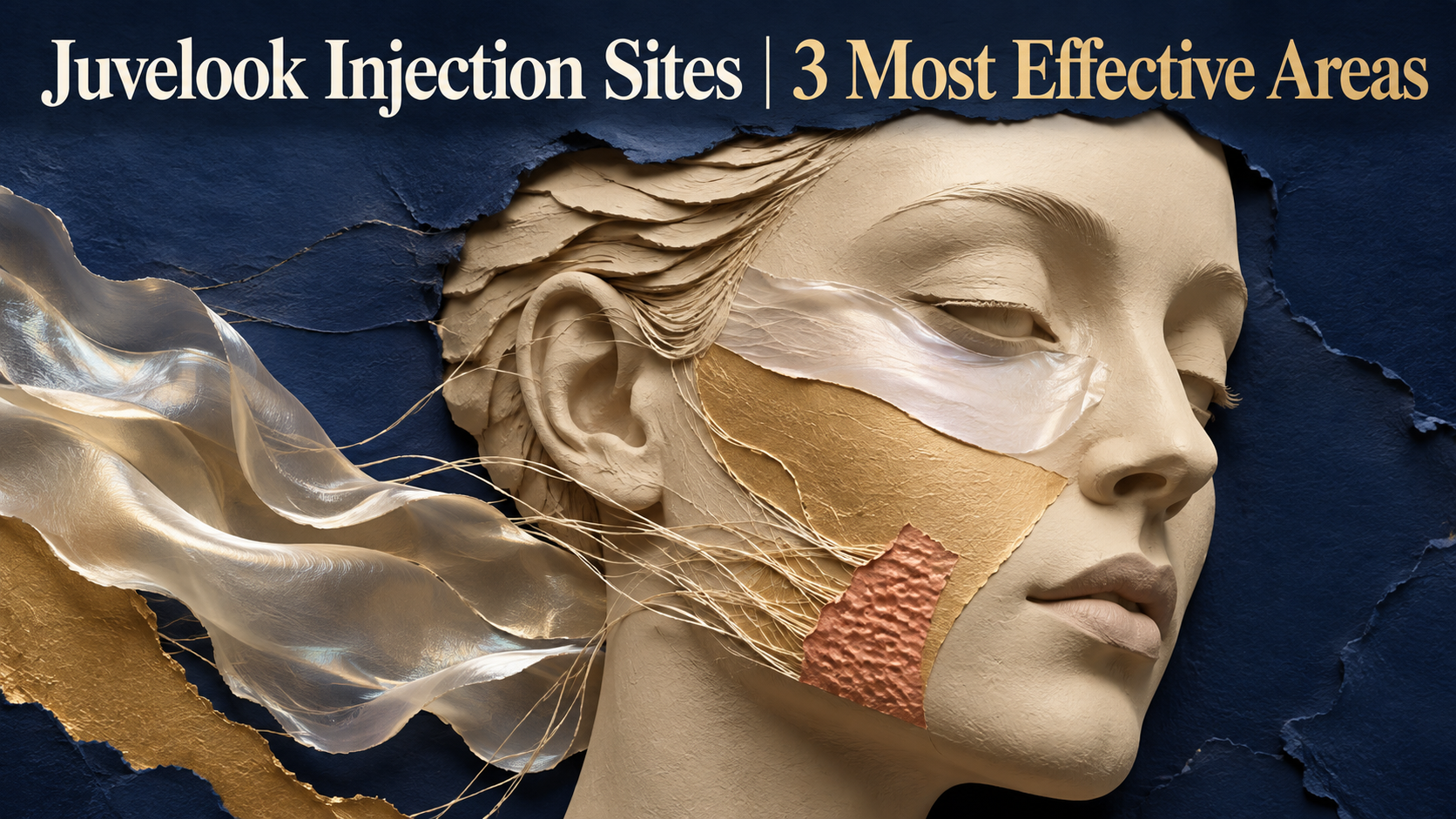
The useful way to read “Juvelook injection sites” is as three clinician-assessed area-and-concern discussions: under-eye skin quality or tear-trough concerns, cheek and midface texture or support, and selected atrophic acne-scar zones.
Table of Contents
Quick Answer
The three most useful Juvelook area discussions are the under-eye region, the cheeks and midface, and localized atrophic acne-scar zones. They are not universal injection points or a guaranteed top-three ranking. Each region can represent several different problems, and the exact concern, anatomy and Juvelook formulation determine whether treatment is appropriate.
Use these areas as consultation prompts. A qualified clinician must distinguish skin quality from structural hollowing, diagnose what is causing an under-eye or scar concern, select the exact formulation and own all decisions about placement, technique and follow-up.
Area One: Under-Eye Skin Quality and Tear-Trough Concerns
One location can contain several different problems
An under-eye request may mean fine crepey texture, a true tear-trough hollow, pigmentation, visible vessels, shadow, puffiness or a mixture. These causes do not share one product answer, and a treatment-region label cannot replace diagnosis.
Recent clinical research has made this a reasonable Juvelook discussion rather than a purely marketing-led area. A recent study of standard Juvelook for tear-trough and under-eye rejuvenation reported improvements in appearance and skin-quality measures in an Asian population. Another lower-eyelid PDLLA study followed outcomes over time in Korean women.
Those papers support early interest in the region; they do not make every dark circle, eye bag or hollow suitable. The under-eye has thin, anatomically demanding tissue, and the studies used defined participant groups and clinical protocols. The clinician must determine whether the concern is surface quality, structural support or something an injectable is unlikely to solve.
Readers should also separate early bruising or swelling from gradual change. The Juvelook results timeline explains why immediate post-treatment images are not a clean measure of a later skin-quality result.
Area Two: Cheeks and Midface Texture or Support
Clarify whether “cheek” means surface or structure
A cheek request may involve pores, fine texture, shallow irregularities or a broader loss of midface support. Those goals point to different formulation conversations and different ways of judging success.
When the priority is skin quality, the standard Juvelook formulation is the more relevant starting discussion. Small preliminary PDLLA-and-HA research has reported changes in fine wrinkles and texture measures, supporting cautious interest in rejuvenation. The preliminary study indexed by PubMed was limited in size and involved repeated treatment, so it does not identify the cheek as universally most effective or establish one protocol.
When the concern is structural hollowing or support, Juvelook Volume becomes a separate product-selection question. It should not be chosen merely because its name or total content sounds more powerful. The clinician must decide whether a volumizing strategy fits the anatomy and whether another modality would provide a more predictable result.
Before comparing product routes, review what Juvelook is and how the lineup differs. Product identity should follow the diagnosed goal rather than lead it.
Area Three: Localized Atrophic Acne-Scar Zones
The scar pattern matters more than the facial coordinate
Atrophic acne scars are depressed, but they are not all identical. Depth, edges, tethering, surrounding texture and the mix of scar types affect whether a collagen-stimulating injectable is relevant and whether a combination approach is being considered.
The Juvelook evidence here should be described carefully. A recent small case series indexed by PubMed included Juvelook in a combined treatment approach for atrophic acne scars. It involved only a handful of patients, had short follow-up and cannot isolate the effect of Juvelook from the other intervention.
That makes acne-scar zones a legitimate consultation topic, not a guaranteed indication or a stand-alone answer for every scar. A clinician needs to classify the scars, assess tethering and set expectations for texture rather than promising that adding product to a coordinate will erase a depression.
Why a Concern Map Is Safer Than an Injection Map
A concern map asks what the patient wants to change and why it looks that way. An injection map tells a reader where to place a product without knowing anatomy, vascular variation, tissue plane, formulation, medical history or the approved instructions for that market. Those are not equivalent forms of education.
This page intentionally does not show injection dots, coordinates, volumes, depths, dilution or technique. Exact placement is a patient-specific medical act. Copying a map from a web page can turn a broad treatment region into unsafe self-instruction.
The three illustrated regions are therefore deliberately broad. They help a customer organize consultation questions: Is this an under-eye skin-quality problem or a structural hollow? Is the cheek request about texture or support? What scar pattern is present, and is a combined approach being discussed? The professional then decides whether any injectable plan is suitable.
To connect those area questions with formulation choice, candidacy, result review and product verification, follow the broader five-step Juvelook decision guide.
For a separate overview of product-related risk questions, read possible Juvelook side effects. That guide also does not replace individualized assessment or urgent care.
How to Match the Juvelook Formulation to the Area
The product decision should be driven by the goal within the region. Standard Juvelook aligns with a skin-quality discussion, including selected fine-texture or superficial scar-related goals. Juvelook Volume belongs to a clinician-confirmed structural-support discussion. Neither name determines suitability by itself.
The same region can therefore lead to different decisions. Under-eye texture is not the same problem as a pronounced hollow; cheek pores are not the same problem as midface volume loss; a shallow rolling irregularity is not the same scar question as a sharply edged deep depression. Formulation follows diagnosis and plan.
Qualified professional buyers should also verify exact product identity, market status, sealed packaging, batch records and the accountable follow-up route. Current stock status confirms availability only; it does not establish that a particular region or patient is suitable.
Three-Area Decision Table
| Broad region | Concern to separate | What current evidence supports | Main decision blocker |
|---|---|---|---|
| Under eye | Fine texture or tear-trough hollow versus pigment, vessels, shadow or puffiness | Early studies support clinician-led investigation of selected tear-trough and skin-quality concerns | Different causes can look similar in a mirror |
| Cheeks and midface | Texture, pores or shallow irregularity versus structural hollowing | Small preliminary evidence supports skin-quality research; it does not prove one best facial area | Standard and Volume formulations answer different goals |
| Localized atrophic scars | Scar type, depth, tethering and whether a combination plan is needed | A very small combined-treatment case series supports further investigation | The evidence cannot isolate Juvelook or cover every scar pattern |
No row identifies a universal “best injection point.” Instead, each row exposes the question that must be resolved before product selection. That is a more useful interpretation of the article title because it helps the reader avoid purchasing the wrong formulation for the wrong type of concern.
Final Recommendation
Use the three regions as consultation prompts, not injection coordinates. Define whether the concern is under-eye skin quality or hollowing, cheek texture or structural support, or a specific atrophic scar pattern. Then let a qualified clinician select the formulation and plan before any professional procurement decision.
Qualified professional buyers may review the standard Juvelook or Juvelook Volume route only after a clinician has matched the exact concern, area, formulation and local eligibility.
Frequently Asked Questions
What are the three most useful Juvelook treatment-area discussions?
They are the under-eye region for selected skin-quality or tear-trough concerns, the cheeks and midface for texture or support goals, and localized atrophic acne-scar zones. They are consultation categories, not universal injection points or a guaranteed ranking.
Can Juvelook be considered for under-eye concerns?
Early clinical studies support discussion of selected tear-trough and under-eye skin-quality concerns. Darkness, puffiness, pigment, visible vessels and structural hollowing have different causes, so a qualified clinician must diagnose the concern and determine suitability.
Which Juvelook formulation is used for cheek concerns?
Standard Juvelook is the more relevant route for clinician-confirmed skin-quality goals, while Juvelook Volume belongs to a separate structural-support discussion. The cheek location alone does not choose the formulation.
Can Juvelook improve every type of acne scar?
No. Current evidence is limited and includes a very small combined-treatment case series for atrophic scars. Scar type, depth, tethering and the need for other modalities must be assessed before Juvelook is considered.
Why does this guide not show Juvelook injection points?
A treatment region can organize a consultation, but exact placement depends on individual anatomy, formulation, tissue plane and professional instructions. Publishing a coordinate map would turn education into unsafe procedural guidance.
Can qualified buyers purchase standard Juvelook or Juvelook Volume?
Current FillersFairy routes exist for both formulations. A qualified buyer should use a route only after a clinician has matched the exact concern, region, formulation, local eligibility and follow-up plan.
Evidence note: Area statements are bounded to current product identity and indexed studies. “Most effective” is interpreted as three high-interest concern regions, not a universal ranking. No injection points, volumes, depths, dilution or self-treatment technique are included.