Quick Answer
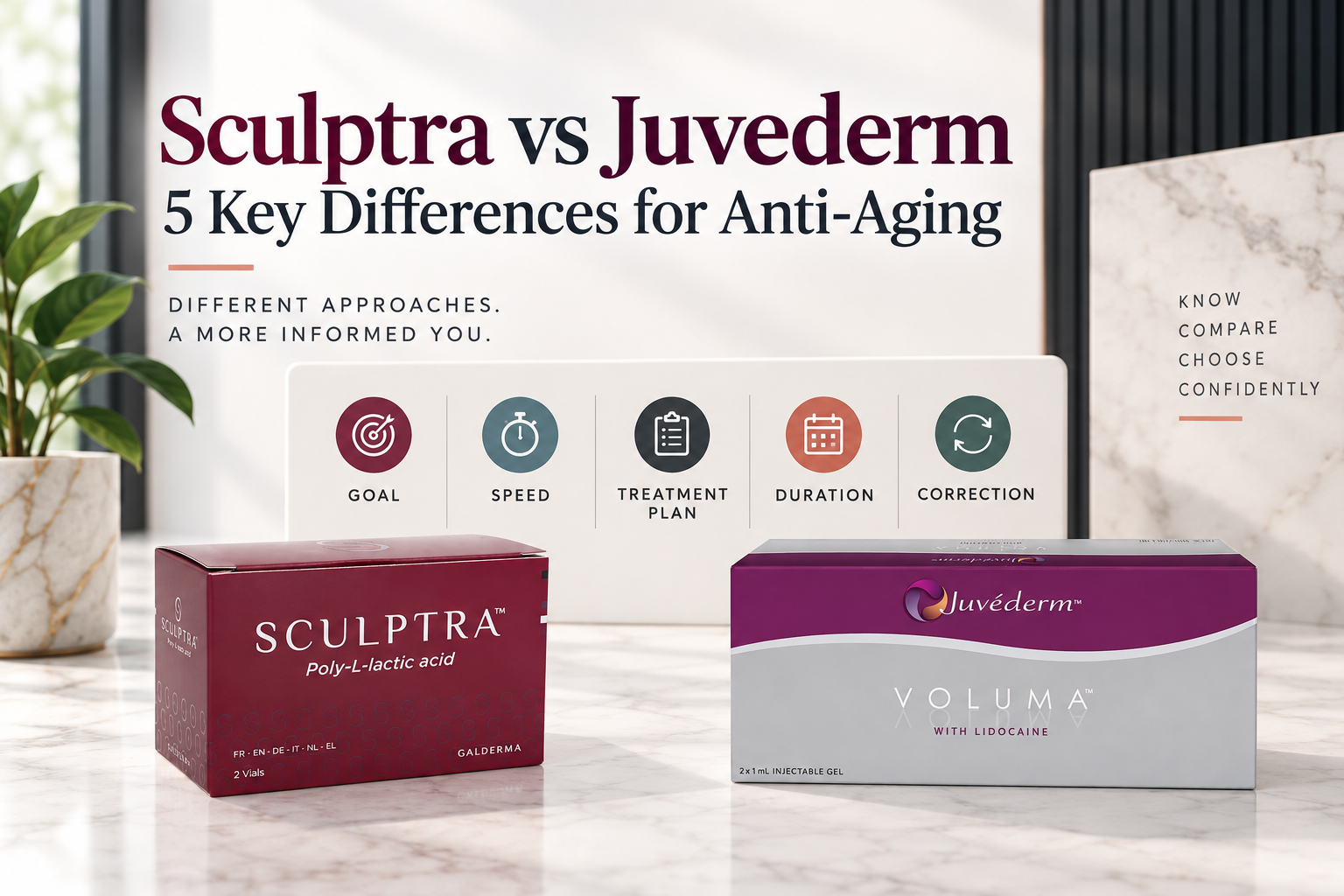
Neither Sculptra nor Juvederm is the universal better anti-aging treatment. Choose a specific Juvederm hyaluronic acid product when the priority is an immediate, localized change, such as defined cheek volume or another product-specific correction. Consider Sculptra when the priority is a gradual, broader improvement in age-related cheek appearance and you accept that the result builds over time through an individualized treatment plan. Juvederm is a family of different gels, so its result, approved area and expected duration must be checked by exact product; it should never be compared with Sculptra as though every Juvederm syringe does the same job. The most useful choice therefore depends on five things: what you want to change, how quickly you want to see it, whether the concern is precise or broad, the commitment and total cost of the complete plan, and how the material can be managed if the result is not what you expected.
The common shortcut is to call Sculptra the natural, long-term option and Juvederm the quick, one-visit option. That sounds useful but can mislead a real decision. Sculptra and the Juvederm collection differ in material, timing and treatment role, while Juvederm itself contains multiple products with different documented uses. A fair comparison starts with the visible change you want, then narrows Juvederm to the formula that could address the same concern.
Difference 1: They do different anti-aging jobs
Sculptra is a poly-L-lactic acid, or PLLA, injectable product. It is used as a collagen-stimulating strategy, so the desired change develops progressively instead of being created solely by a gel that remains as immediate volume. The current FDA Sculptra approval record describes correction of fine lines and wrinkles in the cheek region and emphasizes gradual improvement.
Juvederm is not one interchangeable filler. It is a collection of hyaluronic acid, or HA, gels. Each formula has its own texture, documented treatment role and market-specific labeling. One Juvederm product may be considered for cheek volume, while another may be designed for a different facial concern. The current Juvederm collection is therefore a starting point for selecting the exact product, not evidence that every item in the range produces the same result.
This distinction also answers the frequent question about which looks more natural. Natural-looking is not a material property or a guaranteed brand outcome. It depends on the goal, the selected product, anatomy, amount used and the professional plan. Sculptra may suit someone who prefers change that develops gradually, while a well-matched HA product can also produce subtle correction. Neither deserves a universal naturalness label.
Decision rule: If the question is still simply “Sculptra or Juvederm?”, define the treatment job first. If the job is precise, name the exact Juvederm product. If the goal is a gradual collagen-stimulating plan, compare Sculptra with other products in that material category using the biostimulatory fillers guide.
Difference 2: Immediate change versus a result that builds
A Juvederm HA gel adds volume when it is placed, so an initial change can usually be seen immediately. That does not mean the treatment-day appearance is the final result. Temporary swelling, tenderness or bruising can change how the area looks at first, and the appropriate review point depends on the exact product and the clinician’s plan.
Sculptra requires a different expectation. Its benefit is assessed as collagen-related change develops over weeks and months. The initial appearance should not be used as proof of the final outcome, and a reader who wants to judge the result immediately may find this timeline frustrating. The FDA approval information reports that the clinical study allowed up to four treatment sessions, but that is study context, not a fixed prescription for every person.
This is one of the most important practical differences. Juvederm may suit a person with an upcoming event or a specific contour goal who values an immediately visible change. Sculptra may suit someone who is comfortable waiting and reviewing progress across a staged plan. Neither timeline is automatically better; one is simply more compatible with the person’s expectations.
- Choose speed carefully: immediate does not mean fully settled, and gradual does not mean invisible.
- Choose the assessment date: ask when the result can be judged fairly before deciding whether more treatment is needed.
- Choose for real life: if delayed feedback would make you anxious, include that preference in the consultation rather than treating it as an afterthought.
Difference 3: Precise area correction versus broader facial change
Juvederm becomes useful when the concern can be matched to one exact HA product. For cheek-focused comparison, Juvederm Voluma with Lidocaine is a clearer counterpart than the Juvederm brand as a whole. FDA patient labeling for Voluma addresses age-related volume deficit in the cheek area, while other Juvederm products have separate indications. That product-level distinction matters because a formula selected for one area should not be assumed to be suitable everywhere.
Sculptra is better framed as a gradual cheek-aging strategy rather than a precise substitute for every HA contouring product. It may be investigated when the concern is a broader loss of facial support or an overall change in cheek appearance, but it should not be promised as a liquid facelift or as a solution for every form of skin laxity. Loose skin, surface texture and volume loss can overlap visually while needing different assessments.
The best comparison is therefore not “Which brand is stronger?” It is “Which material and exact product can address this specific visible concern?” A professional may conclude that an HA product fits one defined area, that Sculptra fits a broader gradual plan, that both have different roles, or that filler is not the right solution.
Difference 4: One appointment price is not the total plan
Online comparisons often say Juvederm costs less because it may be completed in one appointment, or Sculptra costs more because it is commonly planned as a series. Neither shortcut is reliable. The total investment depends on the exact product, the amount selected by the clinician, the number of visits, local professional fees and whether follow-up or maintenance is recommended.
A storefront box price is also not the same as a patient treatment price. Package format identifies what is being purchased; it does not determine how much should be used for an individual. Likewise, one Juvederm appointment is not a guarantee that no review or touch-up will be considered, and the number of Sculptra sessions cannot be fixed from an article.
For a useful cost conversation, ask for a complete plan rather than one headline figure:
- Which exact product is being proposed, and what treatment goal does it address?
- How many planned visits and review appointments are included?
- When could maintenance reasonably be discussed for that exact product?
- What happens financially and clinically if the result needs adjustment?
This makes the comparison personal without inventing a universal dollar total. A lower first appointment price is not automatically better value, and a longer plan is not automatically a better investment.
Difference 5: Duration and correction are material-specific
Sculptra’s FDA information states that results may last up to two years. That does not mean every person receives two years of the same visible effect. Juvederm duration must be checked by exact formula. For example, the FDA patient labeling for Juvederm Voluma reports cheek results lasting up to two years in the majority of clinical-study participants, but that statement cannot be transferred to every Juvederm product or facial area.
The correction pathway is just as important as duration. HA fillers have a clinical management option using hyaluronidase. A peer-reviewed review of hyaluronidase use describes its role in managing HA filler complications and unwanted outcomes. This should not be advertised as a guaranteed undo button: response varies by product and situation, more than one intervention may be needed, and serious complications require urgent professional care.
Sculptra does not have an equivalent HA-dissolving enzyme pathway. That does not make every HA decision easy or every Sculptra outcome permanent, but it changes the risk and expectation conversation before treatment. Readers who place a high value on having an HA-specific correction option may prefer to investigate a Juvederm product first.
Do not choose by the longest number: compare the exact product’s evidence, how the result changes over time, the maintenance plan and the available response if the outcome is unwanted.
Decision table
| Your priority | Start by investigating | What to verify before deciding |
|---|---|---|
| Immediate correction in one defined area | An exact Juvederm HA product matched to that area | Product-specific indication, expected settling time, follow-up and correction plan |
| Gradual improvement in age-related cheek appearance | Sculptra as a PLLA treatment strategy | Realistic timeline, complete visit plan, evidence boundary and how progress will be assessed |
| A precisely shaped cheek result | A cheek-specific HA product such as Voluma | Whether direct gel-based volume matches the anatomy and desired change |
| A broader collagen-stimulating plan | Sculptra, then a like-for-like comparison with other collagen stimulators | Material differences, delayed result, correction limitations and market-specific documentation |
| Highest priority on an HA correction pathway | A suitable Juvederm HA formula | What hyaluronidase can and cannot do, plus the clinic’s complication protocol |
| Lowest total cost | Neither product until the full plan is quoted | Exact product, expected visits, professional fees, review and maintenance rather than one unit price |
Readers considering Sculptra alongside other non-HA materials can also use the PLLA, PDLLA, PCL and CaHA comparison to keep material categories separate. This avoids treating all collagen stimulators as interchangeable.
Why people feel disappointed
Disappointment often begins before treatment, when the comparison is framed too broadly. Someone expecting Sculptra to create the same immediate, sharply defined change as an HA gel may judge it too early. Someone who wants a broad improvement but chooses one precise filler correction may feel that the result did not address the larger concern.
Other expectation errors are equally common:
- Calling one material more natural: this replaces a product-and-goal decision with a marketing label.
- Judging HA during early swelling: the treatment-day appearance may not represent the settled result.
- Judging Sculptra immediately: the desired collagen-related change is not designed to be assessed on the day of treatment.
- Comparing one syringe with one Sculptra vial: package units do not describe equivalent treatment jobs or complete plans.
- Assuming longer means better: duration matters only after suitability, expected appearance and correction options are understood.
A good consultation should turn each of these assumptions into a specific question. Ask what visible change is realistic, when it can be judged, what the full plan includes and how an unwanted outcome would be managed.
Final choice
Investigate a specific Juvederm product first when you want an immediate, localized correction and value an HA-specific management pathway. Investigate Sculptra first when your concern is broader age-related cheek change, you prefer a result that develops gradually and you accept a staged plan. Do not compare Sculptra with the Juvederm brand name alone; compare it with the exact Juvederm formula that targets the same goal, then compare the complete plan rather than one appointment or package.
For product-level verification, review the current Sculptra product record, the Juvederm collection and the Voluma listing. Confirm the exact SKU, current stock, sealed presentation, batch documentation, supplied instructions and eligibility in the destination market before ordering. Treatment selection remains a licensed professional decision.
Frequently asked questions
Which is better for cheeks, Sculptra or Juvederm?
It depends on the cheek goal. Sculptra may be investigated for gradual, broader improvement in age-related cheek appearance. A cheek-specific Juvederm product such as Voluma may be investigated for immediate, localized HA volume. A professional assessment must decide whether either approach fits the anatomy and desired change.
Which works faster, Sculptra or Juvederm?
Juvederm HA gel produces an immediate volume change, although early swelling means the treatment-day appearance is not necessarily final. Sculptra is intended to be judged over weeks and months as collagen-related improvement develops.
Which lasts longer, Sculptra or Juvederm?
There is no brand-wide winner. FDA information says Sculptra results may last up to two years, and Voluma labeling reports cheek results up to two years in the majority of study participants. Other Juvederm formulas have different evidence and durations, and individual results vary.
Is Juvederm always completed in one visit?
No. Some people may see the desired correction after one appointment, while others may have a review, touch-up or later maintenance. The plan depends on the exact product, treatment goal, anatomy and professional assessment.
Can Juvederm be dissolved while Sculptra cannot?
Juvederm is an HA filler, and clinicians may use hyaluronidase to manage certain unwanted HA outcomes or complications. This is not guaranteed complete reversal. Sculptra is PLLA and does not have an equivalent HA-dissolving enzyme pathway.
Can Sculptra and Juvederm be used in the same overall plan?
They may have different roles in a clinician-designed plan because one is a gradual PLLA strategy and the other is an area-specific HA gel. Whether both are appropriate, and how they should be sequenced, requires an individual professional assessment.
Sources
Evidence reviewed September 23, 2026: the FDA overview of approved dermal filler materials, FDA Sculptra approval information, FDA Juvederm Voluma patient labeling and the peer-reviewed hyaluronidase review cited above. Current Google results and social discussions were used to identify customer questions, not to prove superiority. Current FillersFairy product records were used only to verify product identity, stock and the next internal comparison path.