Quick answer: Dermalax or Rejeunesse?
Neither brand is automatically better. Dermalax currently offers a three-step export range from Across with a concentration change between Plus and the deeper models, while the standard Rejeunesse Fine, Deep and Shape family uses the same stated HA concentration and separates models mainly by intended depth and correction role. Compare Fine with a superficial option, Deep with a mid-depth option and Implant or Shape with a structural option; then let current stock, exact documentation and local eligibility decide what can actually be procured.
Difference 1: how the two ranges are organized
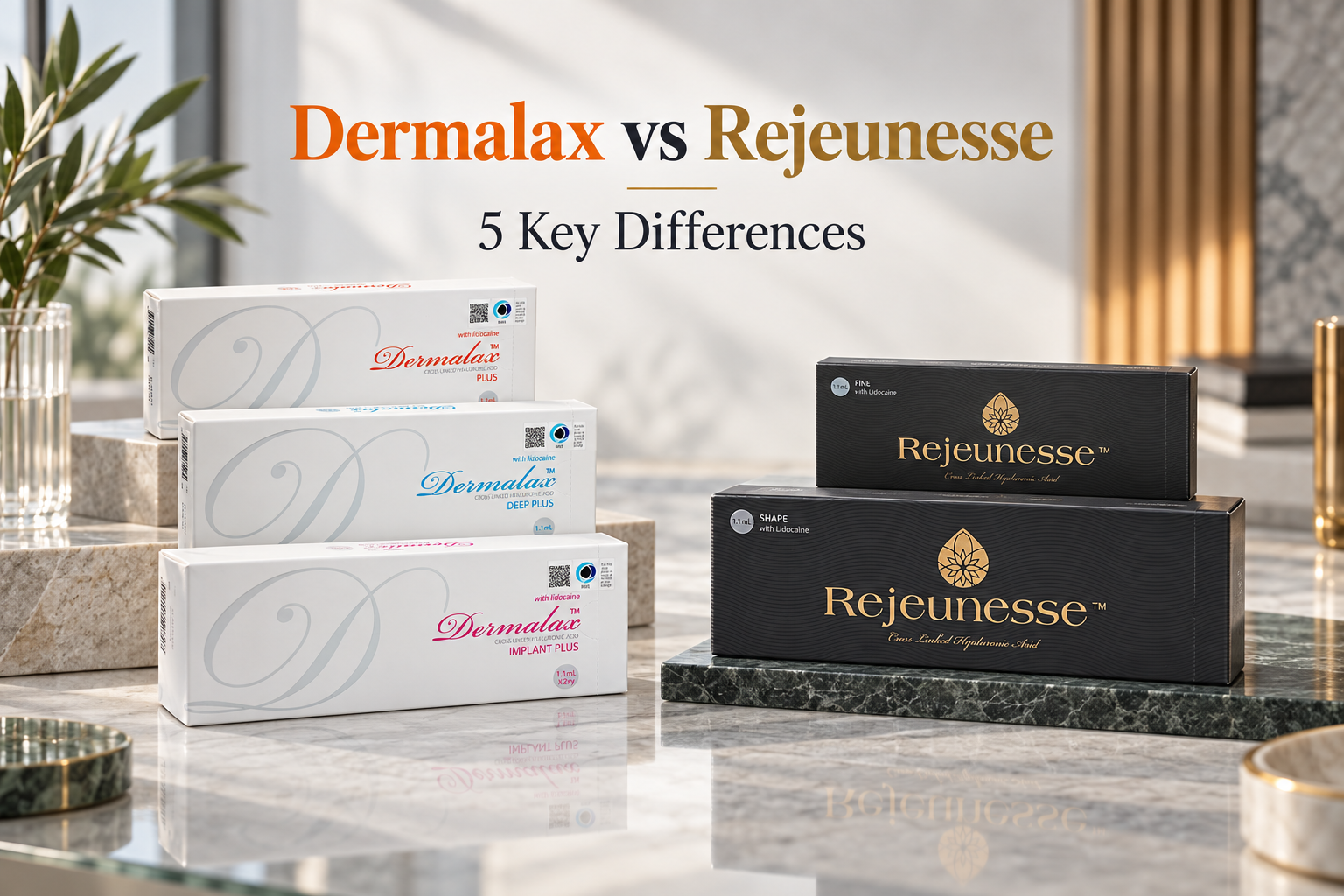
Across describes Dermalax as an export brand divided into Dermalax, Deep and Implant according to application. FillersFairy’s current catalog presents that ladder as Dermalax Plus, Dermalax Deep Plus and Dermalax Implant Plus. The names move from a lighter correction role toward a deeper structural role.
Rejeunesse uses Fine, Deep and Shape for its standard filler ladder. Its official-sales record positions Fine for superficial-to-mid dermal correction, Deep for mid-to-deep correction and Shape for deep-to-subcutaneous structural correction. The two families therefore follow a similar “lighter to deeper” logic, but the model names are not direct synonyms and should not be swapped without reading the exact product record.
Difference 2: what changes as you move up each range
The verified formula records show a genuine technical difference in how the families are organized. Dermalax Plus is listed at 20 mg/mL HA, while Dermalax Deep Plus and Implant Plus move to 24 mg/mL. The standard Rejeunesse Fine, Deep and Shape records use that same higher HA concentration across the ladder and distinguish the models primarily by their intended correction depth and handling role. Both compared lines include 0.3% lidocaine.
This is exactly why concentration cannot choose a filler by itself. A number on the box does not describe the full gel behavior, clinical plan or tissue response. For Dermalax, the formula record changes as the range moves deeper. For Rejeunesse, the stated concentration stays constant while the model role changes. The buyer still needs the exact IFU and cannot infer that two products with the same concentration will handle or perform identically.
Difference 3: which models are fair comparisons
A useful comparison pairs models by the problem they are designed to investigate. A superficial Rejeunesse Fine record should not be compared with Dermalax Implant Plus merely because both are Korean HA fillers. That comparison would confuse the product’s depth role with the brand’s general reputation.
The fairer framework is:
- Lighter correction role: Rejeunesse Fine versus the most relevant lighter Dermalax record available for the intended market.
- Mid-depth role: Rejeunesse Deep versus Dermalax Deep Plus after reviewing their exact supplied instructions.
- Structural role: Rejeunesse Shape versus Dermalax Implant Plus when the procurement brief calls for the deepest range endpoint.
This is a procurement shortlist, not an injection map. A licensed professional owns the final clinical choice and must work within the product’s local authorization and instructions.
Difference 4: what a current buyer can actually source
A technically neat comparison is not useful if the named SKU cannot be sourced. On the FillersFairy Store API snapshot checked September 10, all three Dermalax records above were in stock. The standard Rejeunesse Fine, Deep and Shape product records were not in stock. Rejeunesse Sparkle was available, but it is a different skin-improvement format and should not be substituted silently for the standard Fine, Deep or Shape filler being compared.
That live availability changes the practical answer. A buyer with a current order need can build a documented Dermalax shortlist today. Rejeunesse remains a valid range to compare, but an unavailable model is an availability watch, not a reason to order a different Rejeunesse product under the assumption that the brand name makes it equivalent.
Stock is part of fit. The correct comparison is exact SKU versus exact SKU. “Same brand” and “currently available” do not mean “same clinical role.”
Difference 5: what documentation the buyer must verify
Across states that Dermalax has a Korean manufacturing license for export. Rejeunesse records identify Newmedic as the manufacturer and JDBIO as an official sales source. Those facts help confirm identity, but they do not establish that either product is FDA approved or lawful to import, sell or use in every country.
Before purchase, the buyer should match the manufacturer name, exact model, lot, expiry, sealed presentation and supplied IFU. The destination market’s device rules and the purchaser’s professional eligibility must also be checked. The site’s HA dermal filler safety reference explains the class-wide boundary; the product’s own documentation still controls.
A like-for-like decision table
| Decision point | Dermalax | Rejeunesse | Buyer action |
|---|---|---|---|
| Range structure | Plus, Deep Plus, Implant Plus | Fine, Deep, Shape | Map the exact model to a comparable depth role before comparing brands. |
| Formula pattern | The current record changes between the lighter and deeper models. | The standard range keeps one stated HA concentration while model depth changes. | Read the exact IFU; do not choose from concentration alone. |
| Like-for-like peer | Deep Plus and Implant Plus occupy different points in the ladder. | Deep and Shape occupy different points in the ladder. | Compare mid-depth with mid-depth and structural with structural. |
| Current FillersFairy availability | Three listed models were in stock at the checked snapshot. | Fine, Deep and Shape were not in stock at the checked snapshot. | Verify live inventory again immediately before ordering. |
| Market record | Across export-brand documentation | Newmedic manufacturer and official-sales documentation | Confirm exact local eligibility instead of generalizing from Korean origin. |
Why texture and longevity anecdotes cannot pick the winner
Community discussions often rank Korean fillers by how firm they felt, how hard the plunger seemed or how long one person’s result appeared to last. Those stories do not control for the exact model, treated area, storage history, practitioner technique, anatomy, amount used or follow-up. A positive or negative experience with one Rejeunesse or Dermalax SKU cannot be transferred to the entire brand.
The responsible comparison therefore uses anecdotes to discover questions, not to answer them. Ask for the exact model, manufacturer record, intended role, current documentation and market status. If two products cannot be matched at that level, there is no reliable “winner” to declare.
Final recommendation
Do not choose Dermalax or Rejeunesse at brand level. Match the exact model to a surface, mid-depth or structural purchasing need, verify the formula and manufacturer record once, then prefer the SKU that has current traceable stock and complete documentation for the destination market. On the current FillersFairy inventory snapshot, that creates an actionable Dermalax shortlist while the standard Rejeunesse filler models remain an availability watch rather than an order recommendation.
Compare the three current Dermalax product records by role, then confirm the exact SKU, current stock, sealed pack, lot, expiry, IFU and destination-market eligibility before ordering; treat Rejeunesse as a future comparison only when the equivalent model is actually available and documented.
Frequently asked questions
Is Dermalax better than Rejeunesse?
There is no verified basis for declaring one brand better overall. Compare equivalent models by intended role, formula record, current availability, documentation and destination-market eligibility.
Which Dermalax and Rejeunesse models are closest to compare?
Build pairs by depth role: lighter with lighter, mid-depth with mid-depth, and the structural endpoints Dermalax Implant Plus and Rejeunesse Shape with each other.
Do Dermalax and Rejeunesse use the same HA concentration?
Not across every model. The verified records show a change within the Dermalax ladder, while the standard Rejeunesse Fine, Deep and Shape family keeps one stated concentration. That fact alone does not predict handling or results.
Are Rejeunesse Fine, Deep and Shape currently in stock?
They were not in stock on FillersFairy in the September 10, 2026 snapshot. Inventory changes, so check the exact product record again before making a procurement decision.
Is Dermalax FDA approved because it is licensed for export from Korea?
No. A Korean export manufacturing record is not the same as US FDA approval. Buyers must verify the exact product’s status in the destination market.
Can Rejeunesse Sparkle replace Rejeunesse Fine, Deep or Shape?
No automatic substitution should be made. Sparkle is presented as a different skin-improvement format, so its availability does not make it equivalent to the standard filler models in this comparison.
Sources
Evidence checked September 10–11, 2026: Across’s current English Dermalax range record; Newmedic product instructions and JDBIO official-sales Rejeunesse records; current FillersFairy Store API identity and stock records. Social discussions were used only to identify buyer questions about texture, longevity and model confusion, not as proof of superiority.