Editorial method: this guide separates peer-reviewed category research, United States regulatory information, manufacturer-issued product information and current FillersFairy inventory records. A statement about one layer is not transferred to another. Last evidence review: August 3, 2026. Inventory routes verified: August 3, 2026.

Scope: this is an evidence and procurement guide for professional clinic teams and buyers. It does not diagnose hair loss, recommend a patient, describe a delivery technique, provide a dose or session schedule, or establish that a product is authorized in every market. The supplied label, current instructions for use (IFU), destination-market requirements and appropriately qualified clinical judgement remain controlling.
What Does “Exosome Hair Treatment” Mean?
In research, exosomes are small extracellular vesicles involved in communication between cells. In search results, however, hair exosome treatment can refer to several very different things: an intervention studied in a paper, a professional scalp-care product, a clinic service assembled around a named product, or a cosmetic hair-care item that uses exosome-related language. Those uses should not be treated as synonyms.
The word on a product page does not by itself identify the vesicle source, isolation method, characterization standard, concentration, complete formula, intended use or regulatory status. It also does not show that the commercial product is the same preparation investigated in a paper. Those details have to come from the exact current product documentation.
| Layer | What it can establish | What it cannot establish alone |
|---|---|---|
| Peer-reviewed intervention | What happened with the defined material, population, methods and endpoints in that study. | Results for a different branded product or an undefined clinic protocol. |
| Professional scalp product | Identity, format and intended positioning when supported by current manufacturer documents. | Independent clinical efficacy or authorization in every country. |
| Cosmetic hair-care product | A separate rinse-off or maintenance route when the label supports that format. | Equivalence to a professional scalp product or a treatment for a disease. |
What Does the Clinical Evidence Actually Show?
The literature on exosomes for hair loss has moved beyond laboratory-only discussion, but the clinical evidence is still limited. A 2023 systematic review identified 16 eligible studies at its January 2023 search point: 15 were preclinical and only one was clinical. That review described preliminary potential while calling for further work on efficacy, delivery and safety.
A newer 2025 systematic review searched clinical studies through May 10, 2025 and included 11 studies: two randomized controlled trials, three retrospective studies, three prospective single-arm studies, one case series and two case reports. The authors reported improvements in at least one measured hair parameter across the included studies, but also emphasized heterogeneity, small samples and differing follow-up periods. Those limitations prevent simple product-to-product comparisons.
| Evidence checkpoint | Verified finding | Safe interpretation |
|---|---|---|
| 2023 review | 16 studies; 15 preclinical and one clinical. | The evidence base was predominantly preclinical at that cutoff. |
| 2025 review | 11 clinical studies, including two randomized trials. | Clinical evidence is growing, but study heterogeneity and scale still limit certainty. |
| Named products in this guide | No product-specific peer-reviewed study was matched to ASCE+ HRLV, Hairna or Hairiz in this evidence review. | Do not present category findings as proof for any of the three families. |
How to read the evidence levels
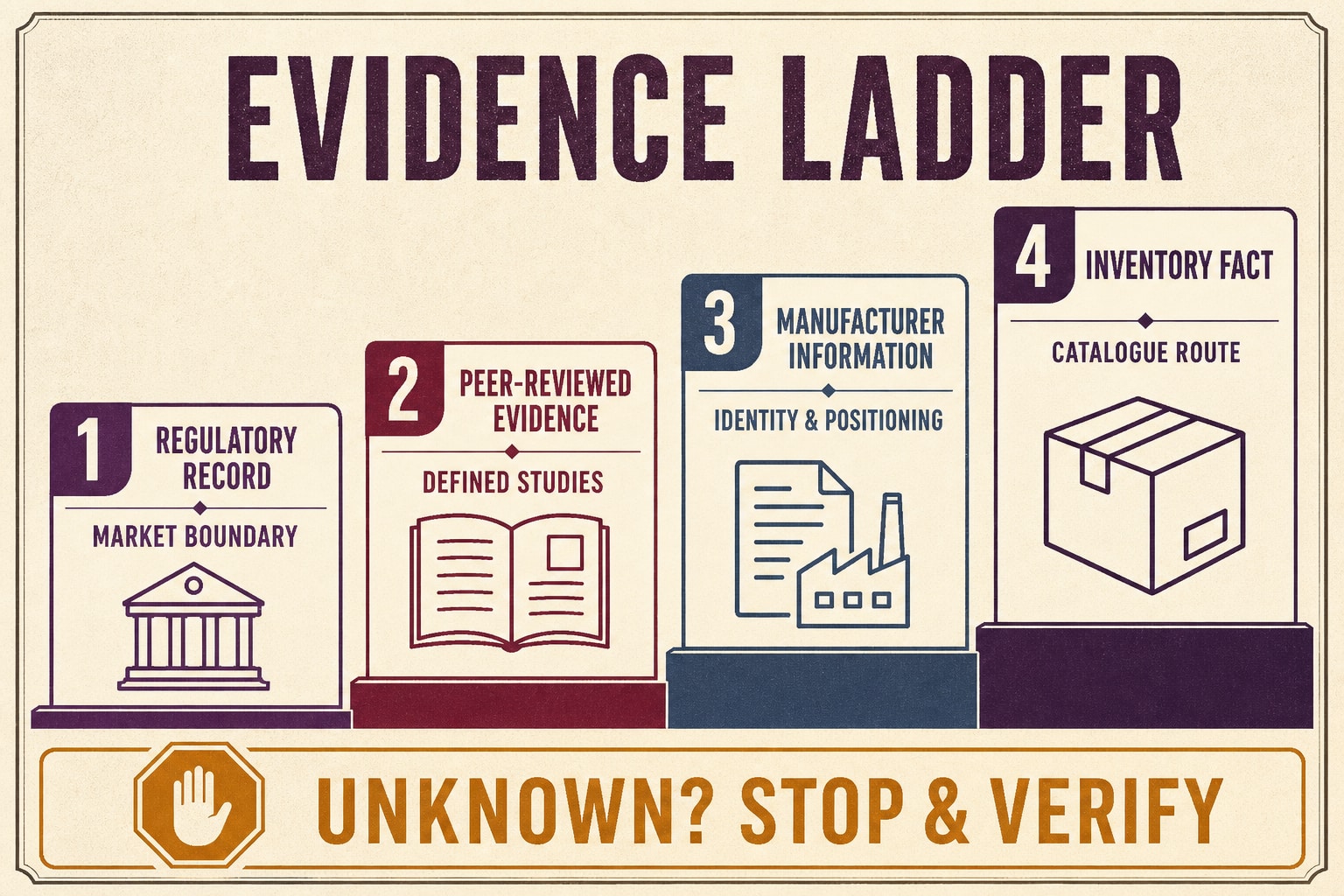
A regulator, a systematic review, a manufacturer and a retailer do not form a single ladder in which one source replaces all the others. They answer different questions. A regulatory record addresses authorization or enforcement within a defined jurisdiction. A peer-reviewed study addresses the intervention and endpoints it actually examined. A manufacturer document can establish product identity, composition or intended positioning. An inventory record can establish what is currently listed for purchase.
The practical rule is to ask whether the source is both authoritative for the question and specific to the exact product. For example, the FDA page is authoritative for the current United States approval boundary, but it does not describe a Korean catalogue entry. A systematic review can summarize category evidence, but it cannot confirm the contents of a Hairiz box. Conversely, a current box or IFU may settle product identity and storage, but it cannot make an uncontrolled marketing outcome equivalent to a randomized trial.
ASCE+ HRLV, Hairna and Hairiz Product Formats Compared
The current FillersFairy catalogue contains four relevant routes. The table below is not a ranking of the “best” exosome hair products. It shows which identity signals are available, which evidence level supports them, and what a clinic still has to verify before sourcing.
| Current route | Format in this guide | Highest verified source level | Product-specific clinical evidence found | Open verification gate |
|---|---|---|---|---|
| ASCE+ HRLV | Manufacturer-positioned professional scalp-care route. | Official ASCE+ product page. | None matched in this review. | Exact current formula, quantity, IFU, storage and destination-market status. |
| Hairna Exosome Hair Fill | Manufacturer-issued professional scalp-product positioning. | Maypharm-issued launch release plus current inventory record. | None matched in this review. | Current manufacturer documents, exact pack/IFU match and independent support for any performance claim. |
| Hairiz 3D Scalp Filler | Professional scalp-product inventory route. | Current FillersFairy inventory fact. | None matched in this review. | Authoritative manufacturer identity, current IFU, formula support, storage and market status. |
| Hairiz Shampoo | Rinse-off cosmetic maintenance route. | Current FillersFairy inventory fact. | Not treated as a professional intervention in this guide. | Current cosmetic label, complete ingredient list and destination-market requirements. |
ASCE+ HRLV: an official product-identity route
The official ASCE+ HRLV page identifies HRLV and describes it as a “Premium Scalp Care Solution.” That is useful manufacturer information for product identity and positioning. It is not independent proof of hair growth, a formula quantity, comparative superiority or authorization in a buyer’s market. Clinics can review the current ASCE+ HRLV product record, but the supplied box and applicable current documents must settle the operational facts.
Hairna: manufacturer-issued positioning, not independent proof
A 2023 Maypharm-issued launch release confirms the Hairna name and the company’s positioning for the product. Because the release is supplied by Maypharm, its performance language remains a company claim unless independently verified for the exact commercial product. The Hairna Exosome Hair Fill inventory page provides the current purchase route, not a substitute for product-specific clinical evidence.
Hairiz: keep the professional and cosmetic routes separate
Current inventory confirms two different formats: Hairiz 3D Scalp Filler and Hairiz scalp-care shampoo. No authoritative Hairiz manufacturer page or current IFU was verified in this research pass, so formula, performance and handling claims should remain open rather than reconstructed from retailer copy. The shampoo is a rinse-off cosmetic maintenance product; it is not presented as equivalent to a professional scalp product.
Clinic Selection Map: Choose by Documentation, Not Hype
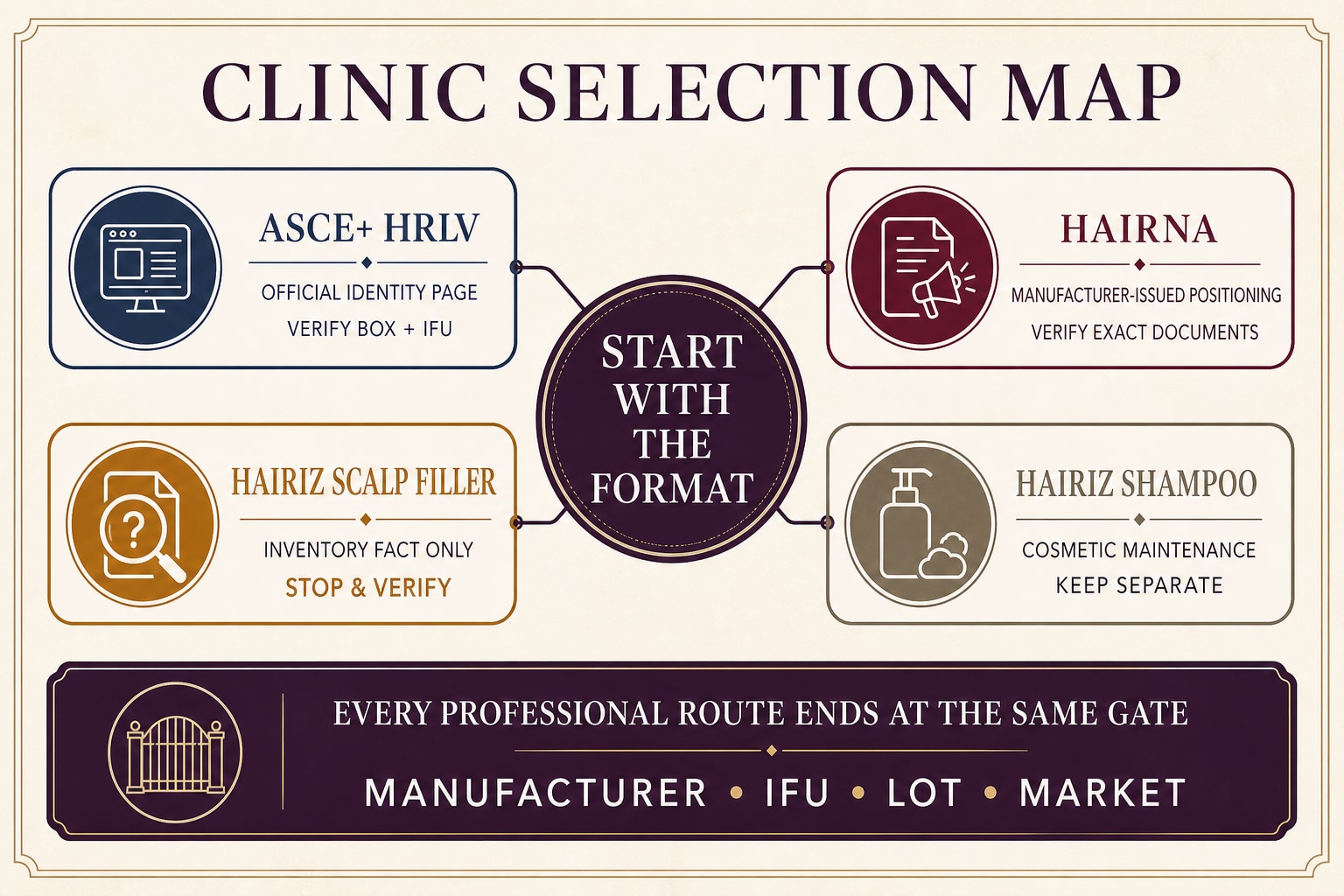
Route 1 — manufacturer-traceable professional product: begin with an official manufacturer identity, then match the physical box to the current IFU, lot, expiry, storage statement and destination-market record. ASCE+ HRLV currently has the clearest official identity page among the reviewed routes, but the remaining documents still need to match the exact supplied product.
Route 2 — inventory present, documentation incomplete: pause the purchasing decision when the manufacturer, IFU or formula source cannot be reconciled. Hairiz 3D Scalp Filler sits here in this research pass. “Available in the catalogue” answers an inventory question; it does not close the evidence or regulatory question.
Route 3 — cosmetic maintenance: keep rinse-off shampoo in a separate procurement lane with cosmetic label and ingredient checks. It may sit beside a professional scalp range commercially, but that does not make the formats clinically equivalent. If a clinic needs a broader category frame, the exosomes in aesthetics guide explains the same source-versus-claim boundary across aesthetic uses.
The same clinic may legitimately stock more than one route, but each route needs its own reason for being on the shelf. A professional product might be considered because its manufacturer and documents can be traced for the intended market. A shampoo might be stocked as ordinary scalp-care maintenance. A documentation-incomplete item should remain on hold until the missing record is supplied. Stock breadth is not evidence strength.
This approach also prevents a common comparison error: ranking products by the number of ingredients, source-related buzzwords or the visual sophistication of the packaging. None of those fields can replace product-specific clinical evidence. The decision map therefore ends at a verification gate, not at a universal winner.
Source, Storage and Batch Verification Checklist
A procurement file should make the exact product traceable without relying on a screenshot or sales description. Before ordering, record the following items for the specific SKU and destination market:
- Legal identities: exact manufacturer, responsible company, exporter or distributor, and the supplier shown on the commercial documents.
- Box-to-document match: full product name, presentation, version, language and current IFU must describe the same item.
- Material description: record only the source and composition language supported by the manufacturer document; do not infer what “exosome” means from the front panel.
- Traceability: photograph the sealed box, lot, expiry and tamper evidence, then reconcile them with the invoice and receiving record.
- Storage chain: verify the documented conditions across dispatch, transit and receipt. Do not create a temperature, opening or reconstitution instruction when the authoritative document is missing.
- Market and escalation: confirm local status, professional-use restrictions where applicable, and a reachable contact for quality complaints or adverse-event escalation.
This checklist is deliberately stricter than a visual product comparison. A clean box image can support identification, but it cannot prove authenticity, storage history, clinical performance or authorization.
When two records conflict, preserve both versions and stop the decision at the disputed field. Record the URL or document title, revision or access date, market, product name and exact wording. Ask the manufacturer or responsible supplier to reconcile the difference in writing. Do not silently choose the more commercially attractive version, and do not transfer a storage or formula statement from another member of the same family.
When Hair Loss Needs Medical Assessment First
Hair loss is a symptom with multiple possible causes. Sudden shedding, sharply defined patches, scalp pain, inflammation, scale, scarring, broken hairs, systemic symptoms or an otherwise unexplained change should be assessed by an appropriately qualified medical professional before a cosmetic purchasing decision is turned into a patient recommendation.
A product-selection page cannot determine the cause of loss, rule out an underlying condition or establish that a person is suitable for an intervention. Even when loss is gradual, medication history, nutrition, hormonal factors, scalp disease and established evidence-based options may need clinical review. Procurement and diagnosis are separate responsibilities.
Safety and Regulatory Boundary
The FDA consumer alert states that there are currently no FDA-approved exosome products. This is a United States regulatory boundary. It should not be rewritten as a global status statement, but it also should not be softened into an assumption that a catalogue listing or cosmetic sale authorizes treatment claims in the United States.
Every clinic and buyer must verify the exact intended use and destination-market requirements for the specific product. If the documentation, advertised use and market record do not align, stop and reconcile them before purchase or use. A promising research category, a professional-looking pack and a commercial listing are not substitutes for regulatory review.
Frequently Asked Questions
Is exosome hair treatment FDA-approved?
No. The FDA says there are currently no FDA-approved exosome products. That statement applies to the United States and does not by itself describe every other market. Clinics should verify the exact product, intended use and destination-market requirements rather than relying on a general category label.
Does research on exosomes prove that ASCE+ HRLV, Hairna or Hairiz works?
No. The reviews summarize different exosome or extracellular-vesicle preparations and study methods. This research pass did not match a product-specific peer-reviewed clinical study to ASCE+ HRLV, Hairna or Hairiz. Category findings therefore cannot be transferred to those named commercial products.
Is an exosome shampoo the same as a professional scalp product?
No. A rinse-off shampoo and a professional scalp product are different formats with different documentation questions. Hairiz Shampoo is treated here as a cosmetic maintenance route, not as an equivalent substitute for Hairiz Scalp Filler, ASCE+ HRLV or Hairna.
What documents should a clinic verify before sourcing an exosome hair product?
Verify the manufacturer and supplier identities, exact box-to-IFU match, material description, lot, expiry, seal, invoice, documented storage chain, destination-market status and a quality or adverse-event contact. Missing facts should remain open rather than being copied from unrelated products or sales pages.
When should hair loss be medically assessed before any cosmetic treatment?
Seek an appropriately qualified medical assessment for sudden, patchy, painful, inflamed, scarring or otherwise unexplained hair loss, and whenever systemic symptoms are present. Product selection cannot diagnose the cause of hair loss, exclude disease or determine an individual patient’s suitability.
Sources and Related Routes
The safest conclusion is not that every exosome-labeled item is equivalent, but that every claim must remain attached to its source. Start with the evidence level, verify the exact documents, and keep professional and cosmetic formats separate. For adjacent procurement context, use the Korean skin boosters guide. FillersFairy can help professional buyers confirm current inventory and available product records; the clinic remains responsible for local eligibility and clinical decisions.