Quick answer: what is Gouri?
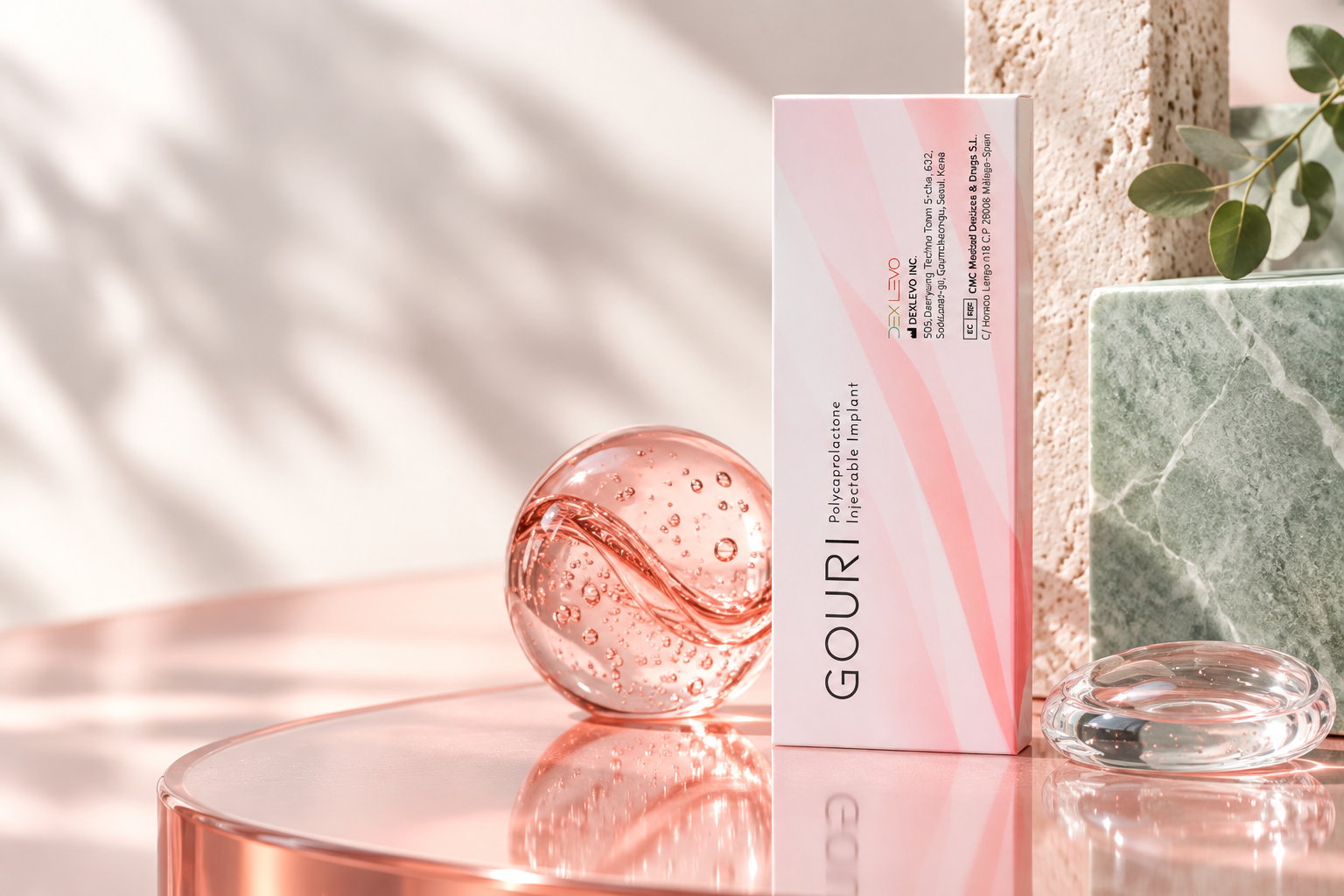
Gouri is a liquid polycaprolactone collagen stimulator, not a conventional hyaluronic acid volume filler. It is worth investigating when the goal is a gradual biostimulatory approach and a qualified professional can verify product identity, local eligibility, treatment fit, supply traceability and realistic follow-up; it is not a product for self-injection or a universal substitute for HA filler.
The useful first question is therefore not “Where are the injection points?” It is “Am I looking for immediate shape and volume, or am I discussing a collagen-stimulation strategy?” That distinction changes the product category, the evidence a reader should expect and the questions a responsible provider must answer.
Why Gouri is often mistaken for a conventional filler
People commonly use “filler” as a catch-all word for cosmetic injectables. That creates the wrong mental model for Gouri. DEXLEVO identifies Gouri as a liquid PCL injectable. A conventional HA filler, by contrast, is typically selected because a particular gel can provide volume or structural correction in a professional treatment plan.
The shared injectable format does not make the products interchangeable. A Gouri discussion starts with biostimulation and gradual change; an HA filler discussion often starts with the amount and location of immediate support that may be appropriate. Neither route is automatically better. The useful choice depends on the desired change, the evidence for the exact product and a qualified clinician’s assessment.
For more detail on the material category, read the PLLA, PDLLA, PCL and CaHA collagen-stimulator guide. Readers who need the brand-level mechanism discussion can use the separate Gouri liquid PCL overview.
Check 1: decide whether the goal is volume or biostimulation
A customer asking for a sharply defined contour, immediate projection or correction of a specific fold is asking a different question from someone exploring gradual skin-quality or collagen-related change. Starting with the desired outcome prevents the word “filler” from forcing both needs into the same product choice.
This is also where expectations become more honest. The available product identity supports describing Gouri as liquid PCL. It does not support promising a precise amount of collagen, a guaranteed lift, a universal timeline or a better result than every HA filler. If a consultation begins with a guaranteed outcome rather than a clear goal and evidence boundary, that is a reason to slow down.
| Decision question | Gouri discussion | Conventional HA filler discussion |
|---|---|---|
| What is the main strategy? | Investigate a liquid PCL biostimulatory approach. | Investigate an exact HA gel for immediate volume or support. |
| What should be verified? | Exact product identity, PCL evidence boundary, professional plan and follow-up. | Exact SKU, documented gel properties, professional plan and market eligibility. |
| What should not decide the choice? | Online injection maps, influencer protocols or guaranteed collagen claims. | A whole-brand ranking, price alone or unsupported longevity claims. |
| Useful next step | Ask whether gradual biostimulation matches the goal. | Ask whether immediate volume or structural support matches the goal. |
Check 2: verify the exact Gouri product record
Brand recognition is not a substitute for traceability. Before a professional purchase, the product should have a clear name, intact sealed presentation, readable lot and expiry details, a seller record and documentation that can be matched to the unit received. A stock photo, low price or familiar pink box is not enough on its own.
The current Gouri product record gives qualified buyers a concrete item to review. Use it as the beginning of the check, not proof that the product is suitable for a person or permitted in every market. The buyer remains responsible for confirming the exact unit, jurisdiction and professional-use requirements before ordering.
Check 3: replace online injection maps with a professional assessment
Search demand around Gouri is heavily shaped by “points,” “depth” and “technique.” Those queries reveal uncertainty, but a public diagram cannot account for a person’s anatomy, previous procedures, medical history, treatment goal or local professional standards. It also cannot confirm that the product in hand is authentic.
A useful consultation should instead establish what the reader wants to change, whether a collagen-stimulation strategy is appropriate, which product record is being proposed and how the provider will monitor the response. Gouri is a professional-use injectable; it should not be bought as a shortcut to self-treatment.
Check 4: separate manufacturer claims from independent evidence
Manufacturer material is valuable for confirming identity: who presents the product, what material category is named and how the product is positioned. It is not a blank cheque for every performance claim on a reseller page. Likewise, research on PCL or collagen stimulators as a class cannot automatically prove a Gouri-specific result.
A balanced decision uses each source for the job it can support. Product and manufacturer records confirm identity. Independent literature helps explain the broader material category. A licensed clinician applies that information to an individual assessment. Reviews and social posts may reveal concerns, but they cannot isolate the product from technique, anatomy, aftercare or source authenticity.
Check 5: plan how results and concerns will be reviewed
A responsible decision includes a review plan before treatment, not only a product purchase. Ask what change will be assessed, what photographs or records will be used, which concerns require prompt contact and how the provider will decide whether any further treatment is appropriate. The answer should be specific to the patient and product rather than copied from an online schedule.
If your main question is how long a claimed effect lasts, keep that separate from this initial choice and read the Gouri duration guide. Duration estimates do not replace the first decision about product category and suitability.
How Gouri and HA filler lead to different questions
The most useful comparison is not “Which brand is best?” It is “Which treatment strategy am I evaluating, and what evidence is available for the exact product?” Gouri may be worth considering when a gradual biostimulatory strategy matches the goal. A conventional HA filler may be the more relevant discussion when immediate volume or defined structural support is the priority.
That decision should be made by a qualified professional who can explain why the proposed category fits, what is known about the exact product and what remains uncertain. A seller can provide product access and records; it cannot diagnose suitability or replace clinical judgment.
Final recommendation
Consider Gouri only when a gradual collagen-stimulation strategy matches the goal and a qualified professional has verified the exact product, local eligibility, supply traceability and follow-up plan. Choose a conventional HA filler discussion instead when immediate volume or contour is the primary decision.
Qualified professional buyers can review the current Gouri product record, then confirm product traceability, local eligibility and treatment fit before ordering.
Frequently asked questions
Is Gouri a hyaluronic acid filler?
No. DEXLEVO identifies Gouri as a liquid PCL injectable. It should not be treated as interchangeable with a conventional HA gel selected for immediate volume or structural support.
Is Gouri a collagen stimulator?
Yes. Its verified product identity is a liquid PCL collagen-stimulating injectable, although that identity alone does not guarantee a particular result for an individual.
Can an online Gouri injection map tell me whether it is suitable?
No. A map cannot assess anatomy, history, goals, product authenticity or local requirements. Suitability and treatment planning belong to a qualified licensed professional.
How should I compare Gouri with an HA filler?
Compare the treatment strategy first: gradual biostimulation versus immediate volume or support. Then compare evidence for the exact product rather than ranking whole categories or brands.
What should a professional buyer verify before ordering Gouri?
Verify the exact product, intact sealed presentation, lot and expiry records, traceable seller, local eligibility and the treatment plan that will govern professional use.
Can Gouri be self-injected?
No. Gouri is a professional-use injectable. Online purchase, social instructions or a public diagram cannot replace licensed assessment and treatment.
Sources
Evidence checked on September 9, 2026: DEXLEVO official GOURI material for product identity; FDA dermal-filler consumer guidance for the professional-use boundary; FillersFairy Store API for the current product and stock record. Manufacturer claims were not converted into guaranteed outcomes.