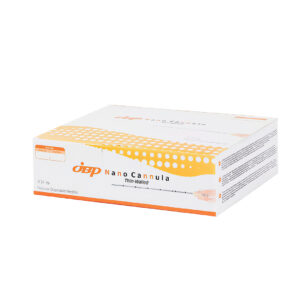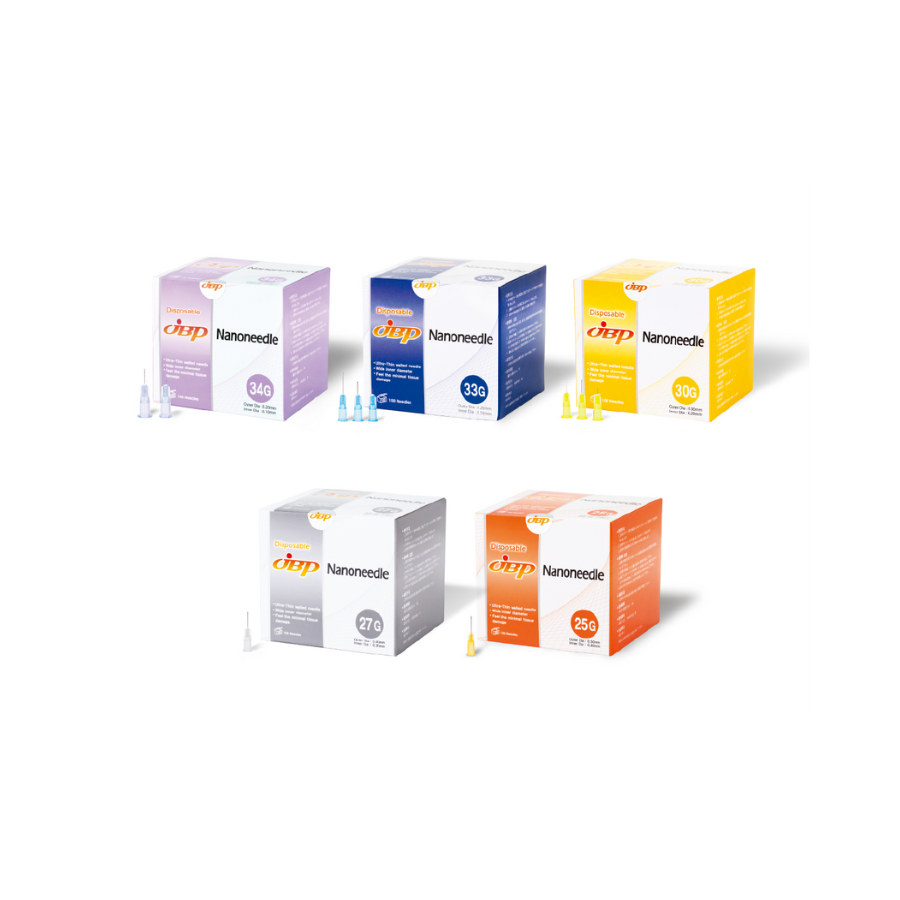
This is an ultra-thin-wall injection needle whose 0.20 mm outer wall and micron-polished bevel maximise the inner lumen while keeping the puncture small. It is offered in a range of gauge and length options so clinicians can match the needle to the solution and depth.
What it is
A precision injection needle built with an ultra-thin wall (0.20 mm class) and a micron-polished, triple-bevel tip. The thin wall widens the internal lumen for a given outer size, easing the flow of viscous solutions.
Sizes available
Selectable by model — gauges from 23G down to 33G in lengths of roughly 4 to 25 mm — so the same line covers superficial skin-booster work through deeper, higher-viscosity filler delivery.
How it is used
Designed for shallow insertion (about 10–15° for dermal planes) with a slow, controlled extrusion rate; finer 33G tips suit low-viscosity solutions and botulinum toxin, while 25–27G suit higher-viscosity HA.
Sterility
Each needle is sterile, single-use and ethylene-oxide sterilised; it must not be bent, reshaped or reused.
| Wall / lumen | Ultra-thin wall, 0.20 mm class — widened inner lumen |
|---|---|
| 25G | 13 / 25 mm; ID 0.26 mm / OD 0.51 mm — deep subcutaneous, high-viscosity HA |
| 27G | 13 / 25 mm; ID 0.20 mm / OD 0.41 mm — mid-to-deep dermis |
| 30G | 4 / 8 / 13 mm; ID 0.20 mm / OD 0.30 mm — superficial dermis, skin boosters |
| 33G | 4 / 8 / 13 mm; ID 0.16 mm / OD 0.26 mm — epidermal, botulinum toxin, low viscosity |
| Technique | Insertion 10–15°; extrusion <0.1 mL/sec |
| Sterilisation | Ethylene-oxide (EO); sterile, single-use |
| Limits | 33G not for solutions above ~600 mPa·s; 25G and larger not for periosteal contact |
- Select the gauge and length to match the solution’s viscosity and the target depth (e.g. 33G for low-viscosity/botulinum, 25–27G for higher-viscosity HA).
- Insert at a shallow 10–15° for dermal planes and keep the extrusion rate below 0.1 mL/sec.
- Do not use 33G tips for solutions above ~600 mPa·s, to avoid excessive extrusion pressure.
- Avoid periosteal contact with 25G and larger sizes.
- Open the sterile needle immediately before use; never bend, reshape, re-sterilise or reuse it.
- Dispose of used needles as clinical sharps per local regulations.
What does ‘ultra-thin wall’ mean here?
The needle wall is thinner than a standard needle of the same outer gauge, which widens the inner lumen. That lets a given outer size pass more solution with less force, so a finer-looking needle can still deliver viscous material.
What gauges and lengths are available?
It is offered across a range of models — gauges from 23G to 33G in lengths of about 4 to 25 mm — chosen on the product page to suit the procedure.
Which size should I use for which solution?
As a guide: 33G (4–13 mm) suits low-viscosity solutions and botulinum toxin; 30G suits superficial dermis and skin boosters; 25–27G suit higher-viscosity HA and deeper placement. The clinician makes the final choice.
What are the inner and outer diameters?
They vary by gauge — for example 33G is about 0.16 mm inner / 0.26 mm outer, 30G about 0.20 / 0.30 mm, 27G about 0.20 / 0.41 mm, and 25G about 0.26 / 0.51 mm.
Is there a viscosity limit?
Yes. The finest 33G needles are not recommended for solutions above roughly 600 mPa·s, because the extrusion pressure required becomes too high.
Is it reusable?
No. Each needle is sterile, ethylene-oxide sterilised and strictly single-use. It must not be bent, reshaped, re-sterilised or reused.
What injection angle and speed are recommended?
For dermal planes, a shallow insertion of about 10–15° with a slow extrusion rate under 0.1 mL/sec helps control placement and comfort.
Who should use it?
It is a professional single-use medical device for licensed, trained practitioners, who should dispose of used needles as clinical sharps.

Reviews
There are no reviews yet.