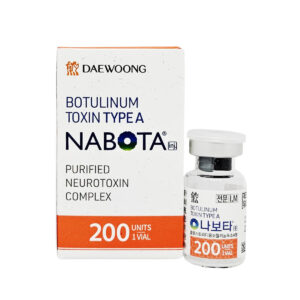
To choose between Innotox and Nabota, two points can be considered first: Innotox is a liquid, ready-to-use type, with common specifications of 25U/50U/100U, stored refrigerated at 2–8℃; Nabota (US name Jeuveau) is a lyophilized powder, approved by the in 2019. Public clinical data show that approximately 68%–70% of subjects had a ≥2-grade improvement in glabellar lines at day 30 with Jeuveau; Actual maintenance duration, onset speed, and price also depend on the doctor’s preparation, injection site, and individual metabolism.
Cost
From user bills, the difference between Innotox and Nabota is not in “which bottle is cheaper”, but in how many units were actually used after one injection at the same site, how much was left, and whether reconstitution and follow-up visits were included. Innotox is a liquid finished product, commonly available in 25U, 50U, 100U; Nabota is commonly a 100U lyophilized powder, requiring reconstitution before use. For high-frequency procedures like glabellar lines, the official recommended total dose is about 20U, but units from different brands are not interchangeable, so looking at the total cost is closer to the actual expenditure than looking at the single bottle price.
Inquiry methods
The first type of quote users usually hear in institutions is “priced by area”. One price for glabellar lines, one price for the forehead, one price for crow’s feet, and a package price for three areas. The advantage is that it sounds simple and you can get a number within 10 seconds; the problem is that you don’t know how many units are actually included in this price. In public labels, common plans for glabellar lines mostly revolve around 20U, but units from different brands are not interchangeable, so “one price for glabellar lines” does not mean two institutions offer the same dosage. JEUVEAU, the US equivalent of Nabota, states in its prescribing information that potency units are only applicable to this product and cannot be converted to other botulinum toxin products. If the quote is changed to “priced by unit”, transparency will be much higher. You can see whether it’s 18U, 20U, or 24U this time, and distinguish how much was used for the glabellar lines and forehead respectively. But there’s also a common error here: many users compare unit prices across brands to conclude “which is cheaper”. This comparison method is incomplete because different brands have different assay methods, and unit definitions are not based on the same scale. A more practical approach for users is to ask the institution to provide “planned units + injection site + follow-up rules” together, and then look at the total price. Innotox often encounters another situation when inquiring about prices: institutions will mention that it is a liquid finished product and comes in three specifications: 25U, 50U, and 100U. This information is related to the user’s wallet. Because the specifications are finer, small-dose projects are easier to arrange, especially when only doing glabellar lines or crow’s feet, the remaining amount may be less. Medytox’s official website publicly lists these three specifications and states they are colorless transparent liquid-filled injections, meaning liquid-filled injectables. In other words, when asking “how much for one treatment”, Innotox’s quote sometimes already includes the advantage of “smaller specifications being easier to allocate”. Nabota commonly comes as a 100U lyophilized powder. When institutions quote a price, in addition to the drug itself, they will also include reconstitution, whether it can be shared on the same day, and how unused units are handled, all factored into the pricing. JEUVEAU’s information states its dosage form and strength as 100 Units vacuum-dried powder in a single-dose. For high-traffic clinics, this specification is not difficult to arrange; for small-dose users, if you are the only one opening this bottle on a given day, unit utilization will affect the quote. Thus, you will see a very common phenomenon: ostensibly the same glabellar line project, Institution A quotes $280, Institution B quotes $360, the price difference does not necessarily come from differences in doctor’s skill, but may also come from bottle utilization. The following table is more suitable for users to refer to when inquiring about prices, making it less likely to miss items:
| Inquiry Method | What you’ll hear | Easily missed data | Who it’s more suitable for |
|---|---|---|---|
| By Area | “One price for glabellar” | Number of units, whether touch-ups are charged separately | People inquiring for the first time |
| By Unit | “Price per U” | Units from different brands cannot be directly compared | People who want to see the dosage clearly |
| Package Price | “Three areas together are cheaper” | Whether high-usage areas are averaged out | People doing multiple areas on the same day |
| First-time Price | “New customer discount this week” | Follow-up price, next maintenance price | People only looking at the first order |
| Annual Membership Price | “Includes several follow-ups” | Maximum units per visit | People with fixed maintenance frequency |
Another number often overlooked: the average doctor’s fee. In the public statistics of the American Society of Plastic Surgeons, the average doctor’s fee for botulinum toxin injections has long been in the hundreds of dollars range, earlier public reports showed $466, and recent industry pages continue to indicate that the cost of such projects is affected by region, institution, doctor, and dosage. It can’t give you the exact price of a specific institution, but it can help you determine if a quote deviates significantly from the common range. For example, for the same single-area project, a ridiculously low price usually warrants asking: does it only include the basic dosage, and are touch-ups charged separately? To clarify the bill, users can condense their questions into a few short sentences at the front desk or during consultation:
- How many total units are planned for this time?
- How many units for glabellar, forehead, and crow’s feet respectively?
- Does the price include a 10 to 14-day follow-up?
- If 4U to 6U are needed for touch-up, is it charged separately?
- What size is opened today, and how are the remaining units handled?
- Is this institution charging by doctor’s plan, or by product brand?
These questions may seem detailed, but each one relates to cost. For example, regarding touch-up charges, for the same initial consultation of $320, some institutions do not charge for minor adjustments within 2 weeks, while others recalculate by unit; A difference of 4U to 6U, estimated at a common quote of $10 to $18 per unit, can add an extra $40 to $108 for one follow-up. If users only remember the initial consultation price, they might later find that the actual payment is 15% to 30% higher than the initial quoted figure. Innotox is more likely to be described as “this area is better suited for smaller specifications” because the existence of 25U and 50U makes it easier for institutions to arrange for small projects. Nabota is more commonly described as “if two areas are done together today, unit utilization is higher” because 100U is more suitable for high-turnover use. For users, the former is more like asking “how much will it cost me to do a small area alone this time”, while the latter is more like asking “if I do several areas together today, can the total price be more even”. For the same one visit, the pricing logic is already different. If you want to get a sufficiently detailed price, a very practical way is to ask the institution to write the quote in two lines. The first line states “area and units”, and the second line states “whether follow-up and touch-up are included”. For example: glabellar 20U, $320; minor adjustment within 14 days including 4U, no additional charge. This format adds two numbers compared to “glabellar $320”, but it can prevent later disputes.
Loss
When users inquire about the cost of Innotox and Nabota, the most easily overlooked expense is not the number of units on the label, but the portion that does not enter the skin after opening the. Innotox’s official data lists three specifications: 25U, 50U, and 100U, and it is a liquid finished product; JEUVEAU, the US equivalent of Nabota, states in its data that it is a 100 Units single-dose , which needs to be reconstituted before use. Different specifications and formulations lead to different starting points for loss: the former makes it easier to fit small areas and small doses into smaller specifications, while the latter relies more on daily patient traffic and co-scheduling efficiency. Common glabellar line plans often revolve around 20U. If only this area is treated today, Innotox, using 25U or 50U specifications, has relatively less remaining product; Nabota mainly uses 100U single-dose. If there are no second or third similar project patients sharing on the same day, the remaining portion is often factored into the bill. Users superficially see “a $40 to $120 difference for the same glabellar project”, but the actual difference often comes from utilization, not purely from the brand name. Liquid finished products eliminate the reconstitution step, meaning institutions don’t need to prepare 100U powder; Lyophilized powder, on the other hand, requires adding sterile saline according to instructions, and then drawing it into a. Any additional preparation step introduces, residue, operating time, and human variability. JEUVEAU’s prescribing information explicitly requires reconstitution with sterile, preservative-free 0.9% Sodium Chloride Injection and provides the corresponding volume; These operations are not free, and they all eventually contribute to the user’s payment.
For a 20U project, users don’t just buy “20U of liquid medicine”, but also the costs of opening, preparing, drawing, observation, and disposal of unused units.
Further down, loss isn’t just “how much is left in the bottle”. There’s also dead space residue. Clinically, even a difference of 0.02 mL to 0.05 mL can become significant for small-dose projects, as this portion of the liquid cannot reliably enter the skin completely. Assuming an institution designs a single treatment of 12U to 16U for crow’s feet, the larger the total reconstitution volume and the more aliquoting times, the more difficult it is to achieve perfectly consistent residue ratios. Liquid finished products cannot eliminate residue, but they can bypass the “reconstitution then aliquoting” process, leading to a smaller margin of error in the bill. Here, users don’t need to know the model of each, just that: an extra preparation step usually introduces an additional source of loss. Many institutions do not proactively mention “how many other people will use this today” when quoting prices. This statement is highly relevant to the cost. If a single 100U can be allocated to 4 users on the same day, each receiving 20U to 25U, the remaining amount is usually small; If only 1 user comes for 20U on that day, theoretically, 80U are not used in this treatment. Due to product instructions and sterile management requiring careful handling of opened medication, institutions usually do not calculate the bill solely based on “you used 20U”, but rather factor the cost of opening the into the price. This leads to a common price difference: two institutions in the same city offer the same glabellar line treatment, one has high patient traffic and good co-scheduling, while the other has scattered appointments and low opening frequency. It’s not surprising for the latter to have a higher single treatment price. For users, the most important items to pay attention to are:
- What specification is opened today: 25U, 50U, or 100U?
- Is this used only for me?
- If only one small area is treated, how are the remaining units priced?
- Are the 2U to 6U for touch-up during follow-up charged separately?
- Does the institution charge by unit, or is the loss included in the area price?
- Can doing the forehead or crow’s feet on the same day help spread the cost of opening the ?
Innotox’s finer specifications often provide an advantage for individuals requiring low doses. For example, if one person only needs 20U for glabellar lines, and another only needs 12U to 16U for crow’s feet, the 25U or 50U specifications are more likely to align with actual needs; Whereas Nabota, with its 100U single-dose, is better suited for high-turnover clinics, where multiple users within the same timeframe can be fitted into the same plan. The former is more suitable for sporadic, small-volume, single-area treatments; the latter is more suitable for batch, continuous, multi-area treatments. If a user’s institution has stable daily appointments, the 100U loss issue will be reduced; if appointments are sporadic, the single-dose price is more likely to be elevated. Innotox’s official website states refrigeration at 2–8℃ in a sealed container, with a shelf life of 24 to 36 months according to the page information; Lyophilized powder also has strict storage conditions, but once it enters the reconstitution and aliquoting stages, management requirements are no longer just about “whether it has expired”, but “whether this can still be used safely and stably”. Users usually see a finished and a few minutes of injection, while institutions bear the costs of cold chain, inventory rotation, opening records, and disposal. Slow inventory turnover leads to increased loss; fast inventory turnover makes it easier to lower single-dose prices. If we frame the loss in terms of everyday expenses, it will be easier to understand. Assuming an institution only has 6 to 8 wrinkle-reducing users per week, and appointments are spread over 3 days, the pressure to manage a 100U will be much greater than for an institution with 15+ project users daily. High-turnover institutions can divide 100U into 4 to 5 portions and administer them continuously, while low-turnover institutions may encounter situations where “only 20U were used today, and the remainder may not be successfully allocated.” 
Long-term Cost
Botulinum toxin procedures themselves are recurring expenses. The ISAPS 2024 report states that botulinum toxin remains the most common non-surgical procedure globally, with plastic surgeons performing approximately 7.8 million cases annually. High procedure volume indicates that most users don’t stop after just one treatment, but maintain it monthly. Looking at Innotox and Nabota over a year, the bill typically consists of 4 parts: initial injection, touch-up after about 2 weeks, next maintenance, and total annual treatments. When asking for the price for the first time, many people only remember “how much for glabellar lines”. This figure only covers part of the current bill. For example, common treatment amounts for glabellar lines mostly revolve around 20U, and JEUVEAU, the US equivalent of Nabota, states in its data that it is a 100 Units single-dose; Innotox’s official website lists three specifications: 25U, 50U, and 100U, and it is a liquid finished product. By annual calculation, the difference in specifications gradually amplifies, because for small-dose users who get treatments 3 to 4 times a year, smaller-spec products can more easily reduce the remaining amount each time, while larger-spec products rely more on the clinic’s co-scheduling efficiency on that day. Users typically don’t get injections every month, but rather once every 3 to 4 months, adjusting based on facial expressions, professional scenarios, filming frequency, and makeup needs. Based on this interval, single-area users will have approximately 3 to 4 payments per year; For a combination of glabellar + forehead + crow’s feet, 3 annual maintenance treatments are not uncommon. In this case, a single difference of $60, which seems small, adds up to $240 over 4 treatments; If touch-ups are also included, the annual difference will further widen. This amplification is not because the product itself suddenly becomes more expensive, but because repeated treatments accumulate small differences each time. Many institutions offer attractive prices for the initial consultation, but a 10 to 14-day follow-up may not be included. Users often need 2U to 6U for touch-up during their first glabellar line follow-up; If the forehead and crow’s feet are treated together, the touch-up range might be even larger. Assuming an institution charges $12 per unit, a 4U touch-up would cost $48; If this happens 3 times a year, with the same touch-up each time, it adds an extra $144 annually. If another institution’s initial consultation price is $30 higher but includes one minor adjustment, it might end up being cheaper over the year. Long-term costs often diverge not during the “first injection”, but in the details of each subsequent adjustment. When calculating annual expenses, users should at least include the following items in the same table:
- Total planned units per session
- Does follow-up include 1 minor adjustment?
- Is the interval 3 months or 4 months?
- Are 1 area or 2 to 3 areas treated at a time?
- Does the institution charge by area, or by unit?
- Is there a difference between the initial promotional price and subsequent regular prices?
If we look at Innotox in terms of long-term costs, it is more likely to be chosen by users with small doses, single areas, and relatively stable intervals. The reason is simple: the official public information shows 25U, 50U, and 100U, and the liquid finished product eliminates the reconstitution step, making project arrangements more suitable for small-dose use. For example, if someone only maintains glabellar lines 3 times a year, around 20U each time, smaller specifications make it easier to keep the remaining amount close to the actual usage each time. By the third and fourth treatments, this difference will accumulate into a relatively stable annual expenditure. Nabota, on the other hand, operates on a different logic. JEUVEAU’s data states it’s a 100U single-dose, requiring reconstitution before use. For high-turnover clinics, this does not necessarily increase long-term costs, as 100U can be continuously allocated when treating 3 to 5 users on the same day; However, if users only treat one small area at a time, and appointments are sporadic, clinics usually factor the cost of opening the and preparation more consistently into the quote. Therefore, Nabota’s annual expenditure depends not just on “how much per unit”, but also on the project density of your institution within a week. After continuous maintenance for 12 months at the same institution, users often find that while the doctor, location, and time slot remain unchanged, the total single-treatment price increase after switching from a single area to a dual area may not be proportional to the unit count. To make long-term costs easier to understand, we can break down a year into three common usage patterns:
- Glabellar lines only: approximately 20U each time, 3 to 4 times per year
- Glabellar lines + crow’s feet: total units often higher than single area, 3 times per year common
- Glabellar lines + forehead + crow’s feet: higher single bill, but some institutional package prices may average out units
In these three paths, what truly makes a big difference in the annual bill is not just the total units, but also “whether the package includes follow-up”. Some institutions brand the initial consultation as a new customer price, but subsequent visits revert to the regular price; Other institutions bundle the initial consultation and follow-up, making the initial order appear higher. If users only look at the first visit, they often misjudge an annual difference of 10% to 25%. The simplified table below is more suitable for assessing long-term costs than “what’s the lowest price”:
| Annual Variable | Low-frequency Maintenance Users | Medium-frequency Maintenance Users | High-frequency Maintenance Users |
|---|---|---|---|
| Annual Visits | 2–3 times | 3–4 times | >4 times |
| What matters most for a single visit | Total cost for the session | Follow-up and touch-ups | Package deals and unit averaging |
| Where Innotox shines | Small arrangements | Less leftover product | No reconstitution process |
| Where Nabota shines | Transparent institutional pricing | High turnover can spread costs | More stable costs with continuous co-scheduling |
The ASPS public page continues to advise that the actual cost of botulinum toxin is affected by region, doctor, institution, and dosage, and public average costs cannot replace individual bills.
If users plan to maintain more than 3 times a year, the way they inquire about prices should also change. Don’t just ask “how much for this time”, but ask “how many times will I likely visit in the next 12 months, will the second and third visits be the same price, and how are touch-ups calculated?”. These seemingly ordinary questions can clarify annual expenses very well. Because the truly significant aspect of long-term costs often lies in the differing rules for repeat visits, rather than just the initial consultation figure. A single difference of $40 less does not necessarily mean less for the entire year; a single difference of $50 more, if it includes follow-up and touch-up, does not necessarily mean more for the entire year. When comparing Innotox and Nabota over 12 months, the comparison should be between “total annual payment” and “total annual visits”, not the lowest quote from a single consultation.
Results
Both Innotox and Nabota can improve dynamic wrinkles such as glabellar lines, forehead lines, and crow’s feet, but the actual differences users perceive typically focus on three areas: onset speed, expression preservation, and duration. According to public data, Innotox is a pre-prepared liquid formulation, eliminating the reconstitution step; Nabota, in studies for glabellar lines, had a median onset time of approximately 2.3 days, with a response rate of up to 93.9% at week 4 for at least a 2-grade improvement. Most type A botulinum toxins gradually show effect within 2 to 14 days after injection, with a common duration of approximately 4 to 6 months.
Onset Speed & Stability Period
In public studies, Nabota had a median onset time of approximately 2.3 days when used for glabellar lines; The same study also recorded that 51.2% of subjects showed improvement in static glabellar lines by day 2 after injection, and the number continued to increase. Another type of type A botulinum toxin also commonly shows changes starting within 2 to 3 days in glabellar line studies. But what is seen on Day 2 is usually just “starting to work”, not yet the most suitable time point for comparison. Clinical data on dynamic wrinkles of the upper face typically place formal evaluations at 1 week, 2 weeks, and 4 weeks, for a simple reason: muscle inhibition continues to increase in the first 72 hours, and facial expression habits have not yet fully adapted. Public reviews mention that full results are more accurately judged around Day 14, while peak performance often falls between Day 30 and 60. The glabellar area often feels it first, because the corrugator and depressor supercilii muscles have concentrated strength. A single treatment usually involves about 5 injection points, with a total dose of approximately 20U as a classic reference; The forehead area is slower and more subtle, because the frontalis muscle is responsible for lifting the eyebrows. Even slight changes in point height, depth, or left-right distribution can differentiate “a little tight” from “too flat”. Can be seen more clearly according to the timeline:
| Time | More common user perception | What kind of judgment is more appropriate |
|---|---|---|
| Within 24 hours | Slight red spots at injection sites, local tactile changes | Not suitable for judging brand differences |
| 48–72 hours | Resistance when frowning or squinting starts to increase | See if it starts to take effect |
| Day 7 | Forehead lines, glabellar lines enter a more obvious change period | See early inhibition magnitude |
| Day 14 | Most facial areas are close to stable | See naturalness and expression preservation |
| Day 30 | Usually in a relatively complete performance period | Suitable for before and after photo comparison |
| Day 90–120 | Effect starting to wane is more common | See duration and re-injection interval |
Initial improvement in glabellar lines often appears within 2 to 3 days, with more complete results forming within 2 weeks. High satisfaction can be maintained until Day 60, and in early studies, the median duration of response for glabellar lines was approximately 120 days. For Innotox and Nabota, the difference users feel in “onset speed” is often amplified by an operational step: Innotox is a liquid pre-prepared formulation, official data states it is a colorless transparent liquid-filled injection, eliminating the need for on-site reconstitution; Nabota follows the more common lyophilized powder route. Clinical results can also be stable, but reconstitution concentration, residue, and aspiration habits can all lead to slight operational differences. If comparing solely based on “how many days after injection did I start to feel it”, Nabota has more complete public data on glabellar lines. In that prospective study, the primary endpoint recorded a median onset of 2.3 days, and the secondary endpoint a median onset of 2.8 days, with the proportion of improvement continuously increasing from day 2 onwards. For those who regularly check changes in the mirror, these products will more easily be described as “feeling effects faster in the first few days”. However, early onset does not equate to early stability. Between day 3 and day 14, two things often happen: first, muscle inhibition continues to strengthen, and second, users begin to adapt to the new range of expressions. Some people feel “many wrinkles are gone” on day 3, but find their forehead flatter than expected on day 10; others worry “there’s no change” on day 3, but only see crow’s feet significantly reduced when smiling on day 12. Public clinical data prefer evaluation at 1 week, 2 weeks, and 4 weeks precisely because these three time points are closer to everyday conditions. The area most easily misjudged by users is actually the forehead. If glabellar lines commonly have a total of around 20U, forehead treatment requires more individualized allocation, as the frontalis muscle is responsible for lifting the eyebrows. Literature repeatedly mentions that forehead injection design must consider eyebrow position, forehead height, and muscle activity patterns; for the same upper face treatment, the “stable period” for the forehead is often better judged at 10 to 14 days. Crow’s feet are similar. Unlike glabellar lines, which concentrate when frowning, the outer corner of the eye is a fan-shaped dynamic area, and wrinkles change with facial expressions when smiling. Many users don’t see much difference at rest, only noticing reduced line density when smiling for photos. For this area, photos from around Day 7 are usually more informative than subjective feelings in the mirror. Public data on the upper 1/3 of the face consistently emphasize standardized photography and fixed expressions. Breaking down the factors affecting onset and stability makes it easier to understand why the same product can have such varied reputations:
- Muscle strength: Men and people with expressive faces may experience a later onset of resistance or require a higher total dose.
- Injection site: Glabellar lines usually show changes faster than masseter muscles; masseter contour often takes 4 to 8 weeks to become noticeable.
- First time or re-injection: Literature mentions that the duration of response in subsequent treatments can gradually improve, and subjective satisfaction is also more stable.
- Reconstitution and proportion: For lyophilized powder, consistency of operation affects the sensation; liquid pre-preparation reduces one variable.
- Assessment time: Day 3 is too early, Day 14 is closer to a stable conclusion.
Many users ask during the first week after injection: “Will this state get worse?” From publicly available research, the answer is usually yes. This is because peak performance often falls between Day 30 and Day 60. This means that while the general direction can be seen by Day 7, the “degree of restraint” on the face may still increase, especially in the glabellar and forehead areas. Common maintenance time for facial dynamic wrinkles is often cited as 4 to 6 months in public reviews; If we only look at the earliest classic glabellar line data, the median duration is approximately 120 days. Clinically, many users feel best between week 8 and 10, because at this stage, it has fully settled and has not yet started to significantly recede. By Day 90, many people begin to feel a resurgence in frowning, eyebrow raising, or smiling wrinkle activity. To make reading easier, common user observation points can be condensed into two groups:
- Want to see who starts faster: focus on Day 2, Day 3, Day 7
- Want to see who is more stable: focus on Day 14, Day 30, Day 90
- Want to take before and after photos: fix lighting, expressions, and lens distance
- Want to judge suitability for re-injection: see how much inhibition remains around Day 120
Another often overlooked point: the definition of “results” in public clinical trials is usually not “the user finds their face pleasing today”, but a reduction of ≥1 point or ≥2 points on a wrinkle scale. In the Nabota study, the improvement rate in maximum frown state at week 4 reached 93.9%. This type of data is more suitable for assessing whether the product can achieve standardized efficacy, but what users truly care about—”is it natural” and “will the forehead be too flat”—still needs to be observed in everyday expressions after day 14. From a user perspective, to make this more practical: it’s not appropriate to make hasty judgments in the first 72 hours after injection, look at the early trend on Day 7, evaluate naturalness on Day 14, check photos and makeup status on Day 30, and determine how long the effect lasts between Day 90 and 120. Both Innotox and Nabota are effective within this timeline, but Nabota’s public data more clearly indicates “faster onset in the first few days”, while Innotox’s liquid pre-prepared form simplifies the operational process.
- For those rushing to an event, injection time usually needs to allow for 10 to 14 days
- For first-time users, the feeling on Day 14 is more indicative than on Day 3
- For those who often shoot videos, Day 30 is often a more stable period for camera-ready appearance
- For those planning re-injection, around 3 to 4 months is more suitable to start observing the degree of regression
Naturalness & Expression Preservation
For most people, what is meant by naturalness is not “absolutely no change,” but rather that friends, at a social distance of 0.8 to 1.5 meters, simply feel the face is more relaxed, wrinkles are shallower, and photos look better, without immediately noticing a flattened forehead or crow’s feet that seem to lose some movement when smiling. Public reviews mention that the results of type A botulinum toxin in the upper face are not only dependent on the brand, but more often influenced by anatomy, dosage, injection points, and depth. For combined glabellar and forehead line treatment, the common reference dose for glabellar lines is approximately 20 U, and for the forehead, it varies within the range of 10 to 20 U; a dose increase of 2 to 4 U, or an injection point 5 to 10 mm lower, can lead to a noticeable difference in facial expression preservation. From a user perspective, the forehead is the area most likely to disrupt “naturalness”. The frontalis muscle is responsible for raising the eyebrows and is involved in daily speaking, looking up, and screen viewing, so a flatter forehead is not always better. Public anatomical and injection literature repeatedly warns to maintain a safe margin of about 2 cm from the supraorbital rim during treatment. The reason is not a written rule, but because this area is related to eyebrow lifting, eyebrow position maintenance. If the injection points are too low, or the lower forehead dose distribution is too heavy, users are more likely to feel “eyes look sleepy”, “brow tails appear lower”, or “forehead feels stuck” within 7 to 14 days. A 2025 review on forehead treatment mentioned that the goal of individualized injection is not to evenly block the entire frontalis muscle, but to preserve necessary movement areas based on contraction patterns, forehead height, and eyebrow habits. In simpler terms for users: some people primarily lift their eyebrows using the central part, while others primarily use the lateral part; Some have naturally high eyebrows, while others rely on their frontalis muscle to lift their eyelids. For the latter group, an overly high dose in the forehead, even if it reduces wrinkles, may not necessarily improve their appearance in the mirror. The glabellar muscle group is responsible for frowning, concentrating, and downward movements when squinting. Its activity is more concentrated and it’s easier to see a “restricted” feeling within a few days. In public studies, standardized glabellar line treatment often uses 5 injection points and a total of 20 U; if this area is treated properly, users often feel less fierce and less tense. However, if the glabellar is overly treated while the forehead is under-treated, the mechanical balance between the brow tails and mid-brow can be disrupted; Conversely, if the glabellar is not sufficiently treated, and the forehead relaxes first, the expression may appear “forehead is flat, but frowning muscles are still active,” leading to an imbalance. Crow’s feet are dynamic wrinkles that appear when smiling. Public data show that the standard reference total for lateral canthal lines is commonly 24 U, but actual injection depends more on the fan-shaped wrinkle area and the extent of the smile. If the dosage here is too concentrated, wrinkles will be much shallower, but the outward spread of the smile will be reduced. While photos might appear flatter, videos could reveal that the “smile isn’t as open as before.” For people who frequently attend meetings, shoot vlogs, or meet clients, many doctors would rather preserve 20% to 30% of outer eye corner movement than aim for minimal fine lines. Public literature also mentions that patient satisfaction is not solely determined by wrinkle scores, but also related to expression recognition and facial harmony. Comparing the most frequently asked about areas will provide a clearer understanding:
| Area | More common sensation after overdose | Appearance when better preserved | Common observation time |
|---|---|---|---|
| Forehead | Forehead too flat, brow tails appear low | Eyebrow lift range still present, wrinkles reduced | Day 10–14 |
| Glabellar | Facial emotions dulled, reduced sense of focus | Frowning weakened, but still capable of slight movement | Day 7–14 |
| Crow’s feet | Smile’s outward expansion reduced | Fine lines reduced when smiling, eyes still have an arch | Day 7–14 |
| Combined Upper Face | Local asymmetry, inconsistent static and dynamic states | Static smoother, dynamic still looks like self | Day 14–30 |
For the forehead, look at eyebrow lift; for the glabellar, look at downward movement; for the outer corner of the eye, look at the expansion of the smile. If the proportions of these three areas are not balanced, users will feel “not like their usual selves.” Innotox’s public data states it is a pre-prepared liquid formulation, eliminating the reconstitution step; The most practical significance of this for users is that it removes one operational variable like “a bit concentrated today, a bit diluted next time.” Nabota and other lyophilized powder routes can also achieve stable results under standardized reconstitution, but they rely more on the operator’s proportioning and aspiration habits. Users often attribute different sensations from two treatments to the brand. In reality, differences in reconstitution concentration, injected volume per point, and habits of reinforcing left/right sides can all alter the feeling of naturalness. The One21 individualized injection protocol published in 2020 allocates upper facial injection points and doses according to different individuals’ contraction patterns. The article clearly states the goal—to produce natural-looking results and improve satisfaction. A 2024 study on upper face treatment also recorded that with individually designed regimens, satisfaction could be maintained for up to 180 days. Many people, when getting their first injection, misunderstand “natural” as “using less.” In reality, this is not always the case. For someone with very prominent glabellar lines, if the total dose is too conservative, and the forehead relaxes first, the result is often stranger: less eyebrow lift, but still frowning. Public upper face injection data repeatedly emphasize that different areas must be viewed in terms of their synergistic relationships, rather than treating each area as separate in terms of intensity. What users truly need is not a low dose, but a balanced dose. When balanced correctly, the forehead will not be so flat that it has no wrinkles, and the glabellar will not remain as a deep furrow continuing to contract. Age, eyelid status, and skin laxity amplify the importance of “expression preservation.” Public literature indicates that older individuals and those who have long relied on the frontalis muscle to compensate for eye lifting are more prone to brow ptosis or a heavy eyelid appearance after forehead injections. This is because for such individuals, the frontalis muscle not only creates forehead wrinkles but also helps maintain their vision and brow position. Younger users receiving 12 to 16 U might only feel their forehead is a bit quieter, while older users receiving a similar dose might experience a completely different sensation. Broken down, if users want their “face to still be their face”, they typically care more about the following:
- Is there enough safe distance left in the lower forehead area?
- Are the glabellar and forehead designed together, not separately?
- Do the outer corners of the eyes retain some movement when smiling?
- Don’t rush to judge on Day 3, assess naturalness on Day 14.
- Even with the same brand and different doctors, expression preservation can vary greatly.
- For those with eyelid laxity or who often raise their eyebrows, the forehead should be treated more conservatively.
From the perspective of results presentation, users typically judge “naturalness” in two scenarios: speaking in front of a mirror and recording with a phone’s front camera. Static photos only show if wrinkles have lessened, while videos reveal if facial expressions flow smoothly. Public research on facial aesthetic outcomes also mentions that patient and doctor judgments of satisfaction are often heavily influenced by subjective perceptions, so in addition to standardized photography, dynamic expressions must also be considered. Some people have excellent static results on Day 14, but when they smile, their outer eye corners don’t spread enough; others may not have completely lost static wrinkles, but their dynamic expressions are very natural, leading to higher satisfaction. A 2019 review mentioned that long-term cosmetic use of botulinum toxin might lead to persistent changes in facial expression, described as expressionless or mask-like. This statement does not mean that everyone will become like that, but it is a reminder: if one constantly pursues a forehead with zero wrinkles, a completely locked glabellar, and perfectly flat crow’s feet, after several consecutive treatments, the dynamic recognizability of the face may become increasingly low. Users don’t see the difference after one treatment, but after 3 to 5 treatments, the range of smiling, frowning, and eyebrow raising is less than before. 
Maintenance Time & Re-injection Experience
For most people, what truly determines “value” after injection is not the smoothness on Day 7, but how much remains on Day 90, and whether the face feels more stable during the second and third injections. Public reviews are quite consistent in describing cosmetic Type A botulinum toxin: facial dynamic wrinkles typically gradually diminish within 4 to 6 months, and early classic glabellar line studies reported a median duration of response of approximately 120 days. Some newer studies also show that individualized treatment plans can maintain a high proportion of improvement at Day 120, and some subjects still show residual effects at 180 days. Studies often define efficacy by a ≥1-point or ≥2-point decrease on a wrinkle scale, but users are more concerned with whether frowning, eyebrow raising, and smiling wrinkles slowly return when washing their face, applying makeup, or shooting videos. In a 2025 study, most subjects still showed improvement before Day 60; by Day 90, the proportion of improvement began to decrease, further declining by Day 120. This timeline is largely consistent with what is commonly said in clinical consumption: “the first two months are the most stable, and the third month starts to loosen up.”
Many people are most satisfied at week 8, because at this stage, expressions have adapted, makeup is stable, and wrinkle activity has not significantly increased again.
The sensation of the first injection often differs from that of repeated maintenance. Public data mentions that after repeated treatments, static glabellar lines show progressive improvement, meaning that after multiple treatments, the improvement in static wrinkles is more significant than the first time. Another long-term study also stated that after continuous years of treatment, there was no evidence of a shortened duration of cosmetic results. For users, this usually means: the first time is more like “experiencing muscle relaxation,” and subsequent times it’s easier to fall into a fixed rhythm, knowing roughly when the regression starts at which month, and easier to schedule touch-ups. If the interval is too short, the face hasn’t yet regressed to an evaluable state, and users will only feel they are consistently in a flat zone; If the interval is too long, dynamic wrinkles may fully return. A 2024 survey of doctors showed that the most common frequency for regular cosmetic botulinum procedures is every 3 to 6 months. This interval aligns with the 4 to 6 months maintenance duration mentioned in most reviews and is consistent with the regression pattern of most upper facial projects. From a user perspective, when breaking down, the duration of effect is often more influenced by the following factors:
- Strong muscles, earlier regression
- Frequent expressions, more noticeable return of activity
- Men often require higher total doses
- First treatment, stronger subjective changes
- After continuous maintenance, rhythm is easier to predict
- Combined treatment of forehead and glabellar lines is more challenging to proportion than single areas
If the state is good on Day 30, but frowning starts to return around Day 90, this typically falls within the common timeline and does not mean the product has failed.
The “how long it lasts” also varies slightly by area. Glabellar lines have the most complete public data, so the literature commonly reports a median duration of approximately 120 days; Crow’s feet, forehead, and combined treatments often show statistically significant improvement for over 16 weeks, with some studies extending the effect to 24 weeks. But for users, whether it’s noticeable in the mirror usually happens earlier than statistical differences. That is to say, “still improved” in research does not mean users will still feel the same as on Day 30 at a social distance. Many people, before their second injection, ask a question: will it become less effective over time? Currently, public data does not support the idea that cosmetic botulinum toxin generally “fails” quickly. A 2019 review mentioned that when used regularly for cosmetic indications, there is no evidence of cumulative severe adverse events, and the incidence of adverse events in subsequent treatments may even decrease. A few cases of immune-related delayed reactions or secondary treatment failures have been reported, but these are rare occurrences, not the path most re-injection users will encounter. What often has a greater impact on the re-injection experience is not “tolerance,” but the user’s memory of the previous injection. The first time, one often only remembers “it started tightening on Day 3,” while the second time, one pays more attention to “how much is left after the 4th month.” If the previous injection was still satisfactory on Day 120, users’ trust in the same brand, same doctor, and similar dosage will be significantly higher. Regarding satisfaction, public studies usually report high numbers: some studies mention satisfaction remaining above 80% before Day 60, and multi-cycle studies record overall satisfaction of 99.3%.
Re-injection users’ criteria become more detailed: they don’t ask “is it effective”, but “is it as natural as last time” and “does it only start to recede after the 4th month”.
From a scheduling perspective, a practical way to observe can be condensed into a set:
- Day 14: See if it’s settled
- Day 30: See the complete state
- Day 60: See peak satisfaction
- Day 90: See if it starts to loosen
- Day 120: See if a touch-up is needed
- Day 180: See if any residual effects remain
If Innotox and Nabota are viewed within this framework, users are usually comparing not “who can maintain it” but “who regresses more smoothly on my face”. At the public review level, the common maintenance time for cosmetic Type A botulinum toxin generally falls within the 3 to 6 months range; What truly creates a perceived difference often includes the area, dosage, whether it’s individualized, and whether re-injection is adjusted according to the previous regression curve. In other words, it’s not uncommon for the same product to last 3.5 months the first time and over 4 months the second time. Public data also support this user experience, showing a gradual increase in static line improvement after repeated treatments. For people who often take photos, record short videos, or have fixed social engagements, the re-injection experience also involves the “touch-up window.” The peak performance commonly cited in literature falls between Day 30 and Day 60, so many people don’t wait for complete regression before scheduling, but start considering touch-ups between 3 and 4 months. The advantage of this approach is to avoid the forehead, glabellar, and outer eye corners regressing at different times, making the face appear more continuous. The most common 3 to 6 month cycle in doctor surveys also reflects this practical usage habit. How long one injection lasts usually depends on around Day 120; Whether this injection feels comfortable depends on whether the second one can follow the same rhythm. Public research provides relatively stable guidance—most facial cosmetic uses can maintain for at least 3 months, and many can last 4 to 6 months; After repeated treatments, static wrinkles and satisfaction are often more stable, with no evidence of cumulative increase in adverse events over time. For re-injection users, the most valuable reference is never someone else saying “mine lasted half a year,” but rather their own photos and expression changes at Day 30, Day 90, and Day 120.