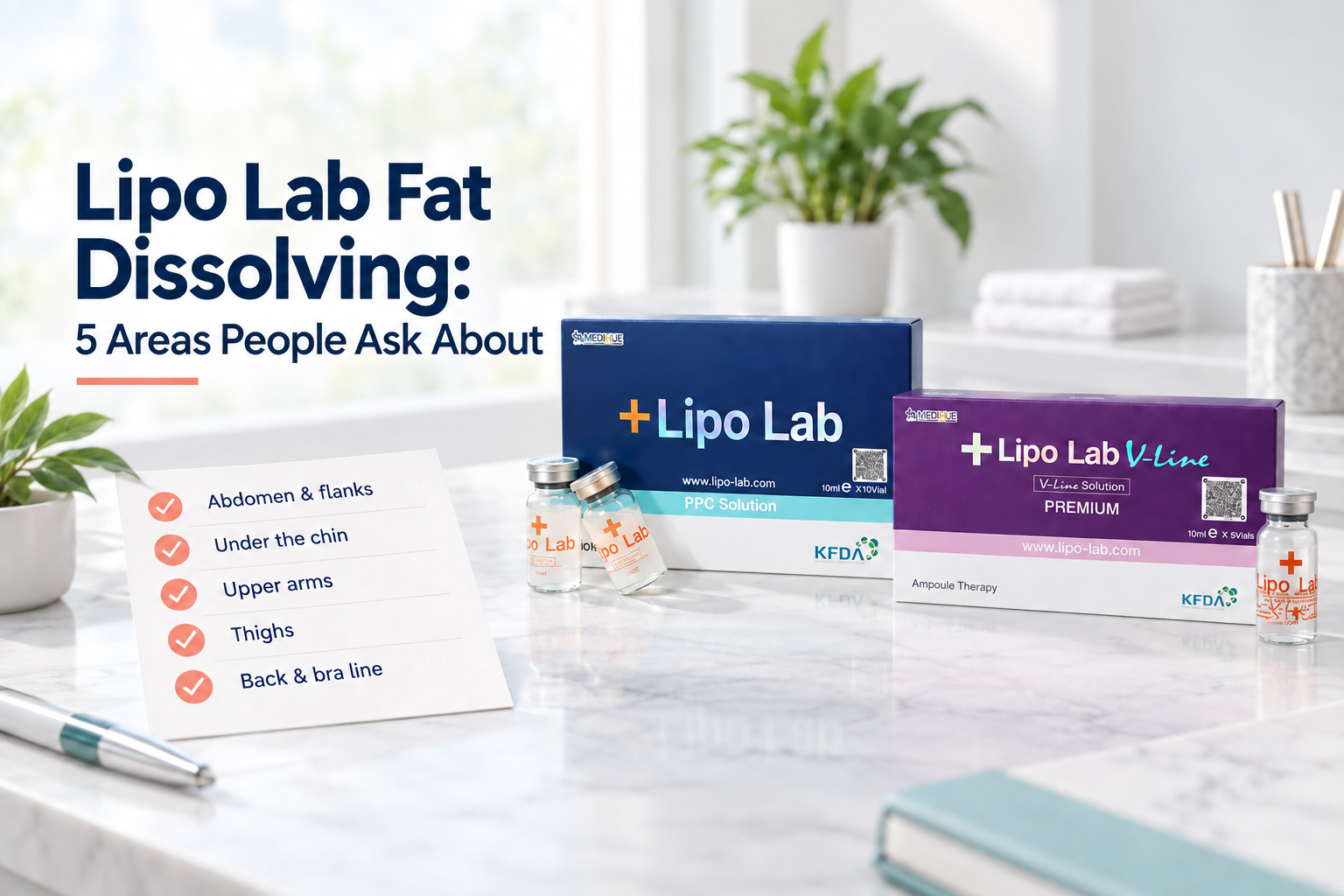
Results by area · treatment course · timing · downtime
Most people researching Lipo Lab are not asking for an anatomy lesson. They want to know whether it is worth treating the stomach, chin, arms, thighs or back, how many appointments they may be paying for, and when they can fairly decide whether it worked.
Table of contents
Quick Answer: What Can You Realistically Expect?
Lipo Lab is most likely to create a noticeable contour change when the target is a small, clearly defined pocket rather than a large area or general weight loss. A compact under-chin or flank pocket can be easier to see changing than a broad abdomen, whole thigh or upper arm where loose skin is the main issue.
Current Lipo Lab clinic and market pages commonly describe two to four sessions, roughly two to four weeks apart. Early change is often discussed after two to four weeks, with a clearer result developing over four to eight weeks. These are useful planning ranges, not a validated universal Lipo Lab protocol: area size, product choice, starting tissue and the provider’s plan can change the course.
Expect gradual and usually modest contouring, not a liposuction-level transformation. If the goal is major weight loss, strong skin tightening, cellulite removal or a dramatic one-session result, Lipo Lab is unlikely to be the best match.
Lipo Lab PPC vs V-Line: Which Product Is for Which Area?
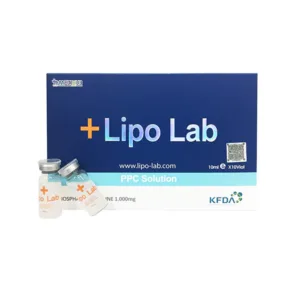
The first useful product distinction is simple. MEDIHUB’s current lineup positions Lipo Lab PPC Solution for body-line professional care and Lipo Lab V-Line for face-line care. They should not be treated as the same box with different colours.
| Product | Current pack | Practical area role | Best buying question |
|---|---|---|---|
| Lipo Lab PPC Solution | 10-vial body pack | Body-line route for areas such as abdomen, flanks, arms, thighs and back | Is the target small enough for gradual nonsurgical contouring to be worthwhile? |
| Lipo Lab V-Line | 5-vial face pack | Face-line route for under-chin and jawline discussions | Is the fullness actually fat, and will reducing it improve the profile without leaving loose skin? |
Product identity does not tell a patient how to inject it. It tells a qualified buyer which listing and documentation to evaluate. The separate Lipo Lab PPC versus V-Line guide covers that product-selection and professional procurement decision in more detail.
The Basic Lipo Lab Treatment Course
Lipo Lab is generally sold as a course, not a one-off treatment. Across current public treatment sources, the most repeated planning range is two to four sessions with a review between sessions. Larger body areas may require more time and product than a compact facial area, which affects both cost and patience.
There is no high-quality public evidence supporting one fixed Lipo Lab course for every area. A clinic should therefore present its schedule as an individual plan and explain the total expected commitment before payment, rather than selling the first appointment without discussing the likely series.
Lipo Lab Results Timeline: When Changes Usually Show
The most common reason people think Lipo Lab has failed is that they judge it during the swelling phase or compare photos taken under different conditions. Fat-dissolving results are gradual, and early puffiness can temporarily make the area look larger.
The American Academy of Dermatology also describes nonsurgical fat-removal results as gradual and subtler than liposuction. Its precise timing for approved under-chin injections is not a Lipo Lab protocol, but the expectation principle is useful: do not promise an immediate or dramatic transformation.
1. Abdomen and Flanks: Good for a Defined Pocket, Slow for a Large Area
Most realistic goal: soften a small lower-belly pocket or love handle, not flatten the entire abdomen.
The abdomen is popular because even a modest contour change can affect how a waistband sits. The trade-off is size: a broad belly contains much more tissue than a chin or small flank pocket, so the visual change from one session is usually less obvious and the full course can cost more.
More likely to satisfy
A person at a relatively stable weight with one or two defined pockets and realistic expectations of a gradual, modest change.
More likely to disappoint
Someone expecting weight loss, a flat stomach, a solution for visceral fullness, or tightening of loose post-weight-loss or post-pregnancy skin.
What the result may look like
A slightly smoother lower abdomen or waistline and a smaller bulge in consistent photos. It should not be sold as a large-volume transformation.
2. Under the Chin: A Small Area Can Show a Clearer Change
Most realistic goal: improve a small pocket that blurs the jaw-to-neck outline.
The under-chin area can show a clearer visual change because it is compact and affects a strong profile line. It is also the area where product choice and provider skill matter most: fullness may come from fat, loose skin, muscle, glands or skeletal profile, and reducing fat will not correct all of those causes.
More likely to satisfy
A person whose main concern is a small, visible pocket and who accepts temporary swelling before the jawline looks better.
More likely to disappoint
Someone whose main issue is loose neck skin, a recessed chin, strong muscle bands or a broader facial-shape concern rather than a localized pocket.
What the result may look like
A cleaner jaw-to-neck transition rather than a completely different face shape. Swelling can make the profile look temporarily worse before it settles.
3. Upper Arms: Fat Can Reduce While Loose Skin Remains
Most realistic goal: soften a small localized pocket, not tighten the full upper arm.
Upper-arm dissatisfaction often combines two problems: volume and loose skin. Reducing a small pocket may slim the outline, but it can also reveal skin laxity that was already present. That is why “smaller” does not always look “tighter.”
More likely to satisfy
A person with a compact soft pocket and reasonably firm skin who wants a subtle reduction in the arm outline.
More likely to disappoint
Someone mainly bothered by hanging skin, broad arm size or the expectation that Lipo Lab will create a firm, toned arm.
What the result may look like
A modest decrease in localized fullness. If laxity remains, a skin-tightening discussion may be more important than another fat-dissolving session.
4. Thighs: Better for a Small Pocket Than Whole-Leg Slimming
Most realistic goal: reduce a defined inner- or outer-thigh pocket, not reshape the whole leg.
Thighs are large, and their appearance is influenced by fat distribution, muscle, skin texture and natural asymmetry. A small pocket may be a reasonable contour goal, but treating the whole thigh as one area usually creates an expensive, slow and hard-to-measure course.
More likely to satisfy
A person focused on one limited pocket that can be photographed and measured consistently.
More likely to disappoint
Someone expecting major leg slimming, a thigh gap, cellulite removal or correction of swelling and uneven skin texture.
What the result may look like
A softer local bulge or slightly smoother transition. Changes can be difficult to see without consistent photos because pose and stance alter the thigh outline.
5. Back and Bra-Line Fat: Compact Rolls Are Easier to Judge
Most realistic goal: reduce a distinct upper-back or side roll that remains visible across consistent clothing and poses.
Back and bra-line fullness can be frustrating because a compact roll is visible from the side and through fitted clothing. When the target is small and clearly defined, even a modest reduction may improve the line of clothing. Broad upper- or lower-back fat is a different commitment and may not produce a satisfying change from a short course.
More likely to satisfy
A person with one stable, visible roll who wants a gradual softening rather than complete removal.
More likely to disappoint
Someone trying to slim the whole back, correct loose skin or judge the result from different bras, tops, posture and lighting each time.
What the result may look like
A less prominent roll and smoother clothing line. Standardized back photos are particularly important because people cannot monitor this area accurately in a mirror.
Why Lipo Lab May Not Seem to Work
Current social discussions repeat the same frustration: “I have done several rounds and still cannot tell.” That does not prove the product worked or failed, but it reveals the practical mistakes that make a result impossible to judge.
| Reason the result looks weak | What is happening | Better decision |
|---|---|---|
| Judging too early | Swelling or firmness hides the contour, or only a few days have passed | Wait for the agreed review point and compare settled photos |
| The area is too large | A modest change is spread across a broad abdomen, thigh or back | Ask whether the expected course and cost are still worthwhile |
| Loose skin is the main issue | Volume changes but the skin does not create the tighter outline expected | Compare a skin-tightening or combined plan |
| The goal is too dramatic | The person expects liposuction-level reduction from a gradual nonsurgical course | Compare the result and recovery trade-off of other options |
| Photos are inconsistent | Pose, lighting, distance or clothing changes create a false before-and-after | Use a fixed photo setup and one agreed measurement |
| Product identity is uncertain | The variant, source, batch or storage history cannot be verified | Stop and resolve authenticity and handling before use |
One more session is not automatically the answer. If the agreed comparison shows little change, the provider should explain whether the issue is timing, area selection, product choice or an unsuitable treatment goal before recommending more spend.
Lipo Lab vs Other Options: When Another Route Makes More Sense
| Main goal | Lipo Lab fit | Option worth comparing |
|---|---|---|
| Small localized pocket and gradual change | Potentially reasonable after qualified assessment | Other nonsurgical contouring options based on area and market |
| General weight loss | Poor fit | Evidence-based weight-management care |
| Loose skin is the main concern | Fat reduction alone may disappoint | Skin-tightening or surgical consultation |
| Large-volume or dramatic reduction | Likely too subtle or too long a course | Liposuction or surgical body-contouring consultation |
| U.S. treatment of under-chin fat | Lipo Lab is not FDA-approved | Discuss the FDA-approved option and alternatives with a qualified clinician |
The point is not that one option always wins. It is that the desired scale of change, tolerance for swelling and downtime, budget for a series, skin quality and local regulatory status should determine which category deserves comparison.
What to Ask Before Paying for a Course
- Which exact product will be used? PPC Solution or V-Line, and why does it match this area?
- How many sessions are included in the estimate? Ask for the likely range, spacing and total course cost, not only the first-session price.
- What result is realistic? The provider should describe what may improve and what probably will not.
- What will recovery look like? Ask about expected swelling, tenderness, bruising and when the area can be photographed fairly.
- How will progress be measured? Agree on standardized photos, measurement and the review date.
- What happens if the result is weak? There should be a reasoned stop, continue or change-treatment decision, not an automatic upsell.
- Can the product be verified? Check sealed condition, source, batch and the current authenticity route.
- Who handles a complication? The clinic should provide a clear contact and escalation plan.
Qualified professional buyers can review the current Lipo Lab PPC Solution, Lipo Lab V-Line and broader fat-dissolving range after the area, expected result and local professional pathway are clear.
Final Verdict
Lipo Lab is most likely to satisfy someone who wants a gradual, modest contour change in a small localized pocket and accepts a multi-session course. A compact chin, flank or back roll may be easier to see changing than a broad abdomen, whole thigh or loose upper arm. The usual advertised planning range is two to four sessions, but the value depends on whether the goal is realistic and the result is measured after swelling settles.
If the main concern is broad weight loss, loose skin, cellulite or a large volume of fat, compare a more suitable treatment category before paying for repeated sessions.
Qualified professional buyers who have matched the area and expected result can compare the current product listings, then request batch, stock and commercial documentation before ordering.
Frequently Asked Questions
Which area usually shows the clearest Lipo Lab result?
A small, clearly defined pocket is usually easier to judge than a large or diffuse area. A compact under-chin, flank or back roll may show a clearer contour difference, while broad abdominal or thigh treatment often looks subtler per session.
How many Lipo Lab sessions are usually needed?
Current Lipo Lab clinic and market sources commonly describe two to four sessions, often spaced roughly two to four weeks apart. This is a market-observed planning range, not a validated universal protocol, and larger areas may require a different plan.
When should I expect to see Lipo Lab results?
Early change is often discussed at two to four weeks, with a clearer difference developing over four to eight weeks. Do not judge the result during early swelling, and compare consistent photos several weeks after the final planned session.
How much downtime is normal after Lipo Lab?
Public treatment sources commonly mention swelling, redness, tenderness, bruising, stinging or temporary firmness. Many people continue normal activities, but visible swelling can affect social plans and may last longer in some areas or individuals.
Will Lipo Lab tighten loose skin?
Do not rely on Lipo Lab as a skin-tightening treatment. Reducing a fat pocket may improve the outline, but existing loose skin can remain or become more noticeable, especially on the upper arms, abdomen and under the chin.
Why might Lipo Lab appear not to work?
Common reasons include judging too early, treating a large or diffuse area, loose skin dominating the contour, expecting a dramatic result, inconsistent photos, weight change or uncertain product identity. The provider should explain the likely reason before recommending more sessions.
Evidence note: the two-to-four-session and two-to-eight-week figures are recurring commercial planning ranges found across current Lipo Lab treatment sources, not a manufacturer-validated universal protocol. Medical and regulatory statements are kept separate from those market observations.