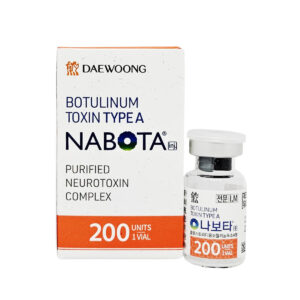
Metox and Nabota are both Korean botulinum toxin type A products in 100U and 200U, and both use vacuum negative-pressure drying. This guide compares the two on the fields procurement actually records — drying form, 900 kDa labeling, purification platform, and the excipient list — and ends with a clear buying direction.
Quick Answer
Metox and Nabota both use vacuum negative-pressure drying, and both come in 100U and 200U presentations. That means the drying method and the number of units are not what separates them.
What actually separates them is technical transparency. Nabota publicly labels a HI-PURE purification platform, a 900 kDa complex, and a stated proportion of over 98% of the 900 kDa fraction. Metox identifies its product as a vacuum-dried Purified Neurotoxin Complex but does not publish equally clear kDa and purity parameters in reliable sources.
The practical takeaway:
- New procurement system, technical parameters and audit documentation first → investigate Nabota first.
- Already using Metox, product-line continuity first → continue with Metox.
The rest of this article proves that conclusion on the technical fields alone.
What Are We Actually Comparing?
This article does not compare aesthetic results, and it does not compare the two brands in general terms. It answers one question:
Both Metox and Nabota are vacuum negative-pressure-dried products. What is actually different about their technical documentation, their 900 kDa labeling, their purification systems, and their value to a buyer?
The comparison is built on a simple main line:
Shared technology → real technical differences → what the differences mean for procurement → a clear buying recommendation.
Before looking for differences, fix the shared points so we do not invent false ones:
- Both are Korean botulinum toxin type A.
- Both use vacuum negative-pressure drying.
- Both are available in 100U and 200U.
Because these three points are shared, you cannot rank one brand above the other just by pointing at the drying method or the unit size. The real differences sit in the fields that follow.
Technical Comparison Table
This is the only full specification table in the article. The sections after it explain the two fields most buyers ask about — vacuum drying and 900 kDa — without repeating the spec sheet.
| Dimension |
Metox |
Nabota |
What it means for procurement |
| Product type |
Korean botulinum toxin type A |
Korean botulinum toxin type A |
Same category — the two can be compared on the same axes |
| Drying method |
Vacuum negative-pressure drying |
Vacuum negative-pressure drying |
A shared point, not a differentiator |
| Post-drying appearance |
May form a thin, nearly invisible dried film |
Same class of vacuum-dried presentation |
A “near-empty” vial does not mean there is no product |
| Toxin complex labeling |
Purified Neurotoxin Complex |
Explicitly labeled 900 kDa complex |
Nabota’s complex parameter is more explicit |
| Purification platform |
No equally named platform found in current reliable sources |
HI-PURE technology |
Nabota suits buyers who need clear technical files |
| Purity expression |
Does not use an unverified 99.8% figure |
Officially stated as over 98% of the 900 kDa fraction |
You cannot force-compare two purity numbers from different sources |
| Excipients |
Human serum albumin + sodium chloride |
Human serum albumin + sodium chloride |
Similar base formulation |
| Presentations |
100U, 200U |
100U, 200U |
Unit size is an order-quantity question, not a quality ranking |
| Current product path |
Metox 100U / Metox 200U |
Nabota 100U / Nabota 200U |
Four in-stock products give clear routing to product pages |
What Is Vacuum Negative-Pressure Drying?
Both products are described as vacuum negative-pressure dried, so this term deserves a precise explanation — it is the single most common source of confusion when a customer inspects a vial.
Vacuum negative-pressure drying removes water in an environment below normal atmospheric pressure. Lowering the pressure allows moisture to be driven off from the product without exposing it to the higher temperatures of ordinary heat drying.
That mechanism leads to a specific consequence buyers should understand:
- Vacuum negative-pressure drying removes water below normal atmospheric pressure.
- After drying, the product does not necessarily form a visible white cake. It may appear as a thin film on the bottom or wall of the vial.
- For that reason, a vial that looks nearly transparent — or even “empty” — can simply be the result of this formulation form.
- Vacuum drying is a technology shared by Metox and Nabota. You cannot use it to argue that one brand is better than the other.
- This technical information explains the product’s appearance, but it does not prove anything about duration, diffusion, or cosmetic outcome.
The honest use of this section is descriptive: it tells a buyer why the vial looks the way it looks, and it removes “vacuum drying” from the list of real differentiators.
What Does 900 kDa Mean?
Nabota’s most visible technical claim is the 900 kDa complex. Three concepts are frequently mixed up, so separate them clearly:
- kDa (kilodalton): a unit of molecular mass. It describes the mass of the toxin complex the product is labeled as.
- U (unit): the labeled biological activity units of the product.
- 100U / 200U: the labeled units per vial. These are not “100 kDa” or “200 kDa.”
With those three separated, two conclusions follow:
- Nabota’s 900 kDa is not “900 times stronger.”
- 200U is not automatically more effective than 100U.
The 900 kDa figure describes the form of the toxin complex the product is identified as. The 100U and 200U figures describe the labeled units per vial. They answer different questions and should never be traded against each other.
The right way to state Nabota’s advantage is this: its technical parameters and purification system are expressed more completely. That is a documentation advantage — it must not be stretched into a claim that the clinical result is automatically better.
Where Metox and Nabota Actually Separate
Once drying method, excipients, and unit presentations are set aside as shared, the real differences narrow to three documentation fields:
- Toxin complex labeling. Nabota names a specific 900 kDa complex. Metox uses the broader “Purified Neurotoxin Complex” identity without an equally explicit kDa figure in reliable sources.
- Purification platform. Nabota names HI-PURE technology. Metox does not present an equally named purification platform in the materials currently available.
- Purity expression. Nabota states its 900 kDa fraction at over 98%. Metox does not rely on an unverified 99.8% figure, and no reliable source currently provides an equivalent, directly comparable number for Metox.
These are documentation differences, not a verdict on clinical performance. For a buyer, however, documentation differences matter — they determine how easy it is to build an audit file and to compare products on recordable fields.
Which Product Fits the Procurement Need?
This is the section the comparison has been building toward. Match the procurement situation to the product worth investigating first.
| Procurement need |
Product to investigate |
Reason |
| First-time choice between the two brands |
Nabota |
Clearer technical documentation: HI-PURE, 900 kDa, and purity information |
| Strongest focus on technical parameters and internal audit records |
Nabota |
More specific, recordable technical fields |
| Already using the Metox line long-term |
Metox |
Maintain brand, product records, and supply-flow continuity |
| Requirement is only vacuum negative-pressure drying |
Either |
Both Metox and Nabota satisfy this technical condition |
| Prefer a smaller single-vial stock unit |
100U of the chosen brand |
Fits smaller-unit inventory configuration |
| Want higher labeled units per vial from the same brand |
200U of the chosen brand |
Fewer vials for the same nominal unit need |
| No brand history, and not comparing on price |
Prefer Nabota |
Beyond shared presentations and drying, its documentation is more complete |
| A mature Metox procurement and file system already exists |
Continue Metox |
No reason to switch systems just because Nabota labels 900 kDa |
100U or 200U?
Unit size is a logistics question, not a ranking. Decide it with two considerations only:
- Inventory turnover: a 100U vial is a smaller single-vial stock unit, which suits smaller and faster-moving inventory.
- Labeled units per vial: a 200U vial carries more labeled units per vial, which means fewer vials for the same nominal unit need.
Do not describe 200U as “more effective” than 100U. The choice between them is about stock configuration and unit economics, not product quality.
For routing, the four in-stock products are Metox 100U, Metox 200U, Nabota 100U, and Nabota 200U — one path for each of the two decisions above.
Final Buying Direction
Three sentences, applied in order:
- New procurement system, technical documentation first: choose Nabota as the first product to investigate.
- Existing Metox system, supply continuity first: continue with Metox.
- Choosing only between 100U and 200U: decide by inventory turnover and labeled units per vial — do not describe 200U as more effective.
Product Routing
The four in-stock products, matched to the buying direction above:
Metox 100U
Smaller single-vial stock unit in the Metox line.
View Metox 100U
Metox 200U
Higher labeled units per vial in the Metox line.
View Metox 200U
FAQ
Is vacuum negative-pressure drying the same as having no product in the vial?
No. Vacuum negative-pressure drying removes water below normal atmospheric pressure and can leave only a thin, nearly invisible film. A near-empty-looking vial is a formulation form, not evidence of a missing product.
What does 900 kDa mean?
It is a molecular-mass unit describing the labeled toxin complex form. It is not a strength multiplier, and it is not the same as the unit (U) or the 100U/200U vial labeling.
Are 100U and 200U different strengths?
They are different labeled units per vial. They are not “100 kDa” and “200 kDa,” and 200U is not automatically more effective than 100U.
Do Metox and Nabota use the same excipients?
Both list human serum albumin and sodium chloride as excipients, so the base formulation is similar.
Is Nabota clinically better because it labels 900 kDa and HI-PURE?
No. Nabota’s technical documentation is more complete, which is a procurement advantage. It is not, by itself, proof of a better clinical result.
What is the main difference between Metox and Nabota?
The drying method and unit presentations are shared. The main difference is documentation transparency: Nabota labels a 900 kDa complex, a HI-PURE purification platform, and a stated purity fraction, while Metox does not publish equally clear figures in current reliable sources.
Which should I buy first?
New procurement with technical documentation as the priority: investigate Nabota first. Existing Metox system with continuity as the priority: continue with Metox.