Reviewed against publicly available manufacturer and regulatory information.
The nasolabial folds — the creases running from the sides of the nose toward the corners of the mouth — are among the most common reasons patients seek dermal filler. They are also one of the more nuanced areas to treat well, because a deep fold is rarely caused by one single thing. This guide explains what nasolabial folds are, why they form, how HA filler is used, and what practitioners and clinics consider when treating and stocking for the area. It is an educational overview, not an injection-technique tutorial.
What Are Nasolabial Folds (Smile Lines)?
Nasolabial folds are the natural creases between the cheeks and the upper lip. Everyone has them; they simply become more visible over time. Patients often call all lines around the mouth “smile lines,” but the nasolabial fold specifically runs from the nose toward the mouth corner.
What Causes Nasolabial Folds?
Nasolabial folds are multifactorial. Depending on the individual, contributing factors can include:
- Mid-face volume change and shifts in the deep and superficial fat compartments
- Ligament and soft-tissue support changes
- Skin laxity and skin-quality changes
- Skeletal support, including the maxilla and pyriform (nasal base) region
- Repeated dynamic movement from facial expression
This matters clinically because the right strategy depends on why the fold is prominent in a given patient — not on a single default technique. Some patients may benefit from restoring selected areas of mid-face support so the fold softens indirectly; in others, carefully planned direct correction of the fold may be appropriate; many are treated with a staged combination. Assessment should determine whether treatment targets the fold, adjacent support, or both. “Cheek first” is not a universal rule.
How Is HA Filler Used for Nasolabial Folds?
Hyaluronic acid is the most common choice, for two reasons: it integrates well into the tissue, and it can often be degraded with hyaluronidase if the result needs adjusting. Beyond that, product selection is not a matter of a single “firmness” grade. A suitable choice is an HA filler whose rheology (elasticity, cohesivity, tissue behaviour), documented indication, and recommended implantation plane fit the patient’s anatomy and treatment goal — in plainer terms, a moderately supportive HA product chosen for the required depth and degree of correction, rather than an all-purpose one.
Choosing an HA Filler for the Area
Product examples that carry documentation relevant to deeper folds — in the markets where their authorization permits that use — include:
- Revolax Deep with Lidocaine — brand documentation positions it for deep wrinkles including nasolabial folds
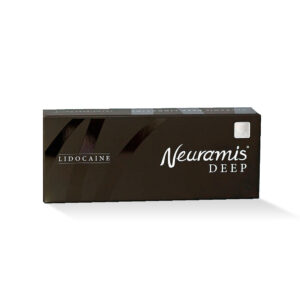
- Neuramis Deep with Lidocaine — manufacturer documentation associates it with nasolabial folds
- Specific Restylane formulations such as Restylane Refyne or Restylane Defyne, which are positioned for dynamic facial folds, and Restylane
Product indications and regulatory status differ by country. These are not interchangeable, and “Restylane” is a product family rather than one item — the individual SKUs differ in rheology, recommended plane, and approved use. Buyers should verify the exact SKU, its local authorization, and the current instructions for use before treatment or purchase.
Vascular Safety in the Nasolabial Region
This is the area of the guide that matters most. The nasolabial region lies near the facial and angular arteries, whose course and depth vary between people. Anatomical and ultrasound studies indicate that no single injection plane or zone can be described as universally safe across the entire nasolabial fold; even planes once considered relatively safe have been associated with serious vascular events, and different segments of the fold may correspond to different considerations. Injection plane is therefore anatomy- and product-dependent.
Although uncommon, inadvertent intravascular injection can cause tissue ischemia or necrosis and, in severe cases, visual impairment or blindness. For this reason:
- Treatment should only be performed by qualified practitioners with detailed anatomical knowledge and an established complication-response protocol.
- HA filler can often be enzymatically degraded with hyaluronidase — but this does not make injection risk-free or guarantee complete reversal of every complication.
Because of these risks, this guide does not describe entry points, “safe” depths, needle-versus-cannula preferences, or dosing. Those are clinical decisions for a trained practitioner, made per patient and per product IFU.
When Filler Is Not the Whole Answer
Very deep folds accompanied by significant skin laxity, or folds driven mainly by skin quality rather than volume, may not be fully corrected by filler alone — and overfilling to chase a deep line usually looks worse rather than better. Setting realistic expectations, and recognising when a different approach is more appropriate, is part of good practice.
How Clinics Compare HA Fillers for Nasolabial-Fold Treatment
For a clinic or wholesale buyer, stocking well for this area is not about buying “one firm filler.” It is about matching products to treatment roles and verifying the details that determine whether a SKU is suitable. Before adding a product to a nasolabial offering, it is worth checking:
| Check | Why it matters |
|---|---|
| Exact SKU indication | Is the specific product documented for nasolabial folds or moderate-to-severe facial folds? |
| Recommended plane | Which layer does the IFU recommend — dermis, subcutis, or other? |
| Treatment role | Direct fold softening vs mid-face structural support |
| Rheology | Elasticity, cohesivity, tissue adaptation and water uptake — not just “soft/hard” |
| Pack format | Volume per syringe, units per pack, presence of lidocaine |
| Duration evidence | Data specific to that SKU and this area, not a category claim |
| Regulatory market | FDA, CE, MFDS, or the destination market’s status |
| Documentation | IFU, traceable batch, storage conditions, supply paperwork |
In practice this means stocking by role — a product documented for direct fold correction, a separate structural product where mid-face support is appropriate, and the resources and protocols for managing complications (including hyaluronidase) — rather than by a single firmness label.
Frequently Asked Questions
How long does nasolabial fold filler last?
It depends on the exact HA product, the treatment plan, and patient factors. Published or manufacturer-reported duration for individual products used in this area may range from approximately 6 to 18 months. Buyers and patients should refer to the evidence for the specific SKU rather than applying one duration claim to all nasolabial-fold fillers.
Is it better to fill the nasolabial fold or the cheek?
It depends on the anatomical cause. Some patients may benefit from mid-face support, some from direct fold correction, and some from a staged combination. “Cheek first” should not be treated as a universal rule — the assessment determines whether treatment targets the fold, adjacent support, or both.
Does nasolabial filler look natural?
It can look natural when patient selection, product choice, amount, and placement are appropriate. An unnatural, heavy look usually comes from over-filling the line directly without considering the underlying cause. No treatment can guarantee a particular aesthetic result.
What filler is used for smile lines?
There is no single best HA filler for every nasolabial fold. The exact SKU should be selected according to anatomy, fold severity, the intended plane, the product’s rheology, and its locally approved use. HA is favoured partly because it can often be degraded with hyaluronidase if adjustment is needed.
Are nasolabial folds the same as marionette lines?
No. Nasolabial folds run from the sides of the nose toward the corners of the mouth. Marionette lines extend downward from the corners of the mouth toward the chin. They may require different assessment, products, and treatment planning, even though patients often group them together as “smile lines.”
How should a clinic stock for nasolabial treatments?
Stock by treatment role rather than by one generic firmness label: a product documented for direct fold correction, a separate structural product for cases where mid-face support is appropriate, and the complication-management resources and protocols (including hyaluronidase). Verify each SKU’s indication, recommended plane, and regulatory status for your market before purchase.