NASHA® Technology · The Original · FDA Approved
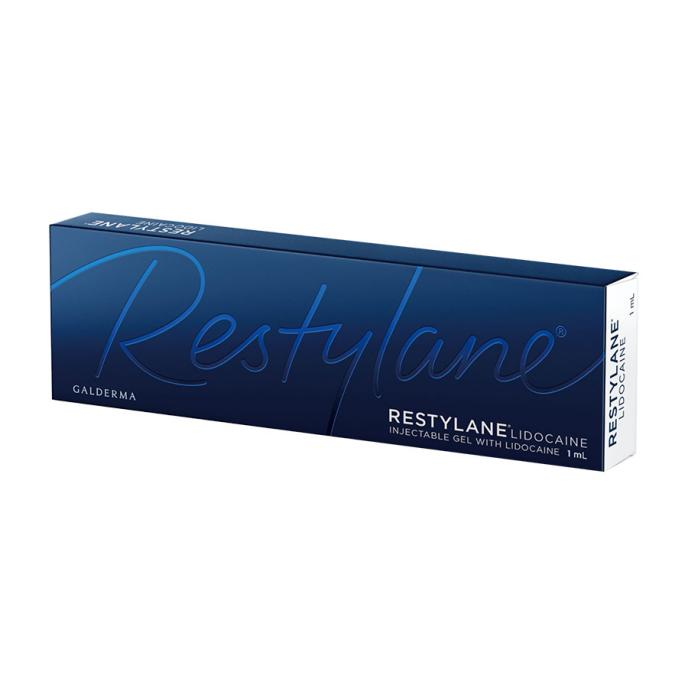
Restylane Lidocaine 1ml — The Original NASHA Technology Filler (Restylane-L)
The original Restylane — first launched by Q-Med in 1996, now part of the Galderma portfolio. Restylane Lidocaine 1ml (also marketed as Restylane-L in the US) uses Galderma’s NASHA® (Non-Animal Stabilized Hyaluronic Acid) technology — a biphasic, particle-based gel built for precision and structure. 20 mg/mL HA + 3 mg/mL premixed lidocaine. FDA approved for mid-to-deep facial wrinkles and lip enhancement.
Professional use only — for licensed aesthetic practitioners.
Last reviewed: May 2026 · Manufacturer: Q-Med AB / Galderma, Uppsala, Sweden
NASHA®
Non-Animal Stabilized HA
Since 1996
First HA filler on market
Side-By-Side
Restylane Lidocaine 1ml vs Juvederm vs Belotero
| Feature |
Restylane Lidocaine 1ml |
Juvederm (Allergan) |
Belotero (Merz) |
| HA Concentration |
20 mg/mL |
15–24 mg/mL |
20–26 mg/mL |
| Cross-Linking Tech |
NASHA® Technology |
Vycross / Hylacross |
CPM® Polydensified |
| Gel Structure |
Biphasic (particle) |
Monophasic |
Polydensified gradient |
| Lidocaine |
0.3% (premixed) |
0.3% (XC lines) |
0.3% |
| Origin |
Sweden (Galderma / Q-Med) |
USA (Allergan / AbbVie) |
Germany (Merz) |
| Established Since |
1996 (first HA filler) |
2006 |
2005 |
| Distinctive Strength |
Precision lift, structural projection |
Long duration, high G-prime |
Tissue integration, soft feel |
↔ Swipe horizontally on mobile to view all columns
Comparison based on manufacturer published data. See our top dermal filler comparison guide for broader market context.
FAQs
Restylane Lidocaine 1ml — Frequently Asked Questions
What is Restylane Lidocaine 1ml?
Restylane Lidocaine 1ml (marketed as Restylane-L in the United States) is the original Restylane product — first launched by Q-Med in 1996. It uses Galderma’s NASHA® Technology (Non-Animal Stabilized Hyaluronic Acid), a biphasic particle-based cross-linking process. The formulation contains 20 mg/mL of HA and 3 mg/mL (0.3%) lidocaine premixed for injection comfort. FDA approved for mid-to-deep facial wrinkles and lip enhancement.
What is NASHA Technology in Restylane?
NASHA stands for Non-Animal Stabilized Hyaluronic Acid — Galderma’s original cross-linking process used in classic Restylane, Restylane Lyft, Restylane Silk, and Restylane Eyelight. NASHA produces a biphasic, particle-based gel built for precision and structured projection. This contrasts with OBT / XpresHAn Technology (used in Defyne, Refyne, Volyme, Kysse, Contour) which produces a monophasic gel optimised for movement and flexibility.
How is Restylane Lidocaine 1ml different from Restylane Kysse?
Both products contain 20 mg/mL HA and 3 mg/mL lidocaine, but they use different cross-linking technologies. Restylane Lidocaine 1ml uses NASHA Technology — biphasic, particle-based, firmer projection. Restylane Kysse uses OBT / XpresHAn Technology — monophasic, soft, more flexible. Practitioners often select classic Restylane for patients wanting defined projection and Kysse for patients prioritising soft, natural lip movement.
How long does Restylane Lidocaine 1ml last?
Per Galderma clinical data, classic Restylane delivers approximately 6-9 months of correction in nasolabial folds and similar facial wrinkles, and approximately 6 months in lip enhancement. The shorter duration compared to newer OBT-technology variants reflects NASHA’s higher metabolic turnover in dynamic facial zones. Individual duration depends on dose, placement, patient metabolism, and movement intensity.
Is Restylane Lidocaine 1ml FDA approved?
Yes. Restylane-L (the US name) holds FDA approval for mid-to-deep injection into facial tissue for the correction of moderate-to-severe facial wrinkles and folds, such as nasolabial folds, and for lip enhancement in patients over 21. Restylane was the first FDA-approved hyaluronic acid filler in the United States (approved 2003 for the non-lidocaine version, with Restylane-L approved subsequently).
Can Restylane Lidocaine be used for tear trough correction?
Tear trough correction with Restylane is an off-label but widely used clinical application. NASHA’s particle-based structure provides predictable placement in the thin-skinned periorbital area, and practitioners often prefer classic Restylane over softer OBT fillers for this indication. Off-label use is at the practitioner’s clinical discretion. Tyndall effect risk requires very precise depth — deep supraperiosteal placement is generally recommended.
Where is Restylane manufactured?
Restylane is manufactured by Q-Med AB in Uppsala, Sweden. Q-Med is a subsidiary of Galderma, which is headquartered in Lausanne, Switzerland. Q-Med originally launched Restylane in 1996 as the world’s first non-animal HA dermal filler.
How does the lidocaine work in Restylane-L?
The 3 mg/mL (0.3%) lidocaine HCl is premixed into the gel during manufacturing. This eliminates the need for on-site mixing with separate lidocaine vials and reduces injection-site discomfort by providing immediate local anaesthesia at the moment of injection. Clinical studies show meaningful reduction in patient-reported pain scores compared to non-lidocaine versions.
How should Restylane Lidocaine 1ml be stored?
Store at 2-25 °C in original packaging, away from direct sunlight. Do not freeze. Shelf life is typically 24 months from manufacturing date when unopened. Once opened, contents must be used immediately — partial syringes cannot be retained for later use.
Does Restylane contain animal-derived ingredients?
No. Restylane uses non-animal stabilized hyaluronic acid (NASHA) produced by bacterial fermentation. The ‘non-animal’ in the technology name is literal — there are no animal proteins or by-products. The product is contraindicated in patients with severe allergies to gram-positive bacterial proteins (used in the fermentation process).
Important Safety Information
Read Before Clinical Use
Restylane Lidocaine 1ml is a prescription medical device for use only by licensed aesthetic practitioners. Common reactions include injection-site bruising, swelling, redness, and tenderness — generally resolving within days. Like all hyaluronic acid dermal fillers, treatment carries rare but serious vascular complication risks. Deep injection sites (subcutaneous and supraperiosteal placements) require heightened anatomical awareness of facial vasculature. Contraindicated in patients with severe allergies to gram-positive bacterial proteins. Full contraindications, vascular complication protocols, aftercare, and emergency guidance are detailed on the dermal filler safety page.
Read Full Dermal Filler Safety Information →
RESTYLANE is a registered trademark of Galderma S.A. Fillersfairy.com is a channel distributor and does not provide medical advice. This page is for informational purposes only and does not replace the manufacturer’s official Instructions for Use, which remains the authoritative source for clinical administration. Regulatory status varies by jurisdiction — buyers are responsible for verifying legal status before ordering.





Reviews
There are no reviews yet.