Quick Answer
Can ASCE+ SRLV help melasma and dark spots? There is an early reason to investigate it as an optional professional adjunct, not enough evidence to call it a proven melasma treatment. A small controlled pilot used the named ASCE-plus SRLV product alongside microneedling. Both groups improved, but the extra improvement in the product group did not reach statistical significance in the reported between-group comparisons. Earlier studies observed improvement with rose-derived exosome products in combined-care settings, without showing what the product would do on its own. No study here establishes that ASCE+ SRLV prevents melasma from returning. If you are deciding whether to add it, first confirm what kind of pigmentation is present, what the existing care plan covers, and whether the possible incremental benefit justifies the added cost.
Why do different dark spots need different decisions?
“Dark spots” is a useful description of appearance, but not a diagnosis. Melasma often presents as broader patches and can recur; post-inflammatory hyperpigmentation follows inflammation such as acne; sun-related spots may have a different pattern and history. The same-looking concern can therefore lead to different priorities. A person with suspected melasma needs an assessment of triggers and an ongoing photoprotection plan before considering a premium add-on. If a mark is new, changing, or uncertain, a dermatologist should evaluate it rather than treating it as routine pigmentation.
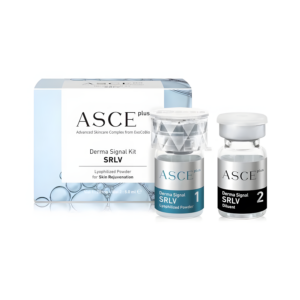
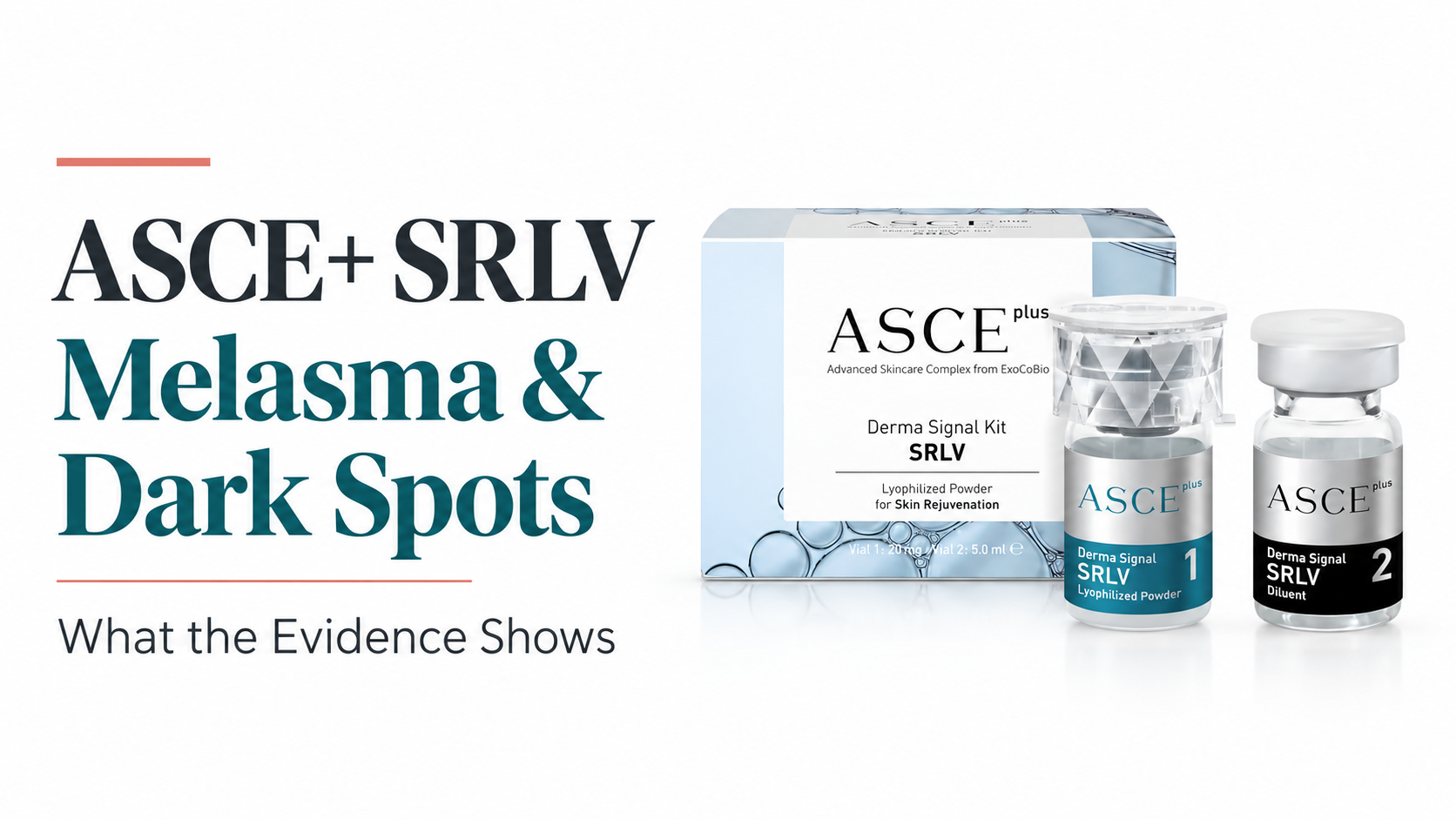
This distinction matters commercially, too. A clinic should not transfer results from a melasma study to every post-acne mark or sun spot. Nor should it treat a general “exosome” claim as evidence for the exact product on the shelf. ASCE+ SRLV is a specific rose-derived kit; the relevant question is whether studies of that kit, or sufficiently close formulations, show an additional benefit for the patient’s particular concern.
What did research involving ASCE+ SRLV actually observe?
The most direct comparison is a 2025 pilot randomized study that explicitly named ASCE-plus SRLV. Twelve women with melasma entered; ten completed, with five in each group. One group received microneedling with the product, while the comparison group received microneedling with saline. Both groups’ melasma scores improved. The product group’s change was numerically larger, but its baseline melasma was also more severe, and neither evaluator’s between-group change reached the paper’s significance threshold (reported p-values: 0.207 and 0.059). That is a possible signal to investigate, not proof of an added product effect. The study did not establish long-term relapse prevention.
A 2024 observational study followed 20 people with melasma receiving microneedling plus topical Rosa damascena stem-cell-derived exosomes. Ninety percent showed improvement on the modified Melasma Area and Severity Index at the end of the study. That is encouraging as an observation of a combined approach, but there was no microneedling-only control group. It cannot tell us how much improvement came from the vesicle product rather than the procedure, photoprotection, natural variation, or their combination. Its lighter Fitzpatrick I–III study population also limits how confidently the result can be extended to other skin types.
A 2025 eight-person case series names the commercial ASCEplus Derma Signal Kit/SRLV. It includes one woman with melasma and another person with hyperpigmentation. The melasma case showed visible improvement after combined care, but one case has no comparison group and cannot establish a repeatable result, independent product benefit, or recurrence control. These papers are more relevant to this product than studies using “ASCE” merely as shorthand for adipose stem-cell-derived exosomes, which are a different evidence category.
What might change, and what should not be promised?
The studies give a reason to ask whether a professional pigmentation plan might gain something from a rose-derived exosome adjunct. They do not provide a reliable percentage chance that one patient’s patches will fade, a standard time-to-result, or a duration of benefit. The controlled pilot is particularly useful because it asks the buyer’s real question: does adding ASCE+ SRLV outperform the underlying procedure? With only five completers per arm, baseline imbalance, and non-significant between-group differences, the honest answer is that this remains unresolved.
Melasma’s recurrent nature makes “will it stay away?” a separate question from “did it look lighter at follow-up?” Short follow-up observations do not answer the first question. The studies also do not justify applying a melasma claim to post-acne marks, or describing a combined result as a stand-alone effect of ASCE+ SRLV. A practitioner can discuss it as an investigational adjunct within a broader plan; a buyer should be cautious of promises to erase pigmentation permanently.
When is ASCE+ SRLV worth considering?
It is most relevant to a licensed practice that already evaluates pigment concerns, has a documented professional care pathway, and wants to assess whether an optional product add-on is worth testing in its own service mix. The product has a more specific research trail than an unnamed “exosome facial,” but that trail is still small. A sensible procurement conversation asks what exact kit will be supplied, whether current manufacturer directions match the intended use, what destination-market rules apply, and how outcomes will be assessed without promising a cure.
For someone seeking help with a dark patch, product selection is not the first step. Confirm the concern with a qualified clinician and agree on the core management plan, including photoprotection where appropriate. If that plan already makes sense and the practitioner believes an adjunct is suitable, then the ASCE+ SRLV evidence can inform a discussion of cost, uncertainty, and expected follow-up. The broader exosome therapy guide explains the category, while our skin-booster comparison puts it alongside other product classes; neither substitutes for the product-specific evidence above.
How should a buyer make the next decision?
| Your situation | What the evidence means | Best next step |
|---|---|---|
| Uncertain type of dark spot | The ASCE+ SRLV melasma papers cannot diagnose it or predict a response. | Get the lesion or pattern assessed before shopping for an add-on. |
| Confirmed melasma, no settled care plan | Small combined-care studies do not replace established management or recurrence planning. | Agree on clinician-led management and photoprotection first. |
| Clinic considering an optional adjunct | The named product has early human evidence, but added benefit remains uncertain. | Compare the exact product documentation, local status, cost, and follow-up measures. |
| Promise of permanent clearing or a guaranteed result | No cited study supports that promise. | Ask for product-specific controlled evidence and a realistic consent discussion. |
Bottom line: For confirmed melasma, prioritize a dermatologist-led plan and photoprotection. For a clinic evaluating an optional pigment-care adjunct, ASCE+ SRLV merits a product-specific discussion because it appears by name in early human reports, but it should not be sold as a proven stand-alone melasma therapy.
Professional purchasing route: Review the FillersFairy ASCE+ SRLV product listing and ask for the current manufacturer directions and destination-market status before purchase. This article is evidence context, not an instruction to self-select or perform treatment.
FAQ
Has ASCE+ SRLV been proven to treat melasma on its own?
No. The named-product pilot studied ASCE+ SRLV alongside microneedling, and its between-group differences did not reach statistical significance. The other reports used combined care without a suitable product-only comparison.
Does the 90% improvement figure mean ASCE+ SRLV works for nine in ten people?
No. That figure comes from a 20-person observational study of microneedling plus rose-derived exosomes. It describes improvement within that study, not a product-only success rate or a prediction for an individual buyer.
Will the pigment stay away after ASCE+ SRLV?
That has not been established. The cited studies do not provide convincing long-term recurrence data, and melasma commonly needs ongoing management.
Is evidence for any exosome product evidence for ASCE+ SRLV?
No. Exosome products differ by source and formulation. Check that a paper names the relevant product or clearly comparable material before applying its findings to ASCE+ SRLV.
References
Gominho BOF, Medeiros ACF. Controlled clinical trial evaluating microneedling combined with exosomes versus microneedling alone in melasma. Journal of Regenerative Medicine. 2025;14(4). DOI: 10.4172/2325-9620.1000375. Proietti I, et al. Efficacy and tolerability of a microneedling device plus exosomes for treating melasma. Applied Sciences. 2024;14(16):7252. DOI: 10.3390/app14167252. Majewska et al. Efficacy of rose stem cell-derived exosomes in skin treatment: case series and review. Journal of Cosmetic Dermatology. 2025. DOI: 10.1111/jocd.16776.