Quick answer: does Juvederm expire?
Yes. Juvederm must be used before the expiration date printed on the product label, and an unopened pack should still be rejected if the exact product cannot be identified, the packaging is open or damaged, the storage record is unacceptable, or the gel shows a change that the applicable instructions for use say should not be used.
Refrigeration, an intact-looking box or a short time past the date does not extend the manufacturer’s expiry; do not use expired product. The safe procurement decision is simple: quarantine a questionable unit and replace it instead of looking for a reason to use it.
Why the printed date is a stop line, not a suggestion
Official Juvederm instructions tell professionals to use the product before the expiration date printed on the label or carton. That date belongs to the manufacturer’s validated shelf-life conditions for the exact product. A buyer cannot extend it by judging that the box looks clean, that the gel looks normal or that only a short period has passed.
Storage also cannot turn an expired unit back into an in-date unit. For example, the U.S. directions for Juvederm Ultra say to store the product at room temperature up to 25 C and not to freeze it. Other Juvederm products and markets may have their own instructions. In every case, storage requirements and the printed expiry work together; meeting one does not cancel a failure of the other.
Reject the unit if the printed expiry has passed. Do not use appearance, refrigeration, a discount or an online anecdote as a shelf-life extension.
Check 1: match the exact product and instructions
Juvederm is a product family, not one universal box with one universal instruction sheet. The product name, market, lot and instructions for use should all match the unit in hand. Guidance for one Juvederm SKU should not be copied onto another simply because both carry the same brand.
Before accepting stock, record the exact product name and keep access to the applicable local instructions. If the carton, label and accompanying records do not agree, stop the intake check and contact the supplier. A familiar brand logo cannot resolve a product-identity mismatch.
Check 2: read the expiry on the product label
Locate the printed expiry on the product label or carton and read it in the date format used for that market. Do not rely on a seller’s inventory sheet when the unit itself shows a different date. If the date is unreadable, altered, missing or already passed, treat the product as unacceptable until the discrepancy is resolved by the manufacturer or authorized supply channel.
A separate lot number is useful for traceability, but it does not replace the expiry. The full check needs both: the lot connects the item to records, while the expiry states the manufacturer’s use-before limit for that unit.
Check 3: reject a broken seal or damaged box
The Juvederm Ultra directions for use explicitly say not to use the product if the packaging is opened or damaged. Damage can include a broken seal, crushed or wet carton, puncture, evidence of tampering or an inner sterile barrier that is no longer intact. A professional should not open the unit to “check the gel” and then return it to stock.
Package integrity is a separate pass-or-fail condition. An in-date label cannot rescue a damaged unit, just as an undamaged box cannot rescue an expired one. Record the problem, separate the item from usable inventory and contact the supplier.
Check 4: confirm storage history and appearance
An in-date, sealed product still needs an acceptable storage record. Review the conditions in the exact instructions for use and confirm that transport and storage stayed within them. If the history is missing after a known temperature excursion, the buyer should not invent a safe range or assume the product is unaffected.
Some regional Juvederm instructions also tell users not to use gel that shows separation or cloudiness. That appearance check is an additional rejection rule, not permission to use an expired product that still looks clear. Follow the wording for the exact product and market.
| Check | Accept only when | Reject or quarantine when |
|---|---|---|
| Identity | Product, market, lot and applicable instructions match. | The SKU or records are unclear or inconsistent. |
| Expiry | The printed date is readable and has not passed. | The date is missing, altered, unreadable or expired. |
| Integrity | Outer and sterile barriers are intact with no tampering. | A seal is broken or the box or inner barrier is damaged. |
| Storage and appearance | Documented history and appearance meet the exact instructions. | There is an unresolved excursion, separation, cloudiness or another prohibited change. |
Unopened expiry and opened-syringe questions are different
This article answers whether an unopened Juvederm unit can be accepted before use. Once a sterile single-use product has been opened or partly used, the question is no longer only shelf life. Package integrity, sterility and the manufacturer’s single-use instructions become central.
Do not save an opened unit merely because its printed expiry is still in the future, and do not use an expired unopened unit merely because the seal is intact. Both shortcuts combine different checks in a way the instructions do not support.
What to do with a questionable Juvederm unit
- Quarantine it: remove the item from usable stock so it cannot be selected accidentally.
- Document it: photograph the product, lot, expiry and damage or discrepancy without opening the sterile barrier.
- Contact the seller: ask for a documented resolution, return or replacement rather than informal reassurance.
- Replace it: if the unit fails any applicable check, source an in-date, traceable product that meets the exact instructions.
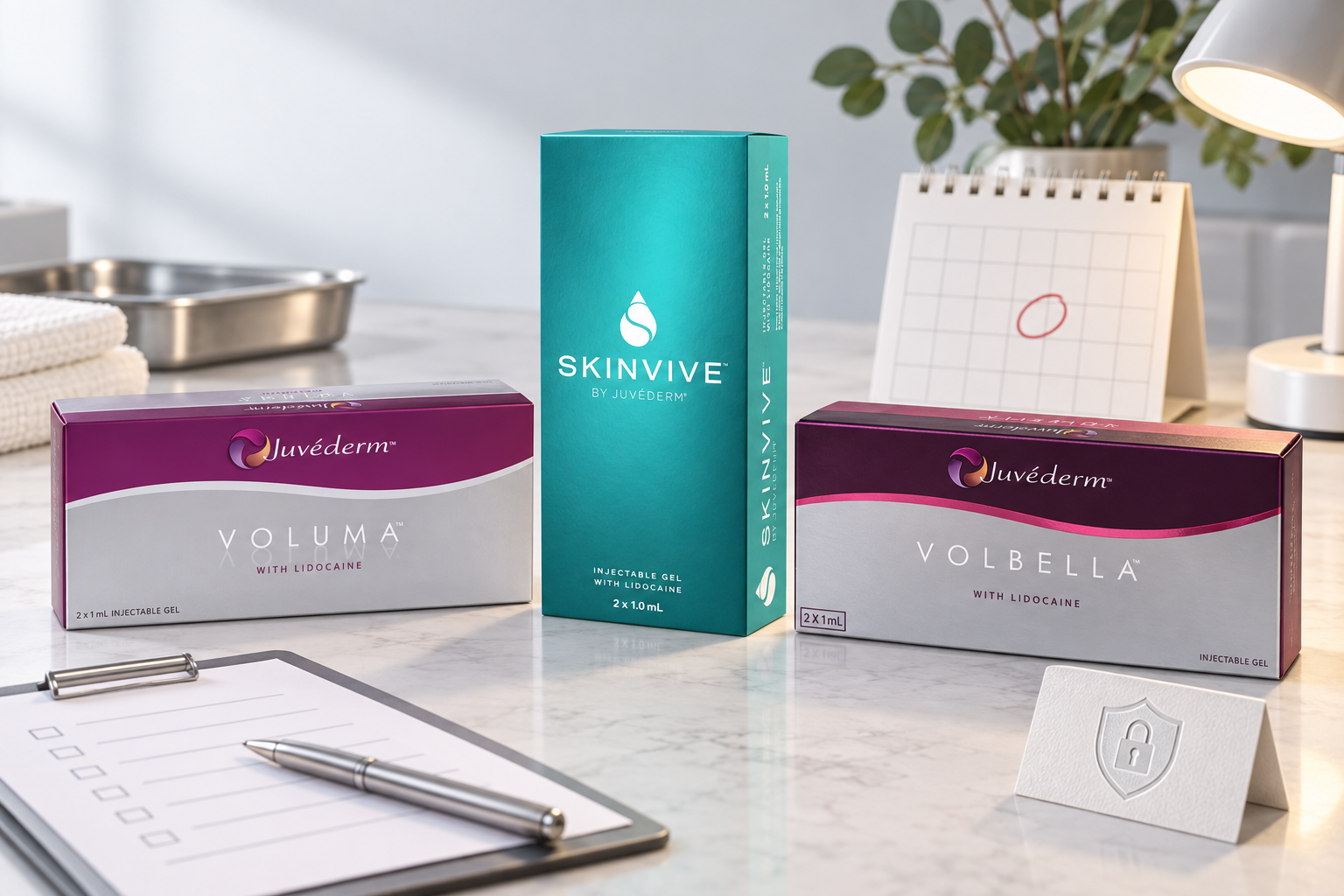
Professional buyers replacing stock can review current records for Juvederm Skinvive, Juvederm Voluma with Lidocaine and Juvederm Volbella with Lidocaine. Availability does not establish suitability or approval in every market; confirm the exact SKU, local eligibility and documentation before ordering.
Final recommendation
Use Juvederm only when the exact unit is in date, matches the applicable product instructions, has intact packaging, has an acceptable storage record and passes every appearance check. Quarantine and replace any questionable unit rather than trying to extend or rescue it.
Professional buyers who need to replace a rejected unit can compare current in-stock Juvederm product records, then verify the exact SKU, expiry, local eligibility and supply documentation before ordering.
Frequently asked questions
Does Juvederm have an expiration date?
Yes. Official Juvederm instructions say the product must be used before the expiration date printed on its label or package.
Can unopened Juvederm be used shortly after it expires?
No. An intact seal does not extend the manufacturer’s shelf life. Quarantine the expired unit and replace it.
Does refrigeration extend Juvederm’s expiration date?
No. Follow the exact product’s storage instructions, but correct storage never changes or extends the printed expiry date.
Can Juvederm be used if the box is damaged?
No. Official directions say not to use the product if the packaging is opened or damaged, even when the printed expiry has not passed.
Is clear-looking gel proof that expired Juvederm is safe?
No. Appearance is only one check. A product that has passed its printed expiry must not be used even if it still looks normal.
What should a clinic do with a questionable Juvederm unit?
Quarantine it, document the product, lot, expiry and issue, contact the supplier, and replace any unit that cannot be confirmed acceptable under its exact instructions.
Sources
Evidence checked on September 9, 2026: Allergan Juvederm Ultra directions for use; Allergan Australia Juvederm Ultra XC directions for use; FillersFairy Store API for current in-stock product records. The exact SKU’s current instructions and local requirements always control.