Quick Answer
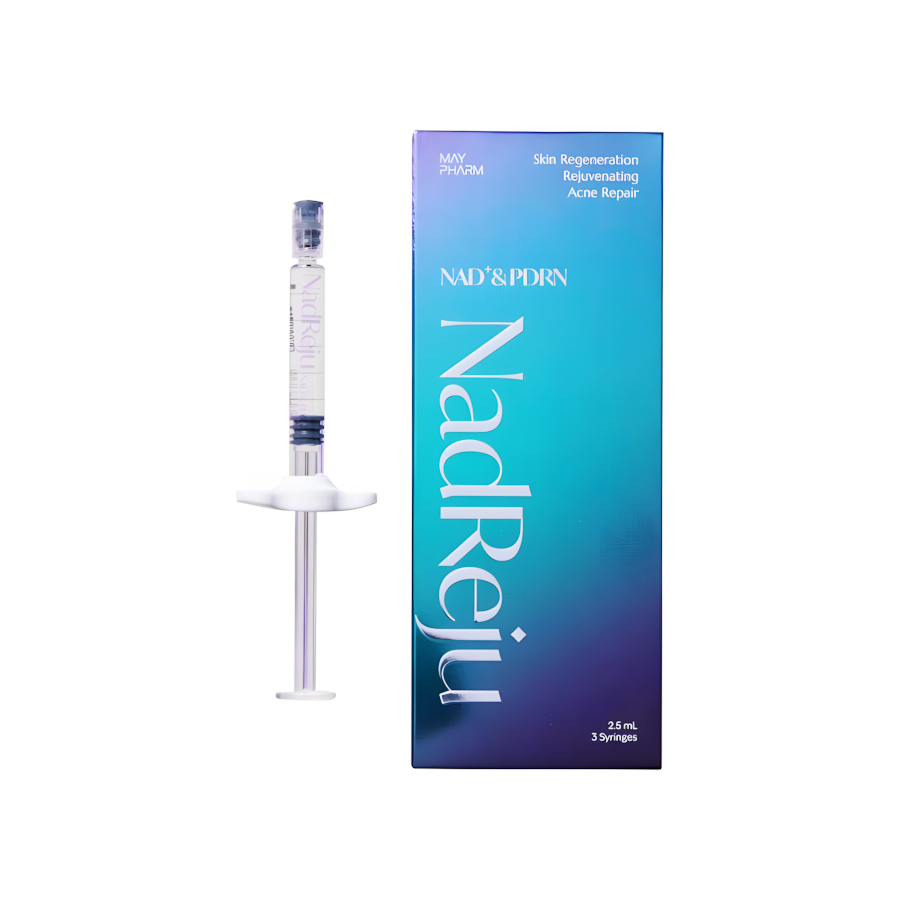
NadReju is a dual-active formulation combining ≥98% pure NAD+ with salmon-derived PDRN, supplied as 3 × 2.5 mL vials. Korean patent No. 10-2025-0100043 covers the enzymatic stabilization process. The protocol uses ultrafine 33–34G needles for precise 0.01–0.05 mL deposits at 1 cm spacing. NAD+ provides cellular energy; PDRN provides fibroblast activation signal. Standard course is 3–4 sessions at 3–4 week intervals.
Why This Skinbooster Is Different
NadReju pairs the two most evidence-supported regenerative actives — NAD+ (cellular energy currency) and PDRN (fibroblast receptor signalling) — in a focused dual formulation. The high purity (≥98% NAD+) and patented enzymatic stabilization (Patent 10-2025-0100043) differentiate it from less-defined NAD+/PDRN combinations. Recommended ultrafine 33–34G needle technique is optimized for areas where minimal trauma matters (periocular, hands).
Mechanism of Action
NAD+/PDRN dual formulation (cellular energy + DNA repair). NAD+ is a coenzyme required for ATP production, DNA repair (PARP), and sirtuin pathway regulation. Skin NAD+ declines with age. Intradermal NAD+/NMN delivery replenishes the cellular currency that downstream regenerative pathways (collagen synthesis, fibroblast migration) depend on. The mechanism is upstream — supporting, not replacing, other regenerative actives.
Frequently Asked Questions
What does Patent 10-2025-0100043 cover?
The Korean patent (No. 10-2025-0100043) covers the enzymatic stabilization technology used in NadReju to maintain NAD+ stability over the product's shelf life. NAD+ is intrinsically unstable in solution — the stabilization technology is what makes the dual NAD+/PDRN formulation commercially viable.
Why ≥98% NAD+ purity specifically?
≥98% purity is the threshold considered pharmaceutical-grade for NAD+ in injectable use. Lower-purity material contains nicotinamide and other degradation byproducts that contribute to side effects (flushing, headache) without contributing to NAD+ availability. The ≥98% specification minimizes degradation byproduct burden.
How does it differ from AMI NAD+?
Both contain NAD+ and PDRN. AMI NAD+ adds NMN, niacinamide, and adenosine — broader multi-active. NadReju is the focused dual — only the two best-evidenced actives in a higher-purity, patent-stabilized formulation. Selection depends on whether comprehensive cocktail or focused dual fits the patient profile.
Why is 33–34G needle recommended?
33G–34G is the ultrafine range, used where minimal injection trauma matters most: periorbital, dorsum of hands, knees, elbows. The narrower bore reduces bruising and discomfort but requires careful technique because of the slow flow rate. Practitioners with steady-hand technique can use 30G for larger fields if preferred.
Are knees, elbows, and hands appropriate treatment areas?
Yes — these are explicitly listed indications. Hand, knee, and elbow skin shows pronounced photoaging, thinning, and pigmentation in many patients. The NAD+/PDRN dual is well suited to these areas because of the regenerative (not volumising) action. Treatment volume scales to the area treated.
Why such small per-point volume (0.01–0.05 mL)?
Smaller per-point volume serves two purposes: (1) it limits intradermal pressure and minimises papular distension at each point, important for areas with thin overlying skin (eyelid, neck), and (2) it allows the practitioner to spread the 2.5 mL across a larger number of points for more uniform field coverage. Up to 50–60 points per 2.5 mL vial.
How quickly does it work?
Visible skin quality improvement is typically reported from week 4 after the first session. Full cumulative benefit appears 8–12 weeks after the third session. The NAD+ component delivers any 'instant glow' some patients report 24–72 hours post-treatment (likely barrier and hydration related).
Are there contraindications?
Standard injectable contraindications: pregnancy and lactation (precautionary), active infection at the treatment site, severe coagulopathy, hypersensitivity to any component. Active malignancy or current chemotherapy: evaluate case-by-case given the metabolic activity of NAD+.
Can it be combined with HA fillers or botulinum toxin?
Yes. Sequential injection at different anatomical levels is the standard approach. NadReju mesotherapy first (superficial dermis), then botulinum toxin (intramuscular) and HA filler (deep) in the appropriate planes. Single-session combination is widely practiced.
Does it require cold-chain shipping?
Yes. NAD+ and PDRN are both temperature-sensitive — 2–8 °C refrigerated transit and storage. Single-use only; discard any unused portion after opening the vial. The patented enzymatic stabilization extends usability but does not eliminate cold-chain requirements.




Emma Watson –
After turning 35, my skin started losing collagen fast, and regular skincare just wasn’t cutting it for my smile lines and fine wrinkles. A friend recommended this upgraded booster with NAD+ and PDRN. I’ve finished the first syringe, and I can say it offers much better structural support and tightening for mature skin than the older Chanel injections I used to get. The texture is spot on—not too thick to cause persistent lumps, yet rich enough to yield results. The fine lines around my eyes have faded significantly, and my face feels firmer and subtly lifted.