Quick answer
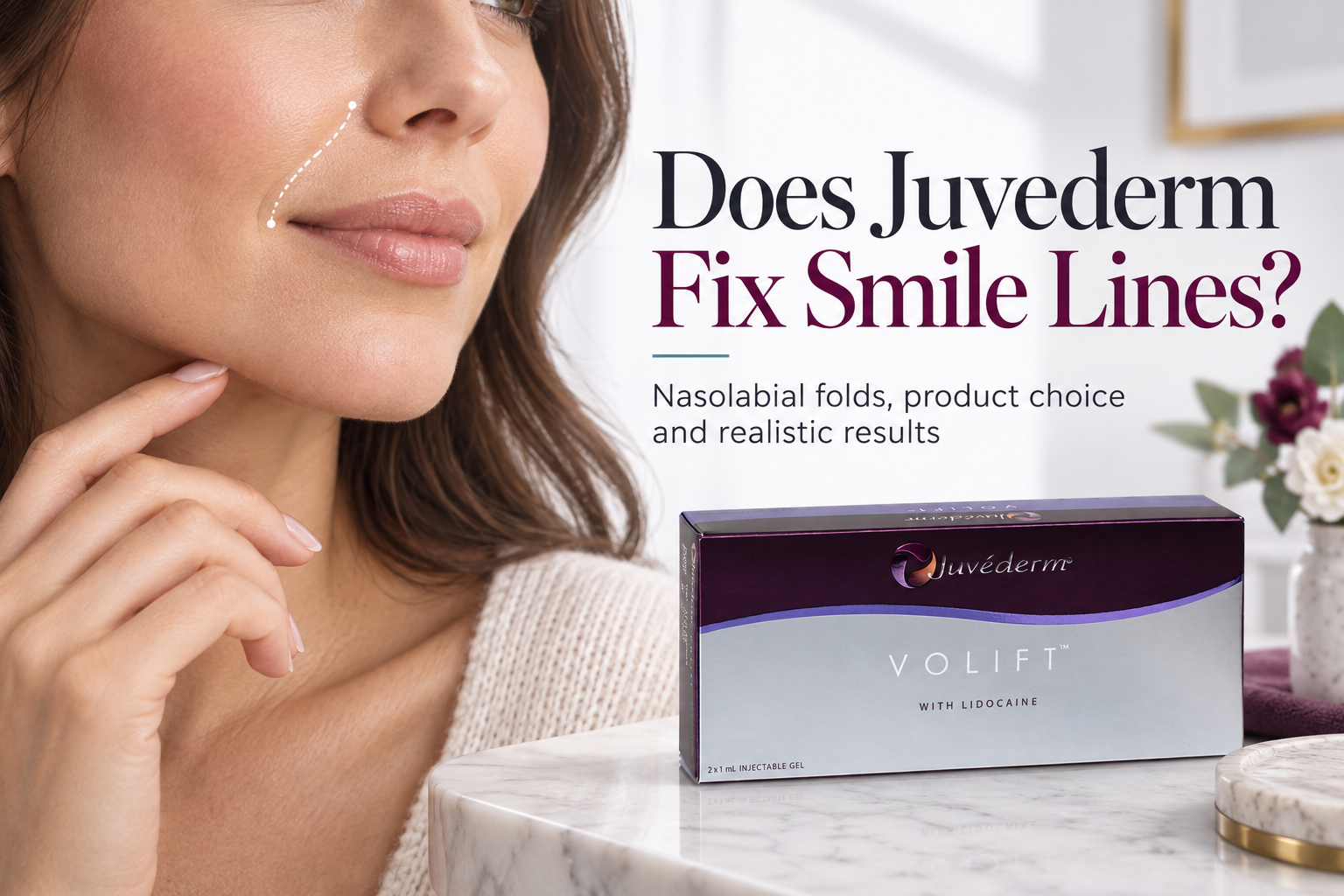
Yes, selected Juvederm hyaluronic-acid fillers can temporarily soften true nasolabial folds, the creases running from the sides of the nose toward the corners of the mouth. VOLIFT, known through the same VYC-17.5L product family as VOLLURE in the United States, has direct evidence for moderate-to-severe folds. The realistic goal is usually a softer crease and shadow, not a completely flat face.
But “smile lines” can also mean fine lip lines, marionette lines or creases visible only during expression. Those are different concerns. Juvederm is a family of products, so the right question is not simply “Does Juvederm work?” It is “Which line am I treating, what is causing it, and which Juvederm role matches that problem?”
First, what do you mean by “smile lines”?
People use the phrase loosely. That matters because a product supported for one type of line should not be presented as the answer to every crease around the mouth. Before comparing Juvederm products, identify what is visible when the face is relaxed and what appears only when you smile.
| What you see | Where it appears | What it usually means for the Juvederm decision |
|---|---|---|
| Nasolabial fold | From the side of the nose toward the corner of the mouth | This is the classic fold with direct VYC-17.5L evidence and the main focus of this article. |
| Fine lip or perioral lines | On or immediately around the lips | These belong to a lip and perioral discussion, where products such as VOLBELLA or Ultra Smile may enter the shortlist. |
| Marionette lines | From the mouth corners downward toward the chin | This is a different lower-face pattern and should not be renamed a nasolabial fold to justify the same product route. |
| Movement-only crease | Visible mainly or only during smiling | A normal expression line is not automatically a volume deficit, and filler may not be the whole answer. |
A true nasolabial fold is normal anatomy. It can look deeper as cheek support changes, facial tissue descends, skin quality changes or a naturally strong fold casts more shadow. That is why two people with a similar-looking line may need different assessments.
How Juvederm can soften a true nasolabial fold
Juvederm fillers use hyaluronic-acid gel to add volume and support in selected facial tissues. For a true nasolabial fold, an appropriate product can reduce the depth or shadow of the crease so it looks less prominent at rest. That is an improvement, but it is not the same as deleting the fold.
VYC-17.5L has randomized clinical evidence for moderate-to-severe nasolabial folds. In the United States it is labeled as JUVEDERM VOLLURE XC; published literature also identifies the product family as JUVEDERM VOLIFT with Lidocaine outside the US. The name and authorized claims can vary by market, so the exact local product record still matters.
A good endpoint is a softer transition, not a frozen or perfectly flat lower face. Nasolabial folds help define normal facial movement. Chasing total erasure can create more fullness than the face needs and may still fail to address the reason the fold looks deep.
Which Juvederm product fits the concern?
The old version of this page treated product choice as a simple severity ladder. That is not how the decision should be made. Different Juvederm products have different roles, and depth alone does not turn VOLUMA into the automatic answer for a deep fold.
| Concern | Product role to investigate | What not to assume |
|---|---|---|
| Moderate-to-severe nasolabial fold | VOLIFT / VOLLURE family: direct evidence for temporary correction of this fold. | Do not expect permanent removal or a universal amount for every face. |
| Midface or cheek deflation contributing to the fold | VOLUMA: a structural-volume product that may enter a broader midface plan. | Cheek filler does not automatically improve every nasolabial fold, and it is not a guaranteed substitute for direct fold correction. |
| Fine vertical lip lines or subtle lip-volume concerns | VOLBELLA or Ultra Smile: products associated with lip and perioral roles. | These concerns are not the same as a nose-to-mouth nasolabial fold. |
For a genuine nasolabial-fold question, the most relevant FillersFairy product record is Juvederm VOLIFT with Lidocaine. The product page can confirm current presentation and availability; it cannot decide personal suitability. That remains a licensed provider’s job.
Direct fold correction or cheek support?
This is the decision readers repeatedly struggle with. Some folds are driven mainly by the local crease. Others look stronger because the upper cheek has lost support. Many faces show both. A provider should therefore assess the fold and the midface together instead of applying one rule to everyone.
The practical takeaway is simple: cheek filler should not be sold as a universal workaround for smile lines, and direct fold filling should not ignore the face above it. The general nasolabial-fold guide covers the wider area-based decision; this page stays focused on Juvederm.
What a natural result should look like
A natural result is visible when the face is relaxed but still looks like the same face in motion. The fold should appear softer, the lower face should not look newly heavy, and the smile should not look constrained by an attempt to eliminate every trace of a crease.
Overfilling anxiety is not irrational. It is a reason to set a realistic endpoint before treatment. Ask what change is expected in a neutral expression, which part of the fold is likely to respond, and whether cheek support is being proposed because the midface actually contributes or simply because another product is available.
It also helps to compare like with like. Evaluate the face under similar lighting, head position and expression. A dramatic smiling photo beside a relaxed after-photo can exaggerate improvement, while early swelling can make the first result look fuller than the settled outcome.
When will it look settled, and how long can it last?
An immediate change may be visible because the gel adds volume as soon as it is placed, but early swelling, tenderness or bruising can distort the first impression. The result should be judged after the initial reaction has settled according to the treating provider’s review plan, not from a same-day mirror check alone.
FDA patient labeling for VOLLURE XC reports results lasting up to 18 months at the treatment site, and 59 percent of study subjects were still responders at 18 months. “Up to” is the important phrase. Duration varies with anatomy, product, treatment plan, movement and individual response. It is not a promise that every fold will remain equally improved for 18 months.
If a result looks underwhelming, the explanation is not automatically that more product is needed. The original concern may have been misidentified, cheek support may be part of the problem, swelling may not have settled, or the expected endpoint may have been complete erasure rather than realistic softening.
When Juvederm is unlikely to be the whole answer
Juvederm may not solve the entire concern when the line appears only with expression, when skin laxity is the main issue, when a lower-face crease has been mistaken for a nasolabial fold, or when the desired change would require flattening normal anatomy. In those cases, changing from one Juvederm name to another does not fix the diagnosis.
Temporary reactions such as swelling, tenderness, bruising, redness, firmness or lumps can occur. Injectable fillers also carry rare but serious risks, including accidental placement into a blood vessel. Suitability, contraindications and urgent warning signs should be discussed with a licensed professional using the instructions for the exact product and market. The broader dermal filler safety guide covers this in more depth.
Practical recommendation
If your concern is a true nose-to-mouth nasolabial fold, investigate Juvederm VOLIFT or the locally authorized VYC-17.5L product and aim for visible softening with natural movement. If the concern is cheek deflation, lip lines, marionette lines or a crease that appears only when smiling, do not assume the same product or plan applies.
Readers who are also comparing brands should use the separate Restylane versus Juvederm guide. If the discussion is specifically about restoring cheek structure, the Juvederm VOLUMA guide keeps that decision separate from direct nasolabial-fold correction.
Review the current Juvederm VOLIFT product record, then confirm that the concern is a true nasolabial fold and that the selected product is authorized and appropriate in the destination market before ordering.
Frequently asked questions
Does Juvederm remove smile lines completely?
Usually, the realistic goal is to soften a true nasolabial fold rather than erase it completely. A fold that still moves naturally can look more balanced than a lower face made too full in pursuit of perfect flatness.
Which Juvederm is used for nasolabial folds?
VYC-17.5L has direct evidence for moderate-to-severe nasolabial folds. It is known as JUVEDERM VOLLURE XC in the United States and is also identified in published literature as JUVEDERM VOLIFT with Lidocaine outside the US. Local names and authorizations should be checked.
Is VOLUMA or VOLIFT better for smile lines?
VOLIFT has the more direct role for a true nasolabial fold. VOLUMA addresses structural midface volume and may be relevant when cheek deflation contributes, but cheek filler is not a guaranteed fix for every fold.
How soon can I see the result?
An early change may be visible immediately, but swelling and bruising can affect the first impression. Judge the settled result according to the treating provider’s review plan rather than relying only on the same day.
How long can Juvederm last in smile lines?
FDA labeling for VOLLURE XC reports results lasting up to 18 months at the treatment site, with 59 percent of study subjects still classified as responders at 18 months. Individual duration varies, so this is not a personal guarantee.
Why can Juvederm look unnatural around smile lines?
An unnatural result can come from trying to erase normal anatomy, adding more lower-face volume than the face needs, or treating the fold without assessing the midface and facial movement. Product choice and the endpoint both matter.
Sources and evidence limits
Evidence checked September 17, 2026: FDA JUVEDERM VOLLURE XC patient labeling; the randomized six-month VYC-17.5L nasolabial-fold study; the 18-month follow-up study; a peer-reviewed description of VYC-17.5L as Juvederm VOLIFT with Lidocaine; and the Cleveland Clinic nasolabial-fold overview. Current social discussions were used only to identify customer questions about overfilling, cheek support and underwhelming results, not as clinical evidence. Product names, indications and legal availability vary by market.