Quick answer: how often should you do AMI Eyes?
AETHERMED currently recommends an initial course of three AMI Eyes sessions spaced two to four weeks apart, followed by maintenance every four to six months depending on skin condition and lifestyle. Treat that as a manufacturer-published starting framework, not a personal prescription: a trained medical professional should confirm suitability before the first session and reassess recovery, concerns and response before repeating or planning maintenance.
Doing sessions closer together is not a shortcut to better or faster results. The next appointment should be based on how the under-eye area has recovered and whether the original concern still matches what AMI Eyes is designed to address.
Why AMI Eyes is usually planned as a course
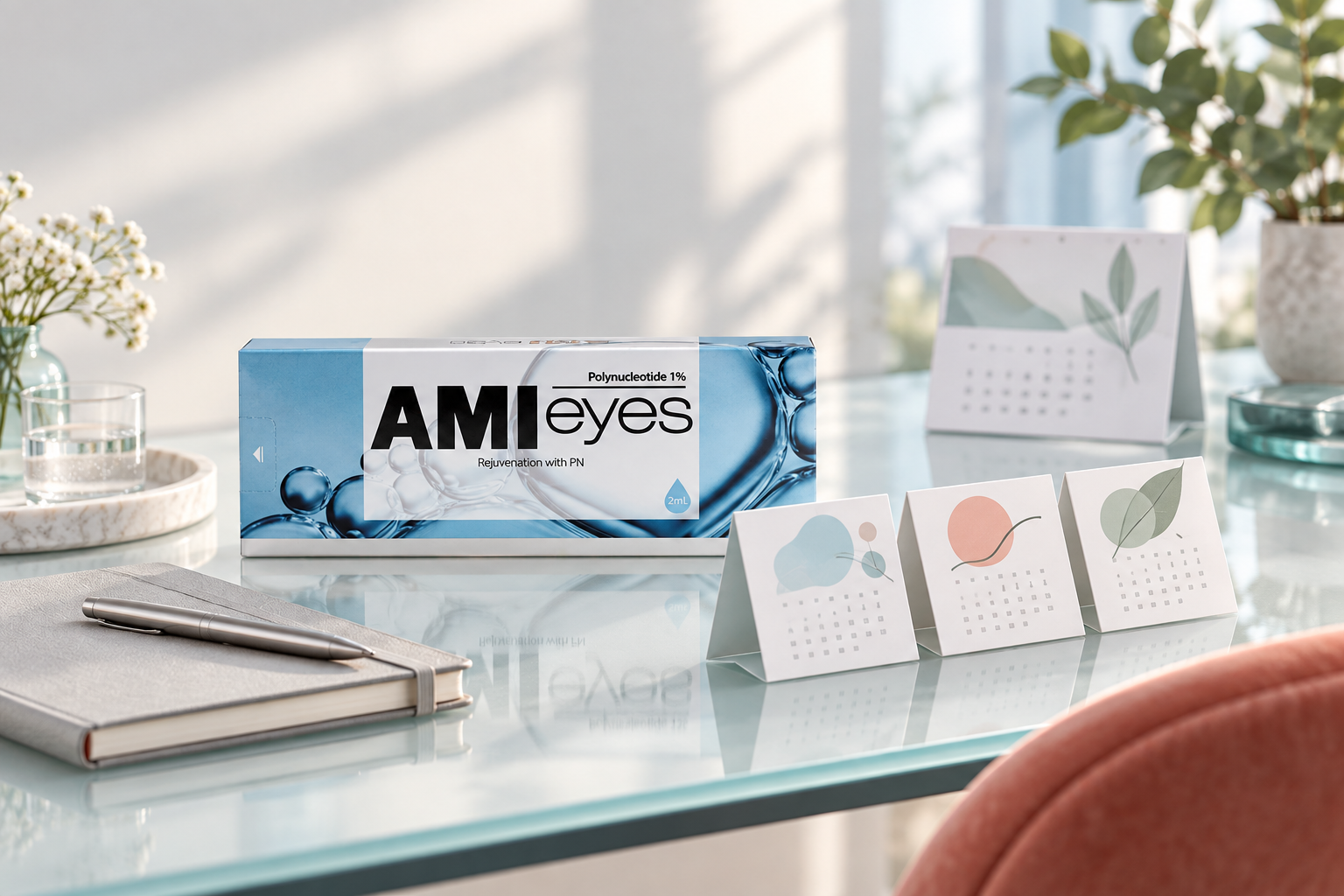
AMI Eyes is presented by AETHERMED as a PN-based product for the under-eye area and for use by trained medical professionals. The manufacturer describes an initial series rather than a one-off promise, which matters because the decision is about a staged treatment plan, not an instant volume correction.
Peer-reviewed periorbital PN research also commonly evaluates treatment as a course. One randomized study compared an unnamed PN filler with non-crosslinked HA over three sessions at two-week intervals. That supports the broader logic of staged PN treatment, but it did not test AMI Eyes and cannot prove an AMI Eyes-specific result, maintenance interval or superiority claim.
This is why the basic course can be stated while the expected outcome still needs careful boundaries. The manufacturer schedule answers “how often”; it does not guarantee what one person will see or exactly when they will see it.
The manufacturer-published starting schedule
| Planning phase | Current AETHERMED framework | What the professional still decides |
|---|---|---|
| Before starting | No automatic first session | Whether the under-eye concern, medical history and local requirements make AMI Eyes appropriate to investigate. |
| Initial course | Three sessions spaced two to four weeks apart | Whether recovery and current findings support proceeding with the next planned session. |
| Maintenance | Every four to six months depending on skin condition and lifestyle | Whether maintenance is needed, should be delayed or should be replaced by a different plan. |
The ranges are important. AETHERMED does not publish one mandatory day that fits every patient. Even within the basic framework, skin condition and lifestyle affect maintenance, and the treating professional must also consider recovery, satisfaction, current goals and any new concern.
Why closer spacing is not a shortcut
Social discussions often suggest weekly treatment, compressed courses or repeating a session simply because the first did not produce an obvious change. Those anecdotes are not a safe basis for changing the manufacturer framework. A shorter interval does not establish that the under-eye area has recovered or that more product is appropriate.
Before another session, the professional should check whether temporary swelling, bruising, tenderness or small surface changes have settled and whether anything unexpected needs attention. If recovery is incomplete or symptoms are worsening, the answer is not to stay on a calendar at all costs; it is to contact the treating professional and reassess.
Do not accelerate the course yourself. The two-to-four-week spacing is already a range. The treating professional should decide where within that range the next review belongs.
What can change the maintenance interval
The published four-to-six-month maintenance range is not a subscription that every customer must follow. AETHERMED itself qualifies the range by skin condition and lifestyle. In practice, a responsible review also considers whether the original concern improved, whether the result still looks acceptable, whether the treatment was tolerated and whether the patient’s priorities have changed.
- Current under-eye condition: the concern may no longer require the same plan.
- Observed response: little visible change is a reason to reassess the diagnosis and product choice, not automatically to repeat more often.
- Recovery history: prolonged or unexpected reactions can change or stop the plan.
- Lifestyle and timing: the manufacturer specifically includes lifestyle as a maintenance factor.
- Other treatments: the professional needs a complete and current treatment history before coordinating another session.
Maintenance should therefore be an active decision after review, not an appointment booked indefinitely from the first visit.
What should be reviewed before another session
A useful follow-up compares the current under-eye area with the original baseline under similar lighting, asks what has and has not changed, and records any recovery issue. It should also revisit the original goal. Dark appearance, fine surface texture, puffiness and structural hollowing can have different causes, so the fact that they all occur around the eyes does not make one schedule or product suitable for all of them.
Readers comparing products can use the broader Korean under-eye skin booster guide. Those choosing between two named products can review the separate AMI Eyes versus Lumi Eyes comparison. Neither comparison replaces the reassessment before another session.
If the main concern is an adverse reaction rather than timing, use the AMI Eyes side-effects guide and contact the treating professional. A planned course should never be used to normalize a symptom that needs review.
Treatment frequency is not the results timeline
A treatment schedule answers when sessions are generally planned. A results timeline answers when changes may begin, develop or settle. Combining the two creates a misleading promise that a particular session number must produce a particular visible result.
AMI Eyes marketing material describes initial improvement within several weeks, but that first-party statement is not a guarantee. Current PN literature also varies by product, method and outcome measure. The separate results-timeline page should therefore own those questions after it is rewritten, while this page stays focused on the basic course and the decision to repeat.
How to use the product record responsibly
The current AMI Eyes product record provides a traceable product and current stock path for qualified buyers. It does not authorize self-treatment or prove that the manufacturer schedule is right for a particular person.
Before ordering, verify the exact product, sealed presentation, lot and expiry records, storage and shipping requirements, local eligibility and the clinician-owned treatment plan. If the buyer cannot connect the product to a qualified professional assessment, a written schedule alone is not enough to justify the purchase.
Final recommendation
Use AETHERMED’s current framework—three initial sessions spaced two to four weeks apart and maintenance every four to six months—as a starting point only. A trained medical professional should reassess recovery, response, goals and concerns before every repeat or maintenance decision.
Qualified professional buyers can review the current AMI Eyes product record, then confirm traceability, local eligibility and the individualized treatment schedule before ordering.
Frequently asked questions
How many AMI Eyes sessions are in the basic course?
AETHERMED currently recommends an initial course of three sessions. A trained medical professional should confirm suitability and reassess before each repeat.
How far apart should AMI Eyes sessions be?
The current manufacturer framework spaces the initial sessions two to four weeks apart. The professional should choose the timing within that range after reviewing recovery and current condition.
How often is AMI Eyes maintenance recommended?
AETHERMED describes maintenance every four to six months depending on skin condition and lifestyle. It is a general range, not a mandatory personal schedule.
Is one AMI Eyes session enough?
The manufacturer presents AMI Eyes as a three-session initial course rather than a one-session plan. That does not mean everyone should automatically complete or repeat treatment without reassessment.
Can I do AMI Eyes sooner if I do not see a result?
Do not shorten the interval yourself. A lack of obvious change is a reason for the treating professional to reassess the concern, response and product choice before another session.
Can AMI Eyes be self-administered on this schedule?
No. AETHERMED identifies AMI Eyes for trained medical professionals. A published basic course does not provide injection instructions or establish that self-treatment is appropriate.
Sources
Evidence checked on September 10, 2026: AETHERMED’s current AMI EYES record for product identity and the basic course; a randomized periorbital PN-versus-HA study for category-level course context; a 2026 systematic review for evidence limitations; FillersFairy Store API for the current product and stock record. Social discussions were used only to identify conflicting customer questions.