Reviewed against publicly available manufacturer and regulatory information.
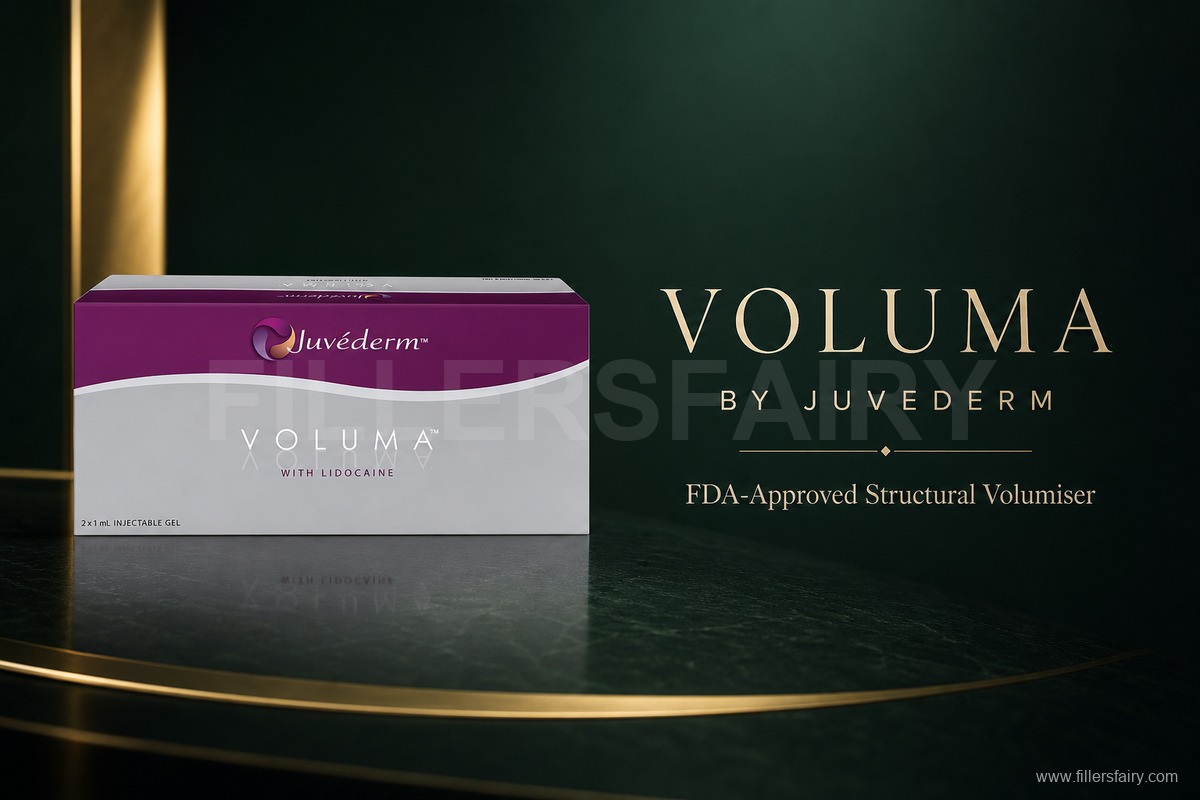
Within the Juvéderm collection, Voluma occupies a specific role: it is the product reached for when the goal is structural support rather than softening a line or improving skin quality. This guide explains what Voluma is, which areas it is approved for, how long results are reported to last, and how clinics position it — as an educational overview rather than an injection-technique tutorial.
What Is JUVÉDERM VOLUMA?
Voluma is a hyaluronic acid dermal filler manufactured by Allergan Aesthetics, an AbbVie company. It is part of the Juvéderm collection and is built on VYCROSS technology, which blends different molecular weights of hyaluronic acid. It contains lidocaine to reduce discomfort during injection.
The product supplied through FillersFairy is JUVÉDERM VOLUMA with Lidocaine, presented as 2 x 1 mL syringes.
Which Areas Is Voluma Approved For?
Voluma holds FDA approval for three distinct areas in adults over 21:
| Area | Approved purpose | Manufacturer-reported duration |
|---|---|---|
| Cheek | Deep injection to correct age-related volume loss | Up to 2 years with optimal treatment |
| Chin | Augmentation to improve the chin profile | Up to 1 year with optimal treatment |
| Temple | Augmentation for moderate-to-severe temple hollowing | Per manufacturer labelling |
The duration difference between areas is worth noting: a single product does not behave identically everywhere. Movement, tissue characteristics, and the amount placed all influence how long a result is maintained, which is why the manufacturer reports different figures for cheek and chin.
Regulatory status varies by market. The approvals above describe the US position; authorisation, approved indications, and labelling differ by country. Buyers should verify the exact SKU, its local authorisation, and the current instructions for use.
What Role Does Voluma Play?
Voluma is a structural volumiser. Where a soft HA is chosen for delicate areas and a mid-robust product for folds, Voluma is positioned for deep placement where projection and support are the goal — restoring mid-face volume, improving chin profile, or filling temple hollowing.
It is not a skin-quality product. Patients whose concern is texture, hydration, or radiance rather than volume are candidates for a different category — a skin booster such as SKINVIVE or a polynucleotide/PDRN option — not a volumiser. Matching category to concern is what keeps results natural.
Voluma vs Volux: Two Structural Products, Different Regions
Voluma is often confused with JUVÉDERM VOLUX, and understandably so: both are built on VYCROSS technology and both are structural products placed deep. The difference is the region and the job they are documented for.
| Aspect | VOLUMA | VOLUX |
|---|---|---|
| Technology | VYCROSS | VYCROSS |
| Role | Structural volume | Structural definition |
| Documented region | Cheek, chin, temple | Jawline definition |
| Typical goal | Restore mid-face volume, chin profile, temple hollowing | Sharpen and define the jawline contour |
In short: both are structural, but Voluma is documented for volume in the cheek, chin, and temple, while Volux is documented for jawline definition. They are not interchangeable, and approved indications differ by market — verify the SKU and its local authorisation before use. For the full picture on the jawline product, see our JUVÉDERM VOLUX guide.
Safety Considerations
Voluma is placed deep, in areas that contain significant vasculature. As with any injectable filler:
- Although uncommon, inadvertent intravascular injection can cause tissue ischemia or necrosis and, in severe cases, visual impairment. Treatment should only be performed by qualified practitioners with detailed anatomical knowledge and an established complication-response protocol.
- HA filler can often be enzymatically degraded with hyaluronidase, although this does not make injection risk-free or guarantee complete reversal of every complication.
- The manufacturer reports that the most common effects in chin augmentation were temporary treatment-site reactions: tenderness, firmness, swelling, pain, lumps or bumps, redness, itching, and discoloration.
Injection plane and technique are anatomy- and product-dependent and are determined by the treating practitioner in line with the product’s instructions for use. This guide does not describe entry points, depths, or dosing.
Why Clinics Stock a Structural Volumiser
A clinic offering facial contouring needs at least one product documented for deep, structural placement — a soft or mid-robust HA cannot substitute for it, and using the wrong rheology in a projection area tends to produce a flat or short-lived result.
Clinics typically position a structural volumiser for patients who:
- ✓ present with mid-face volume loss rather than a specific line
- ✓ want chin profile improvement without surgery
- ✓ show temple hollowing that makes the upper face look drawn
- ✓ need support so that adjacent concerns (such as folds) soften indirectly
Before adding any structural SKU, it is worth verifying its documented indication and recommended plane, its rheology, the pack format, area-specific duration evidence, and its regulatory status in the destination market — rather than treating “firm filler” as one interchangeable category.
Frequently Asked Questions
How long does Juvéderm Voluma last?
It depends on the treated area. The manufacturer reports results lasting up to two years in the cheeks and up to one year in the chin, with optimal treatment. Individual duration varies with the amount placed, tissue characteristics, movement in the area, and metabolism, so these figures are manufacturer-reported guides rather than guarantees.
Is Voluma the same as a cheek filler?
Voluma is commonly associated with cheek augmentation — it is the area it is best known for — but that is not its only documented use. Its FDA-approved indications also include augmentation of the chin region to improve the chin profile and augmentation of the temple region for moderate-to-severe hollowing. So “cheek filler” describes one of its approved areas rather than the product as a whole.
Is Voluma FDA approved for the chin?
Yes. JUVÉDERM VOLUMA is FDA-approved for augmentation of the chin region to improve the chin profile in adults over 21, alongside its cheek and temple indications. Approved indications and pack format differ by market — for the SKU we supply, see the JUVÉDERM VOLUMA with Lidocaine product page.
What is the difference between Voluma and other Juvéderm fillers?
Voluma is a structural volumiser built on VYCROSS technology and placed deep where projection and support are needed. Other products in the collection are designed for different roles — softer formulations for fine or delicate areas, and skin-quality products such as SKINVIVE that improve smoothness rather than volume. They are not interchangeable; the right choice depends on whether the goal is volume, line softening, or skin quality.
Can Voluma be used for the cheeks and chin in the same patient?
It holds FDA approval for cheek, chin, and temple, so a practitioner may treat more than one area where clinically appropriate. Whether to do so, in what order, and with how much product is an individual clinical decision based on assessment and the product’s instructions for use — not a standard package.
How should a clinic decide between a structural volumiser and a mid-robust filler?
Decide by treatment role rather than by a general firmness label. A structural volumiser is documented for deep placement where projection and support are the goal; a mid-robust product is documented for softening folds. Check each SKU’s approved indication, recommended implantation plane, rheology, area-specific duration evidence, and local regulatory status before stocking — the two roles are not interchangeable.
Related Guides
- JUVÉDERM VOLUX Guide — Choosing a Structural HA Filler: Voluma vs Volux
- JUVÉDERM VOLUX with Lidocaine — the jawline-definition structural option
- Juvéderm Filler Collection
- Dermal Filler Category — browse the full range
- Nasolabial Fold (Smile Line) Filler Guide
- SKINVIVE by Juvéderm — skin-quality option