During my Juvelook Blue injection at a Gangnam dermatology clinic in Seoul, I asked the clinic director for a copy of the product spec sheet. Juvelook Blue delivers PDLLA at 42.5mg, while AestheFill V200 contains PDLLA at 154mg — both spanning a particle diameter range of 10–60μm. After reviewing the documentation, I compiled every key data point into a side-by-side comparison.
Mechanism of Action
What Is PDLLA
PDLLA (poly-D,L-lactic acid) microspheres typically range from 10–60μm in diameter, making it the most biocompatible isomer in the PLA family, fully decomposing in the human body into water and carbon dioxide.
Before my injection, I touched the lyophilized powder — it felt like fine table salt with a slight gritty texture between my fingertips. When PDLLA microspheres are injected into the dermal layer, the immune system recognizes them as foreign bodies, triggering a mild inflammatory response that activates fibroblasts to proliferate and secrete large quantities of collagen.
Yonsei University Dermatology’s 2022 clinical paper documented the process: Type I collagen upregulation began measurably at week 4 post-injection and peaked at week 12, establishing a “degrade-while-regenerating” positive feedback loop.
PDLLA microsphere volume increase occurs in two phases: the initial phase involves the microsphere body occupying space (approximately weeks 1–2), while the intermediate phase involves cell infiltration and new tissue replacing microsphere volume (approximately weeks 4–12).
PDLLA Dosage in Juvelook
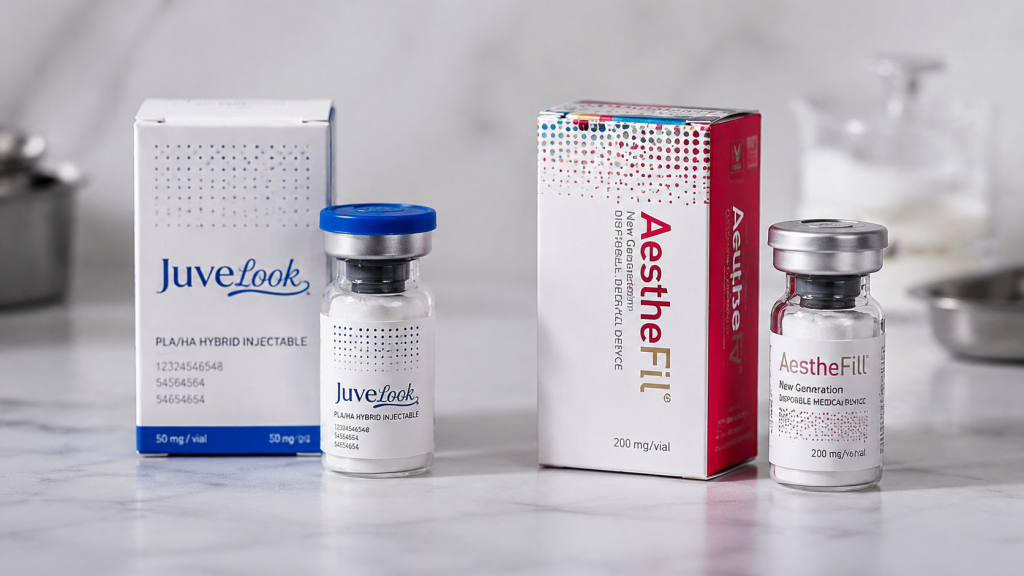
Juvelook Blue delivers a total dose of 50mg per, containing PDLLA microspheres at 42.5mg plus 7.5mg of non-crosslinked hyaluronic acid, with PDLLA particle diameter at 10–40μm and HA molecular weight approximately 3000kDa.
While the numbing cream was applied, I counted — the nurse mixed 5ml saline with a small amount of lidocaine and shook the for approximately 30 seconds until fully dissolved. The Black bottle delivers a total dose of 200mg per, containing approximately 170mg of PDLLA microspheres plus approximately 30mg of non-crosslinked HA, formulated for deep contouring.
| Formulation | PDLLA Content | Carrier | PDLLA Particle Size | Injection Depth |
|---|---|---|---|---|
| Blue | 42.5mg/ | Non-crosslinked HA 7.5mg | 10–40μm | Superficial to mid-dermis |
| Black | 170mg/ | Non-crosslinked HA 30mg | Higher concentration | Mid-dermis to subcutaneous |
The Black formulation’s high PDLLA concentration is designed for areas requiring strong structural support, establishing a scaffold that induces Type III collagen fiber proliferation and restores facial fullness.
PDLLA Dosage in AestheFill
AestheFill V200 delivers a total dose of 200mg per, of which PDLLA microspheres account for approximately 154mg and carboxymethyl cellulose sodium (CMC-Na) approximately 46mg. The V100 delivers 100mg total per, with approximately 77mg PDLLA and approximately 23mg CMC-Na.
AestheFill’s PDLLA particle diameter is approximately 40–60μm, larger than Juvelook Blue’s 10–40μm range. When I first saw the CMC solution, I mistook it for saline — the nurse explained that the invisible PDLLA microspheres were suspended within the milky-white liquid.
| Formulation | PDLLA Content | Carrier | PDLLA Particle Size | Injection Depth |
|---|---|---|---|---|
| V100 | 77mg/ | CMC-Na 23mg | 40–60μm | Mid-dermis |
| V200 | 154mg/ | CMC-Na 46mg | 40–60μm | Deep dermis |
The CMC carrier degrades over 4–6 weeks — slower than Juvelook’s HA carrier, providing stronger initial structural support.
Key Differences
Best Injection Sites
Juvelook Blue particles (10–40μm) are suitable for full-face aqua-injection technique, injected at the superficial to mid-dermis with a common dilution ratio of 5–8ml saline plus lidocaine per.
During my forehead injection, the director used a 30G at a shallow angle into the dermis, delivering approximately 0.05ml per point with swift, precise technique. AestheFill particles (40–60μm) with a denser carrier require a maximum of 0.2ml per injection point to minimize nodule risk.
A case documented on a Korean dermatology clinic’s official site recorded a patient who received excessive per-point dosing of Juvelook Black at an unregulated clinic, developing palpable nodules by month 1 post-injection, requiring referral to a properly licensed clinic for management.
Both products differ in particle diameter and carrier formulation, determining their optimal injection depth and treatment areas.
- Forehead, full-face aqua
- Periorbital fine lines
- Brow bone, nasal bridge, chin
- Nasolabial folds, temples
- Tear troughs, neck, hands
Juvelook Blue (10–40μm) suits shallow-to-mid dermis injection; AestheFill V200 (40–60μm) is formulated for deep-layer contouring in moderate-to-severe volume loss.
Skin Texture Improvement
Juvelook Blue contains non-crosslinked HA (7.5mg/), which immediately replenishes dermal hydration upon injection.
I had my skin tested with a Skin Analyzer device on day 7 post-treatment — moisture levels had increased approximately 15–20%, and the visual effect on my cheeks was an obvious “dewy glow.” PDLLA then took over to promote elastic fiber and Type I collagen proliferation, producing a “fast-then-stable” improvement curve.
Non-crosslinked HA degrades within approximately 2–3 weeks post-injection, providing immediate hydration while reducing vascular occlusion risk — the rapid degradation means HA cannot form emboli within blood vessels.
AestheFill uses CMC as its carrier, which has no hydrating function, so the post-injection skin surface does not display the “dewy glow” effect seen with Juvelook. However, overall skin texture refinement relies primarily on PDLLA-stimulated collagen regeneration, with a slower onset but longer sustained improvement.
Facial Volume Augmentation
Juvelook Black delivers PDLLA at approximately 85% concentration (170mg/200mg), higher than AestheFill V200’s 77% (154mg/200mg).
At the same injection volume, Juvelook Black provides a denser regenerative scaffold and stronger structural support, delivering more noticeable correction for moderate-to-severe nasolabial folds and cheek hollowing.
Higher concentration means higher risk — per-point injection volume must be strictly controlled at 0.2ml maximum and deep injections must be performed by licensed medical professionals. This is the shared safety baseline for both products.
Due to AestheFill’s larger particles (40–60μm) and slower degradation, each stimulation event is stronger, making it better suited for precise deep-layer contouring.
Efficacy and Longevity
Collagen Regeneration
PDLLA microspheres typically range from 10–60μm in diameter, acting as foreign-body scaffolds that recruit fibroblasts for sustained activation — this is the shared mechanism of both products.
A 2021 joint study by Yonsei University and National Yang Ming Chiao Tung University compared collagen density across two PDLLA particle size ranges: at 12 weeks, the 10–40μm group showed approximately 220% increase in dermal Type I collagen density, while the 40–60μm group showed approximately 190% increase.
Study data showed: the larger particle group (40–60μm) maintained high-level collagen for longer (approximately 24 weeks vs. approximately 18 weeks) — slower-degrading microspheres produce more durable regenerative outcomes despite a smaller initial density peak.
Juvelook’s smaller 10–40μm microspheres have a larger surface area per unit volume, producing more uniform collagen distribution suited for shallow large-area coverage. AestheFill’s 40–60μm microspheres deliver stronger per-particle stimulation, better suited for deep precise contouring.
Duration of Effects
Juvelook’s official clinical protocol specifies 3 consecutive treatment sessions, each spaced 1 month apart.
Official clinical data shows a single treatment session maintains results for approximately 6–12 months, and a complete 3-session course extends efficacy to approximately 18 months.
Due to AestheFill’s higher PDLLA concentration and larger microspheres, degradation proceeds more slowly. A single AestheFill injection maintains results for approximately 12–18 months.
| Product | Single Session Duration | 3-Session Course Duration | Collagen Peak |
|---|---|---|---|
| Juvelook | 6–12 months | Approximately 18 months | Week 12 |
| AestheFill | 12–18 months | Approximately 24 months | Weeks 16–20 |
Because the CMC carrier degrades within 4–6 weeks, patients may experience a brief “efficacy dip” — appearing to return to pre-treatment appearance — before PDLLA-induced collagen regeneration gradually takes over, ultimately producing more natural-looking results.
How to Choose
Juvelook Blue is priced at approximately 175,000 KRW/ in Korea (roughly $125–140 USD or approximately 900–1000 RMB), while AestheFill V200 carries a similar price point — both running approximately 30–50% higher per session than conventional HA fillers.
If your primary goal is full-face skin quality improvement, Juvelook Blue is the more appropriate starting point — its HA carrier provides immediate hydration, and PDLLA’s moderate-to-low concentration suits shallow large-area coverage.
For patients with limited budgets who want to try a treatment first, Juvelook Blue is the entry option (3-session course totaling approximately $375–420 USD or 2700–3000 RMB); for patients seeking deep facial contouring with sufficient budget, AestheFill V200 offers superior overall value.
If your primary goal is facial contouring (correcting nasolabial folds, filling temples, improving chin retrusion), Juvelook Black or AestheFill V200 are better suited — both deliver PDLLA concentrations exceeding 75%.
Regardless of which product you choose, always keep each injection point strictly at 0.2ml or less, confirm the operating physician holds a valid medical license, and verify the charging institution can provide complete product traceability information including batch numbers and official distribution channels before committing to treatment. Patient reviews on real self-reported platforms can supplement but never replace direct consultation with a board-certified dermatologist or plastic surgeon.