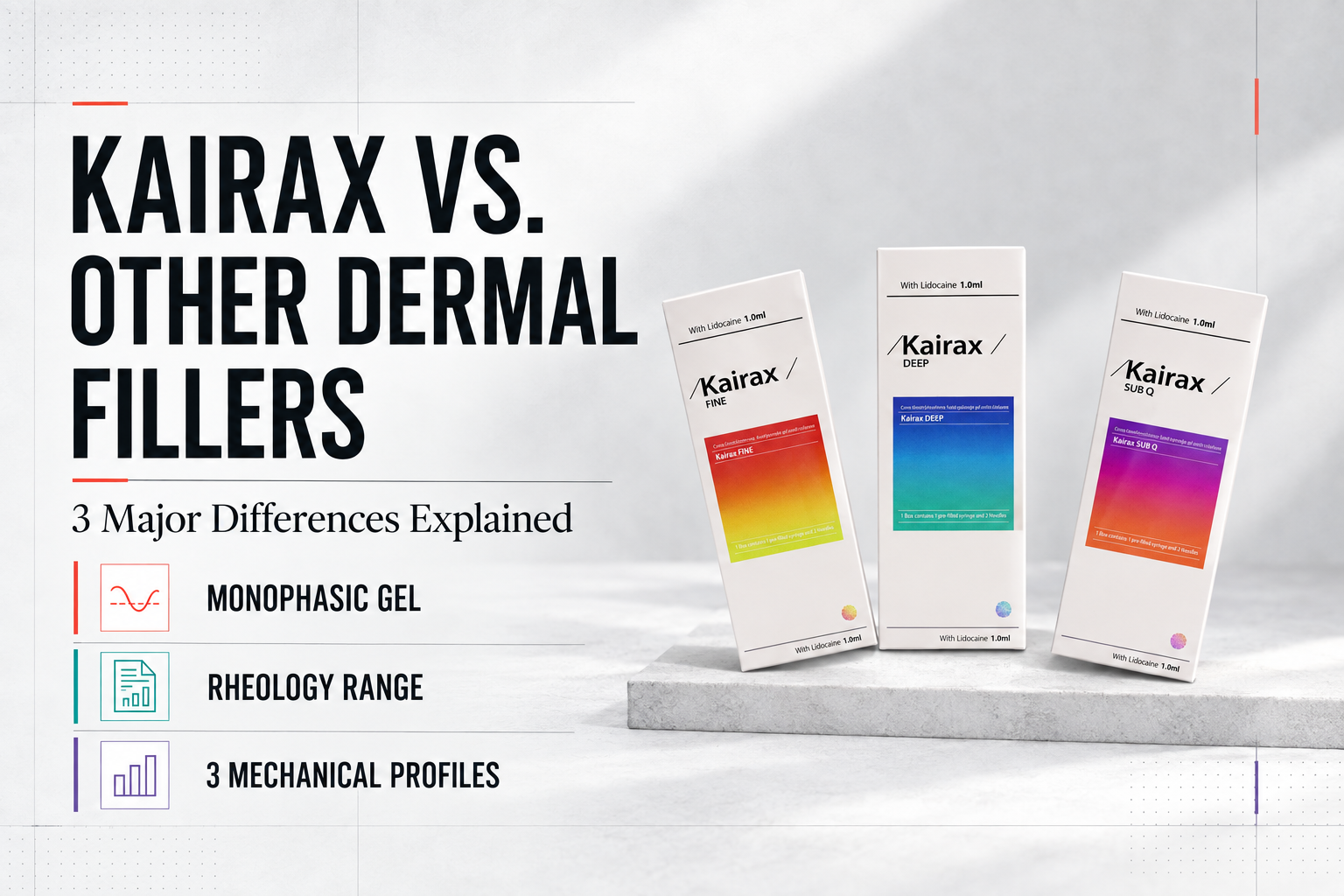
Gel architecture · rheology range · mechanical profile
Kairax’s real technical story is how one cross-linked HA platform is divided into Fine, Deep and Sub-Q. The three versions share a base formula, but their published viscoelasticity ranges show that they are designed to behave differently under mechanical stress.
Table of Contents
Quick Answer: What Are the Three Real Kairax Differences?
The useful differences are technical: Kairax is described in the current product guide as a monophasic cross-linked HA gel; its Fine, Deep and Sub-Q variants form a broad published rheology ladder; and the three variants keep the same documented HA-and-lidocaine base while changing their mechanical profile.
That means the Kairax decision is not simply “Is the brand good?” It is “Which gel behavior is being considered, and how does that exact version compare with the exact Revolax, Juvederm or other filler SKU?” A higher Pa range is not automatically better. It indicates a different resistance to deformation within the published Kairax system.
Difference 1: A Monophasic Cross-Linked HA Gel Platform
A current Kairax product guide describes the core line as a monophasic cross-linked hyaluronic acid gel. In product-technology terms, “monophasic” describes a continuous gel network rather than a brand promise about the final cosmetic result. It is one part of the formulation architecture that can influence how a gel deforms, recovers and holds together.
This matters because “HA filler” is a material category, not a single technology. Different filler families can use different starting HA, molecular-weight mixes, cross-linking conditions, homogenization processes and gel structures. Those manufacturing choices help produce different combinations of elasticity, viscosity, cohesivity, water uptake and extrusion force even when two labels show a similar HA concentration.
A peer-reviewed overview of HA filler rheology explains that finished-gel behavior depends on several interacting properties and manufacturing variables. It also makes an important comparison point clear: concentration alone cannot tell a customer whether one gel will be firmer, more flexible, more cohesive or more resistant to deformation than another.
Difference 2: A Wide Rheology Ladder From Fine to Sub-Q
The most informative Kairax specification is not the shared concentration. It is the separation between the three published viscoelasticity bands shown below. Read together, those ranges describe a deliberate progression from the lowest to the highest resistance within the Kairax line.
Relative bar lengths visualize Kairax’s own published bands. They are not a cross-brand performance ranking.
In plain language, a lower elastic or viscoelastic measure generally describes a gel that offers less resistance when deformed, while a higher measure describes greater resistance and recovery under the stated test. That is why Fine, Deep and Sub-Q should not be treated as interchangeable boxes. They occupy clearly different positions in Kairax’s own mechanical range.
However, a rheology number only becomes directly comparable when the parameter and laboratory conditions match. Frequency, temperature, strain, geometry and test protocol can all change the reported value. A Kairax brochure band cannot be placed beside a number from a Juvederm or Revolax paper and treated as a fair winner-versus-loser score unless both were measured under a consistent method.
Difference 3: One Base Formula, Three Mechanical Profiles
Kairax Fine, Deep and Sub-Q are recorded with the same base concentration, lidocaine component and syringe presentation shown in the technical profile above. The key product-selection difference is therefore not “more HA” as the names progress. It is the change in the finished gel’s published mechanical behavior.
This distinction answers a common customer misunderstanding. If three fillers list the same concentration, they are not necessarily the same product. HA concentration counts the material present, while the gel network and other physicochemical properties describe how the finished material behaves. Two products can share a concentration and still differ substantially in elasticity, cohesivity, water uptake or extrusion characteristics.
For Kairax, the three-version structure is relatively easy to read: Fine sits at the lower end of its published range, Deep in the middle and Sub-Q at the top. The names are navigation aids inside one brand. They should not be converted into injection instructions, and they do not automatically map to another manufacturer’s Fine, Deep or volume-oriented SKU.
Kairax Fine vs Deep vs Sub-Q: What the Numbers Mean
| Variant | Position in Kairax ladder | Technical reading inside Kairax | Useful question for the professional |
|---|---|---|---|
| Kairax Fine | Lowest | Lowest published resistance in the three-product range; the most flexible end of the Kairax ladder. | Does the plan call for the lower-resistance behavior in this product family? |
| Kairax Deep | Intermediate | Intermediate published range; positioned between Fine and Sub-Q rather than as a stronger version of Fine. | Is an intermediate balance the intended mechanical profile, and does the current label support the plan? |
| Kairax Sub-Q | Highest | Highest published resistance in the core Kairax range; mechanically separated from both Fine and Deep. | Is the highest-resistance option actually required, and what product-specific evidence supports that choice? |
This table is deliberately about product behavior, not facial zones or injection depth. Those treatment decisions require the current instructions for use, a qualified clinician’s assessment and the legal status of the exact product in the country where it will be used.
Kairax vs Revolax: Similar Names Do Not Mean Similar Gels
Kairax and Revolax both use Fine, Deep and Sub-Q naming, which makes a quick one-to-one comparison tempting. Technically, that shortcut is unreliable. Product names are not standardized rheology classes, and each manufacturer controls its own formulation and testing.
The clearest visible difference for a buyer is the documented range format. Kairax’s core product record uses the shared formula and syringe presentation shown above, while current FillersFairy records for the three core Revolax products use a 1.1 mL format. More importantly, the Kairax and Revolax rheology values available in different sources are not always generated under matched test conditions. Their raw Pa numbers should therefore not be ranked as if they came from one laboratory experiment.
When deciding between the two ranges, compare the exact Fine, Deep or Sub-Q documents, not the suffix. The separate guide on whether Revolax is a good filler explains the Revolax range and its own evidence boundaries. Qualified buyers can also check the current Revolax Deep product record alongside the exact Kairax variant being considered.
Kairax vs Juvederm: Compare Platforms, Then Exact Products
Juvederm is not one reference gel. It is a broad family with multiple named products and gel technologies, and the available lineup differs by market. A claim that Kairax is softer, firmer or longer lasting than “Juvederm” therefore lacks a defined comparator.
The technically useful process is to identify the exact Juvederm product first, then compare it with Kairax Fine, Deep or Sub-Q across the same fields. Those fields include gel architecture, HA concentration, presence of lidocaine, syringe volume, rheology measured under comparable conditions, water uptake, cohesivity, current indication and product-specific clinical evidence. Kairax’s published Pa ladder supplies one part of that comparison, not the whole answer.
Brand reputation and price also do not replace technical matching. A familiar brand can still contain products with very different behavior, while a lower-cost product does not become equivalent because the package uses a similar descriptor. For a wider category view before choosing a named comparator, see the Korean dermal fillers guide.
How to Shortlist Kairax Without Guessing
Choose the mechanical range
Start with whether the professional plan needs the lower, intermediate or highest-resistance profile within the Kairax family.
Check the exact document
Confirm the current label and instructions for Fine, Deep or Sub-Q rather than relying on a generic Kairax description.
Match the test method
Only compare cross-brand rheology numbers when the measured parameter and conditions are sufficiently consistent.
Look beyond concentration
Ask for the gel properties that matter to the decision instead of treating the headline HA concentration as a quality or duration score.
Verify the supply trail
Keep the sealed pack, lot, expiry, invoice and supplier record connected to the exact product received.
Keep the clinician accountable
The licensed professional should own product selection, patient assessment and complication planning.
Safety boundary: dermal filler injection is a medical procedure. The FDA’s general dermal filler guidance describes common reactions and rare but serious vascular complications and advises against buying fillers for self-injection. This general guidance does not establish FDA approval or market eligibility for Kairax.
Verdict: Who Should Put Kairax on the Shortlist?
Kairax deserves consideration when a qualified professional wants a clearly stepped three-gel range and can match the required mechanical profile to Fine, Deep or Sub-Q. The strongest product-level reason is the published rheology ladder across a consistent base formula, not an unsupported promise that Kairax is better than every alternative.
Use Fine for the lower end of the Kairax mechanical range, Deep for the intermediate range and Sub-Q for the highest range only as a starting framework. Final selection still depends on the current product document, local eligibility, patient-specific assessment and professional accountability.
Kairax Technical Comparison FAQ
What type of gel is Kairax?
The current product guide used for this review describes the core Kairax range as a monophasic cross-linked hyaluronic acid gel with lidocaine. Buyers should still confirm the current document for the exact Fine, Deep or Sub-Q product and market.
What are the three major technical differences in this Kairax comparison?
They are Kairax’s described monophasic gel architecture, its broad published rheology ladder from Fine to Sub-Q, and the use of one shared base formula across three different mechanical profiles.
What do the published Kairax Pa ranges mean?
They distinguish Fine, Deep and Sub-Q within Kairax’s published viscoelasticity ladder. Fine is the lowest range, Deep is intermediate and Sub-Q is the highest. The numbers should not be used to rank another brand unless the same property and test conditions were used.
Are Kairax Fine, Deep and Sub-Q the same formula?
The core product record lists the same cross-linked HA concentration, lidocaine component and syringe format across the three variants. Their published mechanical ranges differ, so the products should not be treated as interchangeable.
Is Kairax the same as Revolax?
No. Both ranges use Fine, Deep and Sub-Q names, but product names are not standardized technical classes. Compare the exact formulation, pack format, rheology method and current documentation rather than assuming name-to-name equivalence.
Is Kairax better than Juvederm?
No brand-wide technical winner can be established. Juvederm contains multiple products and technologies, so a useful comparison must name the exact Juvederm and Kairax products and use comparable test data and product-specific evidence.
Can I choose a Kairax variant from the Pa number alone?
No. The Pa ladder helps distinguish the variants, but it does not replace the current instructions for use, local eligibility, a patient-specific assessment or selection by a properly trained licensed professional.
How to read the evidence: Kairax’s formula, gel description and Pa bands come from current commercial product records and describe the product line; they are not independent proof of clinical superiority. General rheology explanations come from indexed peer-reviewed reviews. Unsupported SmartCross, duration, swelling, complication-rate and superiority claims from the previous page remain excluded.