Reviewed against current FillersFairy inventory pages, official manufacturer information, regulator guidance and peer-reviewed rheology literature. Last source review: July 31, 2026.
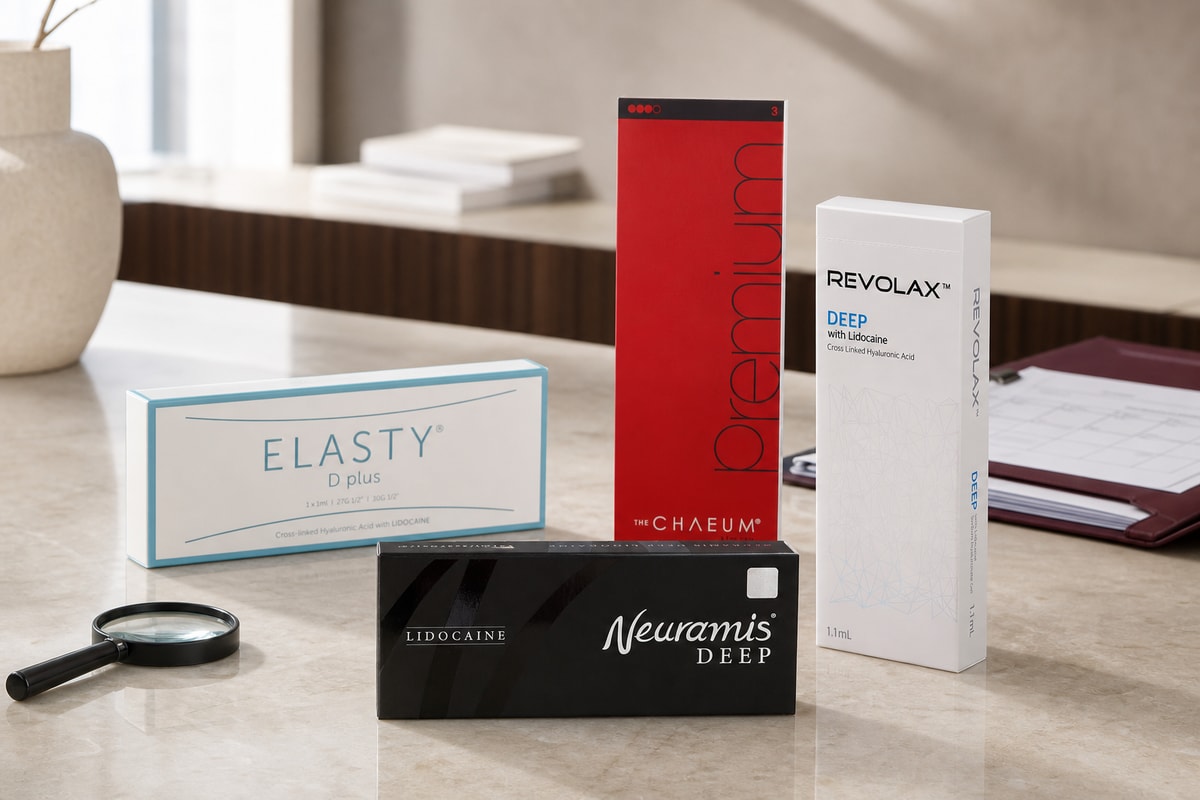
Scope: this is a procurement-education guide for professional clinic teams. It is not an injection protocol, a patient-level product prescription, a universal “best filler” ranking or a substitute for current local law, the exact IFU, regulator records and qualified clinical judgement.
What This Guide Compares—and What It Does Not
A responsible comparison of Korean filler brands begins with product identity. That means separating the legal manufacturer, exact line and variant, gel or label facts, syringe presentation, public evidence and market authorization. A product-family name alone cannot answer all six questions. “Deep,” for example, may be a commercial grade inside one family, while another brand uses a number or an S-code for its own internal range.
FillersFairy product pages are useful inventory references: they show which names and pack presentations are currently represented in the catalogue. They are not the final authority for composition, accessories, storage, shelf life, indications or authorization. Storefront information can also lag behind a revised pack or differ from a manufacturer page aimed at another market. When two public descriptions do not align, the correct answer is not to average them. The clinic should pause and reconcile the supplied box, label, IFU and jurisdiction-specific record.
This guide therefore does not tell a practitioner where, how deeply or how much to inject. It does not transfer evidence from one product to every SKU in the family, and it does not use country of origin as a shortcut for quality, safety or approval.
Evidence Levels Used in This Guide
These labels show what each source can support—and where it stops.
| Evidence level | Meaning |
|---|---|
| Regulatory record | Exact-product, jurisdiction- and date-specific market evidence; it must be current. |
| Manufacturer information | Official family identity, variants and pack facts; versions may differ by market. |
| Peer-reviewed evidence | Material, rheology or exact-product findings within study limits—not family-wide proof. |
| Brand positioning | How a family is organized or presented; not clinical-superiority evidence. |
| Inventory fact | A current FillersFairy listing used for navigation; not a label or IFU. |
Korean Dermal Fillers at a Glance
| Brand family | Current catalogue examples | Naming pattern | Primary-source status located for this guide | Ordering gate |
|---|---|---|---|---|
| Neuramis | Lidocaine, Deep Lidocaine and Volume Lidocaine | Descriptive grades | Medytox product-family page identifies named variants and a 1.0 mL presentation, while also displaying a market-version warning. | Match the received variant and language-specific label to its current IFU and local record. |
| The Chaeum | Premium 1, 2, 3 and 4 | Numbered grades | Hugel’s brand page identifies The Chaeum as an HA-filler line and describes its Korean-market status and manufacturing controls. | Do not treat 1–4 as a universal scale shared by other manufacturers. |
| Elasty | F/F Plus, D/D Plus and G/G Plus listings | Lettered grades, with “Plus” used on lidocaine-labelled catalogue variants | Dongbang Medical’s Elasty site identifies an HA-filler line with three physical-property groupings and PNET terminology. | Broad website certification language is not enough to establish the status of an exact box in every country. |
| Revolax | Fine, Deep and Sub-Q | Descriptive grades | Hugel’s current corporate page describes Revolax as an HA-filler line and explicitly states that market authorization can differ by product and country. | Verify the exact variant, legal manufacturer, current market document and sealed presentation. |
| Yvoire | Classic Plus, Volume Plus and Contour Plus | Descriptive grades | LG Chem’s Life Sciences factsheet presents named Yvoire variants and version-specific compositions. Public presentations may be market-specific. | If concentration or pack wording differs across public pages, use the supplied label and applicable IFU—not a blended figure. |
| Dermalax | Plus, Deep Plus and Implant Plus | Descriptive grades | Current catalogue naming plus a located manufacturer-identity trail support family navigation; exact destination-market status still needs a current check. | Match Plus, Deep Plus or Implant Plus to the physical pack, current IFU and current local record. |
| E.P.T.Q. | S100, S300 and S500 | S-codes | Jetema’s official filler page is the manufacturer route located for the family; the current catalogue groups the three S-coded variants. | The number inside an S-code is not a concentration, syringe volume or cross-brand performance score unless the exact document says so. |
Reading rule: “source located” does not mean every fact needed for ordering has been verified. It means a primary-source route exists. The receiving clinic still needs the document set for the exact SKU, lot and destination market in front of it.
Seven Brand Families and One Protected Spoke
Neuramis filler family
Neuramis is a Medytox HA-filler family. The manufacturer page identifies Light Lidocaine, Lidocaine, Deep, Deep Lidocaine and Volume Lidocaine, and it lists the product as a single-use sterile medical device in a 1.0 mL packaging unit. It also labels certain displayed versions for Ukraine and routes readers to the Korean MFDS database for recent approval details. That combination is a useful lesson: even a manufacturer page can show a market-specific pack, so its information should not be silently transferred to every box worldwide.
Why clinics choose this family: Complete Korean HA family.
Current FillersFairy inventory examples include Neuramis Lidocaine, Deep Lidocaine and Volume Lidocaine. Their names help locate the correct line, but they do not establish interchangeable rheology or a treatment plan. For a narrow product comparison, see Neuramis Deep compared with Revolax Fine.
Chaeum filler family
The Chaeum uses a numbered Premium 1–4 system. Hugel identifies the line as a cross-linked HA medical device and describes Korean MFDS approval and an eight-step dialysis process for the brand information shown on its corporate page. These claims are useful at the family level, but the correct procurement file still needs to name the exact numbered grade, pack, revision and destination market.
Why clinics choose this family: Numbered four-grade portfolio with straightforward 1–4 navigation.
A buyer should not translate Premium 1 as “the same as Fine” or Premium 4 as “the same as Sub-Q.” The sequence suggests positions inside The Chaeum range; it does not prove equivalence to another manufacturer’s product. Exact technical documents—not the number alone—must carry any statement about gel properties or intended role.
Elasty filler family
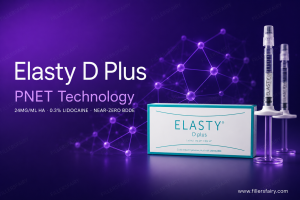
Elasty is an HA-filler brand of Dongbang Medical. Its official site presents three physical-property lines and uses PNET terminology. Current FillersFairy listings include lettered F, D and G products, with Plus and non-Plus variants represented in the catalogue. The names are navigation aids, not a universal firmness scale.
Why clinics choose this family: Technology-led PNET branding.
The official site also uses broad language covering several certifications and authorities. That wording should not be converted into “every Elasty SKU is approved everywhere.” A clinic needs a current record that names the exact product and jurisdiction. Readers investigating one listed variant can continue to the Elasty D Plus product guide; this category hub does not reproduce its product-specific argument.
Revolax filler family
Revolax is represented by Fine, Deep and Sub-Q listings. Hugel’s current corporate information describes Revolax as an HA-filler line certified in Europe and immediately adds that authorization details can differ by product and country. That caveat is more useful than a category-wide badge because it tells a buyer what still needs to be checked.
Why clinics choose this family: Export-oriented brand family with clear Fine, Deep and Sub-Q navigation.
The descriptors should be read inside the Revolax family. “Fine” does not automatically match another brand’s lowest number, and “Deep” cannot be treated as the same gel across unrelated lines. Confirm the legal manufacturer and applicable documents on the physical pack rather than relying only on a familiar brand name.
Yvoire filler family
Yvoire is an LG Chem HA-filler family. Current catalogue examples include Classic Plus, Volume Plus and Contour Plus, and the manufacturer’s current Korean site presents the same named structure. Public product descriptions can differ by region and revision, including how concentration or certification details are displayed. That is not permission to choose whichever figure looks most useful.
Why clinics choose this family: Pharmaceutical-backed Korean HA route.
When a public manufacturer presentation and a storefront title do not clearly describe the same market version, mark the field “requires reconciliation.” The supplied label, exact IFU and current regulator record should resolve it before stock is accepted or used.
Dermalax filler family
Dermalax catalogue examples include Plus, Deep Plus and Implant Plus, giving clinics a broad descriptive family for catalogue navigation. The grade name still needs to be matched to the exact supplied pack, legal manufacturer and applicable IFU.
Why clinics choose this family: Broad HA family with multiple contour roles in its brand positioning.
A historical Philippines regulator record helped confirm one Implant Plus identity and manufacturer trail during research. Because that record expired in 2020, it is kept only as secondary document history—not as the family’s lead description or evidence of current authorization. A current order still requires a live destination-market check.
E.P.T.Q filler family
E.P.T.Q. is Jetema’s S-coded filler family, represented in the current catalogue as S100, S300 and S500. These codes organize the product line, but the numbers should not be interpreted as a universal concentration, syringe volume or clinical-performance score. A code only means what the exact product documentation defines it to mean.
Why clinics choose this family: Structured S-series portfolio.
The safest use of the coding system is operational: it helps a clinic match the ordered variant to the box, invoice, IFU and receiving record. Any further claim about gel behavior should be attached to a current exact-product source.
Kairax: a linked comparison spoke, not an eighth rewritten profile
Kairax also uses Fine, Deep and Sub-Q names, making it useful for seeing why similar descriptors are not cross-brand standards. This hub deliberately does not rewrite the existing comparison. Continue to Kairax compared with other dermal fillers for that narrower intent.
How Naming Systems Differ Across Korean Dermal Fillers
No. Descriptive names, numbered grades and coded grades are internal product-line systems. They can help identify a variant inside one family, but they do not prove equal viscosity, elasticity, cohesivity, particle structure, HA concentration, intended use or clinical performance across manufacturers.
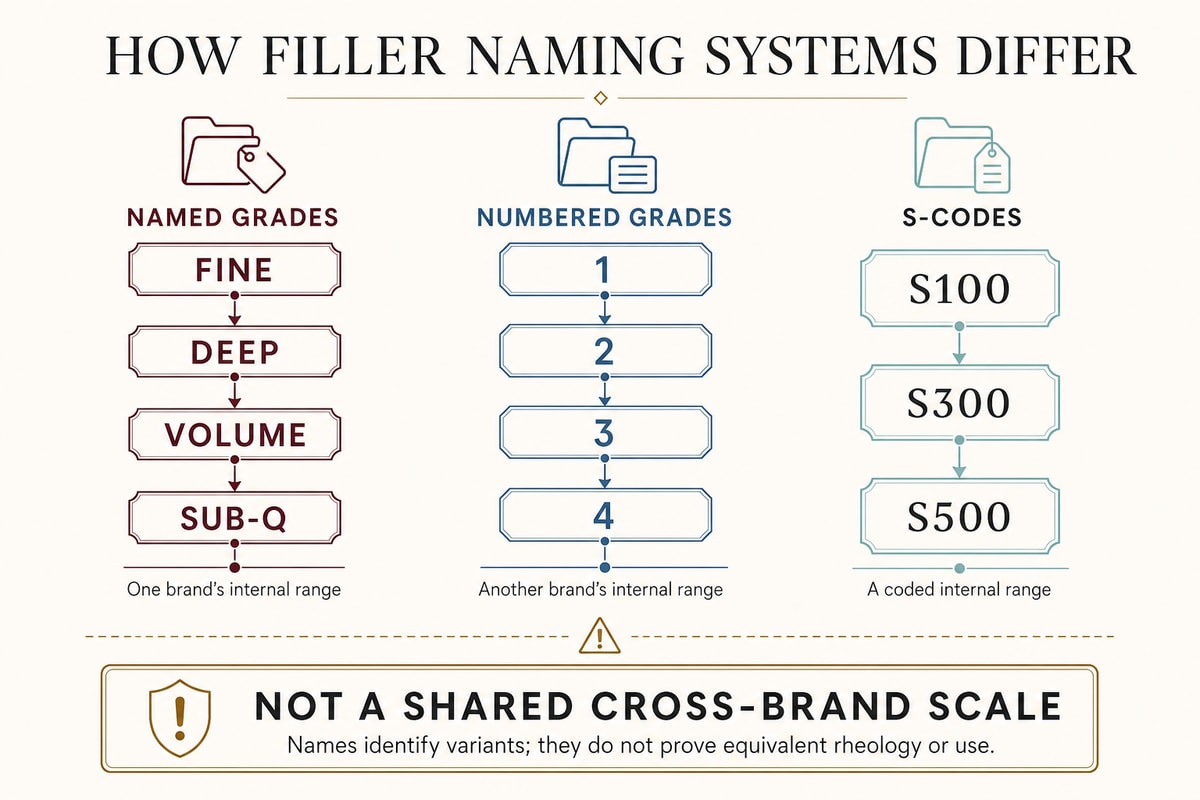
| System | Examples in this guide | What it can do | What it cannot prove |
|---|---|---|---|
| Descriptive | Fine, Deep, Volume, Sub-Q | Locates a named variant inside the relevant brand family. | Cross-brand equivalence or an automatic treatment area. |
| Numbered | Premium 1, 2, 3, 4 | Shows sequence inside The Chaeum range. | A universal 1–4 rheology scale. |
| Coded | S100, S300, S500 | Identifies an E.P.T.Q. variant for document and stock matching. | A concentration, volume or performance value without its technical definition. |
Gel Properties in Korean Dermal Fillers, in Plain Language
Cross-linked hyaluronic acid is a material category, not a complete product description. Manufacturing choices can change the gel network and measurable behavior. Peer-reviewed overviews of HA-filler manufacturing and physicochemical properties and filler rheology explain why multiple parameters are needed. They do not support turning one laboratory number into a universal brand ranking.
| Term | Plain-language meaning | Useful procurement question | Unsafe shortcut |
|---|---|---|---|
| Viscosity | Resistance to flow under defined test conditions. | Are the method, temperature and comparison conditions reported? | “Higher viscosity is always better.” |
| Elasticity / G′ | How strongly a gel tends to recover after deformation in a particular test. | Is the value from the exact product and a comparable method? | “One G′ value predicts the whole clinical result.” |
| Cohesivity | How a gel tends to remain together under a defined assessment. | Which scale or method was used? | “More cohesive means safer or longer-lasting.” |
| Gel or particle structure | How the cross-linked HA network is manufactured and described. | Does the statement come from an exact-product technical source? | “Monophasic always outperforms biphasic,” or the reverse. |
| HA concentration | The amount of HA reported per unit volume for a defined formulation. | Does the number match the exact label and market version? | “A larger number guarantees more lift or duration.” |
Clinical outcomes also depend on the exact product, patient, indication, practitioner assessment and study design. Rheology can help explain a gel; it cannot select a patient or replace product labeling. For a wider risk overview, use the site’s dermal filler safety information.
How a Clinic Can Narrow a Shortlist Without Declaring a Universal Winner
This cumulative clinic selection map organizes portfolio coverage; it is not a clinical ranking.
Small clinic
Neuramis
Revolax
E.P.T.Q.
A compact route with three clear family structures.
Korean-focused clinic
Elasty
Yvoire
Dermalax
Add technology-led, pharmaceutical-backed and broad descriptive routes.
Full Korean HA portfolio
Add The Chaeum
Add the numbered 1–4 family to reach all seven.
Map gate: every addition still requires local eligibility, exact-version documents and traceable supply. A clinic can stop at any stage.
Apply the product-level gate after choosing a portfolio route
| Decision question | Evidence to use | Possible outcome |
|---|---|---|
| Can the exact product be identified? | Full variant name, legal manufacturer, UDI or registration identifiers where applicable. | Continue, or stop until identity is resolved. |
| Is it eligible in the destination market? | Current regulator database or certificate naming that exact product. | Eligible, not located, not applicable, or requires a current check. |
| Does the documented product role match the clinic’s need? | Applicable IFU and exact-product labeling, followed by clinician assessment. | Shortlist one or more products without calling any one universally best. |
| Does the sealed-unit format fit stock control? | Prefilled-syringe count and volume, single-use statement, included accessories and storage. | Accept the format, or choose another documented format. |
| Can the supply chain be traced? | Supplier identity, invoice, lot, expiry, shipment and receiving records. | Receive and quarantine correctly, or do not order yet. |
“Do not order yet” is a valid procurement result. It is safer than filling an evidence gap with a brochure, an old certificate, a pack photograph or another brand’s specifications.
Documentation, Packaging and Authenticity Checks for Korean Dermal Fillers
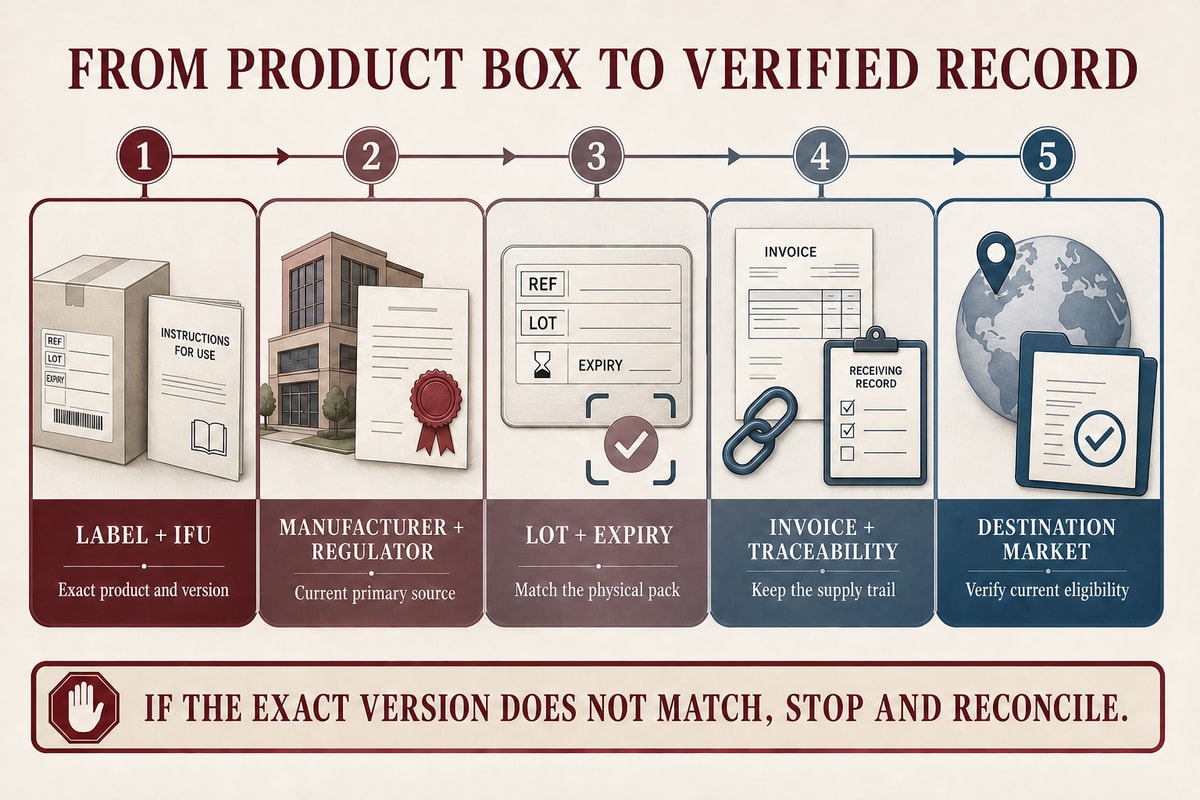
- Exact identity: match the brand, product line, variant, formulation suffix and language version across the order, box and IFU.
- Legal manufacturer: read the manufacturer named on the supplied pack; do not infer it from a marketplace title or distributor description.
- IFU and label: confirm the applicable revision, intended use, contraindications, warnings, accessories, storage and single-use conditions.
- Destination-market status: locate a current official record that names the exact product when authorization is required.
- Sealed pack: reconcile syringe count, fill volume, lidocaine wording and included needles or cannulas with the physical unit.
- Lot and expiry: record both at receiving and preserve traceability through use and adverse-event reporting.
- Commercial trail: retain the invoice, supplier details, shipment conditions and receiving record. A sharp packaging image cannot prove authenticity on its own.
The US FDA’s filler guidance advises healthcare providers to inspect packages for authenticity and reminds patients not to buy or self-inject online. Other markets use their own authorization systems, but the operational lesson travels well: product identity and chain of custody matter.
Regulatory Status of Korean Dermal Fillers Changes by Product and Market
“FDA-approved,” “MFDS-approved” and “CE-marked” are not interchangeable labels, and none should be applied to Korean dermal fillers as a whole. Each statement must identify the relevant authority or framework, exact product, applicable version and current jurisdiction. A Korean manufacturer’s product can have different names, labels or authorization status across markets.
A useful internal status model has four values: verified, when a current exact-product record has been checked; not located, when no suitable public record was found; not applicable, when that framework does not apply; and requires current check, when the record is expired, ambiguous or supplied privately. “Not located” is not the same as “not authorized,” and an expired record is not current proof.
Korean Dermal Fillers: Safety, Reversibility and the Professional-Use Boundary
HA composition is relevant to discussions of hyaluronidase, but it does not make self-treatment safe or guarantee that every unwanted outcome is simple to reverse. Product identity, anatomy, the event involved and timely professional assessment still matter. This article intentionally does not provide injection depth, dose, dilution, technique or emergency-treatment instructions.
The FDA identifies unintended injection into a blood vessel as the most concerning filler risk because it can lead to tissue necrosis, visual impairment including blindness, or stroke. Unusual pain, vision changes, stroke symptoms, or white, grey or blue skin near an injection site require immediate medical attention. Treatment belongs with an appropriately trained, licensed healthcare professional using an eligible, traceable product.
Frequently Asked Questions
What are Korean dermal fillers?
Korean dermal fillers are injectable medical-device products manufactured in South Korea. This guide focuses on cross-linked HA filler families represented in the FillersFairy catalogue. The description identifies origin, not automatic equivalence, approval, quality or suitability. Every exact product and destination market still requires its own label, IFU and authorization check.
Are all Korean filler brands the same?
No. Brands can differ in product-line structure, manufacturing process, gel properties, concentration, lidocaine presentation, syringe format, public evidence and market authorization. Shared Korean origin or shared HA material does not prove the same handling, clinical outcome or safety profile.
Do Fine, Deep, Volume and numbered filler grades mean the same thing?
No. These are internal naming systems. Fine, Deep, Volume and Sub-Q are descriptive names; The Chaeum uses numbered grades; E.P.T.Q. uses S-codes. They help identify variants inside a family but do not form one cross-brand rheology or treatment scale.
Are Korean dermal fillers FDA- or MFDS-approved?
There is no safe category-wide yes or no. Regulatory status belongs to an exact product, version, intended use and jurisdiction, and it can change. Check the current regulator database and applicable label rather than applying a manufacturer’s or another SKU’s status to an entire brand family.
What documents should a clinic check before ordering a Korean HA filler?
Check the exact label and IFU, legal manufacturer, current destination-market record, sealed syringe configuration, lot, expiry, storage statement, invoice and supplier traceability. Reconcile every document with the physical box. If the version or authorization remains unclear, the appropriate decision is not to order yet.
Continue the Product Investigation
Use this hub to identify the correct family, then move to the narrowest available product evidence. Read the Kairax comparison, the Neuramis Deep and Revolax Fine comparison, the Elasty D Plus guide and the dermal filler safety guide. For a dedicated product-route comparison, continue to the Korean lip filler comparison. When documentation and destination-market eligibility are clear, you can browse the current dermal filler range.
Editorial note: public manufacturer pages, regulator records and catalogue listings can change. This guide records the source position reviewed on July 31, 2026 and should be rechecked against the exact supplied product before a procurement or clinical decision.