Editorial method: this guide separates under-eye concern classification, peer-reviewed PN evidence, manufacturer-issued product specifications and current FillersFairy inventory facts. A statement from one evidence layer is not transferred to another. Last evidence and inventory review: August 4, 2026.
Scope: this is an evidence and sourcing guide for professional clinic teams and research-stage buyers. It does not diagnose an under-eye concern, select a product for a patient, provide an injection technique, dose, depth, point map or treatment schedule, or establish that a product is permitted in every destination market. The current supplied label, instructions for use where applicable, local requirements and appropriately qualified clinical judgement remain controlling.
Start With the Concern, Not the Product Name
“Dark circles” is a visual description, not one diagnosis. A review of periorbital hyperpigmentation describes several possible contributors, including pigment, visible vasculature beneath thin skin, edema, skin laxity and shadowing from a tear-trough contour. That means two people using the same words may be describing different underlying patterns.
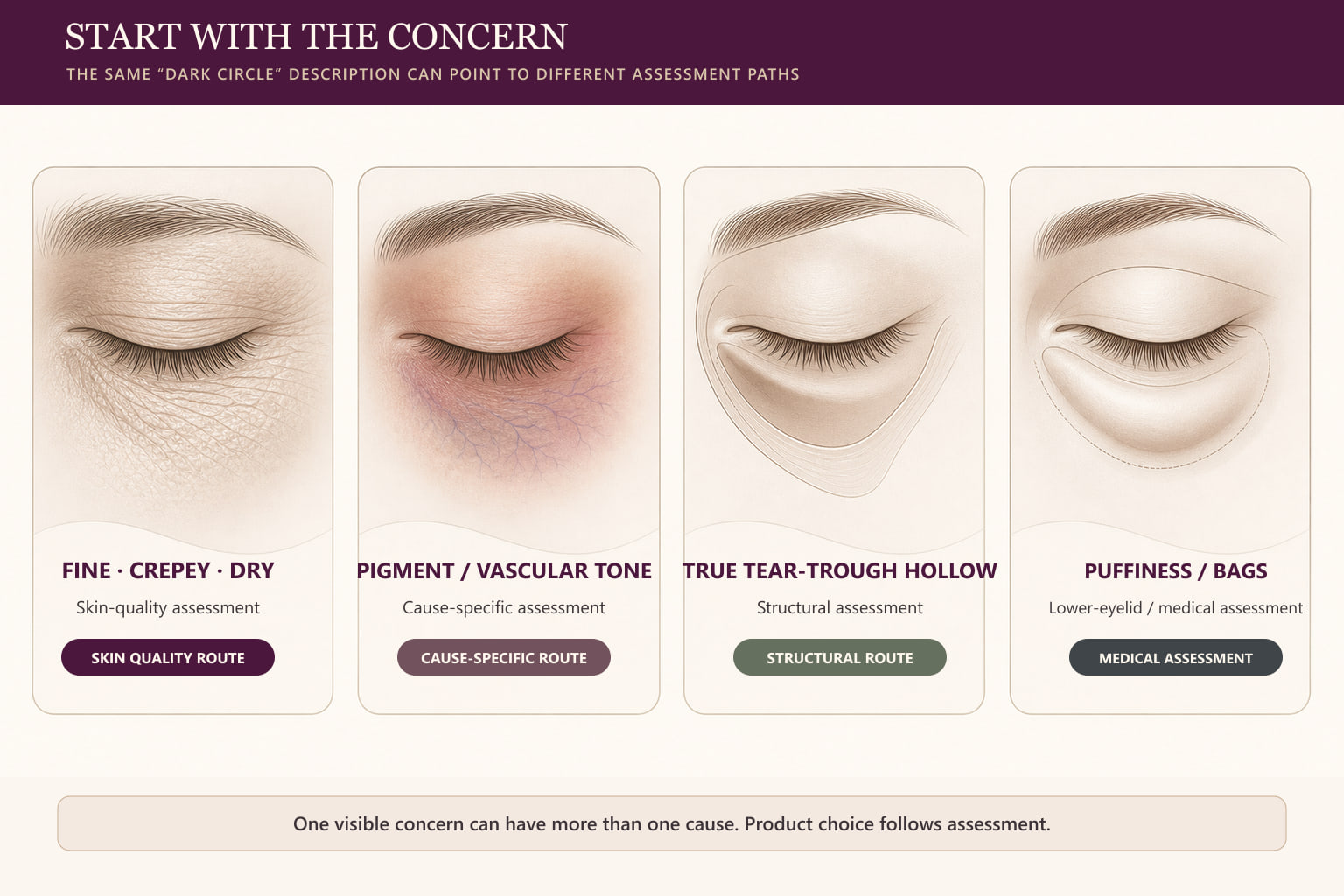
| Visible concern | Question to resolve first | Relevant route | Do not assume |
|---|---|---|---|
| Fine, crepey or dry-looking texture | Is skin quality the dominant concern? | Qualified skin-quality assessment; this is the closest lane for a PN product comparison. | That every PN label has the same formula, evidence or expected outcome. |
| Brown, blue or purple-looking darkness | Is pigment, vascular visibility, inflammation, thin skin or shadow contributing? | Cause-specific assessment before product selection. | That one “dark circle” claim covers every cause. |
| True tear-trough hollow | Is a contour deficit creating a shadow? | Structural and anatomical assessment. | That a skin-quality product is a volume replacement. |
| Persistent puffiness, bags, mounds or festoons | Is fluid retention, fat prolapse or another eyelid issue present? | Lower-eyelid or medical assessment as appropriate. | That adding any injectable automatically improves a bag or edema pattern. |
The decision can be mixed. Thin or crepey skin may coexist with a structural groove, pigment or puffiness. The correct conclusion is not that one route always replaces another, but that product comparison should begin only after the main contributors have been assessed.
What Does the PN Evidence Actually Show?
A 2025 systematic review of polynucleotides in aesthetic medicine included nine studies and 219 patients. The authors described the evidence as low to moderate quality and reported variation in treatment areas and procedural characteristics. They found promising signals for wrinkles, texture and elasticity, while calling for more rigorous studies and noting limited consensus on optimal use.
A separate randomized, double-blind, split-face trial enrolled 27 participants and compared a PN-containing product with a non-crosslinked hyaluronic acid product in the periocular area. Overall aesthetic scores were not significantly different between groups. Some measured skin parameters favored the PN side, while dermal-density improvement was not significantly different. No serious adverse events were reported in that small study.
Those papers support a cautious category-level discussion. They do not establish that Rejuran I, AMI Eyes, Diva Eye or Puri Eyes was the exact product studied, and they do not prove that a PN product corrects structural hollowness, pigment, bags or every cause of a dark circle. Product-specific claims must remain attached to product-specific evidence.
Evidence Levels: What Each Source Can Prove
| Evidence level | What it can establish | What it cannot establish alone |
|---|---|---|
| Level 1 — regulator / IFU | Named product identity, intended purpose, warnings, pack or storage within the applicable record. | Worldwide approval or superiority over another product. |
| Level 2 — manufacturer | Official composition label, quantity, format and product positioning. | Independent clinical efficacy. |
| Level 3 — peer-reviewed research | Results for the exact intervention, population and endpoints studied. | A result for an unstudied commercial product. |
| Level 4 — brand positioning | How a company markets or categorizes a product. | A verified outcome, regulatory status or ranking. |
| Level 5 — inventory fact | The exact SKU and route currently listed by FillersFairy. | Medical evidence, authenticity or suitability for a person. |
These levels are not a single score. A manufacturer page may be the best source for pack format, while a randomized trial is the better source for a defined clinical outcome. The question determines the source.
Rejuran I, AMI Eyes, Diva Eye and Puri Eyes Compared
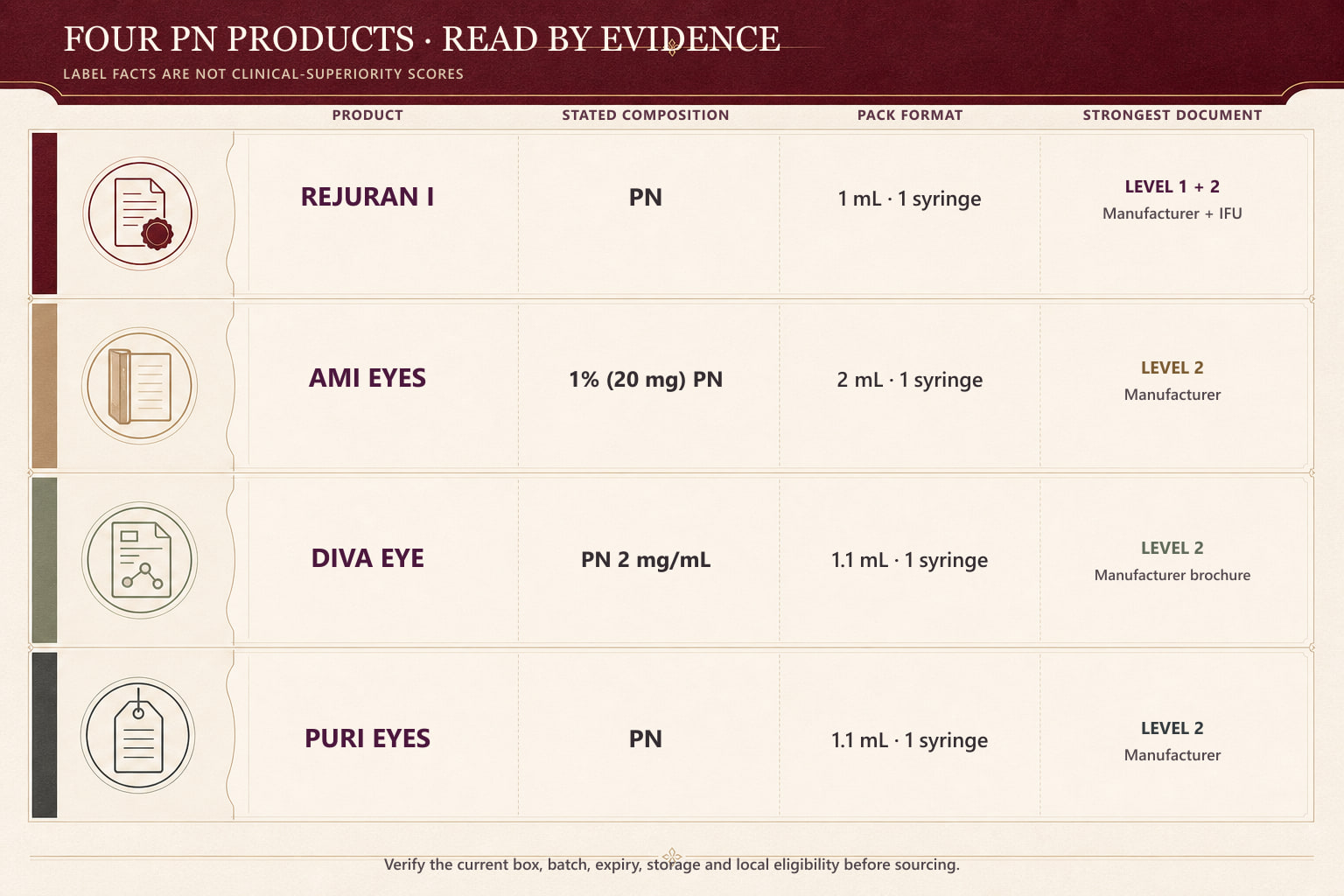
| Current product route | Manufacturer-stated composition | Pack format | Strongest product source used here | Open verification gate |
|---|---|---|---|---|
| Rejuran I | PN | 1 mL, one syringe per pack | PharmaResearch product page plus Korean IFU | Match the supplied market label and current IFU. |
| AMI Eyes | 1% (20 mg) PN, quoted exactly as published | 2 mL, one prefilled syringe | Quiver Medic product microsite | Do not recalculate the label into mg/mL without a reconciled current document. |
| Diva Eye | PN 2 mg/mL | 1.1 mL, one syringe | JJ Med LEXYAL DIVA EYES brochure | Recheck the exact current box label before relying on the specification. |
| AETER Puri Eyes | PN | 1.1 mL, one syringe per box | WEDERM product detail | Keep regular Puri Eyes, Puri Eyes Pro and the PDRN Patch separate. |
Rejuran I: the strongest manufacturer and IFU trail in this set
The current Rejuran I manufacturer record lists PN, a 1 mL syringe, one syringe per pack, and facial use with specific reference to the eye and perioral areas. The Rejuran I product page is the FillersFairy inventory route. Product variants should not be treated as interchangeable, and a comparatively clear document trail is still not proof that Rejuran I is universally better for every under-eye concern.
AMI Eyes: use the published label wording, not a derived claim
The current AMI Eyes manufacturer materials state 1% (20 mg) PN and one prefilled 2 mL syringe. Because public listings can express concentration differently, this guide preserves the published wording and does not convert it into a new mg/mL claim. The AMI Eyes product page is the FillersFairy inventory route. A larger syringe is a format difference, not automatic evidence of greater efficacy.
Diva Eye: a distinct product identity, not a Lumi Eyes substitute claim
The current manufacturer brochure identifies the product as LEXYAL DIVA EYES and lists PN 2 mg/mL in one 1.1 mL syringe. FillersFairy uses the shorter Diva Eye product page for its inventory route. Diva Eye appears here because it is in the current catalogue; replacing the stale Lumi Eyes plan does not make the two products equivalent or establish comparative clinical performance.
AETER Puri Eyes: keep the booster, Pro version and patch separate
The current manufacturer record identifies regular Puri Eyes as a PN under-eye skin booster supplied as one 1.1 mL syringe per box. The AETER Puri Eyes product page is the FillersFairy inventory route. Puri Eyes Pro and the Puri Eyes PDRN hydrogel patch are separate products; the patch is an aftercare cosmetic, not the fourth injectable in this comparison.
Clinic Selection Routes Without a “Best” Winner
Route 1 — documentation-first: when the priority is a clear product identity and IFU trail, begin with the manufacturer record, then match the current box, presentation and destination-market document. Rejuran I has the most complete Level 1 and Level 2 trail in this comparison, but that is a documentation distinction—not a universal clinical ranking.
Route 2 — label-and-format comparison: when comparing AMI Eyes, Diva Eye or Puri Eyes, keep every number attached to its source. AMI Eyes is recorded here exactly as 1% (20 mg) in a 2 mL syringe; Diva Eye as PN 2 mg/mL in 1.1 mL; regular Puri Eyes as PN in 1.1 mL. Do not convert these fields into a strength league table when formulation, molecular characteristics and product-specific clinical evidence have not been standardized across brands.
Route 3 — portfolio and inventory fit: a clinic may consider more than one eye-area PN route, but each SKU should have an independent reason for being stocked. Confirm the exact name, pack, document level and current market eligibility. Stock breadth does not increase evidence quality. For a wider category view, use the Korean PN and PDRN buyer’s guide.
What an Under Eye Skin Booster Should Not Be Asked to Replace
A structural tear-trough hollow is a contour problem, while crepey texture is a skin-quality description. A review of infraorbital hollow rejuvenation also notes that pigment, prominent orbicularis muscle, malar mounds, festoons and severe eyelid-bag patterns can limit what filler alone can address. The same caution applies in reverse: a skin booster should not be presented as a guaranteed substitute for structural assessment.
The separate under-eye and tear-trough filler guide explains the structural route, but linking to it is not a recommendation that filler is appropriate. Persistent puffiness, rapidly changing swelling, irritation, pain, visual symptoms or an unexplained unilateral change should be medically assessed rather than routed through a product comparison.
Before Sourcing: Identity and Document Checklist
- Exact product identity: match the front, side and lot labels to the manufacturer document; do not substitute another family member.
- Current pack and formula: record the stated composition, syringe volume, pack count and document date without converting or “correcting” the label.
- Manufacturer and responsible parties: identify the manufacturer, exporter, distributor and supplier shown on the actual documents.
- Traceability: reconcile the lot, expiry, seal condition, invoice and receiving record.
- Storage: follow the exact current product document and preserve the shipping and receiving chain; do not copy storage rules from another PN product.
- Local eligibility and professional responsibility: confirm the intended use and destination-market requirements before purchase or use.
If two records conflict, preserve both and stop at the disputed field. Ask the manufacturer or responsible supplier to reconcile the difference in writing. A commercial listing should never be used to silently override an IFU or regulator record.
Frequently Asked Questions
Is an under eye skin booster the same as tear trough filler?
No. A skin booster is discussed mainly as a skin-quality route, while tear-trough filler is a structural volume and contour route. Some visible concerns are mixed, so a qualified assessment should identify whether texture, pigment, vascular visibility, hollowing, puffiness or more than one factor is contributing.
Which under-eye concerns are mainly skin-quality concerns?
Fine, crepey or dry-looking texture is the closest skin-quality lane. Dark circles still need cause-specific assessment because pigment, visible vessels, thin skin, edema and structural shadowing can look similar. A product label alone cannot identify the cause.
Are Rejuran I, AMI Eyes, Diva Eye and Puri Eyes the same formula?
No. All four are positioned around PN, but the published composition wording, syringe volume, product documentation and brand identity differ. Those differences should be recorded as label and format facts, not converted into an unsupported clinical ranking.
Is Puri Eyes PDRN Patch the same product as Puri Eyes PN skin booster?
No. The current manufacturer record lists regular AETER Puri Eyes as a 1.1 mL PN under-eye skin booster in a syringe. Puri Eyes PDRN Patch is a separate hydrogel aftercare cosmetic. It is not one of the four injectable products compared in this guide.
What should a clinic verify before sourcing an eye-area PN product?
Verify the exact product name, manufacturer, current label or IFU, composition wording, pack format, lot, expiry, seal, invoice, documented storage chain and destination-market eligibility. Product selection, patient suitability and administration remain responsibilities for appropriately qualified professionals.
Sources and Related Routes
The useful conclusion is not that one PN product “wins,” but that different questions require different evidence. Concern classification comes before product selection; peer-reviewed research stays attached to the intervention studied; manufacturer information supports identity and pack facts; and inventory confirms the current purchase route. Keep those layers separate, and the comparison remains practical without becoming promotional or clinically overconfident.