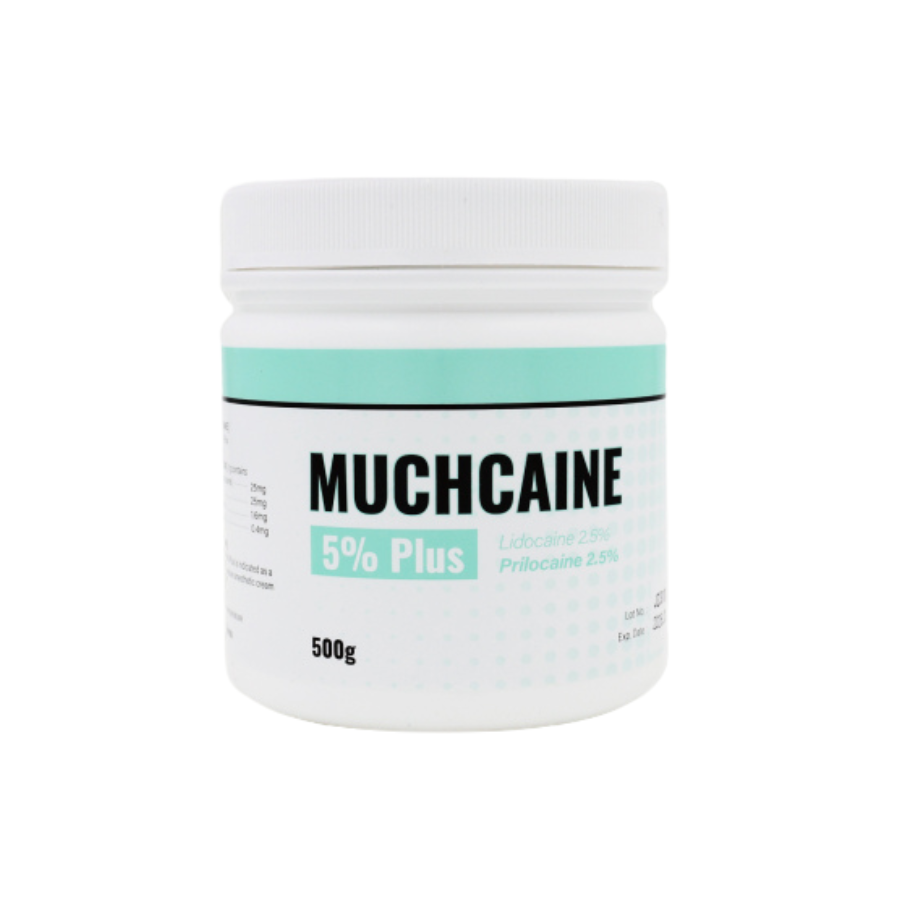
Muchcaine Plus 5% Lidocaine & Prilocaine Topical Anesthetic Cream – 500g
EMLA-Equivalent Dual-Agent Formula – Deep, Long-Lasting Dermal Anesthesia
Muchcaine Plus 5% is a professional-grade topical anesthetic cream combining 2.5% Lidocaine HCl and 2.5% Prilocaine in an EMLA-equivalent 5% formulation – a stable white oil-in-water (O/W) emulsion at pH 7.0–8.0. The dual-agent eutectic mixture allows deeper, more sustained anesthesia than single-agent creams: onset within 25–35 minutes, peak analgesia around 60 minutes, and 120–180 minutes of total duration once occluded, with penetration reaching 3–5mm into the dermal-epidermal junction. Supplied in a 500g tub for clinics running multiple procedures per day.
Indicated Procedures
Microneedling Deep dermal numbing supports comfort during multi-pass microneedling sessions.
Laser Therapies Extended duration suits longer laser sessions covering larger surface areas.
Tattoo Applications 120–180 minute duration provides comfort coverage for extended tattoo sessions.
Dermal Filler & Injectables 3–5mm penetration depth reaches the injection sites typically used for cosmetic fillers.
Clinical Specifications
| Active Ingredients | 25mg/g Lidocaine HCl (2.5%) + 25mg/g Prilocaine (2.5%) – EMLA-equivalent 5% total |
| Classification | Amide-type local anesthetic, eutectic mixture |
| pH Range | 7.0 – 8.0 (bio-compatible skin physiological pH) |
| Excipients | Carbomer 940, Polyoxyethylene Hydrogenated Castor Oil, Methylparaben (1.5mg/g) |
| Appearance | Stable white oil-in-water (O/W) emulsion |
| Onset of Action | 25 – 35 minutes |
| Peak Analgesia | ~60 minutes post-application |
| Total Duration | 120 – 180 minutes (occluded) |
| Penetration Depth | 3mm – 5mm |
| Storage | 15°C – 30°C, away from direct sunlight |
| Format | 500g high-capacity tub |
How to Use
- Sanitize: Cleanse the target area with an alcohol-free, pH-neutral antiseptic. Ensure the skin is completely dry before application – residual moisture can dilute the emulsion.
- Apply: Apply a uniform layer approximately 2mm thick. Typical dosage is 1.5g–2.0g per 10cm² of skin surface.
- Occlude: Seal with a professional dermal wrap. Occlusion increases hydration of the stratum corneum, accelerating delivery of both active ingredients to the nerve endings.
- Wait for onset: Allow 25–35 minutes for full analgesic effect; peak anesthesia is reached around the 60-minute mark.
- Remove & cleanse: Remove the dermal wrap and wipe away residual cream before beginning the procedure.
Frequently Asked Questions
Why is this called “5%” when each active ingredient is only 2.5%?
The 5% figure refers to the combined total concentration of both active ingredients – 2.5% Lidocaine HCl plus 2.5% Prilocaine. This 1:1 ratio is the same proportion used in the well-known EMLA formulation, which is why this product is described as “EMLA-equivalent.” Rather than increasing the dose of a single anesthetic, the formula splits the load between two amide-type agents that work together.
Why does combining lidocaine and prilocaine improve penetration compared to a single-agent cream?
Lidocaine and prilocaine are both amide-type anesthetics that work by blocking voltage-gated sodium channels in nerve membranes. When mixed in roughly equal parts, the two compounds form a eutectic mixture – meaning the combined mixture has a lower melting point than either ingredient alone. A lower melting point allows more of the active drug to exist in an oily, non-ionized form at skin temperature, which penetrates the stratum corneum more readily than a purely aqueous single-agent preparation. This is the same physical-chemistry principle behind EMLA-type creams, and it’s part of why this formula reaches 3–5mm depth with a 120–180 minute duration.
Why is the pH 7.0–8.0 here, compared to the more acidic 5.8–6.3 range used in single-agent Muchcaine Cream?
The pH of a topical anesthetic affects how much of the active drug exists in its non-ionized (uncharged) form, which is the form that crosses cell membranes most easily. The lidocaine/prilocaine eutectic base used in this formula is stabilized at a near-neutral to slightly alkaline pH (7.0–8.0) – close to the skin’s own physiological pH – to keep both active ingredients in a favorable balance for absorption while remaining gentle on the skin barrier. Single-agent lidocaine-only creams are formulated at a slightly lower pH that suits that specific molecule’s solubility and stability profile. Both ranges are intentional choices matched to each formula’s active ingredients, not an indicator that one is “better” than the other.
What is G6PD deficiency and methemoglobinemia, and why does this product specifically caution against them?
Prilocaine is metabolized into a compound called ortho-toluidine, which in susceptible individuals can oxidize hemoglobin into methemoglobin – a form of hemoglobin that cannot carry oxygen efficiently. People with G6PD (glucose-6-phosphate dehydrogenase) deficiency, or anyone with a personal or family history of methemoglobinemia, have reduced ability to reverse this process and are therefore at higher risk if prilocaine-containing products are absorbed in meaningful amounts. This is a prilocaine-specific consideration – it does not apply to single-agent lidocaine creams like the standard Muchcaine Cream 10.56%, which is why this caution appears specifically on dual-agent formulas like Muchcaine Plus.
Why does this formula take longer to work (25–35 minutes) but last longer (up to 180 minutes) than single-agent Muchcaine Cream 10.56% (15–20 minutes onset, 45–60 minutes duration)?
The trade-off reflects the different penetration profiles of the two formulas. Muchcaine Cream 10.56% is a higher-concentration single-agent lidocaine formula optimized for a quicker, shallower numbing effect suited to shorter procedures. Muchcaine Plus 5% relies on the lidocaine/prilocaine eutectic mixture to drive both agents 3–5mm into the dermal-epidermal junction – deeper than a single-agent cream typically reaches – which takes more time to establish (25–35 minutes) but, once established, lasts considerably longer (120–180 minutes). Clinics often choose between the two based on procedure length: shorter sessions suit the faster single-agent formula, while longer sessions benefit from the extended window of Muchcaine Plus.
⚠ Safety Information & Contraindications
Contraindications - Broken skin, eczematous areas, or mucous membranes
- Known G6PD deficiency or methemoglobinemia (use with caution / consult prescriber)
- Known hypersensitivity to amide-type local anesthetics
Stop Use If You Notice - Persistent redness, swelling, or rash beyond mild blanching
- Blistering or skin breakdown at the application site
- Signs of systemic reaction (dizziness, bluish skin tone, irregular heartbeat)
For professional use by licensed practitioners only. Conduct a 24-hour patch test prior to initial full-scale application. Store at 15°C–30°C away from direct sunlight to maintain emulsion stability. This product is not a substitute for medical advice.





Reviews
There are no reviews yet.