VEL Lido 500g Professional Numbing Cream – Fast-Acting Dual 2.5% Lidocaine
Micro-Emulsified Dual 2.5% Lidocaine / 2.5% Prilocaine – Extended-Occlusion Formula for Filler & Botox Prep
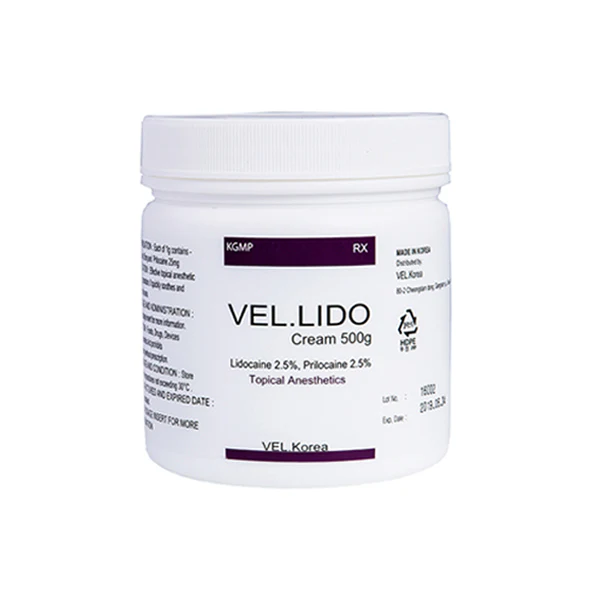
VEL Lido 500g is a medical-grade topical anesthetic combining 2.5% Lidocaine HCl and 2.5% Prilocaine in an EMLA-equivalent oil-in-water emulsion, pH 5.5–6.5, USP 61 compliant (<100 CFU/g). The formula uses a micro-emulsified delivery system (particles under 5µm) at 15,000 cps viscosity, designed to penetrate up to 5mm into the dermal-epidermal junction within 60 minutes under occlusion. Onset is rated at 60–90 minutes with occlusion required, and analgesia continues for 120–180 minutes after the dressing is removed. Supplied in a 500g HDPE jar with heat-induction tamper-evident seal and GS1 batch tracking.
Indicated Procedures
Dermal Filler Prep 5mm penetration depth supports comfort during filler injection sites.
Botox / Neurotoxin Prep Used by medical spas as a pre-treatment for injectable neurotoxin appointments.
Extended Laser Sessions 120–180 minute post-removal duration covers longer laser treatment appointments.
High-Volume Medical Spa Use 500g HDPE jar with GS1 batch tracking suits clinics managing inventory across multiple practitioners.
Clinical Specifications
| Active Ingredients | 2.5% Lidocaine HCl + 2.5% Prilocaine (EMLA-equivalent O/W emulsion) |
| Metabolism | Primarily hepatic via CYP3A4; renal excretion |
| Delivery System | Micro-emulsified (<5µm particle size), 15,000 cps viscosity |
| Penetration | Up to 5mm into the dermal-epidermal junction within 60 minutes under occlusion |
| Onset Time | 60 – 90 minutes (occlusive state required) |
| Analgesic Duration | 120 – 180 minutes post-removal |
| pH Range | 5.5 – 6.5 (dermal barrier matched) |
| Microbial Sterility | USP 61 compliant (<100 CFU/g) |
| Application Density | 0.7g/cm² optimal coverage |
| Thermal Stability | 36 months baseline @ 25°C |
| Packaging | 500g HDPE, heat-induction tamper-evident seal, GS1 batch tracking |
How to Use
- Phase 1 – Degreasing: Cleanse the target dermal area with a pH≤5.5 non-oily cleanser. Avoid alcohol-based astringents, which can alter absorption kinetics.
- Phase 2 – Dispensing: Apply a uniform 2mg/cm² layer. Maintain the formulation’s thickness – do not aggressively rub or massage it into the stratum corneum.
- Phase 3 – Occlusion: Seal completely with standard occlusive film for at least 60 minutes.
- Clearance: Immediately before the procedure, remove the dressing and aggressively wipe away residual base to prevent instrument interference.
- Proceed: Begin the filler, Botox, or laser procedure once the area is clean and anesthesia is confirmed.
Frequently Asked Questions
Why does this product call for at least 60 minutes of occlusion, when other EMLA-equivalent dual-agent creams in the catalog rate onset at 25–35 minutes?
Even among dual 2.5% lidocaine / 2.5% prilocaine formulas, the delivery system affects how quickly the actives reach the dermal-epidermal junction. VEL Lido 500g is built around a micro-emulsified delivery system – particles under 5µm suspended at 15,000 cps viscosity – engineered to drive the actives a full 5mm deep within 60 minutes under occlusion. This deeper-penetration profile is why the rated onset is 60–90 minutes (occlusive state required) and why occlusion is specified for at least 60 minutes in the protocol, rather than the shorter occlusion windows used by faster-acting, shallower-penetration formulas.
What does “primarily hepatic metabolism via CYP3A4” mean, and should this affect which patients I use it on?
CYP3A4 is a liver enzyme responsible for breaking down a large number of medications and other substances absorbed into the bloodstream. Noting that this formula’s active ingredients are primarily metabolized via this pathway is informational – it tells practitioners which metabolic system is involved if systemic absorption occurs. For topical use within the recommended application area and dosage limits, systemic absorption is intended to be minimal. However, for patients with significant hepatic impairment, or those on medications that heavily compete for the same liver enzyme, this information may be relevant background when assessing overall patient suitability – alongside the product’s general contraindication for severe hepatic impairment listed in the safety section.
A reviewer who uses this for filler and Botox prep mentioned it “sets in about 10 minutes faster” than other brands – does that mean it works faster than the rated 60–90 minute onset?
The 60–90 minute figure is the formal rated onset window under standard occlusion conditions. Real-world experience can vary based on application thickness, occlusion technique, and the specific area being treated (see the protocol’s emphasis on a full 2mg/cm² layer without rubbing it in). A practitioner comparing this product to other brands they’ve used in the past may perceive it reaching usable numbness sooner within that 60–90 minute window – for example toward the 60-minute end rather than 90 – if their technique and application matches the protocol closely. The official rated range remains 60–90 minutes, and practitioners should plan their appointment timing around that range rather than assuming the faster end every time.
What do the “30g per session” and “400cm² area” maximums mean together?
These two limits work together as a systemic-safety boundary for a single treatment session. 400cm² (about 20cm x 20cm, or roughly 8×8 inches) is the maximum surface area that should receive this product in one session, and 30g is the maximum total weight of cream that should be used in that same session. At the recommended 0.7g/cm² application density, 400cm² would use roughly 280g of cream – so in practice, the 30g session cap is the more restrictive figure for most treatment areas, meaning practitioners should plan applications based on the 30g ceiling first, and the 400cm² area limit as a secondary boundary for very thin, light applications.
What do “USP 61 compliant (<100 CFU/g)” and “GS1 batch tracking” mean for quality assurance?
USP 61 is a microbiological testing standard that sets limits on the total number of viable microorganisms allowed per gram of a non-sterile pharmaceutical product – “<100 CFU/g” means fewer than 100 colony-forming units per gram, indicating the product meets this microbial cleanliness threshold. GS1 batch tracking refers to a standardized global system for encoding lot/batch information (often via barcodes) so that each jar can be traced back to its specific production batch. Together, these mean the product has been tested against a recognized microbial cleanliness standard and can be traced to its manufacturing batch if a quality question ever arises.
⚠ Safety Information & Contraindications
Contraindications - Mucosal contact, intraocular exposure, or compromised/ablated skin barriers
- Documented hypersensitivity to amide-type anesthetics or cetyl alcohol
- Not evaluated for pediatric use (patients under 12 years)
Stop Use If You Notice - Persistent redness, swelling, or rash beyond mild blanching
- Blistering or skin breakdown at the application site
- Signs of systemic reaction (dizziness, irregular heartbeat, ringing in ears)
Maximum clinical dosage: 30g per single application session, surface area not to exceed 400cm². For professional use only. This product is not a substitute for medical advice.




David Miller –
We use this extensively for dermal filler and Botox prep at the medical spa. The depth of the numbing is exactly what we need for injectables. It feels like they improved the formula compared to last year’s batches of other brands we used, because this sets in about 10 minutes faster. Solid, reliable product for professionals.