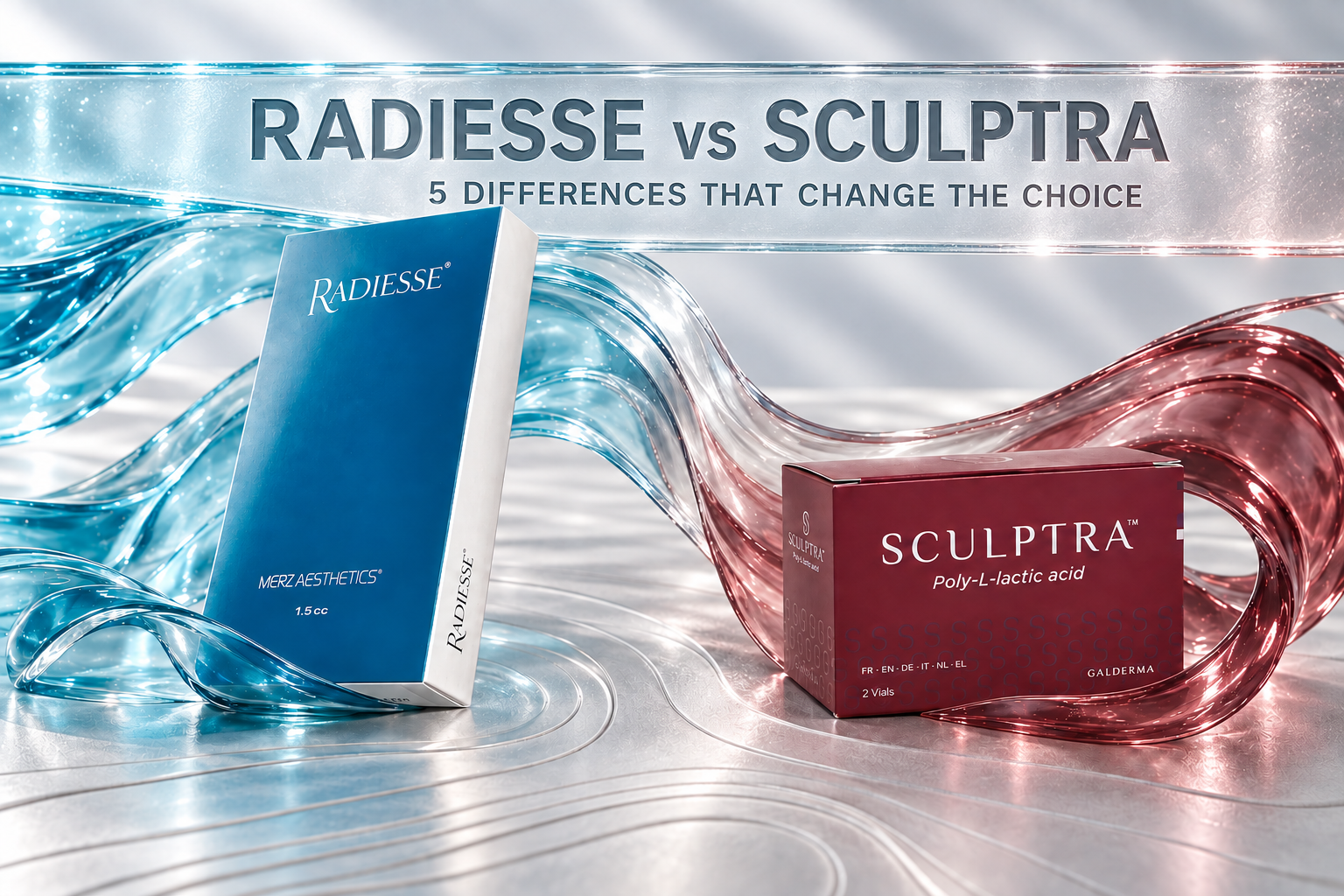
Radiesse and Sculptra are often placed in the same “collagen stimulator” category, but choosing between them is not a small brand preference. One can provide an immediate structural component through a calcium hydroxylapatite gel system; the other is a poly-L-lactic acid treatment whose meaningful correction develops gradually. That difference changes what you may see first, how the plan is assessed, how many visits you may accept and what happens if the result does not match your expectations.
Investigate Radiesse when your priority is a faster, targeted structural result, such as a clinician-led plan for defined contour. Investigate Sculptra when your priority is a gradual change and you are comfortable with a staged treatment plan that is judged over weeks rather than on day one. Neither is universally better, neither is readily dissolved like a hyaluronic acid filler, and neither should be presented as a substitute for surgery when major skin laxity is the real issue.
Radiesse vs Sculptra at a glance
| Decision point | Radiesse | Sculptra |
|---|---|---|
| Material identity | Calcium hydroxylapatite (CaHA) microspheres in a gel carrier | Poly-L-lactic acid (PLLA) particles with a carrier system |
| How the result develops | An immediate volume or contour component, followed by tissue response over time | Initial treatment swelling is not the final result; correction develops progressively |
| Useful choice signal | Faster, more targeted structure or definition | Gradual correction when a staged plan is acceptable |
| Treatment commitment | Individualized; do not assume one appointment is always enough | Current U.S. labeling describes a regimen of up to four sessions, usually assessed several weeks apart |
| Reversibility | Not an HA gel and not readily dissolved with hyaluronidase | Not an HA gel and not readily dissolved with hyaluronidase |
This table is a decision map, not a treatment prescription. Exact indications, formulation names and labeling vary by market. In the United States, for example, current FDA records include Radiesse (+) for moderate-to-severe loss of jawline contour and Sculptra for cheek wrinkles as well as facial wrinkles and folds. A brand-wide list copied from a clinic menu is not a substitute for checking the exact product and intended use.
1. Do you want structure now or change that builds?
This is the clearest practical difference. Radiesse contains CaHA microspheres suspended in a water-based gel. FDA patient information describes visible fullness at the first treatment session because the gel system adds an immediate volume component. Peer-reviewed reviews also describe a later response involving new extracellular-matrix components around the CaHA particles. In plain language, the early contour and the longer biological response are related, but they are not the same thing.
Sculptra is made with PLLA particles. Its current patient labeling is unusually direct: the true correction is not immediate. Water and injection-related swelling can make the area look fuller at first, then that temporary fullness settles before the intended change develops over several weeks. This is why judging Sculptra from a same-day mirror check creates the wrong expectation.
Choose Radiesse to investigate when…
You want the clinician to assess a more immediate structural or contour component and the intended area matches the exact formulation and market label.
Choose Sculptra to investigate when…
You prefer a change that develops gradually and you are prepared to wait before deciding whether the result is sufficient.
The word “natural” does not settle this decision. A conservative Radiesse plan can look subtle, while an excessive or poorly matched plan with any product can look wrong. The better question is whether your desired change is defined and immediate or progressive and assessed over time.
2. Is your priority defined contour or broader gradual correction?
Search discussions often collapse cheeks, temples, folds, jowls, skin quality and sagging into one request for “lift.” Those concerns do not share one cause. A softer jawline may involve lost structural support, but it may also involve skin laxity, fat position, muscle pull or skeletal change. Adding injectable volume cannot reproduce surgical repositioning.
Radiesse is the clearer product to investigate when the decision is about a defined structural contour. The current U.S. Radiesse (+) label provides a concrete example: improvement of moderate-to-severe jawline contour loss in adults over 21. Radiesse labeling also covers specified facial folds and wrinkles, depending on the formulation. That does not mean every jawline, cheek or fold should receive the same product or the same plan.
Sculptra is the clearer product to investigate when the desired change is deliberately gradual and the clinician is evaluating a broader pattern of facial correction. Current U.S. labeling includes correction of fine lines and wrinkles in the cheek region, as well as nasolabial fold contour deficiencies and other facial wrinkles. It does not support turning every social-media claim about temples, under-eyes, necks or body areas into a general product promise.
If sagging cheeks are the main concern, our guide to what Radiesse can and cannot do for sagging cheeks explains the same boundary in more detail. If the choice has expanded beyond these two products, start with how to choose a dermal filler by the change you want.
3. How much treatment commitment can you accept?
Sculptra is commonly a staged decision. Current FDA patient labeling describes a treatment regimen of up to four sessions, scheduled several weeks apart, with reassessment before additional treatment. That is not a promise that everyone needs the same number. It tells you that a fair comparison must include the time and appointments required to reach and judge the planned correction.
Radiesse may offer a visible structural component at the first session, but “immediate” does not mean “one visit for everyone.” The intended area, starting anatomy, formulation and desired degree of correction can change the plan. A responsible comparison therefore avoids the popular shortcut of “one syringe of Radiesse versus three vials of Sculptra.” Those are not universal product facts and can turn a useful guide into a misleading quote.
Compare the total plan, not the unit price
A clinic price per syringe or vial is not the same as total treatment cost. Before comparing quotes, ask what each proposal includes:
- the exact concern and treatment goal being assessed;
- the exact product and market version;
- the expected number of assessment or treatment visits;
- whether the quote covers the complete staged plan or only the first appointment;
- how and when the result will be reviewed;
- what maintenance discussion follows if the initial result is satisfactory.
This also protects professional buyers from comparing unlike pack formats as though they were equivalent treatment units. FillersFairy currently lists Radiesse® 1 × 1.5 ml and Sculptra® (2 Vials). Those listing formats confirm what is being offered; they do not determine a patient’s treatment plan.
4. Which result is likely to last longer?
Sculptra often wins the longevity headline, but the careful answer is more specific. FDA patient labeling reports effects lasting up to 25 months in some patients treated for nasolabial fold wrinkles. In the cheek-wrinkle study, effects remained for most evaluated patients through Month 24 after the initial treatment. These are meaningful durability signals, but they do not guarantee the same duration for every person, concern or off-label area.
Radiesse labeling uses different studies and endpoints. For jawline contour, the patient guide reports that many initial responders still showed improvement at 48 weeks. Its fold-and-wrinkle data also show that duration varies considerably between individuals. These results cannot be placed beside the Sculptra numbers as if the trials treated the same anatomy with the same design.
A recent systematic review found improvements with both PLLA and CaHA products and described longer reported durability for PLLA across the included literature. Another systematic review of PLLA cautioned that much of the evidence for facial rejuvenation remains low quality. The honest conclusion is therefore:
- Sculptra has the stronger long-duration signal when a gradual result and the relevant studied indication match the plan.
- Radiesse may be the more useful choice when an earlier structural effect matters more than maximizing the headline duration.
- Your own duration cannot be predicted from a marketing range alone. Area, tissue, product version, treatment plan and individual response all matter.
If you are comparing Sculptra with a different material because timing is the main concern, the Sculptra vs Juvederm guide explains why a collagen-led plan and a hyaluronic-acid filler plan answer different priorities.
5. How much reversibility and uncertainty can you accept?
This is the point many comparison pages leave until the end, even though it can change the choice immediately. Radiesse and Sculptra are not hyaluronic-acid gels. The FDA notes that filler material not made from HA may be difficult or impossible to remove. Neither product should be chosen on the assumption that hyaluronidase can simply dissolve an unwanted result.
That does not make either product automatically unsafe. It means planning matters more. Both labels describe common short-term injection reactions such as swelling, redness, tenderness or bruising, and both include less common but potentially serious complications. Sculptra labeling specifically discusses delayed lumps or nodules; Radiesse labeling also discusses lumps, migration and vascular complications. The practical safety decision is to use a properly trained, licensed healthcare professional who can identify the concern, confirm the exact product and explain the market-specific labeling and response plan.
Reversibility may point you toward a different conversation:
- If you want a highly precise change and being able to reduce an unwanted result is your first priority, ask whether an HA filler is a better starting point.
- If the main issue is substantial jowling, neck laxity or skin excess, ask whether adding volume would camouflage rather than correct the problem.
- If you want skin-quality improvement without meaningful volume, ask whether the proposed formulation and use are supported for that purpose instead of assuming every “biostimulator” plan is equivalent.
The practical verdict
Choose Radiesse to investigate when you value a faster, targeted structural component and the exact intended use fits the product and your anatomy.
Choose Sculptra to investigate when you value a gradual result, accept a staged plan and are willing to judge the outcome after the collagen-led change has had time to develop.
Choose neither automatically when reversibility is your first concern or major laxity is the real problem. In that case, the best next step is a different treatment discussion, not a stronger sales claim.
Licensed clinics and professional buyers can compare the verified Radiesse and Sculptra listings, then request current stock, batch and market-version documentation for the exact product being considered.
Frequently asked questions
Which is better, Radiesse or Sculptra?
Neither is universally better. Radiesse is the product to investigate when the priority is a faster, targeted structural result. Sculptra is the product to investigate when the priority is gradual correction and a staged treatment plan is acceptable.
Does Radiesse work faster than Sculptra?
Radiesse can provide an immediate volume or contour component through its gel carrier. Sculptra labeling says its true correction develops gradually over several weeks; early fullness from water and swelling is not the final result.
Which lasts longer, Radiesse or Sculptra?
Sculptra has the stronger long-duration signal, with FDA labeling reporting effects up to about two years in some studied facial indications. Radiesse duration varies by indication and individual. The studies are not direct head-to-head comparisons, so neither duration can be guaranteed.
Is Radiesse or Sculptra better for the jawline?
Radiesse (+) has a specific U.S. indication for improving moderate-to-severe loss of jawline contour in adults over 21. That makes it the clearer product to investigate for a defined jawline goal, but a clinician still needs to determine whether the concern is structural volume loss, fat, muscle pull or true skin laxity.
Can Radiesse or Sculptra be dissolved?
They are not hyaluronic-acid fillers and are not readily dissolved with hyaluronidase. The FDA notes that non-HA filler material may be difficult or impossible to remove, so the product, area and treatment plan should be chosen conservatively.
Can Radiesse and Sculptra be used in the same overall plan?
Some clinicians may design multi-product plans for different goals, but that does not make a combination automatically appropriate. The FDA notes that filler combinations have not necessarily been evaluated in controlled clinical studies. Each product, area, timing and risk needs an individual professional assessment.
Sources and evidence boundary
- U.S. FDA: Dermal Fillers (Soft Tissue Fillers)
- U.S. FDA: Radiesse (+) Patient Information Guide
- U.S. FDA: Sculptra Patient Labeling
- Systematic review of facial PLLA and CaHA collagen biostimulators
- Systematic review of PLLA efficacy and safety in facial aesthetics
- Narrative review of CaHA as a regenerative aesthetic treatment
Regulatory indications vary by country, formulation and date. This guide compares decision-relevant product characteristics and does not provide injection instructions or replace an individual medical assessment.