Reviewed against publicly available manufacturer and regulatory information.

Chin filler is best understood as a profile and proportion treatment rather than a generic lower-face filler. A relatively small change in forward projection or vertical length can influence how the nose, lips, jawline, and neck appear together.
This guide focuses on chin retrusion, realistic treatment boundaries, product-specific chin documentation, and clinic purchasing decisions. It does not provide injection points, depths, doses, or individual treatment instructions.
What Can Chin Filler Change?
Chin filler adds temporary volume to the chin region. Depending on the starting anatomy and treatment goal, it may change:
- Forward projection: how far the chin extends in profile
- Lower-face proportion: the visible balance between the upper, middle, and lower facial thirds
- Shape: the apparent width, taper, or central contour of the chin
- Vertical length: the visible height of the lower third
- Chin-to-jaw transition: the connection between the central chin and pre-jowl area
These outcomes are related but not identical. A plan for forward projection is different from one intended to soften a contour irregularity. Before-and-after photographs can illustrate one case, but angle, head position, swelling, and treatment of adjacent areas mean they should not be treated as a forecast for another patient.
What Is Chin Retrusion?
Chin retrusion describes a chin that sits relatively far back in profile. It can affect facial balance and may make the nose, lower lip, submental area, or neck contour appear more prominent. This does not necessarily mean that each of those areas requires treatment.
Filler may be relevant when limited projection is an important part of the visual concern. It cannot correct every skeletal relationship, remove fat, or replace surgery when a more substantial structural change is required. The useful assessment question is therefore not simply “Is the chin small?” but “Which visible proportion is the patient trying to change?”
Chin Filler vs Jawline Filler
Chin filler mainly changes the central lower-face profile. Jawline filler mainly changes the side contour along the mandibular border and jaw angle.
| Decision point | Chin filler | Jawline filler |
|---|---|---|
| Primary region | Central chin | Mandibular border and jaw angle |
| Main visual goal | Projection, length, shape, or profile balance | Side contour and mandibular definition |
| Common overlap | A recessed chin may make the jawline look weaker | Jaw contour alone may not correct chin projection |
Some patients may be assessed for both regions, but “treat both” is not a default rule. Each area needs its own treatment goal. For mandibular contouring, see the Jawline Filler Guide.
Can Chin Filler Change the Look of a Double Chin?
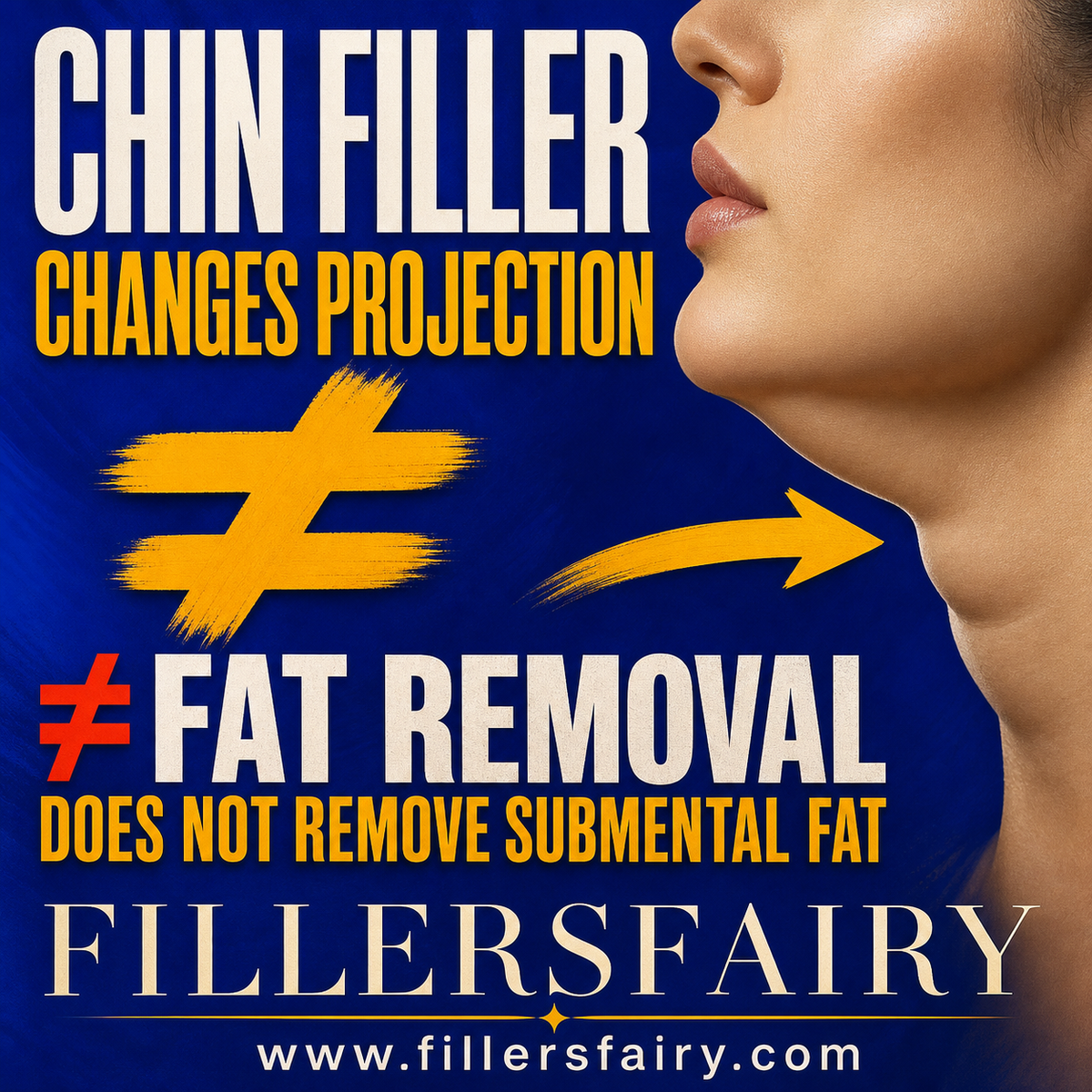
Chin filler does not dissolve or remove submental fat. When limited chin projection contributes to the profile, adding projection may make fullness beneath the chin look less dominant. That is a change in facial proportion, not fat reduction.
A double-chin appearance may involve fat, chin retrusion, skeletal structure, skin laxity, or several factors together. Significant tissue descent may not improve by adding more volume, and an unsuitable treatment can make the lower face look heavier.
The VOLUMA chin study did not establish safety in patients with significant skin laxity of the chin, neck, or jaw. This supports a clear boundary: filler should not be presented as a reliable solution for substantial laxity.
VOLUMA vs Defyne vs Lyft for Chin Augmentation
These three products are hyaluronic-acid fillers with US chin documentation. The comparison below describes regulatory and portfolio roles; it does not rank which product is “hardest” or “best.”
| Comparison | VOLUMA XC | Restylane Defyne | Restylane Lyft |
|---|---|---|---|
| Material | HA | HA | HA |
| US chin indication | Improve the chin profile, adults 21+ | Mild-to-moderate chin retrusion | Mild-to-moderate chin retrusion |
| FDA chin approval | 2020 | 2021 | November 2025 |
| Chin duration statement | Up to one year with optimal treatment | Effect observed through 48 weeks in FDA-reviewed data | Verify current chin-specific labeling |
| Other documented roles | Cheek and temple augmentation | Deep facial folds | Cheek, facial folds, and hands |
| Buyer takeaway | Multi-area structural SKU | Chin plus dynamic-fold portfolio | Recently expanded structural portfolio |
JUVEDERM VOLUMA XC
JUVEDERM VOLUMA received its US chin indication in 2020 for augmentation of the chin region to improve the chin profile in adults over 21. Official information describes chin results lasting up to one year with optimal treatment. See the VOLUMA product page for the version and pack supplied by FillersFairy.
Restylane Defyne and Restylane Lyft
Restylane Defyne received its US chin indication in 2021. FDA-reviewed information reports improvement observed through 48 weeks in the clinical study. View Restylane Defyne product details.
Restylane Lyft with Lidocaine received its US chin indication on November 4, 2025, for adults over 21 with mild-to-moderate chin retrusion. Because this is a newer indication, clinics should check the current chin labeling rather than relying on an older multi-area description. Last regulatory verification: July 2026. View Restylane Lyft product details.
How Long Does Chin Filler Last?
There is no single duration for all chin fillers. VOLUMA official information describes results lasting up to one year with optimal treatment, while FDA-reviewed Defyne data reported effects through 48 weeks. The newer Lyft indication should be checked against its current chin-specific labeling.
These are separate product sources, not a head-to-head longevity study. Individual duration also varies with anatomy, product, treatment plan, movement, and metabolism.
Safety and Treatment Limits
Temporary effects may include swelling, tenderness, bruising, redness, firmness, itching, pain, or lumps. Uncommon vascular complications can be serious and may include tissue injury, visual impairment, blindness, or stroke. HA can often be degraded with hyaluronidase, but that does not remove injection risk or guarantee complete reversal.
The chin contains important vessels, nerves, muscles, and a variable skeletal foundation. Public education should not prescribe universal injection points, depths, doses, or syringe counts. For the broader risk framework, see Dermal Filler Safety Information.
What Clinics Should Verify Before Stocking Chin Fillers
For a clinic buyer, the useful comparison is based on treatment role and documentation rather than a generic firmness label:
- Chin role: Confirm whether the product is documented for chin profile or a defined retrusion range.
- Product behavior: Compare the formulation and handling characteristics relevant to the intended result.
- Pack and supply records: Check syringe volume, lidocaine status, batch traceability, expiry, storage, and sealed packaging.
- Chin-specific evidence: Use duration and safety information from the chin indication, not another facial area.
- Clinical readiness: Maintain trained practitioners, written complication protocols, and appropriate emergency resources.
Frequently Asked Questions
What does chin filler do?
Chin filler temporarily changes projection, shape, length, or lower-face proportion by adding volume to the chin region. The result depends on the starting anatomy and treatment goal.
What is chin retrusion?
Chin retrusion describes a chin that sits relatively far back in profile. It may affect facial balance, but filler is only one possible approach and cannot correct every skeletal relationship.
How long does chin filler last?
Duration depends on the product and patient. VOLUMA information describes up to one year with optimal treatment, and FDA-reviewed Defyne data reported effects through 48 weeks. These are not universal guarantees.
What is the difference between chin filler and jawline filler?
Chin filler mainly changes central projection and profile balance. Jawline filler mainly changes the side contour along the mandibular border and jaw angle.
Can chin filler help a double chin?
It may change profile proportions when limited chin projection contributes to the appearance, but it does not remove submental fat or reliably tighten significant laxity.
Does chin filler tighten loose skin?
Chin filler adds volume; it is not a skin-tightening treatment. Significant laxity requires a separate assessment, and the VOLUMA chin study did not establish safety in patients with significant skin laxity of the chin, neck, or jaw.
What affects the wholesale cost of chin filler products?
Wholesale cost depends on the exact product, pack size, syringe count, lidocaine presentation, destination market, shipping conditions, and supplier documentation. Clinics should compare the cost per sealed pack alongside the product’s intended treatment role.
Related Guides
- Jawline Filler Guide
- JUVEDERM VOLUMA Guide
- JUVEDERM VOLUX Guide
- Dermal Filler Safety Information
- Dermal Filler Collection
Sources Reviewed