Reviewed against publicly available manufacturer and regulatory information.

Jawline filler is one search term for several goals, including mandibular definition, chin-to-jaw balance, early jowling, or lower-face asymmetry. These concerns do not automatically require the same product or treatment category.
This guide explains what jaw filler can change, how HA and CaHA options differ, and what clinics should verify before stocking. It does not provide injection instructions.
What Does Jawline Filler Actually Change?
Jawline filler adds temporary volume to selected lower-face structures. When anatomy and product choice fit the goal, it may make the mandibular border look more continuous or improve the transition between the chin and jaw. It changes contour and support; it does not tighten every layer of the lower face.
Before-and-after images also reflect bone structure, chin projection, soft-tissue thickness, lighting, head position, product, and treatment plan. One photograph cannot predict another patient’s outcome.
Adding volume is not a reliable answer for every case of jowling, laxity, or submental fullness. In an unsuitable candidate, it may make the lower face look heavier or wider.
A useful lower-face assessment looks beyond one line in the mirror. Front, profile, and three-quarter views can reveal whether the main issue is chin projection, mandibular continuity, jaw-angle definition, muscle width, soft-tissue descent, or fullness beneath the chin. This matters because two people who both search for “jawline filler” may be describing completely different anatomical concerns.
Jawline Definition, Chin Projection, Jowls, or Double Chin?
Lower-face concerns sit close together but may have different structural, soft-tissue, fat, or muscular causes.
| Primary concern | What it usually describes | Important boundary |
|---|---|---|
| Loss of jawline definition | A less visible or interrupted mandibular outline | A structural filler may be considered when anatomy and documentation fit the goal |
| Chin retrusion or limited projection | The chin sits farther back in profile or lacks the desired shape | This is primarily a chin-filler decision, even when it affects the overall jawline |
| Submental fullness | Fat or soft-tissue fullness beneath the chin | Filler may alter surrounding proportions but does not remove fat |
| Jowls or skin laxity | Soft-tissue descent, laxity, or a pre-jowl contour change | More volume may not address the main cause and can add heaviness |
| Masseter prominence | Lower-face width driven partly by muscle bulk | Jawline slimming and jawline filling are different treatment goals |
Structural support may change profile proportions in a selected patient, but it does not dissolve submental fat. Significant laxity may also require a different assessment rather than progressively more filler.
Jawline Filler vs Jaw Slimming
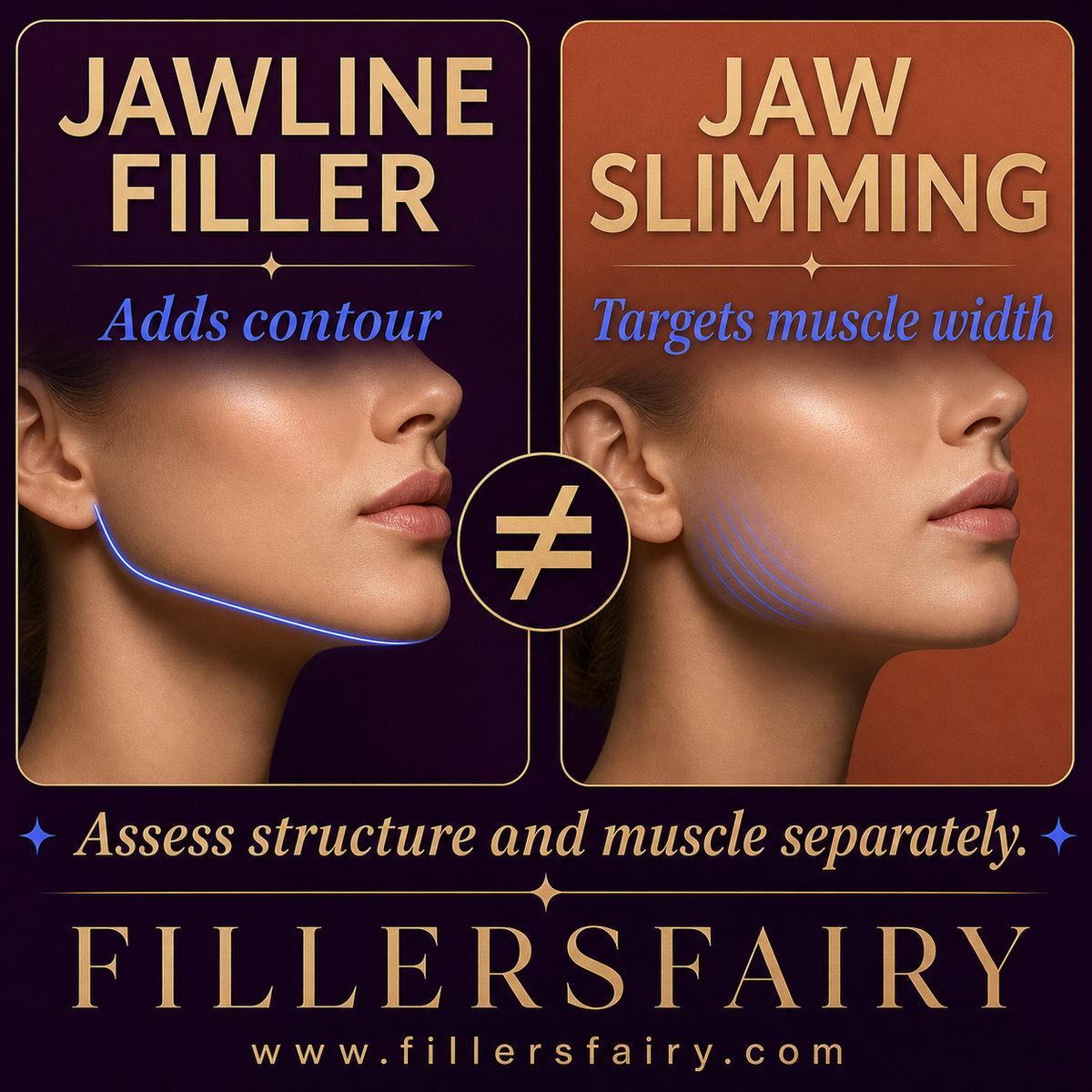
Jawline filling and jaw slimming address different concerns. Filler adds volume or contour to selected lower-face structures. Jaw slimming usually refers to reducing lower-face width when enlarged or highly active masseter muscles are a major contributor; searches often describe this as “masseter Botox.” A muscle-focused treatment does not build a missing mandibular contour, while adding filler does not reduce muscle bulk.
Some patients have both structural deficiency and muscular width, but the two concerns should be evaluated separately. If the face already appears broad because of muscle prominence, adding volume without first identifying the source of width may work against the desired result. The correct category depends on anatomy and the intended change, not on which option is more popular.
Jawline Filler vs Chin Filler: What Is the Difference?
Jawline and chin filler are often assessed together but serve different goals. Jawline filler mainly addresses the mandibular border; chin filler changes central projection, length, shape, or profile balance.
| Decision point | Jawline filler | Chin filler |
|---|---|---|
| Primary region | Mandibular border and jaw angle | Central chin region |
| Typical goal | Side contour and lower-face definition | Projection, shape, length, or profile balance |
| Visual direction | Mostly lateral contour | Mostly forward or vertical profile change |
| Where they meet | The chin-to-jaw transition may be assessed as one lower-face system, but one treatment should not be assumed to substitute for the other. | |
A recessed chin can make the jawline appear less defined, while chin projection alone may not create the desired side contour. See the separate Chin Filler Guide for that decision.
HA vs CaHA for Jawline Contouring
HA and CaHA can both support lower-face contouring, but they are different material systems. HA fillers are crosslinked gels whose firmness, flexibility, water interaction, and tissue behavior vary by formulation. HA can generally be degraded with hyaluronidase, although that correction pathway does not remove the need for careful assessment and complication readiness.
CaHA products contain calcium-hydroxylapatite microspheres suspended in a gel carrier. They provide immediate contour from the carrier and are also positioned around a collagen-related tissue response. CaHA does not have an equivalent hyaluronidase pathway, so material choice affects both the intended role and how a clinic plans for correction. VOLUX and RADIESSE (+) make this distinction concrete without implying that one is universally better.
| Comparison | VOLUX | RADIESSE (+) |
|---|---|---|
| Material | Crosslinked HA gel | CaHA microspheres in a CMC gel carrier |
| Documented jawline role | Restores or creates volume in the chin and jaw area | Improves moderate-to-severe loss of jawline contour |
| Lidocaine | Yes, in the stocked VOLUX with Lidocaine presentation | Yes |
| Correction consideration | HA may be degraded with hyaluronidase | No equivalent hyaluronidase reversal |
| Published duration evidence | Jawline results reported for up to 12 months | Jawline response studied through 48 weeks |
| Buyer fit | HA structural contouring with an HA correction pathway | CaHA contouring with biostimulatory positioning |
These findings come from separate product-specific studies and are not a head-to-head duration comparison.
Read the VOLUX Guide, view VOLUX product details, or browse the dermal filler collection.
How Long Does Jawline Filler Last?
There is no single duration for every jawline filler. Official VOLUX materials describe jawline results lasting up to 12 months, while RADIESSE (+) jawline response was studied through 48 weeks. These are product-specific sources, not a head-to-head comparison.
Duration also varies with anatomy, movement, metabolism, product, and treatment plan. Published follow-up describes study results, not a guaranteed outcome for every patient.
“How long it lasts” may also refer to different endpoints: a visible change, a measured study response, or the point at which a patient considers maintenance. Those are not automatically the same. Clinics should communicate the product-specific study timeframe while making clear that individual results can fade gradually rather than ending on one fixed date.
Jawline Filler Safety, Migration, and Realistic Limits
Temporary treatment-site effects may include swelling, tenderness, bruising, pain, firmness, redness, itching, or lumps. Frequency and duration vary.
Serious vascular complications are uncommon but can include tissue ischemia, necrosis, visual impairment, blindness, or stroke. Hyaluronidase may degrade HA filler, but it does not eliminate risk or provide an equivalent correction pathway for CaHA.
Migration or displacement is possible but not inevitable. Product, amount, anatomy, prior filler, and technique may contribute. Injection planning belongs to qualified practitioners working from the patient’s anatomy and product instructions.
How Clinics Compare Jawline Filler SKUs
For clinics building a lower-face portfolio, the useful question is not “which filler is hardest?” but “which product fits the documented role?” The complete procurement review belongs here:
- Exact SKU and indication: Confirm the named jawline role in current documentation.
- Destination market: Confirm local authorization for the intended use.
- Material and behavior: Compare formulation, rheology, tissue adaptation, and correction pathway.
- Pack format: Check volume, syringe count, lidocaine, accessories, and sealed packaging.
- Area-specific evidence: Use jawline data for that product rather than another facial area.
- IFU, traceability, and storage: Review batch details, expiry, storage, and supplier documents.
- Complication readiness: Maintain trained staff, a written response protocol, and relevant resources.
This framework keeps stocking, documentation, and safety decisions tied to the product being purchased.
Frequently Asked Questions
What is jawline filler?
Jawline filler adds temporary volume or contour along the lower face. It may improve visible definition in a suitable patient, but it does not remove fat or reliably correct substantial laxity.
How long does jawline filler last?
Duration depends on the product, anatomy, movement, metabolism, and treatment plan. VOLUX jawline results are reported for up to 12 months, while RADIESSE (+) jawline response was studied through 48 weeks; these are not head-to-head data.
Does jawline filler make the face wider?
It can change lower-face width or contour. In some patients the result may look sharper; in others, unsuitable volume may make the lower face appear heavier or wider.
Can jawline filler remove a double chin or fix jowls?
Jawline filler does not remove submental fat. A double chin or jowling may involve fat, laxity, skeletal structure, or chin projection, so adding filler may not address the main cause.
What is the difference between jawline filler and chin filler?
Jawline filler mainly addresses lateral contour along the mandibular border. Chin filler mainly changes central projection, length, shape, or profile balance. They may be assessed together but remain different goals.
What is the best filler for the jawline?
Selection depends on the patient’s anatomy and the exact product’s documented jawline role, material, behavior, and local authorization. VOLUX and RADIESSE (+) illustrate different HA and CaHA roles; neither is universally better.
Can jawline filler migrate?
Migration or displacement is possible but not inevitable. Product, amount, anatomy, prior filler, and technique may contribute. Persistent pain, color change, unusual swelling, or visual symptoms require prompt professional assessment.
How many syringes are needed for jawline filler?
There is no universal syringe count. Amount depends on the product, pack size, anatomy, treatment area, intended change, and practitioner plan.
Related Guides
- VOLUX Guide
- Chin Filler Guide
- JUVEDERM VOLUMA Guide
- Nasolabial Fold Filler Guide
- Under-Eye and Tear Trough Filler Guide
- Dermal Filler Collection
Sources Reviewed