Editorial method: this guide separates U.S. regulator information, peer-reviewed evidence, product records and FillersFairy inventory facts. It organizes those sources into a reader decision route but does not diagnose a complication. Last evidence review: August 7, 2026. This article has not been medically reviewed.
Seek immediate medical attention for unusual or severe pain, vision changes, sudden white, gray, blue or blanched-looking skin near the treated area, or signs of a stroke during or shortly after filler treatment. Breathing difficulty or a rapidly progressing whole-body allergic reaction is also an emergency. These are safety routes, not an online diagnosis. The FDA dermal filler safety page advises immediate medical attention for these vascular warning signs.

Scope: this guide helps readers distinguish a possible emergency from a prompt review or a routine aesthetic consultation, identify whether hyaluronidase is even relevant to the known filler material, and prepare useful facts for a qualified healthcare provider. It intentionally omits dose, dilution, injection sites, technique, timing recipes, self-treatment and emergency-treatment protocols.
What Does “Filler Dissolver” Actually Mean?
“Dissolver” is a convenient public term, not the name of one treatment that works on every implant. Hyaluronidase is an enzyme that breaks down hyaluronic acid. In aesthetic practice, a hyaluronidase filler dissolver may be considered when the material is confirmed as HA and a qualified professional has assessed the reason for treatment, the medical context and the expected trade-offs.
The regulatory wording needs care. In the United States, an FDA 2025 executive summary on dermal fillers describes off-label hyaluronidase use as a clinically accepted method for removing HA filler. The same document states that hyaluronidase products have not been evaluated and approved by FDA for use related to dermal fillers. “Clinically accepted off-label use” and “FDA-approved for filler dissolution” are not interchangeable claims.
Labels, prescription rules and authorized uses also differ by product and country. A Korean or European product record cannot establish U.S. approval, and a U.S. statement cannot be generalized worldwide. Product eligibility, professional scope and the controlling local label should be checked for the actual market.
How the Evidence Is Used in This Guide
| Evidence level | What it supports | What it cannot establish alone |
|---|---|---|
| Regulator safety information | Urgent warning signs, U.S. approval boundaries and material-removal limits. | An individual diagnosis or worldwide rule. |
| Peer-reviewed evidence | High-level mechanism, formulation differences, risks and areas of uncertainty. | A consumer protocol or guaranteed outcome. |
| Product record | Facts about one named product and market. | Universal suitability or superiority. |
| Editorial synthesis | A clear material-and-urgency route for readers. | Diagnosis, prescribing or treatment planning. |
| Inventory fact | Whether FillersFairy lists a product for professional buyers. | Clinical evidence, authenticity by itself or patient suitability. |
Can Hyaluronidase Act on the Filler Material?
Material identity is the first compatibility gate. A remembered brand, a photograph or the way a lump feels is not enough to identify a filler. Treatment records, packaging details and a qualified assessment are more useful than guessing. This is why searching for a filler dissolver should begin with “What was injected?” rather than “Which product should I buy?”

| Known or suspected material | What hyaluronidase means here | Safer next question |
|---|---|---|
| Confirmed HA filler | It may be considered after qualified assessment; response is not guaranteed to be uniform or complete. | Why is correction being considered, and what outcome is realistic? |
| PLLA, PDLLA, PCL or CaHA | These are not HA fillers, so hyaluronidase is not their specific reversal agent. | What material-specific assessment is appropriate? |
| PMMA or silicone | These are not HA, and they do not have an equivalent hyaluronidase reversal route. | Which experienced specialist should evaluate the exact material and concern? |
| Unknown or mixed history | Do not assume every area contains only HA or that one response proves the full history. | Can records be obtained and the area be assessed before a plan is chosen? |
The FDA summary notes that semi-permanent PLLA and CaHA fillers and permanent PMMA and silicone fillers have no specific reversal agent equivalent to hyaluronidase for HA filler. FillersFairy’s PLLA, PDLLA, PCL and CaHA material guide explains those non-HA families without implying an alternative dissolving protocol.
Even confirmed HA products do not all behave identically. Formulation, crosslinking, location, the amount and age of remaining material, and the clinical reason for review can affect the response. A 2025 peer-reviewed HA-filler dissolution study found response differences across tested HA filler types and experimental conditions. That evidence supports individualized assessment; it does not provide a consumer dosing formula.
Is This an Emergency, a Prompt Review or a Routine Consultation?
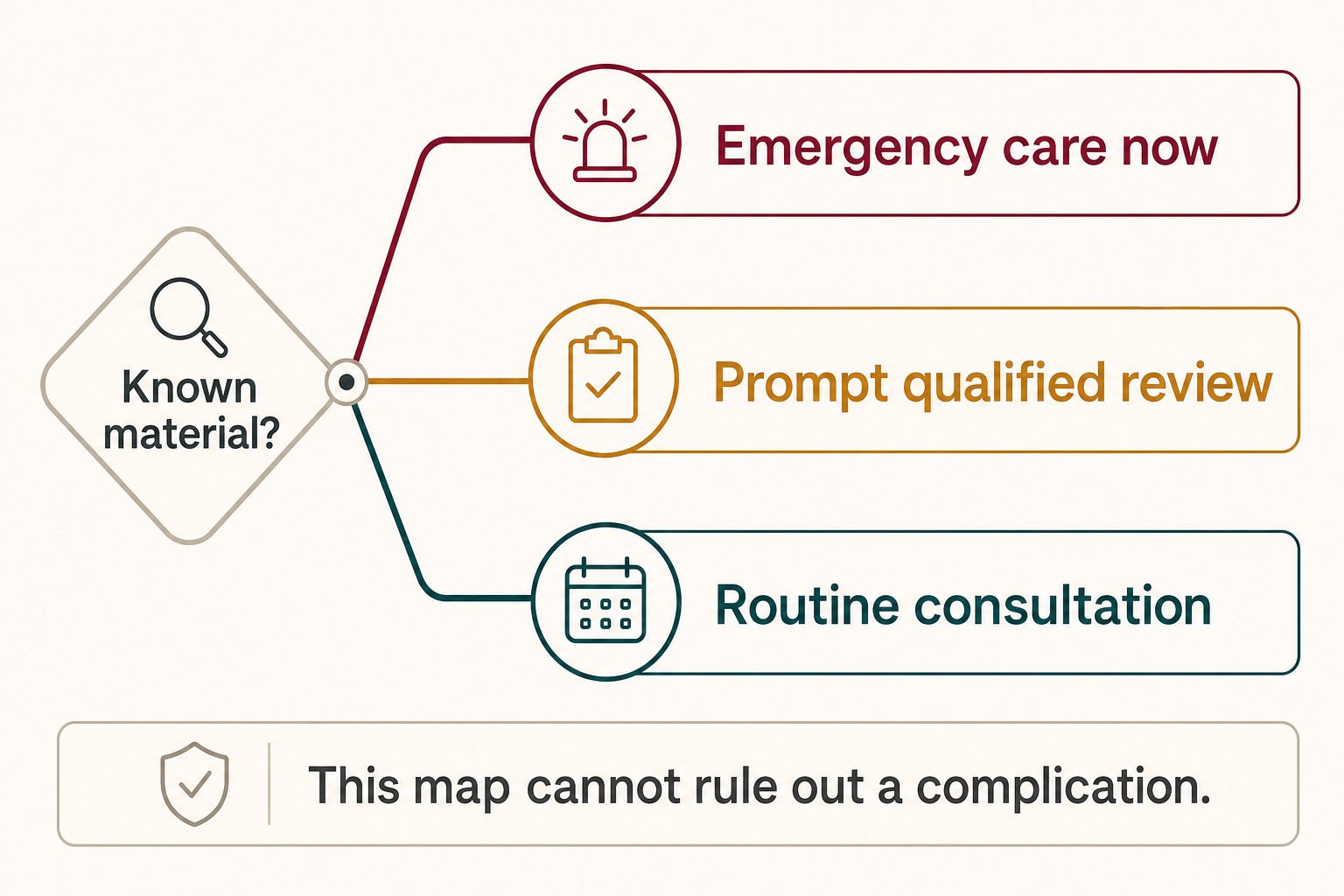
The same request to “dissolve filler” can hide very different levels of urgency. Use the routes below to understand why the next step may differ, but do not use them to rule out a complication. Symptoms, timing, treatment area and medical history matter, and uncertain or changing symptoms need professional assessment.
| Emergency care now | Prompt qualified review | Routine consultation |
|---|---|---|
| Vision change; stroke-like symptoms; unusual or severe pain during or shortly after injection; sudden white, gray, blue or blanched skin; breathing difficulty; or a rapidly progressing systemic reaction. | Worsening pain, warmth, redness, drainage, persistent or increasing swelling, a new delayed nodule, or any change that cannot be confidently understood online. | Stable aesthetic dissatisfaction, asymmetry, an overfilled look, a possible migration concern, a stable irregularity, or a preference to move toward less volume without warning signs. |
Common Non-Emergency Reasons People Request an Assessment
Some people ask when to dissolve filler because the result feels too full, uneven or different from the agreed goal. Others notice asymmetry, a visible or palpable irregularity, a possible migration pattern, or simply decide that less volume would suit them better. These concerns can justify a routine consultation even when there is no emergency signal.
A persistent blue-gray cast may sometimes be discussed in relation to superficially placed HA filler, but it should not be diagnosed from a description alone. A longstanding stable color concern is also different from a sudden white, gray or blue skin change during or shortly after an injection, which belongs on the urgent route above.
Dissolving filler is not a promise to restore an exact old photograph. The starting point may include remaining filler, swelling, baseline asymmetry, previous treatments and tissue change. A useful consultation defines the concern and the realistic direction of change rather than promising a perfectly reconstructed baseline.
What a Qualified Assessment Should Confirm First
A responsible assessment connects the material, timeline, symptoms and desired outcome. Imaging may be considered by a suitably trained clinician in some circumstances, especially when product location or identity is uncertain, but it is not presented here as mandatory or as a guarantee of diagnosis or outcome.
- Product identity: the brand and exact product if known, packaging, implant card, invoice or treatment record.
- Treatment history: area treated, date, clinic or injector, and the number of previous treatments in that area.
- Symptom timeline: what changed, when it began, whether it is stable or progressing, and any associated pain, warmth, redness, swelling or systemic symptom.
- Photographs: clear images from before treatment and from several points in the change, without filters or altered lighting where possible.
- Relevant history: previous filler reactions, allergies, current medical conditions and medicines, shared privately with the treating professional.
- Your actual goal: emergency evaluation, relief of a symptom, correction of one irregularity, partial volume reduction or a broader return toward baseline.
FillersFairy can provide product information and inventory context, but it is not the treating clinic and cannot use an email, photograph or purchase request to diagnose a complication or design an individual treatment plan.
Expectations, Uncertainty and Filler Dissolver Risks
A filler dissolver decision involves trade-offs. Partial correction may be possible in some situations, but neither a precise percentage of removal nor a perfectly even endpoint can be promised. A professional may need to reassess the area after the immediate tissue response settles, and lack of the expected effect can prompt a review of the material identity, product location and original assumption.
At a high level, reported concerns associated with hyaluronidase use include swelling, redness, bruising, pain or burning, allergic reactions, an unintended loss of volume and lack of effect. The FDA’s 2025 summary lists adverse-event reports but does not turn those reports into an individual probability. A peer-reviewed safe-use guideline also discusses formulation and allergy considerations. Those sources support qualified history-taking and preparedness, not self-screening or a home protocol.
Appearance after HA filler reversal is influenced by baseline anatomy, residual filler, temporary swelling, earlier tissue stretching or change, and time. It should not automatically be attributed to removal of the body’s “natural HA,” nor should every crease be assumed permanent. Readers with that specific concern can continue to the separate guide on wrinkly lips after dissolving filler.
Why This Is Not a DIY Procedure
Hyaluronidase is not an at-home fix. Choosing a product from an online listing cannot establish what filler is present, whether a symptom is urgent, whether a proposed use is lawful in the reader’s market, or whether the setting can recognize and respond to an adverse reaction. Suspected vascular or severe allergic complications need immediate professional care, not an online order.
This guide therefore provides no supplies list, dilution ratio, dose, injection point, depth, massage instruction or waiting formula. Material identity, anatomy, allergy and medical history, prescription controls, product provenance and emergency readiness all belong in the professional decision.
After that safety distinction is clear, clinic teams researching one named product can read the Liporase Hyaluronidase product-facts guide. It covers exact product identity, storage and evidence boundaries; it is not proof that Liporase or any other product is appropriate for a particular person.
Next Reading After the Safety Decision
Suitability and urgency come before price. Once the filler material and purpose of the consultation are understood, readers comparing the commercial context can use the separate filler dissolver cost guide. A price page cannot replace clinical assessment, and people with symptoms should use the care route that matches the urgency rather than a shopping route.
Frequently Asked Questions
What is a filler dissolver?
A filler dissolver usually means hyaluronidase used to break down hyaluronic acid filler. It is not one universal treatment for every filler material, and suitability depends on the material, concern, medical context and qualified assessment.
Can hyaluronidase dissolve every type of dermal filler?
No. Hyaluronidase acts on hyaluronic acid. PLLA, PDLLA, PCL, CaHA, PMMA and silicone are not HA fillers and do not share the same specific reversal route. An unknown or mixed treatment history should be identified rather than guessed.
When can a filler concern be an emergency?
Seek immediate medical attention for vision changes, stroke-like symptoms, unusual or severe pain, or sudden white, gray, blue or blanched skin during or shortly after filler treatment. Breathing difficulty or a rapidly progressing systemic reaction is also an emergency.
Can filler be partially dissolved?
Partial correction may be considered in some HA-filler situations, but a precise percentage or perfectly even endpoint cannot be promised. The filler formulation, location, remaining material and clinical context can affect the response and follow-up assessment.
Does dissolving filler always return the face or lips to the old baseline?
No. The later appearance can reflect baseline anatomy, residual filler, temporary swelling, prior tissue change and time. A qualified provider should discuss a realistic direction of change rather than guarantee an exact return to an old photograph.
Can I dissolve filler at home?
No. A product purchase cannot confirm material identity, urgency, allergy risk, anatomy or emergency readiness. Do not inject yourself or follow an online dosing recipe; seek an appropriately qualified healthcare professional, and use emergency care for urgent warning signs.