Reviewed against current manufacturer information, public regulator records and peer-reviewed literature. Last source review: July 29, 2026.

Four Material Questions Before Product Selection
| What the consultation is trying to understand | Material path to investigate | Expected visual rhythm | What must be verified next |
|---|---|---|---|
| “We want a broad, gradual restoration programme.” | PLLA | Early prepared-fluid change settles; the intended correction develops over weeks and months. | Exact product IFU, preparation workflow, documented uses and follow-up evidence. |
| “Do we want PDLLA alone or a PDLLA + HA family?” | PDLLA | Gradual remodelling, with the early presentation influenced by the exact carrier and formula. | Whether the exact SKU is PDLLA-only or hybrid, plus its strength, label and product-specific evidence. |
| “We need a ready-to-use liquid regenerative route.” | PCL | Progressive tissue-quality change rather than an assumed HA-style projection effect. | Liquid versus microsphere formulation, exact product record and the maturity of product-specific evidence. |
| “We want visible structural support now and a later biostimulatory phase.” | CaHA | An immediate carrier-based contour component followed by progressive remodelling. | Exact CaHA product, version, concentration, indication, study and destination-market documents. |
The decision rule: a material name guides the first question; the exact product file controls composition, evidence and authorised purpose.
What Is a Collagen Stimulator?
In aesthetic medicine, the term usually describes an injectable material selected partly for the tissue response it is intended to support. The product may create some physical filling or structural support, but the consultation also anticipates a gradual change associated with extracellular-matrix remodelling, including new collagen.
This differs from the usual buying logic for a conventional hyaluronic-acid gel, which is commonly chosen first for immediate volume, shape, hydration or tissue integration. A collagen-stimulator pathway places more weight on formulation, biological timing, preparation workflow and product-specific evidence.
A 2024 systematic review of facial biostimulators identified growing clinical interest but also limited quantifiable data across products. That is an important purchasing lesson: the broad mechanism is useful for education, while claims about magnitude, duration or a specific visual result require the exact study and product version.
PLLA, PDLLA, PCL and CaHA at a Glance
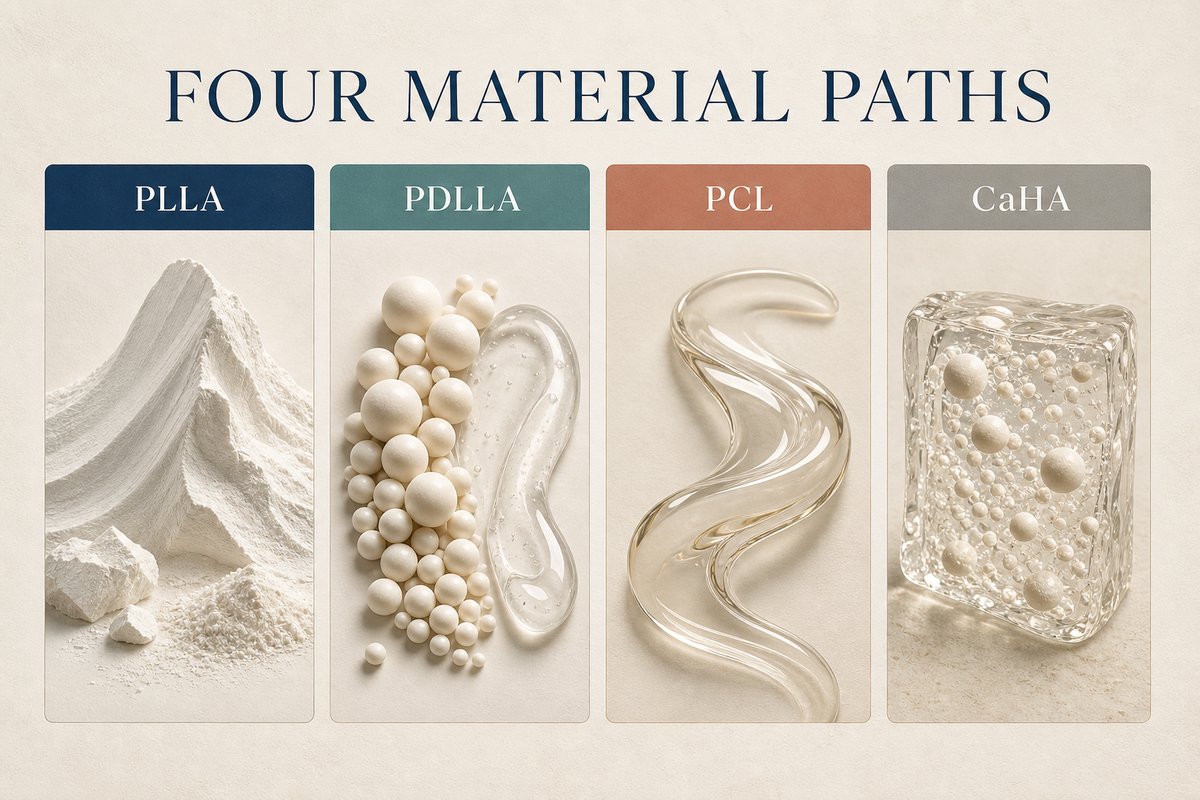
| Material | Representative form in this guide | Early visible component | Useful evaluation window | Representative FillersFairy products | What the material name does not prove |
|---|---|---|---|---|---|
| PLLA poly-L-lactic acid |
Biodegradable microparticles supplied as a lyophilised powder and reconstituted before professional use. | Prepared fluid and normal post-procedure swelling can affect the earliest appearance; intended restoration is gradual. | About 4–12 weeks for meaningful progressive assessment; longer follow-up belongs to the exact product study. | Sculptra | That every PLLA brand has Sculptra’s formulation, indications, preparation or 25-month clinical follow-up. |
| PDLLA poly-D,L-lactic acid |
Lyophilised products that may be PDLLA-based without HA or formulated as PDLLA + non-crosslinked HA. | Depends on the exact formula and carrier; the collagen-related phase remains gradual. | About 4–12 weeks for progressive assessment; duration should be described from exact-product evidence. | AestheFill; Juvelook 50 mg; Juvelook 200 mg | That AestheFill and Juvelook have the same formula, evidence, strength or consultation role. |
| PCL polycaprolactone |
The representative route here is a ready-to-use liquid PCL product rather than an older PCL microsphere filler. | Do not assume instant high projection; the expected direction depends on the exact liquid or particle formulation. | About 4–12 weeks for progressive tissue-quality assessment; liquid-PCL clinical evidence is still developing. | Gouri | That data from a PCL microsphere filler or one limited liquid-PCL study applies to every PCL product. |
| CaHA calcium hydroxylapatite |
CaHA microspheres suspended in a gel carrier and supplied in pre-filled syringes. | Immediate structural or volumising support can come from the carrier system. | About 4–24 weeks for product studies assessing remodelling or skin-quality outcomes. | Radiesse; Volassom | That Radiesse and Volassom share the same label, evidence package, version or authorised use. |
How the Four Material Paths Differ
PLLA: a gradual, reconstituted programme
PLLA is a biodegradable polymer used in particle-based injectable products. The current Sculptra instructions for use describe PLLA microparticles with carboxymethylcellulose and mannitol, supplied in a vial that is reconstituted before use. The same file documents gradual improvement over several weeks and includes controlled and extension follow-up through 25 months for the studied Sculptra use.
The accurate conclusion is that one exact PLLA product has product-specific follow-up through that period. Another PLLA formulation still needs its own label, evidence and workflow. PLLA supports a progressive restoration conversation rather than a single instant gel correction.
PDLLA: the formula matters as much as the polymer name
PDLLA combines D- and L-lactic-acid units, but commercial products do not all use the same formulation. REGEN Biotech positions AestheFill as an injectable PDLLA filler. By contrast, the official Juvelook product page identifies PDLLA + HA formulas and separates product strengths, including 50 mg and 200 mg presentations.
A clinic therefore has two different PDLLA questions: “Do we want a PDLLA-based programme without an HA hybrid story?” and “Do we want a PDLLA + HA family with strength-based roles?” A 2024 PDLLA literature review supports the material’s biodegradability and tissue-regeneration interest while also noting complications and the need to understand physical and chemical characteristics. It does not make AestheFill and Juvelook interchangeable.
PCL: separate liquid PCL from particle-based PCL
PCL is another biodegradable polymer, but “PCL filler” is too broad for a purchasing or evidence claim. Gouri represents a liquid route. The Australian TGA record identifies Gouri as a Class III polycaprolactone injectable implant manufactured by Dexlevo. That regulatory record establishes product identity in that market; it does not establish every global indication.
Liquid-PCL literature is newer than evidence for some PLLA and CaHA products. A published liquid-PCL case report covers one specialised patient and calls for larger, longer trials. Gouri therefore provides a distinct ready-to-use pathway, while expectations remain proportionate to exact evidence.
CaHA: an immediate carrier effect plus remodelling
CaHA products combine mineral microspheres with a gel carrier. This is why CaHA can be discussed differently from gradual powder-only routes: the gel can provide visible support immediately, while the tissue response develops later. The current Radiesse information distinguishes its labelled product versions and describes both volumising and biostimulatory roles.
A systematic review of CaHA mechanisms found evidence of collagen production, cell proliferation and elastic-fibre changes, while also noting methodological limitations. Product-level evidence must still remain product-level: a prospective Volassom study followed 15 participants for 24 weeks and reported midface-volume and skin-quality outcomes. Those results support a Volassom-specific discussion, not a blanket promise for every CaHA syringe.
Collagen Stimulator Timeline: What Changes When?
| Time window | What may influence appearance | What the clinic can reasonably discuss | What the window cannot prove |
|---|---|---|---|
| Day 0 to first week | Prepared fluid, gel carrier, normal swelling and the product’s physical placement. | CaHA may show a genuine immediate structural component; powder-based products should not be judged only from the earliest fullness. | The final collagen-related result or fixed duration. |
| Weeks 4–12 | The early carrier/fluid effect is less dominant and progressive tissue change becomes more assessable. | Whether the visual direction is developing as intended, using the exact product’s assessment plan. | That every patient or material reaches a peak at the same time. |
| Months 3–6 | More mature remodelling and the combined effect of the completed professional plan. | Product-specific outcomes when the supporting study includes this follow-up window. | A universal “six-month result” for all PLLA, PDLLA, PCL or CaHA products. |
| Beyond 12 months | Individual biology, baseline tissue, product, area and the completed plan increasingly affect persistence. | Only the exact product’s long-term label or study, with its population and limitations. | That sharing a polymer guarantees the same 18-, 24- or 25-month duration. |
Which Material Path Should a Clinic Investigate First?
| Clinic service question | First material investigation | Representative products | The next decision |
|---|---|---|---|
| Gradual broad restoration is the central consultation promise. | PLLA | Sculptra | Can the clinic support the preparation, expectation-setting and exact documented programme? |
| The clinic wants Korean PDLLA, but needs two clearly different service stories. | PDLLA-only versus PDLLA + HA | AestheFill; Juvelook 50 mg / 200 mg | Which exact formula, strength and manufacturer documentation matches the intended consultation? |
| The clinic wants a ready-to-use route without powder reconstitution. | Liquid PCL or CaHA | Gouri; Radiesse; Volassom | Is the service centred on gradual liquid-PCL tissue quality or immediate CaHA structure plus remodelling? |
| The consultation needs an immediate structural component. | CaHA | Radiesse; Volassom | Which exact product, pack, study, label and destination-market file supports the intended role? |
Once the material route is clear, use the Biostimulatory Fillers product and clinic-selection guide to compare the six inventory roles. For product-level education, continue to the protected Juvelook guide or Volassom guide; these pages retain their existing search jobs.
Evidence Ladder for Clinic Buyers
| Evidence level | What it can support | What it cannot support | Clinic use |
|---|---|---|---|
| 1. Exact label, IFU or regulator record | Product identity, composition, authorised purpose, warnings and jurisdiction-specific status. | Automatic use in another country or another version of the brand. | The first document checked before the product enters the menu. |
| 2. Exact-product clinical study | The studied product, population, outcome, follow-up and limitations. | Equivalent results for another brand sharing the material. | Set product-specific expectations without turning a small study into a guarantee. |
| 3. Material-level review | Mechanism, evidence patterns, common uncertainties and research gaps. | A brand indication, exact duration or superiority claim. | Train the team to explain PLLA, PDLLA, PCL and CaHA accurately. |
| 4. Manufacturer-positioned role | How the company presents a product family or technology. | A regulatory indication unless the exact label says so. | Build brand-consistent service language and then verify it against formal documents. |
| 5. FillersFairy inventory information | Current SKU, strength, pack and availability details. | Clinical outcomes or destination-market authorisation. | Confirm which presentation is being sourced after the clinical route is defined. |
Limits, Reversibility and Professional Assessment
Collagen stimulators should not be presented as a guaranteed way to “make collagen,” create a fixed lift or last a fixed number of months. Product, formulation, tissue quality, age, area, previous treatments and individual biology all affect the result. A study’s average outcome does not become a promise for one patient.
PLLA, PDLLA, PCL and CaHA are also not reversed like an HA-only gel. Hyaluronidase does not dissolve these polymers or mineral microspheres. A hybrid PDLLA + HA product contains an HA component, but that does not make the entire product or the later tissue response immediately reversible. This difference belongs in the consultation before product selection.
Collagen Stimulator Safety
Selection and administration belong to appropriately qualified professionals who understand the exact product, facial anatomy, preparation requirements and complication management. Expected early reactions can include swelling, redness, tenderness and bruising. Delayed nodules, inflammatory reactions, infection and granuloma are documented possibilities across parts of the category, while unintended vascular injection can cause rare but serious injury.
A patient with an unknown previous filler, active infection, unexplained persistent nodule, suspected product migration or unresolved inflammatory reaction needs individual clinical assessment before another injectable is added. Unusual severe pain, skin blanching or grey-blue colour change, visual symptoms or neurological symptoms require immediate emergency evaluation.
Frequently Asked Questions
Are collagen stimulators the same as dermal fillers?
They overlap, but the buying logic is different. Some collagen stimulators also provide physical filling or structural support, while their consultation additionally focuses on gradual tissue remodelling. The exact balance depends on the product and formulation.
Which collagen stimulator material lasts the longest?
No material should be declared the universal winner. Long-term claims belong to exact products and studies: for example, the Sculptra file includes follow-up through 25 months, while the cited Volassom study followed 15 participants for 24 weeks. Those timeframes cannot be transferred to every PLLA or CaHA product.
Do collagen stimulators give immediate volume?
CaHA products can provide an immediate structural component from their gel carrier. With reconstituted PLLA or PDLLA, very early fullness can be influenced by prepared fluid and swelling, while the intended collagen-related change develops over the following weeks and months. Liquid PCL requires its own product-specific expectation.
Can PLLA, PDLLA, PCL or CaHA be dissolved?
They are not dissolved by hyaluronidase in the way an HA-only filler can be. An HA component in a hybrid formula does not make the polymer or the resulting tissue response fully reversible.
Which material path should a clinic investigate first?
Start with the service question: PLLA for a recognised gradual restoration programme; PDLLA when formula and hybrid options matter; liquid PCL for a ready-to-use progressive tissue-quality route; or CaHA when the consultation needs an immediate structural component plus later remodelling. Then verify the exact product documents.
Move from Material Education to Product Selection
PLLA, PDLLA, PCL and CaHA give the clinic four useful starting paths, not four guaranteed outcomes. The next step is to match the chosen material question to an exact product, evidence level, service menu and destination-market file.
Continue with the Biostimulatory Fillers Guide for six product roles and clinic stock combinations, or browse the current PLLA, PDLLA, PCL and CaHA collection after the consultation route has been defined.