Editorial method: this guide separates the Korean regulator record, current manufacturer identity, peer-reviewed evidence and inventory claims. It does not transfer a statement from one evidence layer to another. Last evidence review: August 5, 2026.
Scope: this is a product-identity and sourcing guide for clinic teams and professional buyers. It does not provide a dilution ratio, dose, injection site, injection depth, mixing volume, self-use instruction or treatment protocol. It also does not establish that the product is authorized for the same purpose in every market. The supplied pack, current local record and qualified professional judgement remain controlling.
For current pack availability, use the Liporase Hyaluronidase product page. Its storage and safety wording has been reconciled with the evidence boundaries in this guide, but the supplied market-specific label still controls.
Does Liporase Need Refrigeration?
The most direct answer comes from the current Korean Ministry of Food and Drug Safety product record for 리포라제주(히알우로니다제), product code 200804336. Its storage field reads “sealed container, room-temperature storage below 25°C.” In practical terms, the unopened product described by this record is a below-25°C room-temperature product, not a product whose official Korean record requires a 2–8°C refrigerator.
That conclusion should be stated precisely. For sealed Liporase Hyaluronidase, “no refrigeration requirement” does not mean the product can be exposed to uncontrolled heat, direct sun, a hot vehicle or a damaged shipping environment. It also does not prove that every market-specific pack has identical instructions. A clinic should keep the product sealed, maintain the temperature condition shown on the supplied label and reconcile any conflicting document before accepting stock.
| Product state | What the Korean record supports | What not to infer |
|---|---|---|
| Sealed and unopened | Sealed container, room temperature below 25°C. | Do not relabel it as a mandatory 2–8°C product without a controlling document for that pack. |
| Receiving and storage | Verify that the seal, lot, expiry and actual label are consistent with the below-25°C record. | Room temperature is not permission for uncontrolled heat or an undocumented supply chain. |
| After solution preparation | The Korean precautions say to use the prepared solution immediately. | Do not turn the unopened-product storage statement into permission to refrigerate and reuse a prepared solution later. |
If a commercial listing says “keep refrigerated” while the current Korean record says sealed room-temperature storage below 25°C, the conflict should be documented rather than silently resolved by copying the reseller wording. Ask the responsible party to identify the exact market label, document version and product state to which the alternate instruction applies.
Verified Liporase Hyaluronidase Product Identity
The Korean record identifies Liporase Injection as a prescription medicine manufactured by Daehan New Pharm Co., Ltd. It records hyaluronidase 1,500 IU EP per vial, lactose hydrate as an excipient, 10 vials per box and a 36-month shelf life from manufacture. These are product-identity fields; they are not a treatment recommendation or a superiority score.
| Field | Recorded fact | Verification note |
|---|---|---|
| Product | 리포라제주(히알우로니다제) | Match the Korean name and product code 200804336. |
| Manufacturer | Daehan New Pharm Co., Ltd. | Do not substitute a similarly named hyaluronidase product. |
| Declared amount | Hyaluronidase 1,500 IU EP per vial | A vial amount is not a patient dose. |
| Excipient | Lactose hydrate | Keep ingredient facts attached to the exact product record. |
| Pack | 10 vials per box | Confirm lot, expiry and seal on the received pack. |
| Storage | Sealed, below 25°C at room temperature | No 2–8°C refrigeration requirement appears in this record. |
What the Korean Record Supports—and What It Does Not
The official Korean indications discuss increasing tissue permeability and supporting dispersion or resorption in specified medical contexts. They do not explicitly name aesthetic dermal-filler dissolution as an approved Liporase indication. This distinction matters because professional off-label discussion, a product registration record and a supplier’s sales description answer different questions.
The same separation applies in the United States. An FDA 2025 executive summary on dermal fillers describes hyaluronidase use for removing hyaluronic acid filler as clinically accepted off-label practice, while stating that hyaluronidase products have not been evaluated and approved by FDA for this dermal-filler use and that specific dosage and injection recommendations are not well established. A Korean prescription-drug record therefore cannot be converted into a worldwide filler-dissolver approval claim.
Hyaluronidase Is Not a Universal Filler Eraser
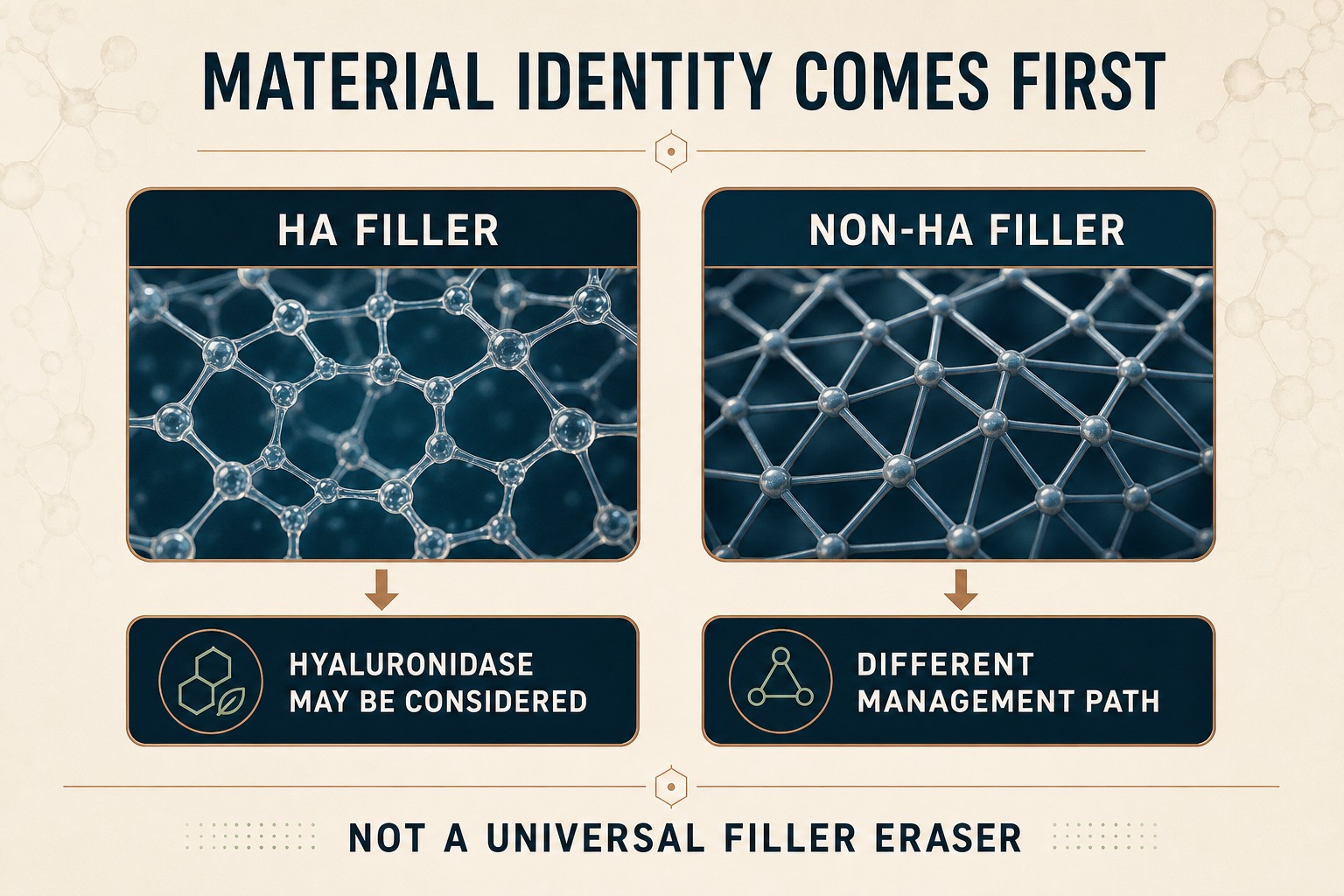
Hyaluronidase acts on hyaluronic acid, so the first question is what material is actually present. Even within HA fillers, formulation, crosslinking and the clinical situation can affect the assessment. Product identification and qualified evaluation cannot be replaced by recognizing a brand name from memory.
PLLA, PDLLA, PCL, calcium hydroxylapatite and PMMA are not hyaluronic acid fillers. The FDA summary notes that semi-permanent and permanent materials do not have a specific reversal agent equivalent to hyaluronidase for HA filler. FillersFairy’s PLLA, PDLLA, PCL and CaHA material guide explains why those product families follow separate evidence and management routes, while the Korean dermal filler family guide provides context for identifying HA product families without treating every SKU as interchangeable.
Why This Guide Does Not Include Mixing or Dosing Instructions
A Liporase Hyaluronidase product guide should not turn a prescription medicine into a do-it-yourself protocol. The appropriate decision depends on the exact product, the filler material, the reason for assessment, the anatomy, the person’s medical and allergy history, the destination market and the professional setting. Copying a volume or unit number from an unrelated indication would remove those controls and could be harmful.
This article therefore records the vial identity and storage facts but intentionally omits dilution ratios, units per area, injection points, depths and procedural sequences. The MFDS record’s instruction to use a prepared solution immediately is included only to prevent the unopened-storage rule from being misread as permission for later reuse.
Safety and Professional-Assessment Boundaries
The Korean precautions list hypersensitivity to the medicine or bovine protein among the contraindication fields and report that severe allergic reactions with shock can occur rarely. They also include postmarketing anaphylaxis. A peer-reviewed review of allergic complications of hyaluronidase identified reports involving prior allergy history, allergic disease and repeated exposure. These findings support careful professional history-taking; they do not provide an online method for predicting an individual reaction.
A routine sourcing question and an urgent clinical problem are not the same task. Sudden severe pain, skin color change, visual disturbance, breathing difficulty or a rapidly evolving systemic reaction requires immediate qualified medical assessment rather than an article, a product order or an email exchange. This page does not remotely diagnose whether hyaluronidase is appropriate.
Read Liporase Evidence in the Right Order
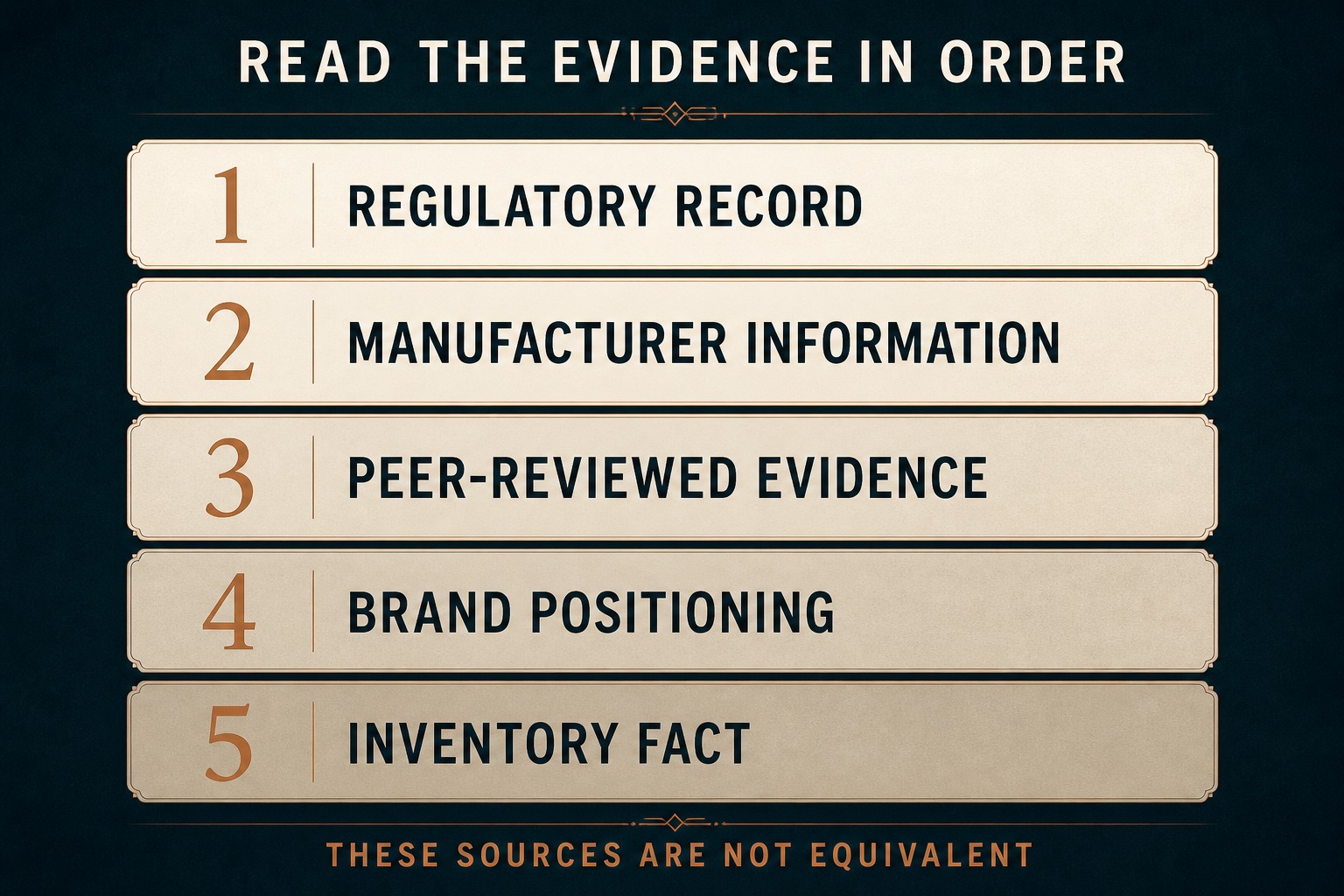
| Evidence level | Best use | Limit |
|---|---|---|
| 1 — Regulatory record | Product identity, classification, label wording, warnings, storage and pack. | One country’s record does not prove worldwide authorization. |
| 2 — Manufacturer information | Current family identity and manufacturer-issued specifications. | It is not independent clinical proof. |
| 3 — Peer-reviewed evidence | Defined findings for the intervention, population and outcome studied. | Category evidence cannot automatically be assigned to Liporase. |
| 4 — Brand positioning | How a product is described commercially. | It does not override a regulator record. |
| 5 — Inventory fact | Whether a named SKU is currently listed. | It does not establish authenticity, approval or suitability by itself. |
Clinic Receiving and Identity Checklist
- Match the exact identity: reconcile the Korean name, Liporase name, manufacturer and product code 200804336.
- Read the actual storage field: for the cited Korean record, the unopened pack is sealed and stored below 25°C at room temperature; do not automatically add a 2–8°C requirement.
- Protect the temperature condition: room-temperature storage still requires control below the stated maximum and protection from an undocumented heat excursion.
- Check pack and traceability: record the 1,500 IU-per-vial identity, 10-vial pack, lot, expiry, seal condition, invoice and receiving date.
- Resolve conflicting documents: preserve both versions and request written clarification rather than choosing the more convenient instruction.
- Keep prepared-solution wording separate: the official precautions say to use it immediately after preparation; the unopened storage rule does not create a reuse window.
- Confirm local eligibility: verify the destination market, responsible professional controls and current supplied documentation before purchase or use.
Storage and price are separate questions. Readers researching the commercial cost context can use the protected filler dissolver cost guide; its presence does not replace product verification or a professional suitability assessment.
Frequently Asked Questions
Does unopened Liporase Hyaluronidase need to be refrigerated?
Not under the cited Korean MFDS record. It states that sealed Liporase should be stored at room temperature below 25°C and does not list a 2–8°C refrigeration requirement. The supplied market label still needs to be checked.
Can prepared Liporase solution be stored in a refrigerator for later use?
This guide does not support that conclusion. The Korean precautions say to use the solution immediately after preparation, so the unopened-product room-temperature rule should not be applied to a prepared solution.
What does the Korean Liporase record list?
It identifies a Daehan New Pharm prescription medicine containing hyaluronidase 1,500 IU EP per vial, with lactose hydrate as an excipient, 10 vials per box, a 36-month shelf life and sealed storage below 25°C at room temperature.
Can Liporase dissolve every type of filler?
No. Hyaluronidase relates to hyaluronic acid, while fillers based on PLLA, PDLLA, PCL, CaHA, PMMA or other non-HA materials follow different assessment paths. It should not be described as a universal filler eraser.
Is Liporase FDA-approved for dermal-filler dissolution?
No Liporase-specific FDA approval for dermal-filler dissolution is established here. FDA materials state that hyaluronidase products have not been evaluated and approved by FDA for use related to dermal fillers, although off-label use for HA-filler removal is described as clinically accepted.
Why does this guide omit mixing and dosing instructions?
Liporase is identified as a prescription medicine in Korea, and product identity does not determine an individual treatment protocol. Publishing ratios, doses, injection sites or depths without the clinical and jurisdictional context would turn a sourcing guide into unsafe procedural advice.