Quick answer: Voluma or Volbella?
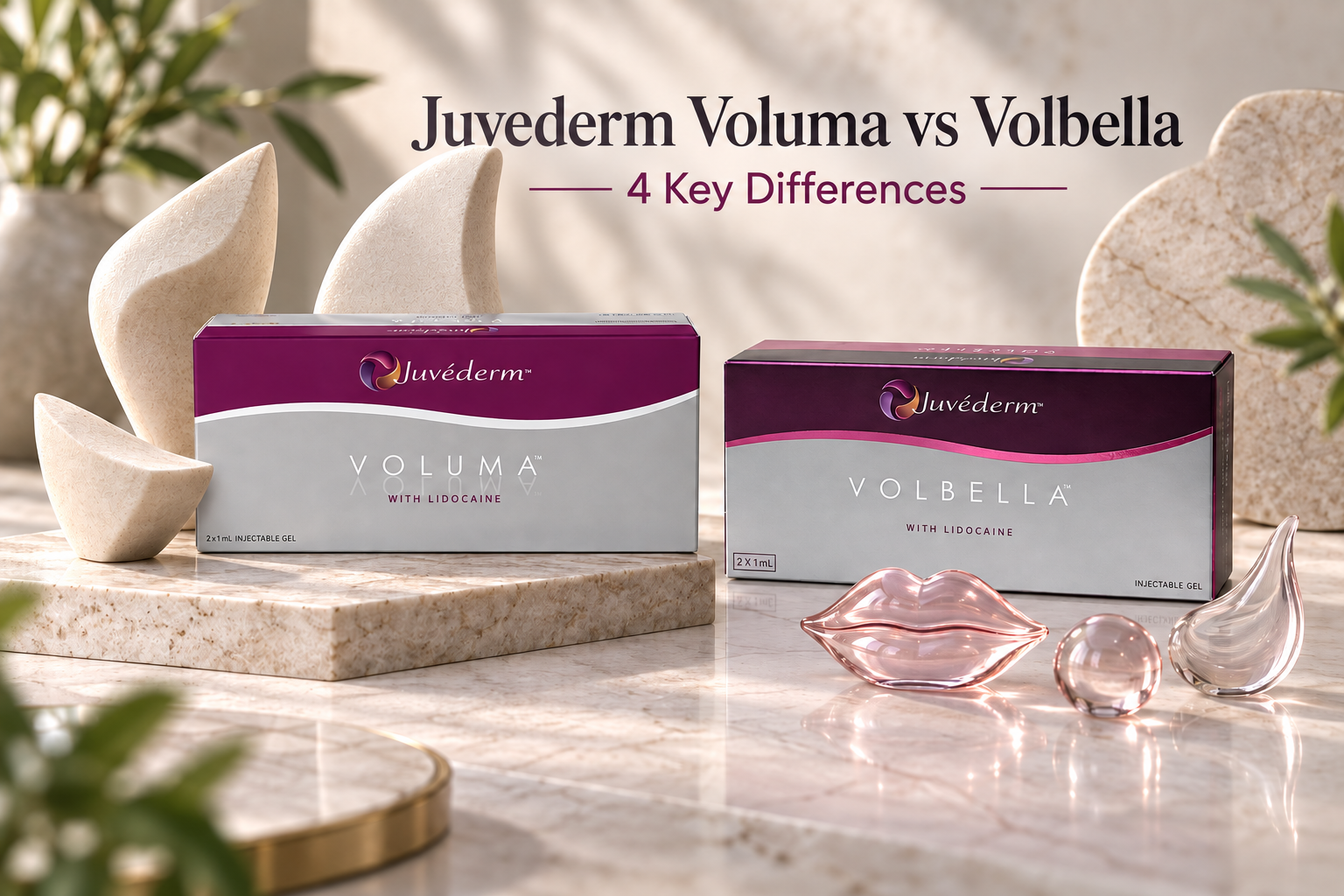
Voluma and Volbella are not interchangeable strengths. In current US labeling, Voluma is the structural-volume option for cheeks, chin and temples, while Volbella is the lower-volume-detail option for lips, perioral lines and under-eye hollows. The right choice starts with the anatomical concern and approved-use record, not a generic preference for a thicker or softer filler.
A licensed specialist still has to decide whether the visible concern is actually caused by volume loss, whether either product is appropriate for the anatomy, and whether the exact SKU is authorized in the destination market.
Difference 1: where each product belongs
The most useful difference is not brand prestige or a one-word texture label. It is the area each product is currently designed and labeled to address. In the United States, Voluma has approved uses for cheeks, chin and temples. Volbella has approved uses for lips, perioral lines and under-eye hollows. That division immediately rules out many false comparisons.
Someone asking for more cheek projection is not choosing between two equally suitable Juvederm syringes. The relevant product to investigate is Juvederm Voluma. Someone asking about subtle lip fullness, vertical lip lines or an infraorbital hollow should discuss whether Juvederm Volbella fits the goal. The word “Juvederm” identifies the family; it does not make every family member substitutable.
Difference 2: structural volume versus subtle detail
Voluma’s labeled roles all involve deeper structural volume: rebuilding age-related midface volume, improving chin profile or augmenting temple hollowness. Volbella’s roles sit in smaller or more delicate areas where the aim is controlled fullness or a smoother transition, including the lips, the lines around them and under-eye hollows.
This does not mean one is universally “hard” and the other universally “soft,” and it does not provide an injection plan. It means the two products solve different planning problems. A provider evaluates facial structure, skin quality, movement, prior treatment and the desired degree of change before deciding whether the product’s labeled role matches the person in front of them.
Area comes before preference. If the concern has not been diagnosed clearly, asking which product feels better or lasts longer starts the decision in the wrong place.
Difference 3: what the duration claims really mean
Official US materials state that Voluma cheek results may last up to two years with optimal treatment. Volbella lip and under-eye materials describe results lasting up to one year in those respective uses. These statements are useful for setting a broad expectation, but they are not a head-to-head trial in the same area, on the same people, using the same outcome measure.
A longer “up to” claim therefore does not make Voluma the better product for lips or under-eyes. Duration varies with product, area, anatomy, movement, treatment plan and individual response. Compare the claim only within the product’s intended role, then discuss what maintenance would realistically mean with the treating professional.
Difference 4: how the buying decision changes
Once the area and goal are clear, the professional buyer has a different set of questions. The exact product name must match the treatment plan; the market-specific instructions and local eligibility must match the destination; and the unit must arrive sealed, traceable and in date. A familiar purple-and-silver box is not enough evidence by itself.
For pre-use checks, the separate Juvederm expiry guide explains why the printed date, package integrity and storage record are stop lines. The broader HA dermal filler safety reference keeps class-wide professional-use and jurisdiction questions out of the product comparison.
A practical area-first decision table
| Customer concern | Product to investigate | Why it enters the shortlist | What still needs assessment |
|---|---|---|---|
| Age-related cheek volume loss | Voluma | Current US labeling includes deep cheek augmentation. | Whether volume loss is the main cause and how much structural change is appropriate. |
| Chin profile or temple hollowing | Voluma | Current US labeling includes the chin and moderate-to-severe temple hollowing. | Anatomy, symmetry, local eligibility and a clinician-owned plan. |
| Lip fullness or lines around the mouth | Volbella | Current US labeling includes lip augmentation and perioral lines. | Desired shape, movement, prior filler and whether another lip product is more suitable. |
| Under-eye hollow | Volbella | Current US labeling includes infraorbital hollows in adults over 21. | Whether darkness comes from a hollow rather than pigment, vessels, edema or laxity. |
When neither product is an automatic answer
A dark under-eye can be caused by pigment or visible vessels rather than a hollow. A heavy lower face may involve skin laxity rather than missing volume. A lip goal may require a different balance of shape and movement. These are reasons to improve the assessment, not reasons to move randomly between Voluma and Volbella.
Both products are injectable medical devices with important contraindications and potential complications. A licensed specialist should review medical history, prior procedures, current symptoms and the exact local instructions before treatment. This article helps build the shortlist; it does not turn a labeled treatment area into a personal recommendation.
Final recommendation
Use an area-first shortlist: Voluma is the product to investigate for deep structural volume in cheeks, chin or temples; Volbella is the product to investigate for lips, perioral lines or under-eye hollows. A licensed specialist must decide whether the visible concern is actually a volume problem and whether the selected SKU is appropriate in the reader’s jurisdiction.
Compare the current Voluma and Volbella product records, then confirm the exact treatment-area plan, market eligibility, lot, expiry and sealed supply documentation before ordering.
Frequently asked questions
Is Voluma or Volbella better?
Neither is better for every concern. Voluma is the relevant Juvederm option to investigate for cheeks, chin and temples, while Volbella is the relevant option for lips, perioral lines and under-eye hollows.
Can Voluma be used instead of Volbella for lips?
Voluma is not the Juvederm product labeled for lip augmentation in current US materials. Product choice should follow the exact approved-use record and a licensed specialist’s assessment rather than substitution by brand family.
Which product is used for under-eye hollows?
Volbella XC has a current US indication for under-eye hollows in adults over 21. A professional must still determine whether the darkness or tired appearance is actually caused by a hollow.
Does Voluma last longer than Volbella?
Official maximum-duration claims differ by product and treatment area, but they are not a same-area head-to-head comparison. A longer claim in the cheeks does not make Voluma a substitute for Volbella in the lips or under-eyes.
Are Voluma and Volbella both hyaluronic acid fillers?
Yes. Both belong to the Juvederm hyaluronic acid filler collection, but their labeled treatment roles differ, so the shared ingredient category does not make them interchangeable.
What should a professional buyer check before ordering?
Confirm the exact SKU, intended treatment-area plan, destination-market eligibility, applicable instructions, sealed presentation, lot, expiry and traceable supply record.
Sources
Evidence checked September 10–11, 2026: current Juvederm US approved-use pages; FDA approval records for Voluma cheek, chin and temple uses and Volbella lip and under-eye uses; current FillersFairy Store API product and stock records. Social discussions were used only to identify customer confusion about area matching, not as evidence of clinical performance.