Study identity · Product identity · Professional buyer map
Quick Answer
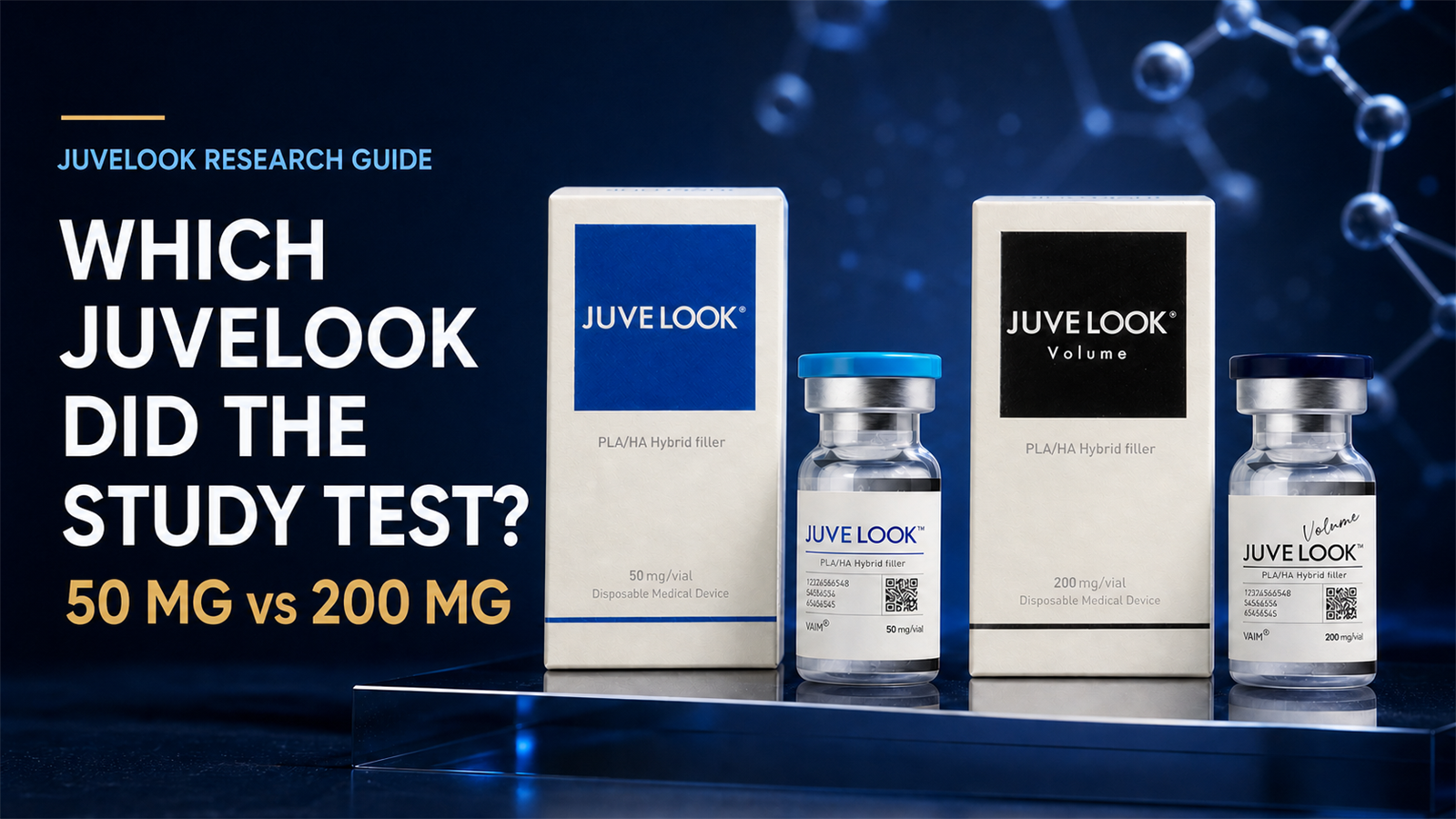
A study that says “Juvelook” does not automatically cover the full Juvelook range. If the methods specify 42.5 mg PDLLA plus 7.5 mg non-cross-linked HA, or 50 mg total, map the paper to Juvelook 50mg. If it specifies 170 mg PDLLA plus 30 mg HA, 200 mg total, or the name “Juvelook Volume,” map it to Juvelook Volume 200mg. Read the result only within that exact product and study design; a larger milligram figure is not a four-times-better outcome, and the reviewed set is not a direct standard-versus-Volume trial. For a research-led purchase, open and verify the SKU that matches the cited formulation; the milligram figure serves as an identity clue rather than a performance score.
That distinction matters when a clinic owner, medical director or purchasing team uses research to evaluate a product. Search results, abstracts and distributor pages often shorten the tested item to “Juvelook,” while the current product line contains more than one composition. Without an identity check, a useful paper can be attached to the wrong SKU in a product brief, quotation or sales deck.
This guide solves that narrow problem. It maps the strongest product clues inside each paper to the current standard and Volume records, then shows what each study can contribute to a buying decision. For a broader explanation of the brand and material, use the separate What Is Juvelook? guide; this page stays focused on research-to-SKU matching.
First, Lock the Two Product Identities
The cleanest evidence map begins with the current product records rather than with a headline or informal nickname. Both products combine PDLLA with non-cross-linked hyaluronic acid, but they do not carry the same total content or component split.
Juvelook standard product
Look for “Juvelook,” a 50-milligram total, or the exact 42.5/7.5 component split in the methods and product description.
Juvelook Volume product
Look for “Juvelook Volume,” a 200-milligram total, or the exact 170/30 component split in the methods and product description.
The 4:1 relationship between the two total-content figures describes the amount of lyophilized product in the respective vial records. It does not translate into four times the clinical effect, four times the duration or a universal ranking. The study population, target concern, comparator, assessment method and follow-up period still determine what a result means.
Juvelook Study-to-Product Evidence Map
The table below answers the practical question behind this article: when a paper is cited, which current product page should the buyer open? It separates material characterization from clinical outcomes so that a laboratory paper is not presented as if it were a patient trial.
| Study record | Design and sample | Exact product clue | Map to | Useful buyer reading |
|---|---|---|---|---|
| 2025 physicochemical comparison | Laboratory characterization of four PLA-based filler products; not a patient outcome trial | The Juvelook sample is identified as the standard product and as a PDLLA system with non-cross-linked sodium hyaluronate | Standard | Product-specific material, morphology and handling-characteristic context for the tested standard sample |
| Preliminary skin-rejuvenation study | Single-arm preliminary clinical study; 16 Asian participants completed the protocol | Methods state PDLLA 42.5 mg + HA 7.5 mg and name Juvelook | Standard | Early human observations for the exact standard composition in that study population and assessment framework |
| 2026 prospective under-eye cohort | Prospective cohort; 15 women; investigator and patient assessments | Abstract explicitly identifies PDLLA-HA 50mg Juvelook | Standard | Product-specific observations for the standard formulation in the cohort’s under-eye setting |
| Randomized split-face nasolabial-fold study | Multicenter, evaluator-blinded, randomized split-face comparison; 33 participants; follow-up through week 24 | Methods state Juvelook Volume with 170 mg PDLLA + 30 mg non-cross-linked HA | Volume | Comparative clinical results for the exact Volume formulation versus the named PLLA comparator in that trial |
Evidence-map rule: the methods section outranks the headline. An explicit component split is the strongest shortcut; an exact variant name is next. If a paper says only “Juvelook” and gives no composition, total content or identifiable product record, keep the SKU unresolved until the full methods or supplementary material provides a match.
A practical evidence note can be only one line long, provided it preserves the right fields: citation → exact tested product → composition → design → decision supported. For example, a note for the randomized split-face paper should retain “Juvelook Volume,” the 170/30 component split, the 33-participant comparative design and the week-24 study context. A note for the physicochemical paper should retain “Juvelook standard” and label the record as laboratory characterization. This format lets a sales, medical or procurement reviewer understand the citation without rereading an entire paper, while keeping the product and evidence type visible.
Five Clues That Identify the Exact Juvelook Product
You do not need to infer the product from the treatment area or from the size of an effect. The identification clues should come from the paper’s own product description and the matching commercial record.
Exact variant name
“Juvelook Volume” is a direct Volume clue. “Juvelook” alone is not enough when the rest of the methods are missing.
Total-content record
A 50-milligram total points to the standard record; a 200-milligram total points to the Volume record.
PDLLA and HA split
The 42.5/7.5 split identifies the standard product. The 170/30 split identifies Volume.
Material description
Carrier and particle descriptions can confirm that the paper tested the same product record, but they should not replace an explicit name or composition.
Study design and target
After identifying the SKU, record the population, concern, comparator, outcomes and follow-up so the conclusion stays inside its original study context.
The last clue is deliberately about interpretation rather than product identity. A correct SKU match does not make every sentence in a study universal. It tells the buyer where the evidence belongs; the design tells the buyer how much weight to place on it.
What the Juvelook Standard Evidence Record Covers
Material and product-characterization evidence
The 2025 physicochemical paper placed Juvelook among the tested PDLLA products and identified non-cross-linked sodium hyaluronate as its carrier. The study compared laboratory characteristics such as particle morphology and reconstitution behavior across several PLA-based products. This is useful for understanding the tested standard material record, but it is not a clinical outcome comparison.
Preliminary human skin-rejuvenation evidence
The preliminary clinical study explicitly used the standard composition. Sixteen Asian participants completed the protocol, and the researchers assessed several visible skin-aging signs alongside imaging and histologic measures. For a buyer, the central value is not a broad promise for every Juvelook product; it is a product-specific human evidence record tied to that formulation.
Prospective under-eye cohort evidence
The 2026 cohort also names the standard PDLLA-HA Juvelook product. It enrolled 15 women and used investigator and patient assessments for the tear trough and lower-eyelid skin features. Because the product identity is explicit, this paper belongs in the standard evidence file. Its cohort design, sample and under-eye setting should remain attached whenever the result is summarized.
Together, these records give the standard product page a clear evidence route: laboratory characterization plus early human studies that explicitly identify the same product. They do not become evidence for Volume merely because both products share the Juvelook name and a PDLLA-HA material family.
What the Juvelook Volume Evidence Record Covers
The strongest clearly mapped Volume record in this review is the multicenter, evaluator-blinded, randomized split-face study of nasolabial folds. Its methods provide the Volume component split and exact name, so the link to the current product identity is direct.
Thirty-three participants received the PDLLA-based product on one side and an injectable PLLA comparator on the other. The paper assessed wrinkle-severity and global-improvement scores through week 24 and reported noninferiority for Juvelook Volume versus the named comparator within that design and follow-up period. This is a meaningful product-specific comparative record, but the comparison is Volume versus a PLLA product—not Volume versus the Juvelook standard formulation.
That distinction makes the paper more useful, not less. It allows a procurement or product-evaluation file to say exactly what was tested, which comparator was used, and where the result belongs. The matching commercial route is the Juvelook Volume product page, where the buyer can then check current availability and request exact-SKU documentation.
Why This Is an Evidence Map, Not a Performance Ranking
No study in the reviewed set directly randomized the Juvelook standard product against Juvelook Volume. The two evidence files also answer different questions: the standard file includes material characterization and small human studies in skin-rejuvenation and under-eye settings, while the Volume file includes a randomized comparison in nasolabial folds against a separate PLLA product.
Putting their outcomes into one “winner” table would erase those design differences. The accurate conclusion is simpler: identify the tested SKU, preserve the study context, and use the evidence for the question that study actually examined. For wider material-level context—without treating unlike products as interchangeable—see the PLLA, PDLLA, PCL and CaHA guide.
Match the Evidence Before Ordering
Once a paper has been mapped, transfer the same product identity into the purchasing record. The goal is a continuous chain from study citation to product page, quotation, delivered box and retained batch documents.
- Copy the exact studied name. Preserve the standard or Volume designation rather than shortening both products to Juvelook.
- Record the component split. Preserve the matching PDLLA/HA split from the product source as an identity checksum.
- Keep the study context. Store the population, target concern, comparator, assessment method and follow-up beside the citation.
- Open the matching SKU. Use the standard or Volume product page that corresponds to the paper, not a generic brand page.
- Confirm current commercial details. Ask for current stock, quoted pack, delivered expiry and storage information for the exact SKU.
- Request current documents. Match the available product, batch, traceability and destination-market records to the item being ordered.
This workflow gives sales and purchasing teams a defensible way to use research without turning it into an unsupported product claim. It also makes internal review faster: another team member can trace the statement back to the study, confirm the exact composition, and see why the selected product page is the correct next step.
Open the Product That Matches the Study
If the paper matches the standard component split, continue with the standard listing. If it matches the Volume split or explicitly names Juvelook Volume, continue with the Volume listing. Then request current stock, batch, expiry, storage and destination-market documents for that exact SKU.
Juvelook Study and Product FAQ
Does “Juvelook” in a study always mean Juvelook 50mg?
No. Check the methods for the total content, PDLLA/HA split and exact variant name. The smaller component split maps to the standard product, while the larger split or the name “Juvelook Volume” maps to the Volume product.
Which research in this evidence map applies to the Juvelook standard formulation?
The mapped standard record includes the comparative physicochemical study, the preliminary 16-participant skin-rejuvenation study and the 2026 prospective under-eye cohort of 15 women. Each identifies the standard product or its matching component split.
Which study in this map applies to Juvelook Volume 200mg?
The multicenter, evaluator-blinded, randomized split-face nasolabial-fold study maps to the Volume product because its methods name Juvelook Volume and provide its exact component split.
Does 200mg mean the Volume product is four times stronger than the standard product?
No. The two figures identify different total-content records. They do not establish a four-times-greater effect, duration or overall performance, and the reviewed studies do not directly compare the two Juvelook products.
Can a result from a Juvelook standard study be used for Volume?
Not automatically. Shared brand and material-family names do not make product-specific clinical results interchangeable. Keep each result attached to the exact composition and study design that produced it.
What should a buyer verify after matching a study to a product?
Verify the exact SKU name, component split, product and box identity, quoted pack, current stock, batch, delivered expiry, storage information and the product or destination-market documents required for the order.
Editorial scope: This evidence map supports research identification and professional product evaluation. It does not provide preparation, dosing, injection, treatment-planning or self-use instructions.