A practitioner’s reference to Juvelook — the PDLLA + HA hybrid skin booster that bridges the gap between hydration and collagen biostimulation.
Quick Answer
What is Juvelook? Juvelook is an injectable hybrid skin booster manufactured by VAIM Global Inc. (Seoul, South Korea). It combines poly-D,L-lactic acid (PDLLA, 42.5 mg) with non-crosslinked hyaluronic acid (HA, 7.5 mg) in a single lyophilized vial. The HA component delivers immediate hydration, while PDLLA microparticles (10–40 μm) stimulate fibroblast activity and long-term collagen production. Juvelook is MFDS-approved (Korea) and CE-certified (Europe). A higher-concentration variant, Juvelook Volume (200 mg, marketed globally as Lenisna), is available for deeper volume restoration.
Why Clinics Choose Juvelook
Juvelook occupies a unique position in the skin booster market. It is neither a pure hydrator (like HA-only boosters) nor a pure biostimulator (like PLLA fillers). It is both — in a single vial.
- Dual mechanism in one session — patients get immediate hydration from HA and progressive collagen building from PDLLA, reducing the need for separate booster + biostimulator appointments
- Patented PDLLA manufacturing — VAIM’s process (Korean patents 10-1481441 and 10-1725279) produces biosphere-shaped microparticles with a porous reticular mesh structure, designed to maximize collagen induction surface area while minimizing nodule risk
- PDLLA vs PLLA safety advantage — unlike PLLA (used in products like Sculptra), which has crystalline-shaped particles that can trigger granulomas if injected imprecisely, PDLLA uses amorphous round particles that integrate more smoothly into tissue
- Two-tier product line — Juvelook (50 mg) for skin quality, Juvelook Volume/Lenisna (200 mg) for volume restoration, allowing clinics to address a broader range of patient presentations from one manufacturer
- Market momentum — won Korea’s Skin Booster of the Year award in 2022, with rapid international adoption since
For a broader view of how PDLLA hybrid technology fits alongside PN, exosome, and HA-only boosters, see our Korean Skin Boosters Guide.
How Juvelook Works

In Simple Terms
Juvelook is delivered as a freeze-dried powder that practitioners reconstitute with saline before injection. Once injected into the dermis, two things happen simultaneously: the HA component binds water and hydrates skin immediately, while the PDLLA microparticles lodge in the tissue and stimulate fibroblasts to produce new collagen over the following weeks and months. The HA is absorbed within weeks; the PDLLA continues working for months as the body gradually breaks it down through natural hydrolysis.
Technical Details — Full Mechanism ▸
The HA layer (immediate, 0–4 weeks): Juvelook contains 7.5 mg of non-crosslinked hyaluronic acid per vial. Unlike crosslinked HA fillers designed to persist for months, this HA is meant to absorb relatively quickly — its role is to provide instant hydration, create a visible plumping effect on treatment day, and serve as a carrier medium that helps distribute the PDLLA particles evenly through the injection zone.
The PDLLA layer (progressive, 4 weeks–24+ months): The 42.5 mg of PDLLA consists of ultrafine microspheres (10–40 μm diameter) with a porous, reticular internal structure. Once the HA carrier absorbs, these microspheres remain embedded in the dermal tissue. They trigger a controlled foreign body response: macrophages surround the particles, fibroblasts are recruited and activated, and new collagen type I and III is deposited around each microsphere.
Why PDLLA, not PLLA? Poly-D,L-lactic acid is the amorphous (non-crystalline) form of polylactic acid. Older biostimulators like Sculptra use PLLA (Poly-L-lactic acid), which has a semi-crystalline structure with angular particles. These crystalline particles are associated with a higher incidence of delayed-onset nodules and granulomas if not injected with precise technique and adequate dilution. PDLLA’s amorphous, spherical particles are designed to reduce this risk — they present a smoother surface to surrounding tissue and degrade more uniformly via hydrolysis.
Degradation timeline: PDLLA microspheres undergo hydrolysis into lactic acid and glycolic acid — both naturally occurring metabolites — over approximately 12–24 months. As the particles degrade, they are replaced by the neocollagen matrix they stimulated, which provides the lasting structural improvement.
Juvelook vs Juvelook Volume
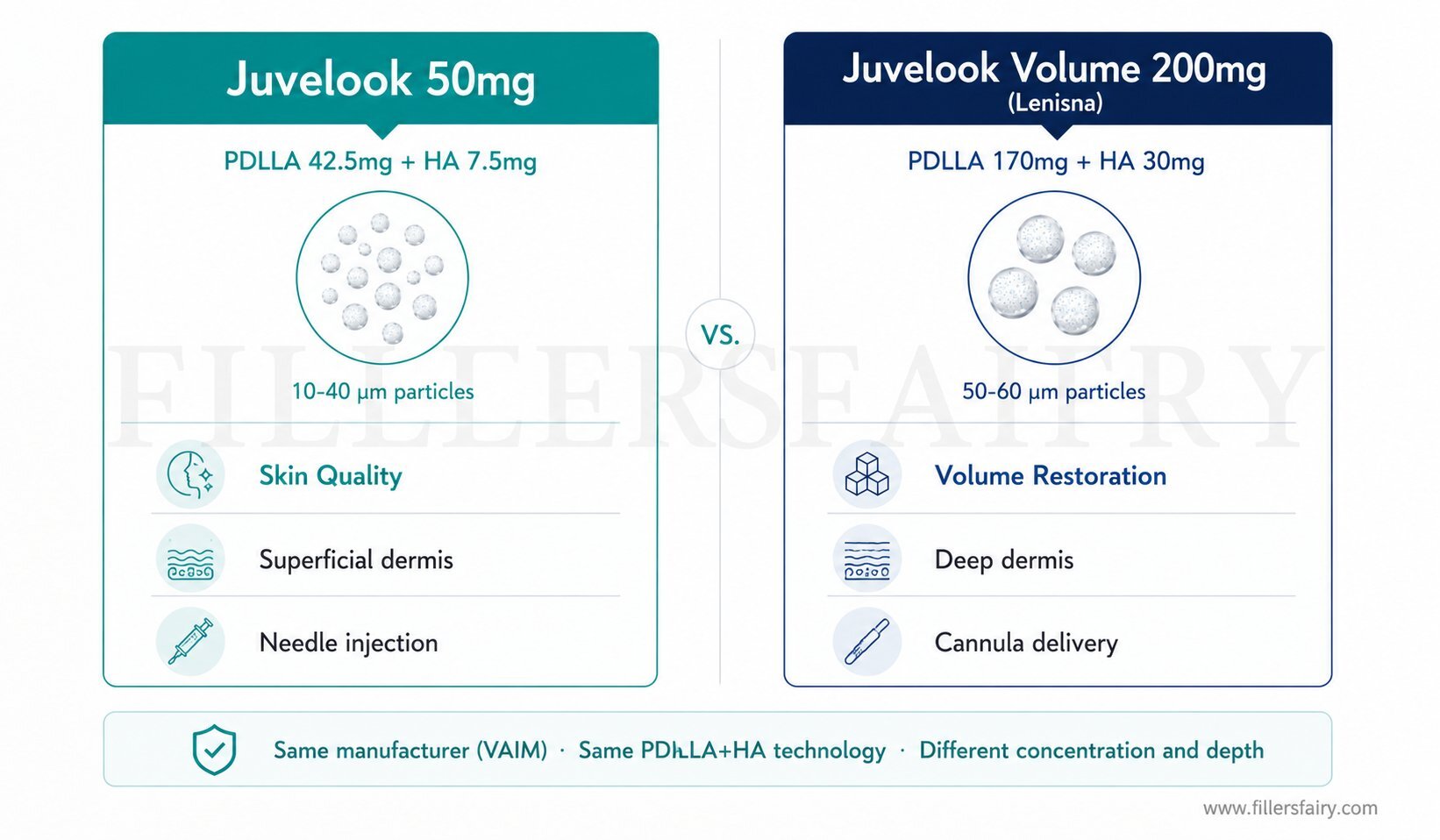
VAIM produces two formulations under the Juvelook brand. They share the same PDLLA + HA technology platform but differ significantly in concentration, particle size, injection depth, and clinical application.
| Specification | Juvelook (50 mg) | Juvelook Volume (200 mg) / Lenisna |
|---|---|---|
| PDLLA content | 42.5 mg | 170 mg |
| HA content | 7.5 mg (non-crosslinked) | 30 mg (non-crosslinked, 3000 kDa) |
| PDLLA particle size | 10–40 μm | 50–60 μm |
| Primary goal | Skin quality, texture, fine lines, pores | Volume restoration, deep wrinkles, facial hollows |
| Injection depth | Superficial dermis (needle) | Deep dermis / subdermis (cannula) |
| Delivery method | Needle or injector gun | Blunt-tipped cannula |
| Global name | Juvelook | Lenisna |
In practice: Juvelook (50 mg) is the skin quality product — it competes with Rejuran, Curenex, and other skin boosters. Juvelook Volume (200 mg) is the volume biostimulator — it competes with Sculptra, Ellansé, and AestheFill. Clinics stocking both can cover the full spectrum from superficial rejuvenation to deep structural restoration.
Treatment Areas

Juvelook (50 mg) — skin quality
Full face — fine lines, enlarged pores, uneven texture, mild laxity across forehead, cheeks, perioral, and periorbital zones.
Neck and décolletage — horizontal lines, crepey skin, sun-damaged texture.
Hands — skin thinning and loss of dermal density on the dorsal hand.
Juvelook Volume / Lenisna (200 mg) — volume restoration
Mid-face — cheek hollowing, temple volume loss, nasolabial folds.
Jawline and chin — mild to moderate contour loss.
Body — skin laxity on the abdomen, inner arms, and other areas with loose skin (growing application, primarily in Korean and Southeast Asian clinics).
Is Juvelook Right for Your Patients?

| Patient Concern | Juvelook (50 mg) | Volume (200 mg) | Notes |
|---|---|---|---|
| Fine lines, skin texture | ⭐⭐⭐⭐⭐ | — | Core indication for Juvelook 50 mg |
| Enlarged pores | ⭐⭐⭐⭐⭐ | — | Collagen densification tightens pore structure |
| Acne scars (atrophic) | ⭐⭐⭐⭐ | — | PDLLA remodels scar tissue; combine with subcision for deep scars |
| Skin hydration + glow | ⭐⭐⭐⭐ | — | HA component for same-day hydration; PN products may outperform for pure hydration |
| Mid-face volume loss | ⭐ | ⭐⭐⭐⭐⭐ | Volume = Juvelook Volume / Lenisna territory |
| Deep nasolabial folds | — | ⭐⭐⭐⭐ | Collagen restoration reduces fold depth over months |
| Immediate volume (same-day result) | ❌ | ❌ | Results are progressive, not instant — use HA fillers for immediate volume |
| Lip augmentation | ❌ | ❌ | PDLLA is not indicated for lip injection |
The key patient conversation point: Juvelook’s results are progressive, not immediate. Unlike HA fillers that deliver same-day volume, Juvelook’s collagen-building effect develops over weeks to months. Patients who want instant transformation need fillers; patients willing to invest in a gradual, lasting improvement in skin quality are ideal Juvelook candidates.
Common Mistakes With Juvelook
- Expecting instant filler-like results. Juvelook’s collagen-building effect develops over weeks to months. Patients expecting same-day transformation need HA fillers, not PDLLA biostimulators.
- Stopping after one session. A single treatment provides mild improvement. The full 2–3 session protocol is required for meaningful, lasting results. Setting this expectation at consultation prevents early dropout.
- Mistaking the week 1–2 hydration drop for treatment failure. When the HA component absorbs and the PDLLA hasn’t yet produced visible collagen, skin can appear to return to baseline. This “dip” is normal — warn patients in advance or they may conclude the treatment didn’t work.
- Using Juvelook when immediate volume is the true goal. If the patient needs visible volume restoration by next week, Juvelook is the wrong choice. Use HA fillers for immediate needs, Juvelook for long-term quality building.
- Inadequate reconstitution. Rushing the mixing step or shaking vigorously can damage PDLLA microspheres and lead to uneven distribution. Allow full dissolution with gentle swirling — never shake.
What to Expect: Procedure, Recovery, Results
Reconstitution
Juvelook is supplied as a lyophilized (freeze-dried) powder. Before injection, it must be reconstituted with sterile saline. Recommended dilution volume varies by protocol — typically 1–2 mL per vial for Juvelook 50 mg. Allow reconstituted product to sit until fully dissolved with no visible particles. Gentle swirling — do not shake vigorously, as this can damage the PDLLA microspheres.
During Treatment
Treatment takes 15–30 minutes. Topical anesthetic applied 20–30 minutes prior. Juvelook (50 mg) is delivered via serial micro-injections or injector gun at superficial dermal depth. Juvelook Volume (200 mg) is delivered via cannula at a deeper plane. Technique mirrors other biostimulator protocols — even distribution across the treatment zone is critical to avoid focal concentration of PDLLA particles.
Recovery Timeline
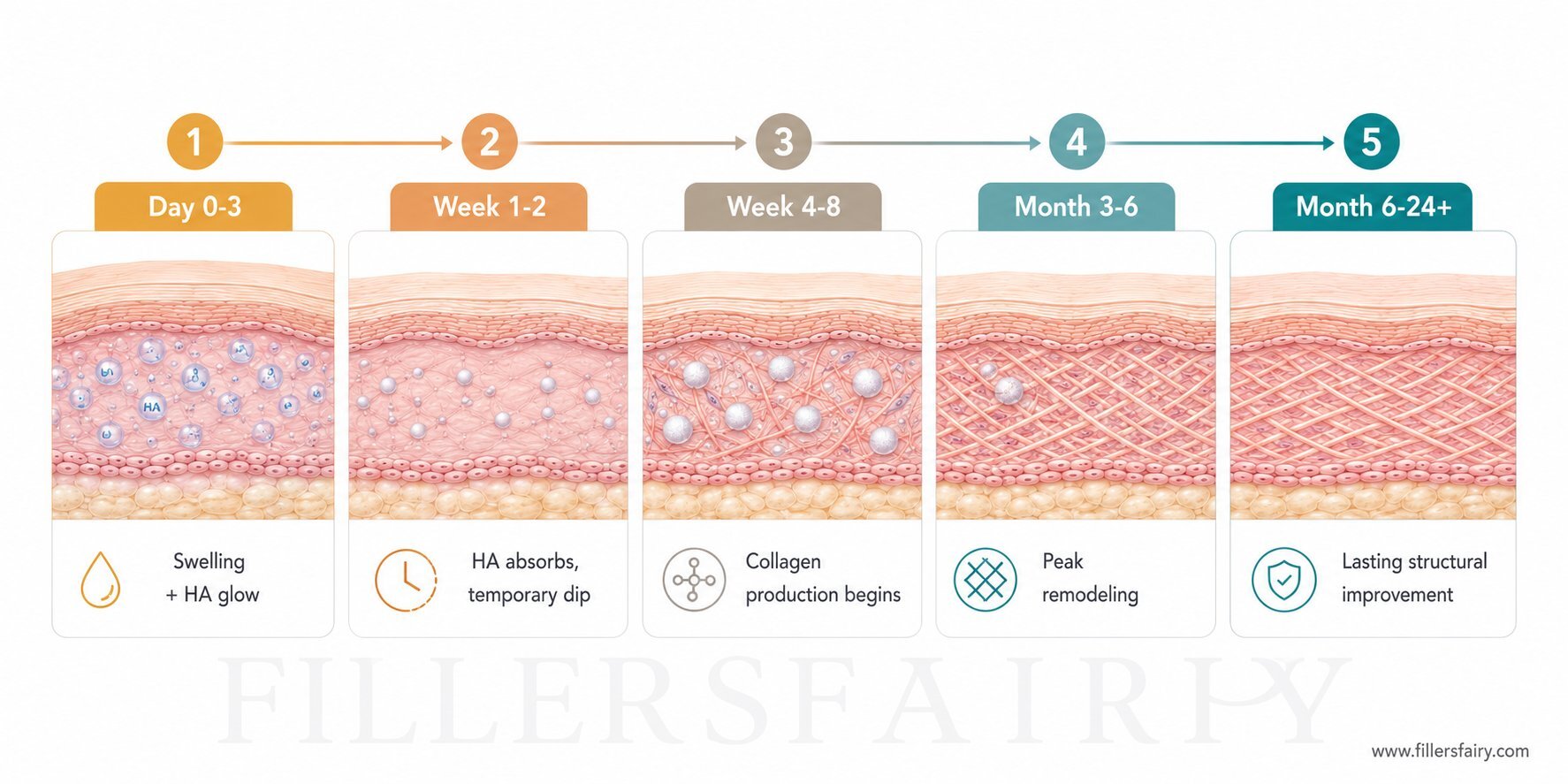
| Phase | What to Expect |
|---|---|
| Day 0–3 | Mild swelling, redness, possible bruising at injection sites. The HA component provides an initial plumping effect — this is temporary hydration, not the final result. |
| Week 1–2 | Initial swelling resolves. The HA “glow” may diminish as the non-crosslinked HA begins to absorb. Skin may appear to return to baseline temporarily. |
| Week 4–8 | PDLLA-driven neocollagen production begins to show. Skin texture, firmness, and elasticity start improving progressively. This is where Juvelook’s real effect begins. |
| Month 3–6 | Peak collagen remodeling. Clinical studies (Seo et al.) show significant improvements in elasticity, firmness, and hydration at this stage. |
| Month 6–24+ | PDLLA microspheres continue gradual hydrolysis. The neocollagen matrix they stimulated remains as lasting structural improvement even after the PDLLA is fully absorbed. |
Important patient expectation management: Warn patients about the “dip” at week 1–2 when the HA absorbs but the PDLLA hasn’t yet produced visible collagen. Without this warning, patients may mistakenly believe the treatment failed during this transition window.
Side Effects and Safety
Juvelook’s safety profile benefits from PDLLA’s amorphous particle structure, which reduces the nodule and granuloma risks historically associated with crystalline PLLA products.
Common (expected and transient)
- Injection-site redness and swelling — resolves 24–72 hours
- Mild bruising — resolves 5–7 days
- Temporary papules at injection points — resolves 24–48 hours
Uncommon
- Delayed-onset nodules — lower risk than with PLLA products due to PDLLA’s spherical particle shape, but not zero. Proper reconstitution, adequate dilution, and even distribution technique are critical preventive measures
- Asymmetry — can occur with uneven distribution; proper injection technique and post-treatment massage mitigate this
Contraindications
- Active skin infection or inflammation at treatment site
- Known allergy to polylactic acid or hyaluronic acid
- Pregnancy and breastfeeding (precautionary)
- Autoimmune connective tissue disorders (relative contraindication)
- Do not inject into lips, periorbital fat pads, or near blood vessels supplying the retinal artery
Regulatory Status
Juvelook is approved by MFDS (Korea), CE-certified in Europe, and approved by Thailand’s FDA. It is not cleared for use in the United States — practitioners in the US should be aware of this regulatory status when sourcing for off-label or research use.
Frequently Asked Questions
What is the difference between Juvelook and Juvelook Volume (Lenisna)?
Juvelook (50 mg) contains 42.5 mg PDLLA with 10–40 μm particles for superficial skin quality improvement. Juvelook Volume (200 mg), marketed globally as Lenisna, contains 170 mg PDLLA with larger 50–60 μm particles for deeper volume restoration. They are injected at different depths using different techniques — Juvelook via needle, Volume via cannula.
How does Juvelook compare to Rejuran?
They use entirely different technologies. Rejuran is PN-based (salmon DNA fragments that activate A2A receptors for skin repair). Juvelook is PDLLA-based (polylactic acid microspheres that stimulate collagen through a controlled foreign body response). Rejuran is primarily a skin healer; Juvelook is primarily a collagen builder. Some clinics use both in combination protocols — Rejuran for repair, Juvelook for structural strengthening. For a full Rejuran overview, see our What Is Rejuran guide.
How long do Juvelook results last?
The HA hydration effect lasts weeks. The PDLLA-driven collagen improvement develops over 3–6 months and can persist for 12–24+ months as the neocollagen matrix remains even after the PDLLA microspheres are fully absorbed. Most protocols recommend 2–3 sessions spaced 3–4 weeks apart for optimal results.
Does Juvelook require reconstitution?
Yes. Juvelook is supplied as a lyophilized powder and must be reconstituted with sterile saline before injection. Follow the manufacturer’s dilution guidelines — typically 1–2 mL for the 50 mg vial. Allow full dissolution and avoid vigorous shaking.
Is Juvelook FDA-approved?
Juvelook is approved by MFDS (Korea) and CE-certified in Europe. It also holds Thailand FDA approval. It is not cleared for use in the United States as of 2026.
What are the risks of nodules with Juvelook?
Juvelook uses PDLLA (amorphous, spherical particles) rather than PLLA (crystalline, angular particles). This design reduces but does not eliminate nodule risk. Proper technique — adequate reconstitution, even distribution, appropriate injection depth, and post-treatment massage — are the primary preventive measures. For more on potential side effects, see our Juvelook side effects guide.
Related Guides on FillersFairy
- Korean Skin Boosters Guide (2026) — the complete technology overview
- What Is Rejuran? Complete PN Skin Booster Guide
- Juvelook Side Effects: 5 Possible Risks Explained
- Curenex Skin Booster: Ingredients, Effect, and Usage
- Is Hyaron a Filler or Skin Booster?
Ready to order? Browse our Juvelook product listings for specifications and wholesale pricing.
Browse our Juvelook product listings for specifications, variant details, and wholesale pricing.