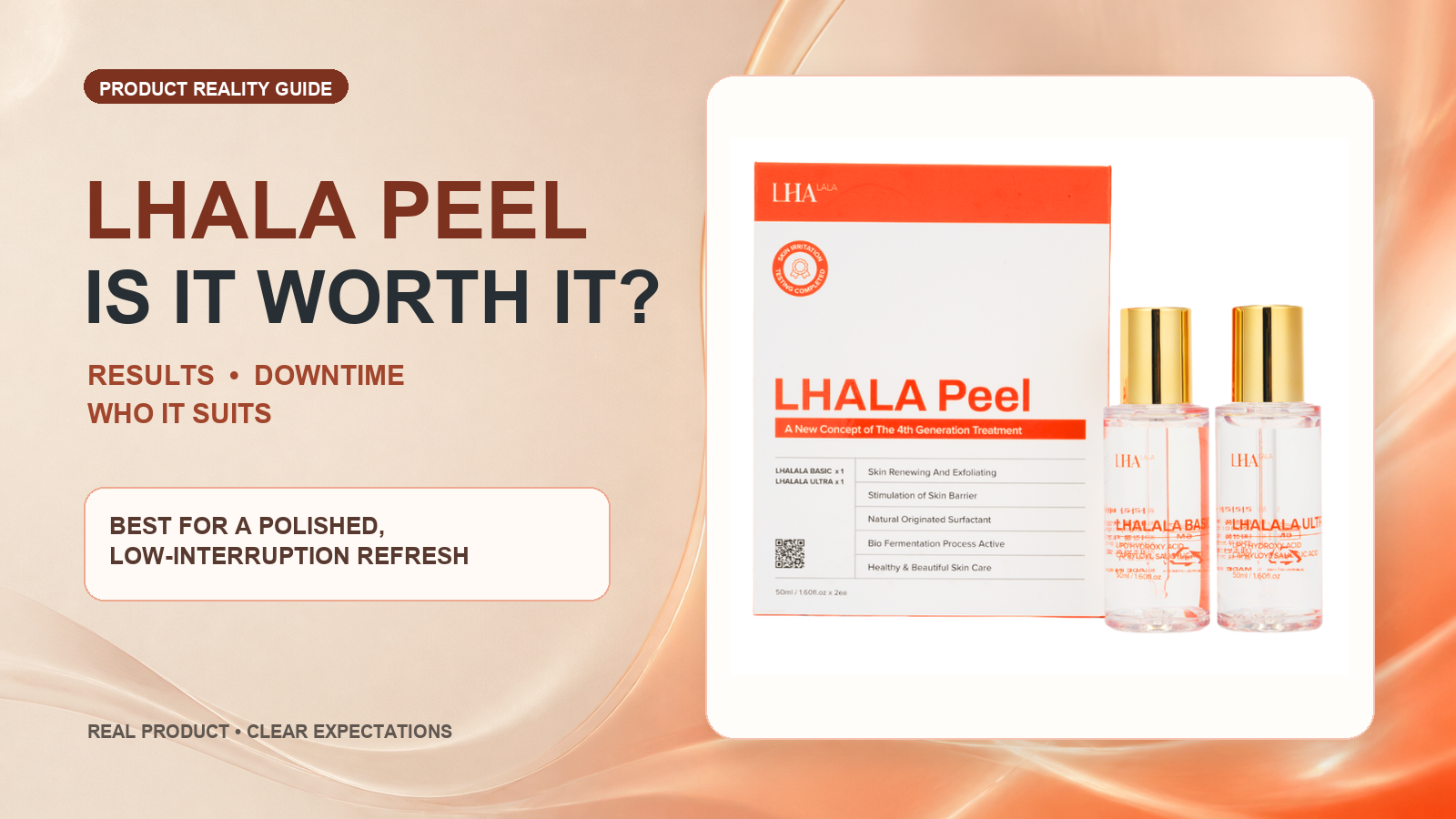
LHALA Peel is often described online as a gentle Korean peel that can deliver a smoother, fresher-looking surface without the recovery associated with stronger resurfacing. That description explains the appeal, but it does not answer the question buyers actually have: will the visible change be meaningful enough for the result they want?
Most likely to feel worth it
A buyer who values surface smoothness, a fresher glow, lighter-feeling congestion care and a low-interruption professional treatment.
Least likely to feel worth it
A buyer who measures value by major resurfacing, scar correction, lifting, a guaranteed pore-size change or a result that lasts without maintenance.
What LHALA Peel Actually Is
LHALA Peel is a professional topical peel system rather than an injectable or a home exfoliating serum. The current FillersFairy listing identifies a Korean product built around lipohydroxy acid, also called LHA or capryloyl salicylic acid, together with an alkaline P-Sol complex and skin lipids. The verified product image shows a boxed system containing LHALALA Basic and LHALALA Ultra bottles. This identity matters because the product is designed to sell a different experience from a conventional “stronger acid equals better peel” story.
| Decision point | What is verified | Why it matters to the buyer |
|---|---|---|
| Product format | Professional topical peel system; current pack image shows Basic and Ultra components. | The value includes a branded two-part professional service format, not only a single consumer acid product. |
| Key material | LHA, a lipophilic derivative of salicylic acid. | LHA has direct class-level evidence for controlled exfoliation and selected texture, comedonal and pigmentation concerns. |
| Supporting complex | P-Sol alkaline complex and lipids are part of the branded product identity. | They underpin LHALA’s gentle, barrier-conscious positioning, although the strongest published clinical evidence is for LHA rather than the complete branded system. |
| Commercial format | The product is listed for professional use and currently has a live purchase route. | Clinics should evaluate service demand, staff readiness, treatment consistency and repeat-booking potential together. |
| Current availability | The live FillersFairy listing showed an active Add to Cart route on 15 August 2026. | Clinics evaluating the service can continue from the editorial comparison to the current product record. |
Published studies on LHA help explain why the ingredient is commercially interesting. A split-face trial comparing 5–10% LHA with 20–50% glycolic acid found improvements in mild-to-moderate hyperpigmentation and fine lines over a repeated 12-week course, with no statistically significant efficacy difference between the two sides. Another small randomized trial found that LHA and salicylic-acid peels both reduced non-inflammatory comedonal lesions and were generally well tolerated. These studies support the ingredient category; they should not be presented as direct proof that every LHALA appointment will produce the same result.
What Results Make LHALA Peel Worth Choosing?
The most defensible expectation is a change in the surface character of the skin. People who are bothered by dullness, a rough feel, a congested look or makeup sitting unevenly may value a treatment that makes the surface look cleaner and more polished without committing to a high-recovery procedure. This is also why LHALA appears frequently in travel-beauty and first-treatment conversations: the appeal is the balance between visible freshness and manageable interruption.
Immediately noticeable value
The first impression is usually judged by smoothness, light reflection and how fresh the skin looks after the professional service. That can be commercially meaningful, especially for clients preparing for routine social plans or those who want maintenance rather than correction. “Immediate glow” should still be read as a surface appearance, not proof of collagen remodeling or a permanent structural change.
Value that requires repeated care
Ingredient-level LHA studies measured outcomes across repeated applications and several weeks, not one isolated appointment. That distinction is important: a client may enjoy a single freshening session, while someone pursuing a longer-term texture or pigmentation goal should judge the service as a planned course with professional reassessment. Clinics should sell the difference honestly. A maintenance service can be valuable without pretending to be a one-session transformation.
Where expectations become too high
LHALA Peel should not be purchased as a substitute for procedures chosen to address deep acne scarring, marked laxity or aggressive resurfacing. It also cannot promise invisible pores. Pores may look cleaner or less obvious when congestion and surface roughness improve, but the treatment does not erase normal skin anatomy. This expectation check keeps the buyer in the right treatment category and helps clinics retain clients who understand what the service is designed to deliver.
How Much Downtime Is Realistic?
Low downtime is a central reason to consider LHALA Peel, but “low” is more useful than “zero.” Official product messaging positions the treatment as gentle and barrier-conscious. Social discussions commonly describe little interruption, no visible flaking or only temporary redness. Those same discussions also include occasional reports of irritation or several days of visible peeling. Skin condition, concurrent products, professional assessment and the way the service is delivered can change the experience.
| Planning question | Practical expectation | Buying implication |
|---|---|---|
| Can normal plans continue? | Many buyers choose the category specifically because interruption is usually expected to be short. | Good fit when low recovery is a top priority, but do not make a first appointment immediately before an irreplaceable event. |
| Will visible peeling happen? | It is not the intended headline experience, yet individual peeling or dryness cannot be ruled out. | Buy the service for controlled surface refresh, not because a visible peel is guaranteed—or impossible. |
| Will it feel like a strong peel? | The branded proposition is gentler than aggressive resurfacing. | Good for clients who dislike the idea of a harsh peel; poor for buyers who equate intensity with value. |
| Is “no downtime” a promise? | No. It is a marketing shorthand for a typically manageable recovery profile. | A clinic should communicate the likely range and assess the individual rather than sell an absolute. |
The useful conclusion is straightforward: if a short recovery window is essential, LHALA belongs on the shortlist, but a first-time buyer should still allow some margin before photographs, travel or an important event. That is a decision, not a disclaimer.
What Are You Actually Choosing with LHALA Peel?
LHALA Peel is not simply another product carrying the word “peel.” A clinic is choosing a recognizable professional system with a clear service story: controlled surface refinement, a gentler experience and a recovery profile that is easier to place into a client’s normal schedule. That combination is the product’s commercial role. It gives the consultation a specific answer for clients who want more than home exfoliation but are not looking for aggressive resurfacing.
The Basic and Ultra components also create a defined professional format rather than an improvised single-product service. For a clinic, that makes staff training, treatment explanation and menu consistency easier to organize. The service can be positioned around smoother-looking texture, freshness, visible congestion and manageable interruption, while the distinction from deep corrective procedures remains clear.
The strongest buying case appears when those questions already occur in consultations: “Will I visibly peel?”, “Can I return to normal plans?”, “Is this suitable as a first professional peel?” and “Will the result look fresh rather than over-treated?” When the product answers an existing demand pattern, it can support a repeatable maintenance menu. When most enquiries concern scar revision, lifting or aggressive correction, the clinic should route those clients to a different category instead of forcing LHALA into the wrong role.
That is what makes the product worth investigating: not a promise that it outperforms every peel, but a well-defined fit between the service experience, the expected surface result and the customer who prefers limited interruption.
Who Is LHALA Peel Best Suited To?
| Customer or clinic priority | Fit | Why |
|---|---|---|
| A fresher, smoother-looking surface with limited interruption | Strong fit to investigate | This is the clearest match for the product’s LHA-based, low-downtime positioning. |
| Congested-looking pores and rough texture | Reasonable fit to investigate | LHA class evidence and the surface-exfoliation format align with this goal better than with deep structural concerns. |
| A first professional peel experience | Potentially good fit | The gentler proposition can lower the barrier for a cautious buyer, provided expectations and skin condition are assessed first. |
| Clinic demand for Korean low-downtime maintenance services | Strong procurement fit | The branded service is easy to explain when clients already ask for glow, pore care and minimal scheduling disruption. |
| Deep acne-scar correction, lifting or aggressive resurfacing | Poor fit | Those goals require a different treatment category and should not be used to justify this purchase. |
| A permanent one-session result | Poor fit | The strongest relevant studies evaluated repeated LHA applications, while surface freshness naturally needs maintenance. |
What Makes It Different from a Generic Chemical Peel?
The distinction is not that LHALA is “better than every chemical peel.” Chemical peel is a broad category containing very different acids, concentrations, depths and recovery profiles. LHALA’s commercial case is narrower: it combines an LHA-centered exfoliation story with a branded alkaline complex and lipids, then positions that system around comfort, barrier support and low interruption.
LHA is lipophilic, which helps explain its relevance to sebum-rich, congested-looking areas and its controlled surface action. The published evidence is useful but modest: small trials support LHA-class exfoliation and selected outcomes, while a systematic review of chemical peels for acne found limited head-to-head evidence and no clear reason to turn one study into a universal winner. The honest sales advantage is therefore fit. LHALA gives clinics a recognizable product route for clients who want professional peel maintenance but hesitate over the discomfort and scheduling demands associated with stronger resurfacing.
How Clinics Can Decide Whether to Stock It
A clinic should not decide from the word “glass skin” alone. Start with the demand already visible in consultations and search enquiries. If clients regularly ask for pore-focused maintenance, gentle Korean facials, event-friendly glow or a first professional peel, LHALA has a clear place. If most demand is for scar revision, pigment correction at a deeper level or device-based tightening, the service will need careful positioning or may not deserve inventory priority.
- Match the service to the query: sell smoothness, freshness, surface refinement and manageable recovery—not a medical transformation.
- Build the complete service: define which companion items, staff steps and after-service communication belong to the treatment menu.
- Start inventory from demand: estimate realistic appointment volume and stock only what the clinic can use within the confirmed expiry window.
- Keep the product system consistent: review the live LHALA Peel collection, the LHALA Peel brush options and the LHALA cleansing-foam category when calculating the service format.
The Final Verdict: Is LHALA Peel Worth It?
Yes, when “worth it” means a recognizable professional peel with a gentle, low-interruption proposition and a realistic goal of smoother, fresher-looking skin. The product has a distinct LHA-based identity, a clear client question to answer and a commercially understandable maintenance position.
No, when “worth it” is being measured against dramatic resurfacing, deep scar correction, guaranteed pore removal or permanent change. A surface-maintenance category cannot perform the job of a different treatment category. The best purchase is the one whose result profile matches the customer’s actual priority.
LHALA Peel FAQ
Does LHALA Peel make the skin visibly peel?
Visible flaking is not the treatment’s main selling point, and many reports describe little or none. Temporary dryness, redness or peeling can still occur, so “low downtime” is more accurate than a universal “zero downtime” promise.
Can one LHALA Peel appointment create glass skin?
One appointment may leave the surface looking smoother and more reflective, but “glass skin” is a marketing description rather than a guaranteed clinical endpoint. Longer-term texture or pigmentation goals should be judged over an appropriate professional plan.
Is LHALA Peel suitable for a first professional peel?
Its gentle, low-interruption positioning can make it an attractive first category to discuss. Suitability still depends on current skin condition, recent products and the assessment of the professional providing the service.
Who is most likely to feel LHALA Peel was worth choosing?
The clearest fit is someone who wants a smoother, fresher-looking surface and manageable recovery rather than aggressive resurfacing. It is also commercially relevant for clinics that already receive enquiries for gentle Korean peel maintenance.
What is the clearest reason to choose LHALA Peel?
Choose it when the priority is a professional surface-refresh service with manageable recovery. Consider another category when the goal is aggressive resurfacing, deep scar treatment, lifting or a permanent one-session change.
Review the Live Product Route
Open the current LHALA Peel product page, confirm availability, the exact batch, expiry and shipping information, and decide whether the expected service volume fits your clinic. That is a more useful next step than buying from the word “glow” alone.