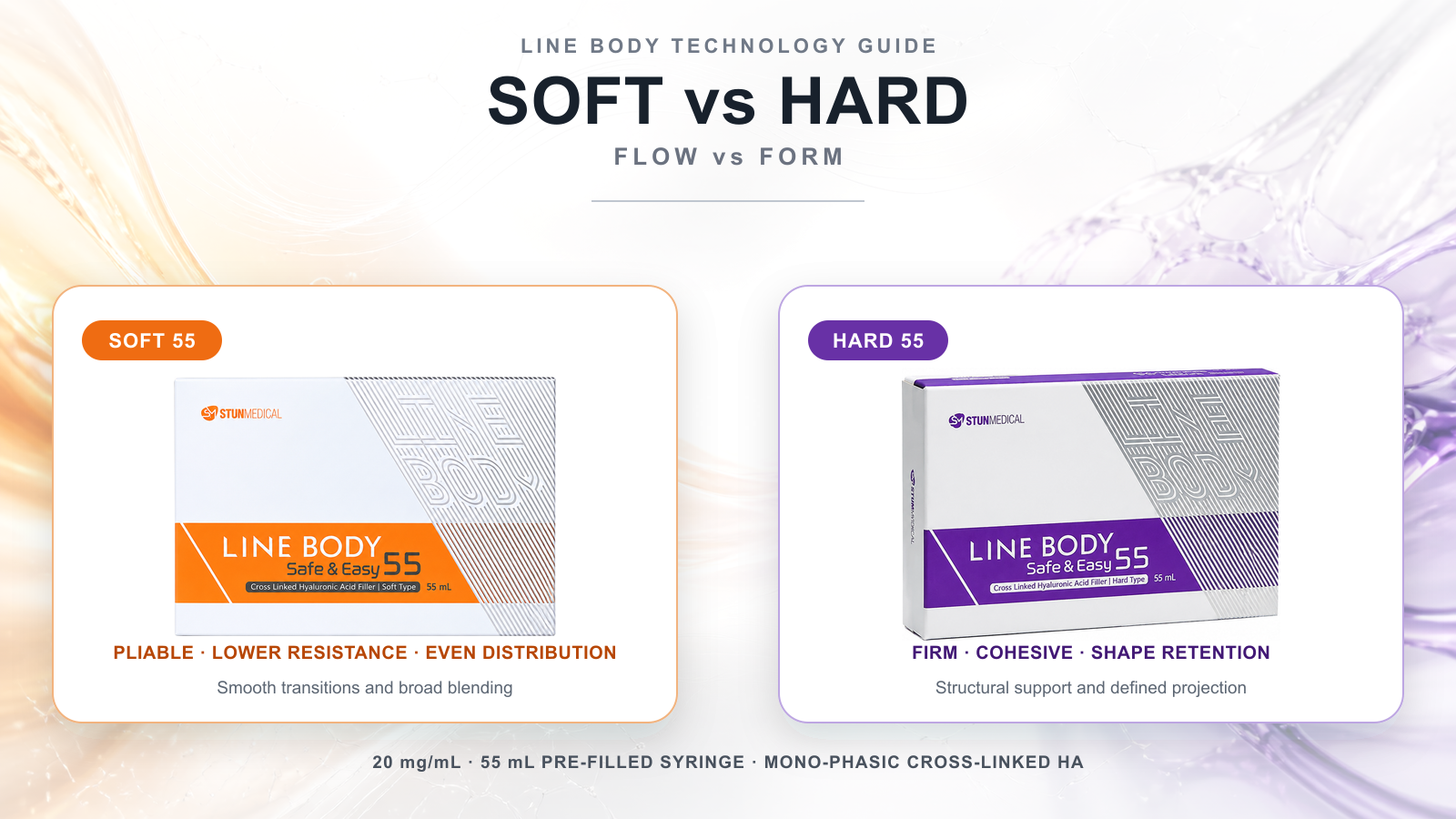
Quick answer: LINE BODY Safe & Easy 55 Soft and 55 Hard use the same core platform—20 mg/mL non-animal, mono-phasic cross-linked hyaluronic acid in a 55 mL pre-filled syringe—but the gel networks are tuned differently. Soft has a lower cross-linking density, creating a more pliable gel with lower handling resistance and wider, smoother distribution. Hard has a higher cross-linking density, creating a firmer, more cohesive gel with stronger structural support, rebound and shape retention. LINE BODY 100 keeps the 20 mg/mL mono-phasic HA platform in a 100 mL vial and is primarily the larger-volume format in the range.
That makes the selection logic straightforward: choose Soft when the priority is smooth integration and gentle contour transitions; choose Hard when the priority is firmer support and more defined projection; investigate 100 when the purchasing plan calls for a larger vial format. The important difference is not simply 55 mL versus 100 mL—it is how the HA network changes the texture and behavior of the gel.
LINE BODY Soft vs Hard: The Technical Difference
| Technical parameter | LINE BODY 55 Soft | LINE BODY 55 Hard | What the difference means |
|---|---|---|---|
| HA concentration | 20 mg/mL | 20 mg/mL | Concentration is held constant, so the main performance difference comes from gel structure rather than HA quantity per millilitre. |
| Fill volume | 55 mL pre-filled syringe | 55 mL pre-filled syringe | The two products can be compared on equal volume and presentation. |
| Gel structure | Mono-phasic, cross-linked HA | Mono-phasic, cross-linked HA | Both are continuous, cohesive gels rather than separate HA particles. |
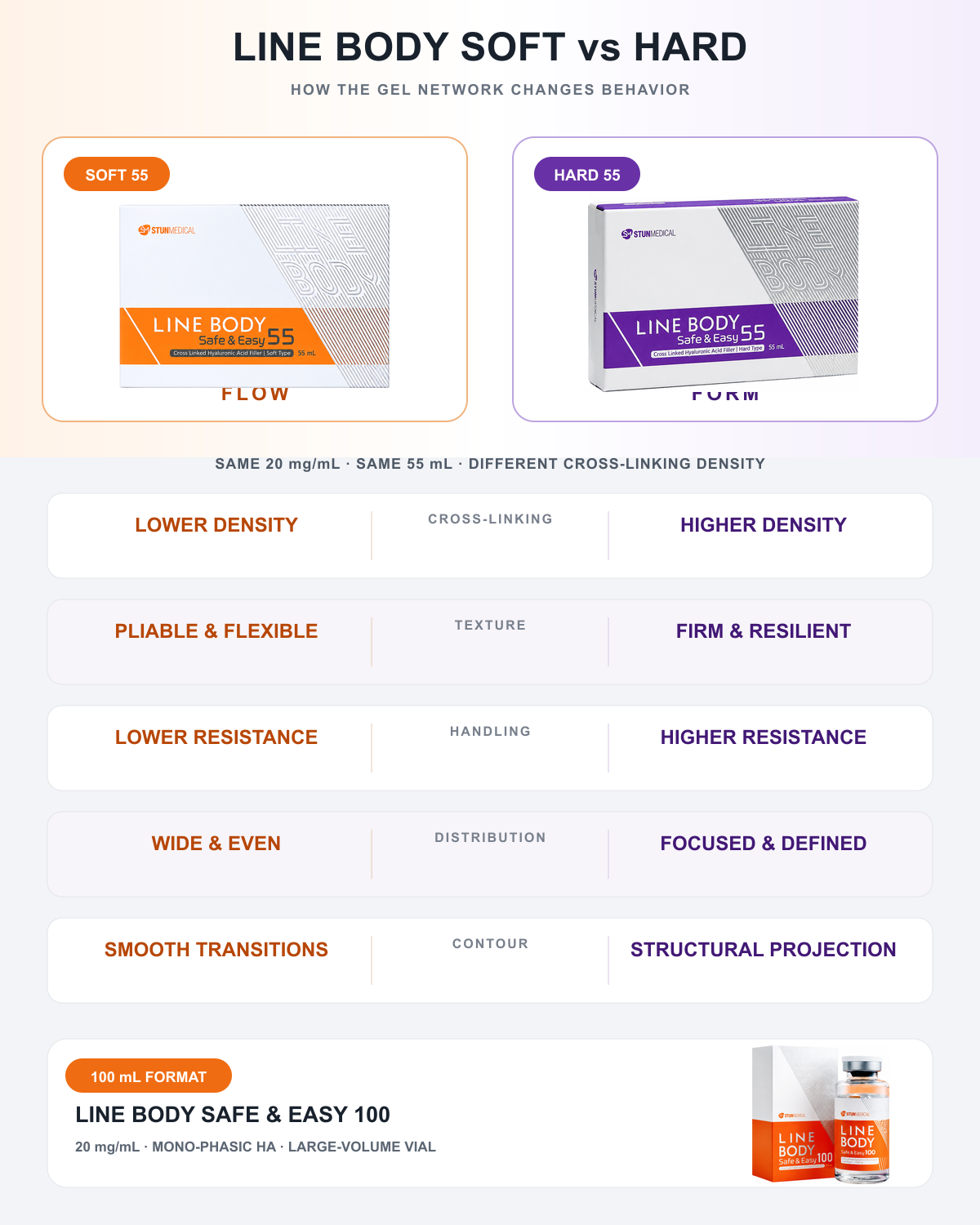
| Cross-linking density | Lower | Higher | Soft remains more flexible; Hard builds a firmer three-dimensional HA network. |
| Firmness | Soft and pliable | Firm and resilient | Soft follows broader transitions; Hard provides more structural definition. |
| Cohesivity | Smooth, flexible cohesion | Higher cohesivity | Soft distributes more gradually; Hard holds the gel mass together more strongly. |
| Handling resistance | Lower resistance | Higher resistance | Soft feels easier-flowing; Hard feels denser and more substantial during professional handling. |
| Distribution pattern | Wide, smooth and even | More concentrated and shape-focused | Soft supports seamless blending; Hard supports a more defined contour. |
| Primary design goal | Natural-looking fullness and smooth transitions | Projection, lifting support and contour definition | The desired finish—not the syringe size—separates the two products. |
The Shared Technology Behind Both 55 mL Gels
Both LINE BODY 55 Soft and LINE BODY 55 Hard are built on the same product foundation. Each contains non-animal-origin cross-linked HA at 20 mg/mL, uses a mono-phasic gel structure and comes in a 55 mL pre-filled syringe. The range uses a stabilization method that introduces a limited number of BDDE cross-links while preserving the naturally entangled HA network. Both product records state a residual BDDE level below 0.2 ppm.
“Mono-phasic” is important because it describes one continuous gel phase. The HA is presented as a uniform gel network, giving the product a smooth, cohesive character. Cross-linking then determines how tightly that network holds together. Increasing the density of links makes the network firmer and more resistant to deformation; reducing the density leaves it more flexible and easier to spread.
This is why two products can have the same HA concentration and the same syringe volume yet feel and perform differently. The number of milligrams tells you how much HA is present per millilitre. The cross-linking design tells you how that HA network behaves.
Three connected properties explain most of the difference. Firmness describes how strongly the gel resists deformation. Cohesivity describes how well the gel holds together as one mass. Viscoelasticity combines flow with elastic recovery. Soft balances these properties toward flexibility and smooth movement; Hard balances them toward resistance, rebound and structural persistence. This gives buyers a much more useful comparison than concentration alone: the formulas contain the same listed amount of HA, but the internal network is tuned for a different contouring job.
LINE BODY 55 Soft Technology: Flexible, Pliable and Even-Distributing
LINE BODY 55 Soft uses the more flexible version of the range’s cross-linked HA network. Its lower cross-linking density allows the gel to deform more easily under pressure and then distribute across a broader area. The resulting texture is soft, pliable and cohesive without feeling rigid.
From a handling perspective, Soft has lower resistance. The gel moves more readily and feels smoother during professional delivery. Once placed, its flexible cohesion helps it spread evenly and blend into surrounding soft tissue instead of concentrating strongly in one compact shape.
These properties make Soft the range’s smoothing-oriented option. Its advantages are:
- Lower-resistance handling: a more compliant gel that flows smoothly.
- Broader distribution: the gel can cover a wider transition area more evenly.
- Soft integration: flexible cohesion supports gradual blending with surrounding tissue.
- Harmonious finish: suited to plans where smooth fullness is more important than strong projection.
- Continuous contouring: useful when the visual goal is to soften an indentation or connect two contours without creating a sharply defined edge.
Soft should not be understood as thin or watery. It remains a cross-linked, mono-phasic HA gel. “Soft” describes its position within the LINE BODY family: more pliable, easier-flowing and more evenly distributing than Hard.
LINE BODY 55 Hard Technology: Dense, Cohesive and Shape-Retaining
LINE BODY 55 Hard uses a more densely cross-linked version of the same HA platform. The tighter network gives the gel greater firmness, cohesivity and viscoelastic resistance. In practical terms, it feels denser, offers more resistance during professional handling and retains a defined shape more strongly.
Higher cohesivity helps the gel remain together as a structured mass rather than spreading as widely as Soft. Its firmer network also provides stronger rebound against compression, which is the technical basis for greater lifting support and more visible contour definition.
These properties make Hard the range’s structure-oriented option. Its advantages are:
- Higher gel firmness: a denser texture that provides more structural presence.
- Stronger cohesivity: the gel holds together and maintains a concentrated form.
- Greater shape retention: the cross-linked network resists flattening and deformation more strongly.
- More defined projection: suited to plans where contour architecture matters more than broad blending.
- Firm support: useful when the desired finish calls for a clearer edge, stronger curve or more pronounced correction.
Hard should not be understood as stiff or unnatural. It is still a mono-phasic HA gel designed for controlled contouring. “Hard” means that it sits at the firmer, more cohesive and more shape-retentive end of the LINE BODY range.
How Do Soft and Hard Feel in Professional Handling?
| Handling characteristic | Soft | Hard |
|---|---|---|
| Initial feel | Softer, smoother and more compliant | Denser, firmer and more substantial |
| Resistance | Lower resistance and easier flow | Higher resistance with a stronger sense of gel body |
| Spread | Moves outward more readily for a broad, even transition | Remains more concentrated for focused shaping |
| Compression response | More flexible and accommodating | More resilient with stronger rebound |
| Contour character | Soft-edged and blended | Defined and structure-led |
The difference can be summarized as flow versus form. Soft prioritizes flow, distribution and integration. Hard prioritizes form, support and shape retention. Neither characteristic is inherently better; each is designed to create a different type of contour behavior.
Which Gel Fits the Desired Contour?
| Desired contour characteristic | Product to compare first | Technical reason |
|---|---|---|
| Smooth a broad contour transition | LINE BODY 55 Soft | Lower firmness and wider distribution help create a continuous, softly blended transition. |
| Add gentle, natural-looking fullness | LINE BODY 55 Soft | The pliable gel integrates smoothly and avoids an overly concentrated contour. |
| Create a clearer projected curve | LINE BODY 55 Hard | Higher cohesivity and shape retention provide stronger structural definition. |
| Support a firmer contour correction | LINE BODY 55 Hard | The denser gel network offers greater resistance to compression and flattening. |
| Combine smooth transitions with defined structure | Soft and Hard as separate professional options | The two textures can address different contour characteristics within one product family. |
Where LINE BODY Safe & Easy 100 Fits
LINE BODY Safe & Easy 100 contains 100 mL of cross-linked HA at the same 20 mg/mL concentration. It is described as a cohesive, viscoelastic mono-phasic gel and uses the same stabilization concept and residual BDDE specification below 0.2 ppm. Its defining difference is the 100 mL vial presentation.
The 100 format is therefore best understood as the large-volume member of the family rather than the next step above Hard. Soft and Hard answer a texture question. The 100 mL product answers a format and volume-planning question. A buyer choosing between all three should decide in this order:
- Choose the desired gel behavior: smooth and flexible, or firm and shape-retaining.
- Choose the presentation: 55 mL pre-filled syringe or 100 mL vial.
- Match the exact product record: Soft 55, Hard 55 or Safe & Easy 100.
Which Format Fits the Procurement Need?
| Procurement need | Product format | Why it fits |
|---|---|---|
| A 55 mL gel focused on smooth distribution and soft transitions | LINE BODY 55 Soft | Lower cross-linking density, lower resistance and a more pliable texture |
| A 55 mL gel focused on support, projection and defined shape | LINE BODY 55 Hard | Higher cross-linking density, greater cohesivity and stronger shape retention |
| A larger single-vial presentation | LINE BODY Safe & Easy 100 | 100 mL of 20 mg/mL mono-phasic cross-linked HA in one vial |
| Two distinct textures within the same concentration and syringe size | 55 Soft + 55 Hard | The pair keeps 20 mg/mL and 55 mL constant while offering different gel behavior |
Soft vs Hard: The Buying Decision in One Sentence
Choose Soft for spread, smoothness and integration; choose Hard for support, projection and shape retention. The same 20 mg/mL concentration does not make the two gels interchangeable, because their cross-linking density changes how the HA network feels, distributes and holds a contour.
For a wider view of Korean HA technologies, continue to the Korean dermal fillers guide. To compare other large-format HA families by texture and format, see the SedyFill vs Maxy Fill body filler guide.
Frequently Asked Questions
What is the main difference between LINE BODY Soft and Hard?
Both contain 20 mg/mL mono-phasic cross-linked HA in a 55 mL pre-filled syringe. Soft has a lower cross-linking density, making it more pliable, lower-resistance and easier to distribute smoothly. Hard has a higher cross-linking density, making it firmer, more cohesive and better at retaining a defined shape.
How does LINE BODY Soft feel?
Soft feels smoother, more compliant and easier-flowing during professional handling. It spreads more readily across a broader transition and creates a softer-edged, blended contour.
How does LINE BODY Hard feel?
Hard feels denser, firmer and more resistant. Its stronger cohesivity and rebound help it remain concentrated and maintain a more projected, structure-led contour.
Does the same 20 mg/mL concentration mean Soft and Hard are the same?
No. Concentration describes how much HA is present per millilitre, while cross-linking density determines how the gel network behaves. Soft and Hard hold concentration and volume constant but use different network firmness.
Is LINE BODY 100 the same gel as Hard?
LINE BODY 100 is the 100 mL vial format in the range. It contains 20 mg/mL cohesive, viscoelastic mono-phasic cross-linked HA, but its product identity is based on the larger vial presentation rather than a Soft or Hard label.
Which LINE BODY format is better for a smooth contour?
Soft is the first format to compare when the goal is smooth distribution, broad blending and gentle contour transitions. Hard is the first format to compare when firmer support, stronger projection and more defined shape are the priorities.
Compare the exact formats: view LINE BODY 55 Soft for flexible, even-distributing gel; LINE BODY 55 Hard for firm, shape-retaining gel; and LINE BODY Safe & Easy 100 for the larger 100 mL vial format. These are professional-use injectable products intended for qualified practitioners.