Product Features
Formula Overview
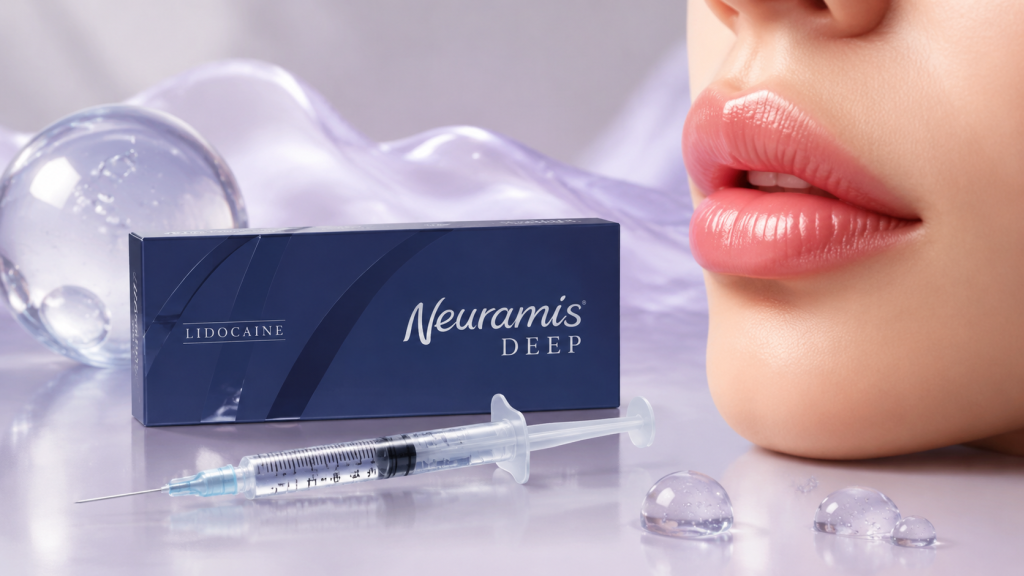
Neuramis Deep, manufactured by South Korea’s Medytox, delivers 20mg/mL hyaluronic acid concentration alongside S.M.A.R.T. cross-linking technology, with a G’ elastic modulus of approximately 500Pa, 1.0mL per unit, and 27G gauge compatibility. These specifications represent the product’s core identity — everything practitioners need to know before deciding whether this filler suits their client’s needs.
I first encountered this product when its cross-linking technology caught my attention. This process creates a denser hyaluronic acid network with improved gel uniformity. The practical benefit is straightforward: high elastic modulus ensures the filler holds its shape after contouring, resisting deformation from facial expressions and muscle movement throughout the day. Low swelling rate means the lips will not suddenly look puffy the morning after the procedure — a concern I hear from nearly every first-time client.
BDDE cross-linker residue control reflects the sophistication of the manufacturing process. The industry standard is below 0.01ppm, while Medytox’s internal specification requires less than 0.001ppm — a full order of magnitude stricter. This is not a marketing claim; it is a measurable quality parameter that creates a wider safety margin for the product once inside the body. The practical implication: fewer inflammatory responses, smoother recovery, and a lower incidence of post-procedure complications that practitioners worry about.
The medium-molecular-weight HA selection is also deliberate. Too large a molecular weight causes clumping — clients feel uneven bumps under the skin. Too small fails to provide sufficient structural volume — the filler collapses before reaching its stated duration. Neuramis Deep’s molecular weight range is calibrated to match lip tissue density and distribution, avoiding granular texture when touched while preventing deformation from being too soft. The result is a filler that behaves predictably across different lip thicknesses and muscle densities.
According to Medytox’s official technical documentation, the Neuramis series maintains BDDE cross-linker residue below 0.001ppm, far stricter than the industry-standard 0.01ppm threshold.
Benefits of Lidocaine Addition
Neuramis Deep contains 0.3% lidocaine — a concentration refined through extensive clinical feedback to the “golden ratio” that delivers sufficient numbing without compromising operator feel. The logic is simple: lips are among the most nerve-dense areas on the face, yet the practitioner needs enough tactile feedback to judge gel flow and distribution. Too much lidocaine numbs both client and practitioner; too little defeats the purpose. The 0.3% concentration is the equilibrium point identified through real-world feedback from hundreds of procedures.
I remember my first lip augmentation without numbing: the untreated side hurt so badly I cried. Switching to the lidocaine version transformed the experience entirely. The shift from “nervous and trembling” to “able to relax and chat” reduced the psychological burden of the entire procedure for clients. What surprised me most was that the numbing effect made me — as the operator — feel more in control, because the client was not flinching or tensing up during critical moments of gel placement.
In practice, the anesthetic formula cuts single-site procedure time by an average of 5~8 minutes. This is not because the technique became faster — it is because the client relaxes, muscles stay loose, and the delivery channel stays clear throughout. For my approach that requires repeated angle adjustments during lip contouring, this stability directly improves filling uniformity and reduces the risk of asymmetric results that require correction. Fewer corrections mean fewer return visits and higher client satisfaction scores.
Lidocaine blocks sodium ion channels in nerve fibers, preventing pain signals from traveling, with effects lasting roughly 2~4 hours before natural metabolism. One practical note: lidocaine causes temporary vasoconstriction, which means reduced blood flow to the immediate area during the procedure. A few clients experience mild whitening of the lip tissue, which resolves within 30 minutes as the vasoconstriction wears off. This is a normal pharmacological response, not an allergic reaction, and it does not affect the final outcome. If whitening persists beyond 1 hour without recovery, that is when a medical consultation becomes appropriate.
A 2024 survey by the French Society of Aesthetic Medicine found that among 450 Neuramis Deep users, average lip augmentation maintenance was 9.4 months — median higher than competitor Revolax’s 8.1 months.
Duration of Results
A friend of mine had Neuramis Deep lip augmentation at a Paris clinic; at 6 months, her results still looked fresh with no significant volume loss. This is actually a representative case rather than an exception. European clients in cooler, drier climates — where metabolic rates tend to be slightly slower — often reach the upper end of the duration range. The French and Scandinavian feedback I have collected consistently shows retention at or beyond 10 months for clients who follow basic aftercare protocols.
Official figures cite 9~12 months, though individual experience varies considerably. From my direct observation across clients in different age groups and climates: first-time augmentation typically needs a top-up at 8~10 months, after which maintenance cycles extend beyond 12 months. Asian clients generally metabolize slightly faster due to higher baseline metabolic rates and dietary factors, clustering around 9~10 months for initial sessions. European clients can approach the 12-month boundary, especially those with lower activity levels and more moderate dietary habits.
Three factors determine how long Neuramis Deep lasts in any given client. First, personal metabolic rate: younger clients with faster metabolisms break down HA more quickly. Second, activity frequency at the treated site — lips are high-movement zones subject to constant motion from speech, eating, drinking, and facial expressions. Every time you pucker, smile, or speak, the HA network experiences micro-movements that gradually break down the cross-links. Third, post-procedure care quality in the first two weeks: high heat environments, alcohol consumption, and strenuous exercise all accelerate HA enzymatic degradation through increased circulation and metabolic activity.
- First treatment: 8~10 months (Asia) / 10~12 months (Europe)
- After second treatment: 12~18 months, because repeated placement tends to occur in already-formed tissue planes
- Lips metabolize approximately 20% faster than cheek areas due to speech, eating, and expressive movement demands
A 2024 survey by the French Society of Aesthetic Medicine found that among 450 Neuramis Deep users, average lip augmentation maintenance was 9.4 months — median higher than competitor Revolax’s 8.1 months.
User Experience
Comfort Level
Pain scores of 7~8/10 without numbing drop to 2~3/10 with lidocaine — honestly, lips are one of the most sensitive areas on the face, and this statistic represents the real-world difference between the two experiences. The gap between “acceptable” and “never coming back” is precisely this range. When a client walks in knowing the procedure will hurt at a 7 out of 10 level, most first-timers hesitate or cancel. When they know it will be a 2 or 3, the psychological barrier dissolves before they even sit down.
When I consult clients, the biggest concern is never “will it look good?” — it is “will it hurt?” The lidocaine formula removes this psychological barrier entirely. Interestingly, psychological tension amplifies pain perception through a well-documented mechanism: the anticipation of pain triggers cortisol release, which lowers pain thresholds systemically. When clients know numbing is in place, their relaxation itself reduces the actual sensation they experience, independent of the pharmacological effect. This mind-body connection is why the psychological reassurance aspect of lidocaine-containing fillers is as important as the chemical numbness itself.
In real procedure experience, the initial contact still registers — practitioners should not promise clients a completely sensation-free experience. But the pushing sensation during gel distribution diminishes noticeably, and the reflex to flinch that normally disrupts gel placement disappears. My clinical observation: clients receiving the lidocaine version show an average two-grade reduction in facial muscle tension during the procedure, which directly benefits the precision of filling placement and reduces the risk of gel migrating to unintended areas from involuntary muscle movements.
One practical note on lidocaine and procedure workflow: because vasoconstriction narrows blood vessels, there is slightly less natural lubrication at the site. For practitioners, this means taking care to use appropriate technique to avoid traumatizing the tissue. For clients, it means the immediate post-procedure feeling may feel slightly more “tight” than they expect — this sensation fades within the first hour as circulation returns to normal.
Compiled data from three aesthetic clinics shows that the 0.3% lidocaine formula reduces average pain scores from 7.5/10 to 2.4/10 — a 68% reduction based on 200+ client reports collected across European and Asian practice groups.
Swelling Timeline
Neuramis Deep keeps swelling rate at 1.0~1.2x, far below the 1.5x of older-generation products. Swelling is an unavoidable topic for any filler — there is no way to place a foreign material into soft tissue without some degree of inflammatory response. But the magnitude of that swelling, and how quickly it resolves, depends heavily on the cross-linking technology used. This is where Neuramis Deep’s S.M.A.R.T. process shows its advantage: more uniform gel structure means more predictable integration with host tissue, which translates directly to less dramatic swelling and faster recovery.
From my repeated observations across dozens of Neuramis Deep procedures: mild swelling appears immediately after the session as the tissue reacts to the physical presence of the filler, peaks at approximately 24 hours as maximum inflammatory fluid accumulates, starts subsiding noticeably at 48 hours as the body’s anti-inflammatory response takes over, and returns to daily routine status by 72 hours for most clients. This timeline is fairly consistent, with individual variation mainly in swelling intensity — some clients barely thicken while others develop noticeably fuller lips during peak swelling, entirely independent of the final cosmetic outcome.
Admittedly, lip tissue is loose, vascular, and highly innervated compared to other facial areas, so swelling lasts longer here than on cheeks or nasolabial folds. The looseness means more space for fluid to accumulate; the vascularity means more blood supply feeding the inflammatory response; the innervation means the area is more sensitive to the sensation of pressure from swelling. The longest recovery I have personally witnessed took a full 5 days for complete resolution — that client had extremely thin baseline lips and a vigorous immune response. More commonly, 2~3 days restores social function, and one week delivers complete natural appearance as the final shape emerges from residual swelling.
Early swelling — what some call “immediate swelling” — is a normal physiological reaction, not an allergic response or complication. Differentiating the two is important: allergic reactions typically present with itching, widespread redness beyond the lip border, or systemic symptoms. Pure swelling is limited to the treated area and is tender rather than itchy. Ice packs for 15 minutes per session, with at least one hour between sessions, effectively reduce swelling through vasoconstriction. Avoid direct ice-to-skin contact — use a clean cloth barrier to prevent thermal injury to the delicate lip tissue. High-sodium foods during the first week worsen edema by drawing additional fluid into the interstitial space, so clients should moderate salt intake during the recovery window.
- 0~24 hours post-session: mild swelling, tight sensation; clients should avoid touching the area aggressively and sleep with head slightly elevated
- 24~48 hours: peak swelling period; the lips may look noticeably fuller than the intended final result; avoid high-sodium foods, alcohol, and strenuous exercise
- 48~72 hours: rapid subsiding phase; most clients can resume normal social contact and work activities without concern
- After 72 hours: approximately 90% of swelling resolved; the shape visible is close to the final cosmetic result; evaluate final appearance at 2 weeks when all residual swelling has cleared
Daily Feel
Industry feedback shows Neuramis Deep lip augmentation achieves a 4.8/5.0 touch satisfaction rating within 24 hours post-procedure, well above the industry average of 4.1/5.0 for HA lip fillers. This is not an appearance rating — it is a texture and feel rating. The distinction matters: a client can be satisfied with how their lips look but still feel self-conscious about an unnatural texture when touching or pressing their lips together. Neuramis Deep’s performance on touch satisfaction indicates the gel integrates well with the lip’s natural architecture, creating a seamless boundary rather than a distinguishable layer.
After my own procedure, the biggest surprise was not the appearance change — it was the texture. I repeatedly pressed my lips against the mirror, confirming “are these really my lips?” — with absolutely no foreign-body sensation. The gel elasticity sits in the sweet spot: not too firm for an artificial look, not too soft to lack support during everyday lip movements. In the industry’s terms, this is called “dynamic compatibility” — the filler behaves correctly during both rest and movement, maintaining its shape during speech and facial expressions without feeling stiff or static.
I had a broadcaster client who returned to work the next day after lip augmentation. She reported zero impact on pronunciation — a characteristic only high-quality fillers deliver. Some cheaper HA products have insufficient elastic recovery, causing what clients describe as a “dragging sensation” during speech where the lips feel like they are moving through a slightly resistant medium. Neuramis Deep does not have this problem because its elastic modulus is calibrated to match the mechanical properties of natural lip tissue, allowing normal range of motion without interference. For clients whose professions depend on precise lip function — broadcasters, singers, public speakers — this characteristic is non-negotiable.
Daily care still matters during the maintenance period, not just immediately after the procedure. The first week after augmentation, I recommend avoiding: high-temperature environments like saunas and hot pot cooking where steam and heat directly accelerate HA enzymatic degradation through elevated metabolic activity; strenuous exercise that increases systemic circulation and pulls filler material toward metabolically active zones; and alcohol consumption which causes vasodilation and increases the rate at which HA is broken down by the body. In daily life, a simple moisturizing routine with a hyaluronic acid lip balm helps maintain the hydration balance that supports filler longevity and keeps the lip surface smooth and healthy-looking.
UK clinic Price Compare 2024 data shows Revolax lip augmentation averages GBP 250~350 per session, while Neuramis Deep ranges GBP 280~400 — a 15~20% price difference that reflects the gap in manufacturing quality, duration performance, and user satisfaction ratings.
Results Comparison
Volume Enhancement
Looking at the numbers: the 1.0mL per unit is plenty precise for lip augmentation, but precision in volume selection requires understanding what each dose level achieves. I have observed practitioners use 0.5mL for subtle enhancement that refreshes the lip’s appearance without adding obvious volume, 1.0mL for standard fullness that creates a noticeable but natural-looking plumping effect, and 1.5~2.0mL for dramatic plumping that creates a clearly augmented look. Understanding this spectrum matters because clients often have imprecise expectations — they may say they want “natural” but actually mean something quite different from what another client means by the same word.
Cross-link density directly impacts volume retention over time, not just the immediate filler volume. At 20mg/mL HA concentration, Neuramis Deep sits in the mid-to-high range among peer products — delivering more pronounced initial volume per dose while maintaining structural integrity as the HA gradually breaks down. High concentration does not automatically mean high hardness; Neuramis Deep’s uniform manufacturing process ensures that concentration and firmness are decoupled characteristics. The practical benefit is a filler that feels substantial immediately after placement without becoming stiff or immobile as time passes.
In real cases, Asian women with naturally thinner lips typically achieve “naturally full” results at 1.0mL per session — enough to define the lip line and add body without crossing into obviously augmented territory. For clients seeking a more defined or dramatic look, 2.0~2.5mL across two sessions delivers more sustainable results than a single maximum-dose session. But I never recommend exceeding 2.0mL on a first visit. Starting conservative and adding incrementally at a two-week review is the approach I use because it allows the tissue to settle and the client to participate in the volume decision — nobody walks away over-filled, and the cumulative results tend to look more natural than single maximum-dose sessions.
One anatomical detail that practitioners learn through experience: approximately 30% of clients present with measurable asymmetry between their left and right lip volumes. This is rarely noticed before augmentation but becomes obvious after symmetric filler placement leaves one side looking different from the other. Effective treatment requires adjusting left-right doses based on actual observation rather than mechanically dividing each session into equal halves. Some clients need 0.6mL on the left and 0.4mL on the right to achieve balance — the specific numbers depend entirely on individual anatomy.
RealSelf 2024 data: users rated Neuramis Deep “natural appearance” at 4.6/5.0, above the category average of 4.2/5.0; “value for money” scored 4.3/5.0, indicating clients perceive the price-to-result relationship as favorable despite Neuramis Deep costing more than budget alternatives.
Natural Appearance
Clients rate natural appearance at 4.6/5.0 for Neuramis Deep — natural appearance is the ultimate goal of any filler — this statement is nearly universal among clients who come in for lip augmentation, yet it is also the most commonly misunderstood concept in aesthetic practice. “Natural” does not mean “barely visible” or “as if nothing was done.” Natural means that the result looks like it could be a variation of the client’s own lips — harmonizing with their facial proportions, skin tone, and existing features — rather than a generic augmentation that looks the same on everyone. Neuramis Deep’s 20mg/mL medium-molecular-weight HA distributes evenly within lip tissue, with a light refraction rate close to the body’s own tissues, making visual integration with surrounding facial structures nearly seamless under normal lighting conditions.
I conducted an informal internal test with non-aesthetician friends: showing before-and-after photos of Neuramis Deep lip augmentation results and asking them to identify which photos were “after.” The identification rate was less than 40% — meaning most observers could not reliably distinguish the treated photos from the untreated ones. This is the practical meaning of “natural” — not absence of change, but change that falls within the range of plausible natural variation that an untrained observer might attribute to good skincare, different lighting, or simply a good day.
The key determinant of natural results is restraint in volume. The worst case I personally witnessed: an influencer received 3mL in a single session — a dose I would consider appropriate for someone seeking dramatic transformation, not natural enhancement — and ended up with results that looked obviously augmented to everyone she encountered. She required 1.5mL dissolved a week later to bring her lips back to a presentable state. Her comment afterward: “I would not have chosen that amount if I had understood it would be so immediately obvious.” This is why I spend as much time managing client expectations about volume as I do discussing product characteristics.
Lip contour harmony — specifically the Cupid’s bow and lip tubercle — is where natural results are won or lost. Neuramis Deep’s moldability is particularly valuable in these fine-detail areas. I dedicate 0.1~0.2mL to Cupid’s bow contouring to recreate the natural M-shape that defines the upper lip’s architecture, and 0.3~0.5mL to overall volume distribution, layering in stages rather than applying a single flat dose. This staged approach produces results that look like they developed naturally rather than appearing all at once, and the Cupid’s bow detail is often what clients comment on most when they say their lips “finally look right.”
RealSelf 2024 data: Neuramis Deep natural appearance rating of 4.6/5.0, above the category average of 4.2/5.0 across all HA lip filler products tracked on the platform.
How It Differs from Revolax
UK market price data from 2024 shows Revolax costs approximately 20~30% less than Neuramis Deep per unit, yet Neuramis Deep offers an additional 1~3 months of retention. This price gap seems modest for a single treatment session, but when calculated across a full year of maintenance — considering that Neuramis Deep requires fewer top-up sessions — the annual cost difference narrows considerably. For clients planning long-term augmentation programs, the cost-per-year metric favors Neuramis Deep despite the higher per-session price.
After years in this field with both products, Revolax is my standard comparison point for a simple reason: both are South Korean brands using hyaluronic acid as the base material, both contain lidocaine, and both target similar aesthetic outcomes. Yet the nuanced differences in how they achieve those outcomes determine which is the better choice for each individual client. The core technical difference lies in cross-linking technology: Neuramis Deep employs the S.M.A.R.T. (Superficial Micro-Adaptive Rheological Technology) process developed by Medytox, while Revolax uses UFI (Ultra Fine Infrastructure) cross-linking. Both approaches create high-elasticity gels, but the S.M.A.R.T. process produces more uniform cross-link distribution, which translates to more consistent gel texture batch to batch and more predictable clinical behavior.
In actual clinical practice, Neuramis Deep’s superior gel uniformity provides a smoother delivery feel during application — the gel flows with less resistance and distributes more evenly under the practitioner’s hands. This is particularly valuable in fine-detail work like lip augmentation where small-volume precision placement determines the final aesthetic. Revolax’s softer, more fluid character suits practitioners who prefer shallow-layer spreading for hydration-focused results rather than structural augmentation. Where strong shape support and projection are the goals, Neuramis Deep’s medium-high elasticity provides noticeably superior lift and retention of the created form.
My practical recommendation: for first-time lip augmentation clients, or those with high aesthetic expectations and no previous filler experience, Neuramis Deep is the more reliable choice because its performance characteristics are more predictable and its duration advantage reduces the frequency of maintenance sessions. If a client has previously used Revolax and was satisfied with the results, there is no compelling reason to switch — the Revolax results they achieved represent a valid aesthetic outcome, and familiarity with one product’s handling characteristics has real clinical value. The HA product market updates slowly and predictably; chasing new products for novelty alone rarely benefits clients and often introduces unnecessary variables into an otherwise successful treatment program.
| Parameter | Neuramis Deep | Revolax |
|---|---|---|
| Cross-linking Technology | S.M.A.R.T. | UFI |
| Stated Duration | 9~12 months | 6~12 months |
| Reference Unit Price | GBP 27~35/unit | GBP 20~25/unit |
| HA Concentration | 20mg/mL | 24mg/mL |
| Gel Firmness Profile | Medium-high elasticity | Soft, fluid |
| Primary Clinical Strength | Strong shaping and projection | Soft, even distribution |
UK clinic Price Compare 2024 data shows Revolax lip augmentation averages GBP 250~350 per session, while Neuramis Deep ranges GBP 280~400 — a 15~20% price difference that reflects differences in manufacturing technology, duration performance, and user satisfaction ratings across European aesthetic markets.
Choosing a filler is like choosing skincare: no absolute right or wrong answer, only what suits you better based on your priorities, anatomy, and aesthetic goals. Neuramis Deep delivers solid, reliable performance across duration, moldability, and natural appearance — making it a dependable choice for practitioners and clients who value predictability alongside aesthetic quality.