Material · Product format · Professional buyer guide
Quick Answer
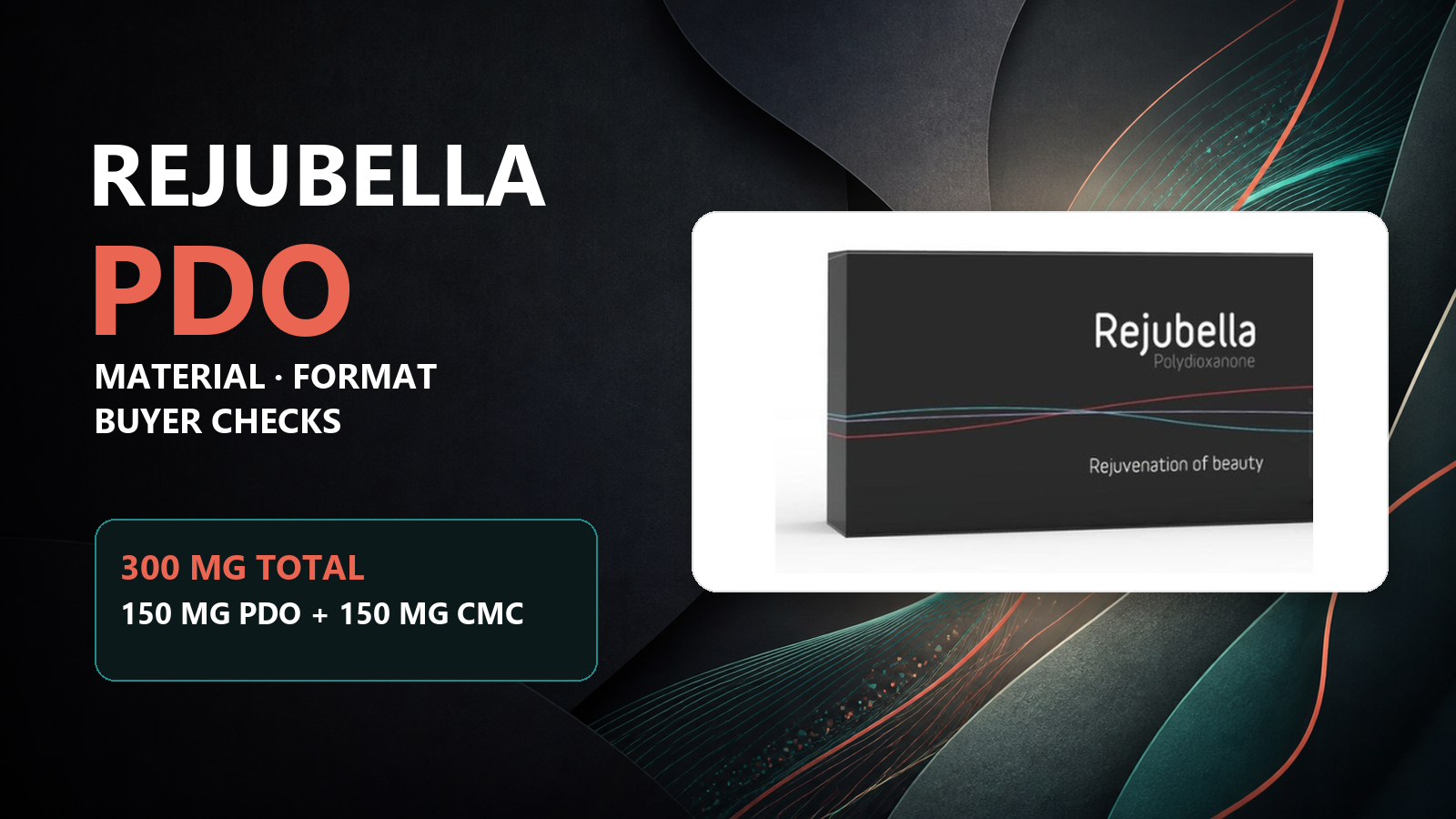
Rejubella is a PDO microsphere powder supplied as a 300 mg total vial, made up of 150 mg PDO and 150 mg CMC. That places it in a different procurement lane from HA filler gels and in a related—but materially distinct—particulate-vial lane from PLLA products. If the brief calls for a gel-format line, investigate a verified HA SKU. If it calls for an established PLLA particulate product, compare exact PLLA vial records. If it specifically calls for PDO microspheres, Rejubella is the format to investigate, with the full composition, pack configuration, batch, expiry, storage and destination-market documents confirmed before ordering.
The labels “filler” and “collagen stimulator” can make very different products sound interchangeable. For a clinic buyer, reseller or purchasing manager, the cleaner comparison starts with three questions: what is the active material, how is the product supplied, and which fields must appear in the purchasing record? This Rejubella PDO filler guide answers those questions without turning unlike materials into an unsupported performance ranking.
Why Buyers Compare Rejubella PDO with HA and PLLA
Rejubella sits at the meeting point of several familiar catalogue terms. Its name includes “filler,” its material is PDO, and its commercial format is a powder vial. HA products are also commonly called fillers, but their core material is hyaluronic acid gel. PLLA products use a different polymer again, although named PLLA systems may arrive in a particulate or lyophilized vial format. The overlap in category language explains the comparison; the material and supply records explain the decision.
Material routes at a glance
Microsphere powder
A PDO-and-CMC powder record with a defined total vial weight and pack configuration.
Gel-format products
HA concentration, gel design, syringe volume and pack count belong to the exact SKU.
Different polymer
A named PLLA product needs its own composition, vial and documentation record.
This distinction also protects search intent. The current Rejubella product listing owns the exact product and transaction path. The comparison article supplies the missing decision layer: where the product fits when a buyer is choosing between material families and formats.
What Is in the Rejubella Vial?
The most important product fact is also the easiest one to misread: the declared vial weight describes the total powder, not pure PDO content. The official Rejubella product record divides that total equally between polydioxanone and carboxymethyl cellulose. This equal PDO/CMC composition should remain attached to the full product name wherever the item appears in a quotation, catalogue or receiving record.
| Product field | Verified Rejubella record | Why it matters to the buyer |
|---|---|---|
| Material | PDO (polydioxanone) microspheres | Separates the SKU from HA gel, PLLA products and PDO thread formats |
| Vial composition | Equal PDO and CMC components within the declared total powder weight | Prevents the total vial weight from being recorded as pure PDO content |
| Particle record | Uniform spherical microspheres listed at 10–60 µm | Provides a precise identity field that can be matched to available product documents |
| Supply record | Powder vial; official materials list 1-vial and 5-vial box configurations | Makes the quoted and delivered pack configuration an explicit order field |
| Product identity | Rejubella packaging and official materials carry Meta Biomed branding | Gives the team a consistent name-and-packaging reference for quotations and receiving |
Rejubella PDO vs HA vs PLLA: The Fast Comparison
A useful PDO filler vs PLLA or HA comparison does not put unlike numbers into one ranking. Instead, it shows how each material family is recognized in a product file and what type of procurement brief it can answer. The table below keeps the comparison at the material, format and record level—the points a professional buyer can verify before purchase.
| Format to investigate | Core material | Supply-form logic | Key buying record |
|---|---|---|---|
| Rejubella PDO | PDO microspheres with CMC | Powder vial with a documented equal PDO/CMC composition | Full composition, exact box configuration, batch, expiry, storage and current market documents |
| HA filler SKU | Hyaluronic acid gel | Gel format; concentration, crosslinking, syringe volume and pack vary by SKU | Exact brand and SKU, gel specification, syringe and pack record, batch, expiry and market documents |
| PLLA product | PLLA polymer particles | Named products may use a particulate or lyophilized vial format with product-specific excipients | Exact PLLA product, composition and vial record, pack, batch, expiry, storage and market documents |
The correct comparison therefore changes with the brief. A buyer building an HA gel range should compare verified HA SKUs with one another. A buyer building a PLLA range should compare named PLLA products and their documents. A buyer seeking a PDO microsphere product has a clear reason to investigate Rejubella, provided the equal PDO/CMC identity and the exact commercial pack remain visible throughout the order process.
Normalize quotations by the commercial unit
When several quotations arrive, begin by defining one complete saleable unit for each candidate. For Rejubella, record the vial composition and whether the quotation covers the one-vial or five-vial box described in the product materials. For an HA option, record the exact syringe or unit volume and the number of units in the pack. For a PLLA option, record the exact named product, vial composition and box count. This prevents a box price, vial price and syringe price from appearing comparable before the units have been aligned.
The same discipline applies to specifications. Total powder weight, active-polymer content, gel concentration, syringe volume and pack count answer different questions. Preserve each field under its correct heading instead of collapsing them into one “strength” column. Once the commercial units and fields are normalized, the purchasing team can request live quotations, calculate stock requirements and compare supply options without losing the product identity that made each option relevant.
Rejubella PDO and HA Fillers: Different Material, Different Format
HA filler products begin with a gel identity. Their useful comparison fields include the exact HA product, the gel specification supplied by that product record, the syringe or unit volume and the pack configuration. Rejubella begins with a powder-vial identity. Its useful fields are the PDO/CMC composition, total powder record, particle description and box configuration. The word “filler” may appear around both categories, but the receiving record should look different.
This is why a milligram figure from Rejubella should not be placed next to an HA concentration or syringe volume as if the numbers measured the same thing. They describe different product systems. For procurement, the more useful question is whether the catalogue needs another HA gel SKU or whether it specifically needs a PDO microsphere powder option. The answer determines which set of specifications the purchasing team should compare.
For buyers who need the wider material and category context, the biostimulatory filler guide provides a broader framework. D7 keeps its focus narrower: it explains the exact Rejubella format and the product record needed to source it accurately.
Rejubella PDO and PLLA: Similar Vial Logic, Different Polymer
Rejubella and named PLLA products can look closer on a purchasing worksheet because both may be represented as particulate or powder-vial systems. That resemblance is operational, not material. Rejubella uses PDO microspheres, while PLLA products use poly-L-lactic acid particles. Each named product has its own composition, vial record, packaging and supporting documents.
CMC can also appear as a formulation component in more than one particulate product, so CMC alone does not identify the active polymer. The buyer should keep the polymer name at the front of the record: PDO for Rejubella, PLLA for a verified PLLA SKU. This simple naming rule prevents a shared excipient or similar box format from making different products look interchangeable.
The collagen stimulator materials guide is the better place to compare the wider PLLA, PDLLA, PCL and CaHA landscape. Rejubella belongs in that purchasing conversation only when its PDO material identity remains explicit.
Which Format Fits the Procurement Need?
Start with the gap in the catalogue rather than a generic request for a “filler” or “collagen stimulator.” The four briefs below lead to different next steps and keep the team from comparing incomplete or mismatched product records.
The brief calls for an HA gel line
Investigate verified HA SKUs and compare the product-specific gel, syringe and pack records. Rejubella does not answer a gel-format brief.
The brief calls for a named PLLA line
Investigate exact PLLA products and compare their polymer, vial, excipient, pack and document records as PLLA systems.
The brief calls for PDO microspheres
Investigate Rejubella and keep its equal PDO/CMC composition, declared total vial weight and pack configuration attached to the quote.
The brief says only “collagen stimulator”
Complete the brief before comparing products. Specify the material family and supply format, then shortlist exact SKUs with matching records.
This format-first route gives sales and purchasing teams a cleaner answer than a broad “best product” list. It also makes supplier enquiries more efficient: each enquiry names the material, exact SKU and records needed, instead of asking several unlike products to satisfy the same undefined requirement.
Where Rejubella adds clarity to a product range
Rejubella is most useful as a clearly identified PDO microsphere option inside a range that already separates materials by name. In a catalogue, that means placing the product under a PDO-led description rather than relying only on the generic word “filler.” In a quotation, it means showing the equal PDO/CMC composition and exact pack beside the product name. In a stock record, it means preserving the same identity through batch, expiry and reorder fields.
This presentation also helps customer-facing teams explain why the product is being compared with HA and PLLA without suggesting that the categories are equivalent. HA represents the gel-format route; PLLA represents a distinct polymer-particle route; Rejubella provides the PDO-microsphere route. The result is a more navigable range in which the buyer can start from a material requirement, move to an exact product, and then request the commercial information needed for that SKU.
Build a Clean Rejubella Buyer Record
Once the brief specifically calls for a PDO microsphere product, turn the Rejubella identity into a receiving template. A consistent record helps the buyer compare quotations, match the delivered item to the order and preserve the information needed for future reorders.
- Use the full product name. Record Rejubella PDO Filler rather than a shortened “PDO filler” description.
- Write the composition correctly. Keep the equal PDO/CMC split and declared total powder weight in the same field.
- Confirm the exact pack. State whether the quotation covers a one-vial or five-vial box configuration.
- Match visible packaging. Compare the carton and vial presentation with the verified Rejubella product identity.
- Capture the batch and expiry. Add the offered lot and delivered expiry to the purchasing and receiving record.
- Record storage and transit details. Ask for the current stock-handling information that applies to the offered batch.
- Collect exact-SKU documents. Keep the available product, traceability and destination-market records with the order.
- Preserve the reorder trail. Retain the supplier, invoice, batch, pack and receiving information together.
A broader portfolio review can continue through the Korean dermal filler guide. The practical role of this article is more specific: it ensures Rejubella enters that portfolio as a clearly named PDO/CMC powder-vial SKU, not as a generic substitute for every product described as a filler or stimulator.
View the Current Rejubella Listing
Compare the material and pack format, then view the current Rejubella listing to confirm the complete formula and request current batch, delivered expiry, storage and destination-market documents for the exact SKU before ordering.
Rejubella PDO Filler FAQ
What is Rejubella PDO filler?
Rejubella is a PDO microsphere powder product supplied in a vial. Its official product record lists an equal PDO/CMC composition within the declared total powder weight.
Does Rejubella’s listed vial total represent pure PDO?
No. The listed figure is the total powder weight, divided equally between PDO and CMC.
Is Rejubella an HA filler?
Rejubella is a PDO microsphere powder, while HA fillers use hyaluronic acid gel. They belong to different material and supply-format records and should be compared as separate product systems.
Is Rejubella the same as PLLA?
No. Rejubella uses PDO, while PLLA products use poly-L-lactic acid. Some named products may share a particulate-vial purchasing logic, but the polymer, composition and exact SKU records remain different.
Is Rejubella the same as PDO threads?
No. Rejubella is identified as a PDO microsphere powder product. PDO thread products use a different physical format and require their own product records.
What should a professional buyer verify before ordering Rejubella?
Verify the full product name, equal PDO/CMC composition, declared total powder weight, exact box configuration, carton and vial identity, batch, delivered expiry, storage information and the documents required for the destination market.
Editorial scope: This buyer guide supports product identification, material comparison and professional procurement research. It does not provide preparation, dosing, treatment or self-use instructions.