LHALA Peel and Aqua Peel are often placed in the same “gentle glow” category. That makes the choice look harder than it is. One is a defined professional peel product built around LHA, alkaline components and lipids; the other is a broader equipment-assisted cleansing format that uses liquid flow and suction. The useful comparison is therefore not which name sounds more advanced, but which job the customer actually needs done.
Investigate LHALA Peel first
Your priority is a defined Korean peel product for rough texture, dullness and a smoother, more polished-looking surface.
Investigate Aqua Peel first
Your priority is a machine-assisted deep-clean feel focused on surface oil, blackheads and visible pore congestion.
What Is Actually Different About the Technology?
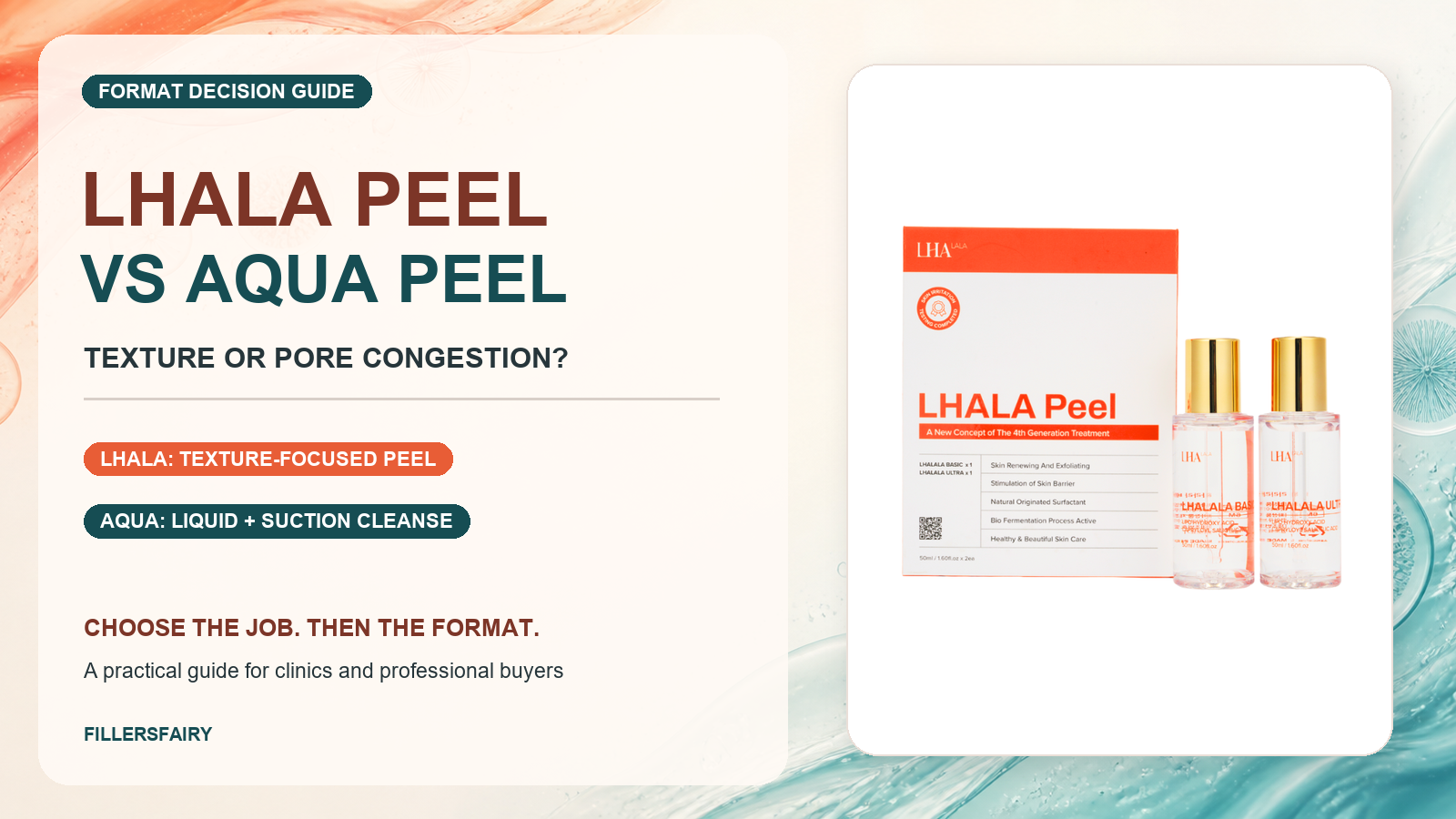
LHALA Peel is a product-specific, chemistry-led professional peel. The current product record is a two-part system containing LHALALA Basic and LHALALA Ultra. Official product materials identify LHA together with alkaline and lipid components as the core of the format. In buying terms, the clinic is choosing a recognizable peel SKU with a defined product identity and a direct reorder path.
Aqua Peel is an equipment-assisted treatment category rather than one universal product. The category is commonly built around water-based or exfoliating solutions moving across the skin while a handpiece provides suction or hydrodermabrasion. The practical purpose is to loosen and remove surface oil, keratin debris and blackhead material while leaving a hydrated, freshly cleaned feel. The exact machine, compatible solutions and service sequence can differ between clinics, which is why “Aqua Peel” should not be described as one fixed formula.
| Decision factor | LHALA Peel | Aqua Peel |
|---|---|---|
| Format | Defined professional two-part peel product: Basic + Ultra, 50 mL × 2. | Equipment-assisted service category using a machine and compatible liquids. |
| Defining technology | LHA-centered peel chemistry supported by alkaline and lipid components. | Liquid-assisted cleansing combined with suction or hydrodermabrasion. |
| Primary buying job | Add a recognizable texture-focused professional peel to the menu. | Add or use a pore-cleansing and extraction-led facial service. |
| Closest customer concern | Rough texture, dullness and a surface that looks less polished. | Blackheads, excess surface oil and visible pore congestion. |
| What is being procured | A specific branded peel kit and its supporting product record. | A compatible device, solutions, maintenance path and operator workflow. |
| Why they are not interchangeable | The product’s identity and chemistry define the service. | The machine-assisted cleaning action defines the service. |
The difference is already large enough to make a decision. A client asking for “clean pores” may be picturing the wet glide and light pull of a suction facial, while a client asking for “better texture” may be picturing a peel-led surface refresh. Treating both requests as the same glow service weakens the consultation and makes the product harder to sell honestly.
Which Is Better for Pores?
Aqua Peel is the more direct format to investigate when pores look prominent because they are filled with surface oil, blackheads or debris. Its commercial strength is the clear connection between the customer’s complaint and the service experience: liquid, suction and visible extraction-led cleaning. That makes it easy to explain to someone who wants the skin to feel cleaner and less congested.
LHALA Peel becomes the closer fit when “pores” is part of a wider texture complaint. A customer may use the word pores when the full concern is roughness, dullness, uneven light reflection and a surface that does not look refined. In that situation, a defined LHA-based peel product gives the clinic a more coherent texture-focused story than a cleaning-only story.
Which Is Better for Texture and Glow?
LHALA Peel has the clearer buying case when texture is the first priority. It is a specific professional peel system, so the clinic can position it around a smoother, more polished-looking surface rather than around extraction. The client is choosing a peel experience and a branded Korean product route, not simply a deep cleanse.
Aqua Peel has the clearer buying case when the desired glow is expected to come from cleaning and hydration. Removing surface buildup and leaving the skin freshly hydrated can create an immediate clean, bright impression. That is valuable, but it is a different type of value from choosing a peel because roughness and dullness are the main concerns.
The word “glow” should therefore be translated into a buying job. Does the customer want a cleaner, freshly hydrated surface, or a peel-led texture refresh? Once that is answered, the comparison stops being vague.
How Do LHALA Peel and Aqua Peel Feel Different?
The experience matters because it shapes expectations before the result is judged. LHALA Peel is product-led: the professional applies a peel system and the client experiences wet product contact without a suction handpiece. Aqua Peel is machine-led: the handpiece moves liquid across the surface while producing a light pulling or vacuum sensation. The exact intensity varies, but the difference in treatment character is easy to understand.
| Experience question | LHALA Peel | Aqua Peel |
|---|---|---|
| What does the service feel like? | A solution-based professional peel experience without the repeated pull of a suction handpiece. | A wet glide with a light pulling or vacuum sensation as the device moves over the surface. |
| What feels “active”? | The customer associates the service with the peel product and its contact with the skin. | The customer can physically recognize the machine-assisted cleansing action. |
| What is the immediate impression? | A smoother, more polished surface is the most coherent expectation. | A cleaner, less congested and freshly hydrated surface is the most coherent expectation. |
| Who may prefer the format? | Someone who wants a peel but does not equate value with aggressive visible peeling. | Someone who wants the tactile reassurance of extraction-led pore cleaning. |
Neither sensation proves a stronger clinical result. It simply helps the buyer select the service format that matches the experience and outcome they actually value.
Which Format Fits the Procurement Need?
For a clinic, the decision is also operational. LHALA Peel is a purchasable product record. Aqua Peel is usually a service platform with equipment and compatible consumables. The better procurement choice depends on what the clinic already owns, what clients request and how the treatment menu is meant to work.
| Procurement need | Product format to investigate | Why |
|---|---|---|
| Add a defined Korean peel SKU with a clear reorder path | LHALA Peel | The product has a fixed identity and a live FillersFairy purchase route. |
| Build a service around blackheads, surface oil and pore clean-outs | Aqua Peel system | Liquid-assisted suction directly matches the service promise. |
| Already own a compatible hydrodermabrasion platform | Aqua Peel protocol and consumables | Existing equipment can make the machine-led format easier to add, subject to compatibility. |
| Want a texture-focused peel menu rather than a cleansing facial | LHALA Peel | The product’s chemistry and two-part peel identity support that menu position. |
| Want the simplest single-product record for stock review | LHALA Peel | A product SKU is easier to track than a device, multiple compatible solutions and maintenance items. |
| Want a visible device experience that clients immediately recognize as pore cleaning | Aqua Peel system | The wet glide and suction sensation reinforce the extraction-led service story. |
The commercial difference in one sentence
LHALA Peel is a product to stock and build into a peel menu; Aqua Peel is a service system to equip, supply and operate. A clinic should compare those operating formats before comparing marketing words such as “gentle” or “glow.”
Which Better Fits a Low-Downtime Goal?
Both categories attract customers who want to return to normal plans quickly, so downtime alone does not separate them well. The better decision is to keep the primary job first. If the customer wants cleaning and extraction with minimal interruption, Aqua Peel remains the closer fit. If the customer wants a peel-led texture refresh without making visible peeling the measure of value, LHALA Peel remains the closer fit.
“Low downtime” should describe the service position, not become an absolute promise. Temporary redness, dryness or sensitivity can still occur with professional facial treatments, and the individual skin condition matters. That boundary needs one clear paragraph; it does not need to dominate the article or replace the product decision.
The Final Choice: LHALA Peel or Aqua Peel?
Choose Aqua Peel first when the purchase problem is congestion. Blackheads, surface oil, debris and the desire for a recognizable deep-clean experience all point toward a liquid-and-suction service format.
Choose LHALA Peel first when the purchase problem is texture. Roughness, dullness, uneven surface polish and the desire for a defined Korean professional peel product all point toward the LHA-based product route.
If the clinic wants to add the LHALA format, the next useful step is to review the current LHALA Peel product page and compare the product identity with the service demand already visible in consultations. For realistic results and recovery positioning, use the complete LHALA Peel results and downtime guide. The Lhala Gel Mask product record can also help a clinic understand the wider branded care range without turning this comparison into a bundle claim.
LHALA Peel vs Aqua Peel FAQ
Is LHALA Peel or Aqua Peel better for clogged pores?
Aqua Peel is the more direct format to investigate when clogged pores, blackheads and surface oil are the main problem because liquid-assisted suction and extraction define the service. LHALA Peel is a closer fit when pores are part of a broader rough-texture or dullness concern.
Which is better for rough texture and dull skin?
LHALA Peel is the clearer first option to investigate when rough texture and dullness are the main priorities. It is a defined LHA-based professional peel product positioned around a polished surface refresh rather than a machine-led pore clean-out.
Is Aqua Peel the same as a chemical peel?
No. Aqua Peel is generally an equipment-assisted hydro-cleansing category that combines liquid flow with suction or hydrodermabrasion. It may use exfoliating solutions, but the machine-assisted cleaning action is what distinguishes the format.
Which option usually feels gentler for a first-time customer?
Both are commonly chosen as lower-interruption options, but they feel different. LHALA Peel is a solution-based peel experience, while Aqua Peel produces a wet glide and light suction sensation. The better first choice depends on whether the customer wants texture-focused peeling or congestion-focused cleaning.
Can LHALA Peel or Aqua Peel permanently shrink pores?
Neither should be purchased with that promise. Aqua Peel can make congested pores look cleaner, while LHALA Peel can support a smoother-looking surface when texture is the concern, but natural pore size is not permanently erased.
Choose the Format Before You Choose the Product
If the clinic’s goal is a defined Korean peel SKU for texture-focused, low-visible-peeling care, review the live LHALA Peel product record and confirm current stock, batch and shipping information. If the goal is suction-based pore extraction, compare Aqua Peel devices and compatible solutions instead of treating the two formats as interchangeable.