Quick Answer
If your upper lip looks balanced when your face is relaxed but rolls inward or seems to disappear mainly when you smile, a lip flip is the more relevant option to discuss. It changes how the upper lip moves and may reveal a little more of the pink lip without adding gel. If your upper lip is also thin at rest—or you want more volume, border definition, projection, or a different shape—hyaluronic-acid lip filler is the more direct route.
Neither choice is automatically “better.” The useful question is whether you want to change movement or add volume and structure. Some people have both concerns, but combination treatment should follow an assessment rather than become the default. A qualified clinician should compare your lips at rest, while speaking, and during a full smile before recommending a product or plan.
Start With the Rest-and-Smile Test
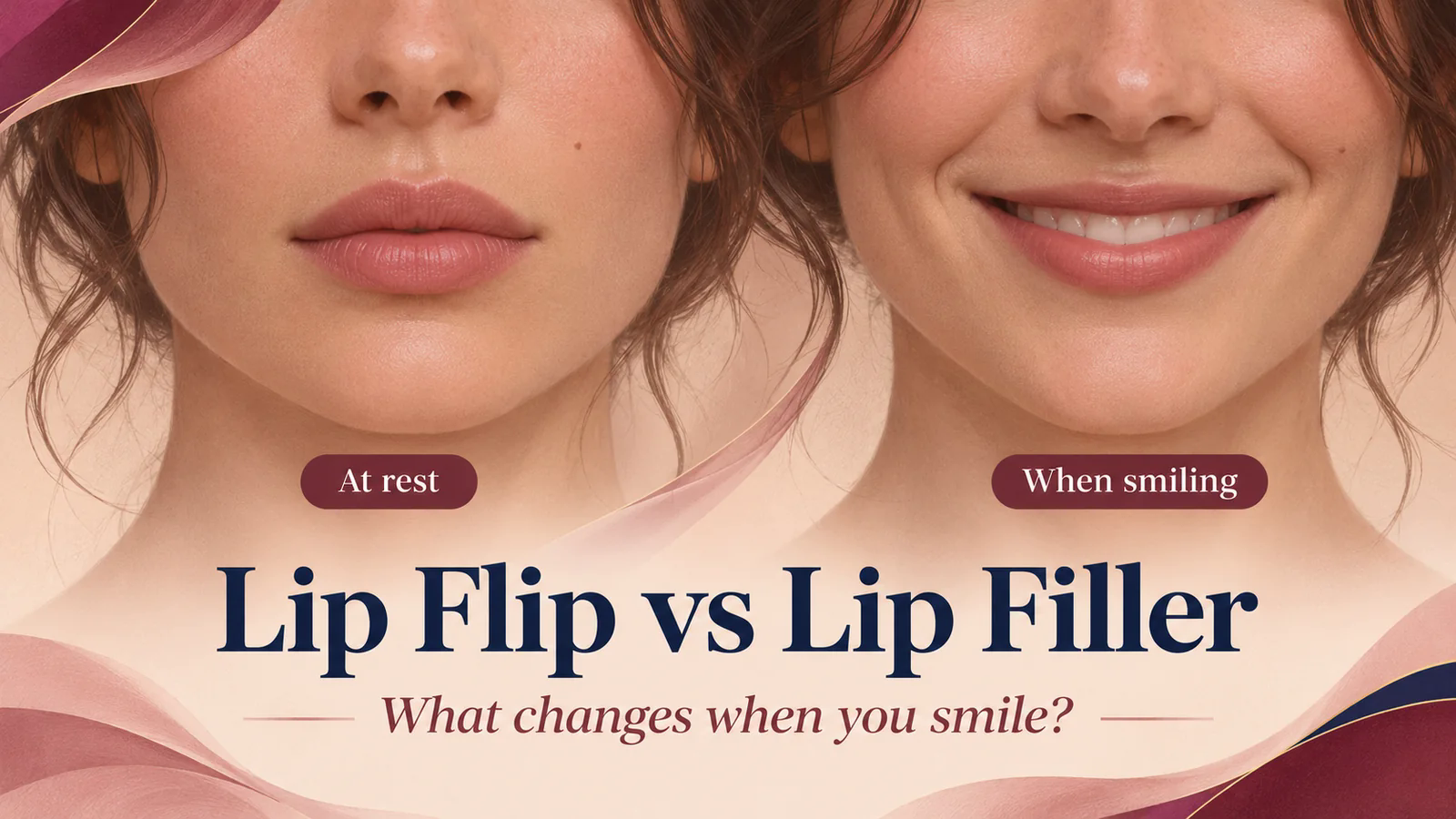
Look at two ordinary photos taken from the same angle: one with your mouth relaxed and one with a natural full smile. Do not judge only from a posed pout. The difference between those two states is the most useful clue.
If plenty of upper-lip vermilion is visible at rest but much less is visible when you smile, the concern is at least partly dynamic. The circular muscle around the mouth helps purse and roll the lips; in selected people, reducing part of that pull can allow a subtle outward turn of the upper lip. If the lip is thin in both photos, however, changing movement alone cannot create the volume that is missing at rest.
| Decision point | Lip flip | HA lip filler |
|---|---|---|
| Primary change | Changes upper-lip movement and subtle eversion | Adds gel volume and can change shape, definition, or projection |
| Best-matched concern | Upper lip looks acceptable at rest but rolls inward during smiling | Lips look thin at rest or need more visible structure |
| What it cannot reliably do | Create true volumetric augmentation | Directly relax the muscle action that makes a lip roll inward |
| When change becomes visible | Develops over several days rather than appearing immediately | Volume is visible immediately, although swelling can hide the settled shape |
| Typical maintenance pattern | Usually shorter and more frequent | Usually longer, but highly product- and person-dependent |
| Distinct trade-off | Temporary changes in lip control, speech, straw use, or lip seal can occur | Swelling and bruising are common; rare vascular complications can be serious |
On mobile, swipe the table horizontally to view the HA lip-filler column.
What a Lip Flip Can Change
A lip flip uses a botulinum toxin product to partially reduce the pull of the upper orbicularis oris. The goal is not to “fill” the lip. It is to let a little more of the existing upper lip turn outward when the mouth moves.
The distinction matters because the evidence supports a modest movement change, not a volume claim. In a small 2026 prospective study of 17 women, measured upper-lip height increased after treatment, while measured lip volume did not. A 2025 systematic review also found that the available evidence base was limited to seven eligible reports. That is enough to explain the mechanism and a plausible subtle outcome, but not enough to promise a dramatic or universal result.
In the United States, “lip flip” is an off-label cosmetic use of botulinum toxin: the current BOTOX Cosmetic label does not list the lips among its approved aesthetic indications. Off-label does not mean automatically inappropriate, but it does mean the clinician must make a patient-specific judgment, explain the evidence limits, and use the exact product according to professional and local requirements.
What Lip Filler Can Change
Hyaluronic-acid lip filler is designed to add physical volume. Depending on the approved product and the individual plan, that added volume may be used to increase fullness, improve border definition, balance proportions, or change projection. That makes filler the more direct category when your upper lip is thin at rest, not only during a smile.
Filler can make more lip tissue visible during animation because there is more volume present, but it does not directly switch off the muscular pull that causes inward rolling. Adding more gel to chase a movement problem can therefore create more resting volume than you wanted without fully resolving the smile that bothered you.
The FDA has approved specific dermal fillers for lip augmentation in adults aged 22 or older, but approval is product-specific and market-specific. “HA filler” is not one interchangeable product. If filler is the better route, first decide whether the priority is shape, definition, or volume before comparing brands.
Which Option Fits Your Pattern?
Your upper lip is fine at rest but disappears in a full smile
Discuss lip flip first. Your stated goal is to preserve more visible upper lip during movement without noticeably enlarging the relaxed lip.
Your upper lip is thin both at rest and when smiling
Discuss HA filler first. A movement-only treatment cannot supply the resting volume, border, or projection you want.
You want less rolling and more volume
Ask whether both factors truly contribute. A staged approach may make it easier to see what each treatment changes; combination should not be automatic.
You mainly want to show less gum
Ask for a gummy-smile assessment. Excessive gingival display can involve lip movement, tooth and gum proportions, or skeletal factors. It is not simply another name for a lip that rolls inward.
If you are unsure whether Botox-type products and fillers are even the same category, continue with the dedicated category explainer below. Excessive gum show also has its own guide because the cause must be assessed before any product is selected.
Timing, Maintenance and Everyday Trade-Offs
Lip flip
The effect develops over days rather than appearing at the appointment. Plastic-surgery guidance commonly describes the strongest relaxation in the first two to three weeks and maintenance in the range of a few months, but the exact course varies by product and person. Because the lip muscle is involved in speech, drinking, whistling, kissing, and keeping a seal around the mouth, excessive weakening can temporarily affect those functions. Small studies have reported transient numbness or functional limitation, and the current U.S. toxin label carries a boxed warning about possible spread of toxin effect.
HA lip filler
Added volume is visible immediately, but the first look is not the final look. Swelling, tenderness, bruising, firmness, and temporary asymmetry can make the lips look larger or less even before they settle. Across HA lip-filler studies, improvement can persist for months and sometimes to a year, but the product, amount, anatomy, metabolism, and evaluation method all matter. Do not use one brand’s duration claim as a universal promise.
Filler also carries a different risk profile. The FDA identifies unintended injection into a blood vessel as the most serious complication because it can cause tissue death, vision problems including blindness, or stroke. This is why lip filler is a medical procedure—not a beauty product to self-administer or receive through a needle-free device.
Why People Choose the Wrong Option
- They judge only a smiling photo. A lip can look small in motion while already having enough volume at rest.
- They ask for “natural” rather than naming the change. Natural could mean no extra resting volume, a softer border, less inward rolling, or simply less swelling. Those are different goals.
- They expect a lip flip to create filler-like fullness. A subtle outward turn can reveal existing lip tissue, but it cannot manufacture new volume.
- They expect filler to fix every smile pattern. More volume does not automatically correct the muscle action, dental proportions, or skeletal features that affect a smile.
- They choose by price or maintenance alone. The cheaper or longer-lasting option is still the wrong purchase if it changes the wrong feature.
What to Ask at a Consultation
Bring one relaxed photo and one natural smiling photo taken in similar lighting. Then describe the result in visible terms: “I like my lips at rest but lose the upper lip when I smile,” or “I want more upper-lip volume even when I am not smiling.” That gives the clinician a clearer target than asking for a trend by name.
A useful assessment should cover:
- whether the upper lip is thin at rest, rolls inward in motion, or does both;
- whether gum show, tooth proportions, asymmetry, or a long upper-lip segment changes the plan;
- how much visible change you actually want in relaxed photos and animated video;
- previous filler or toxin treatment, cold sores, dental work, medicines, allergies, and relevant health conditions;
- the exact product, its approval status in your market, expected follow-up, and what would count as an unsatisfactory result.
Continue on FillersFairy: Guides and Professional Product Routes
Lip Filler Goals: Shape, Definition or Volume
Separate volume, border definition, projection, and shape before comparing individual filler products.
Botox and Dermal Filler: Different Categories
Review why neuromodulators change muscle activity while dermal fillers add physical volume.
Gummy Smile: A Separate Decision Path
Continue here when excessive gum show—not only upper-lip inward rolling—is the main concern.
Restylane Kysse
View the current FillersFairy listing after a qualified professional has confirmed that an HA lip-filler route matches the treatment goal.
Juvéderm Ultra Smile
Compare a second current lip-filler listing without treating the product page as a substitute for clinical assessment or local-market verification.
Korean Lip Fillers Compared
Review the differences among Lipstar, Tesoro Rouge, Revolax, and VOM when the procurement question is broader than one SKU.
Professional-use boundary: the product links are procurement routes, not a recommendation to self-select or self-administer an injectable. Confirm the exact product, current manufacturer documentation, destination-market status, batch information, and professional eligibility before ordering.
The Practical Recommendation
Choose by the problem, not by the trend. If your upper lip is already satisfactory at rest and mainly rolls inward when you smile, discuss a lip flip first. If the lip is thin at rest or you want added shape, border, or projection, discuss HA filler first. If both are true, ask the clinician to identify how much of the concern comes from movement and how much from volume before considering a combined plan.
For licensed professionals who have already confirmed that an HA filler is the appropriate route, use the product cards above to compare current FillersFairy listings and the broader lip-filler guide. Review the current manufacturer instructions and destination-market status before procurement; this article is not an injection protocol.
Frequently Asked Questions
Does a lip flip add volume to the lips?
No. A lip flip changes muscle activity so that part of the existing upper lip may turn slightly outward. A small prospective study found an increase in visible upper-lip height without a measured increase in lip volume.
Can lip filler stop my upper lip from rolling inward when I smile?
Filler can add volume that remains present during a smile, but it does not directly relax the muscle action that causes inward rolling. If the lip looks satisfactory at rest and only disappears during animation, adding volume may not address the main problem.
Is a lip flip the same as gummy-smile treatment?
No. The two may both involve botulinum toxin, but they do not automatically target the same movement or cause. Excessive gum show may involve lip-elevator activity, tooth and gum proportions, skeletal features, or a combination, so it needs its own assessment.
Can I have a lip flip and lip filler together?
They may be discussed together when a person has both dynamic inward rolling and insufficient volume or definition at rest. Combination should follow an assessment; it is not automatically better than choosing the single treatment that matches the main concern.
Which lasts longer, a lip flip or lip filler?
Lip filler usually lasts longer than a lip flip, but there is no universal duration. Lip-flip effects are commonly maintained every few months, while HA lip-filler improvement may persist for several months and sometimes around a year depending on the specific product, anatomy, and individual response.
What is the simplest way to decide between them?
Compare your lips at rest and during a natural smile. If the concern appears mainly during smiling, discuss movement and lip flip. If it is present at rest too, discuss volume, shape, or definition and HA filler. If both states bother you for different reasons, ask for a mixed-problem assessment.
Sources Reviewed
- Lip Flip Revisited: Clinical Outcomes and Neuromodulatory Basis of Upper Lip Eversion (2026 prospective study).
- The Lip Flip: A Systematic Review of Botulinum Toxin Lip Augmentation (2025).
- U.S. FDA: Dermal Fillers (Soft Tissue Fillers).
- BOTOX Cosmetic U.S. Prescribing Information (revised 2024).
- American Society of Plastic Surgeons: Lip Augmentation Options.
Medical information is educational and does not replace an individual assessment. Regulatory status and available products vary by country. Injectable treatments should be performed only by appropriately licensed and trained healthcare professionals.