Editorial method: this guide compares current FILLMED product pages, product-identifiable papers and the present FillersFairy inventory route. Retailer and clinic marketing pages were not used to settle disputed formula facts. Last source review: August 2, 2026.
Scope: this is a product-identity and evidence guide for professional clinic teams and buyers. It is not an administration protocol, dose guide, treatment schedule, patient-specific recommendation or statement of authorization in every market. The exact supplied label, current instructions for use (IFU), destination-market requirements and qualified professional judgement remain controlling.
What Is NCTF 135HA?
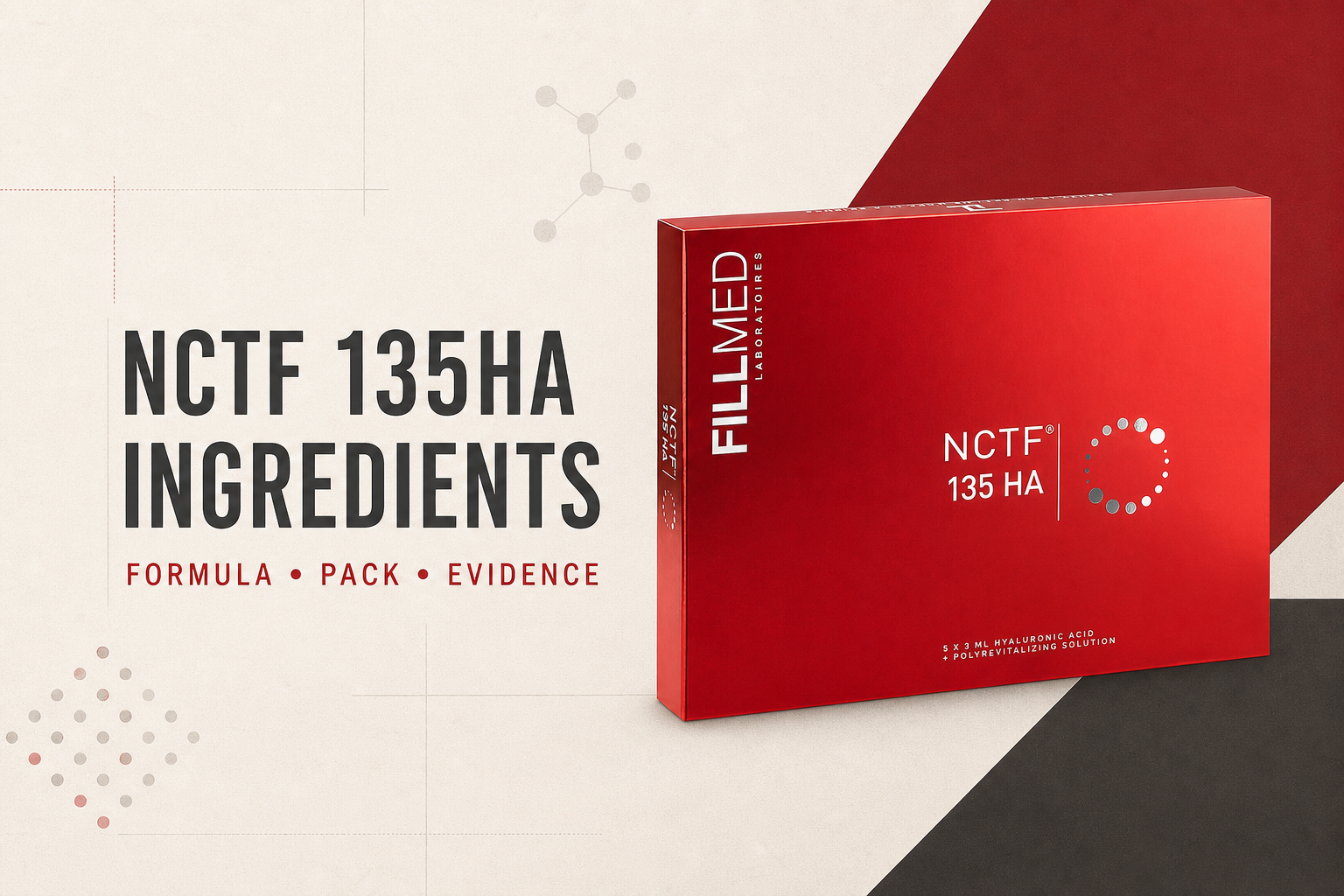
NCTF is the FILLMED product-family name for “New Cellular Treatment Factor.” A 2024 product-identifiable paper describes NCTF 135HA from FILLMED Laboratories, France as a 3 mL vial containing 5 mg/mL non-crosslinked sodium hyaluronate and a polyrevitalizing solution. That establishes a useful product identity and formula reference; it does not establish the product’s status or availability in every country.
The distinction matters on FillersFairy because NCTF can appear beside products used in Korean clinic protocols or within broader skin-booster navigation. That commercial context does not change its origin. For a category view that explicitly recognizes French-origin comparators, use the Korean skin boosters guide; do not relabel NCTF 135HA as Korean manufactured.
Similar NCTF names do not identify the same presentation
The current FILLMED UK portfolio page places NCTF 135, NCTF 135 HA and BOOST 135 HA in one table, but it does not present them as interchangeable. The following comparison reports that named UK page only.
| Name on the FILLMED UK page | HA concentration shown | Presentation shown | Identity warning |
|---|---|---|---|
| NCTF 135 | 0.025 mg/mL | 5 × 3 mL vials on the reviewed page | Not the same HA concentration as NCTF 135 HA. |
| NCTF 135 HA | 5 mg/mL | 5 × 3 mL vials on the reviewed page | The exact product covered by this article. |
| BOOST 135 HA | 5 mg/mL | 10 × 3 mL vials on the reviewed page | The page labels this as a sterile cosmetic for topical use, not the same product presentation. |
Reading rule: “135,” “135 HA” and “BOOST 135 HA” must remain attached to the full product name. A shared family name or HA concentration is not enough to transfer a pack, use status or document from one presentation to another.
NCTF 135HA Formula at a Glance
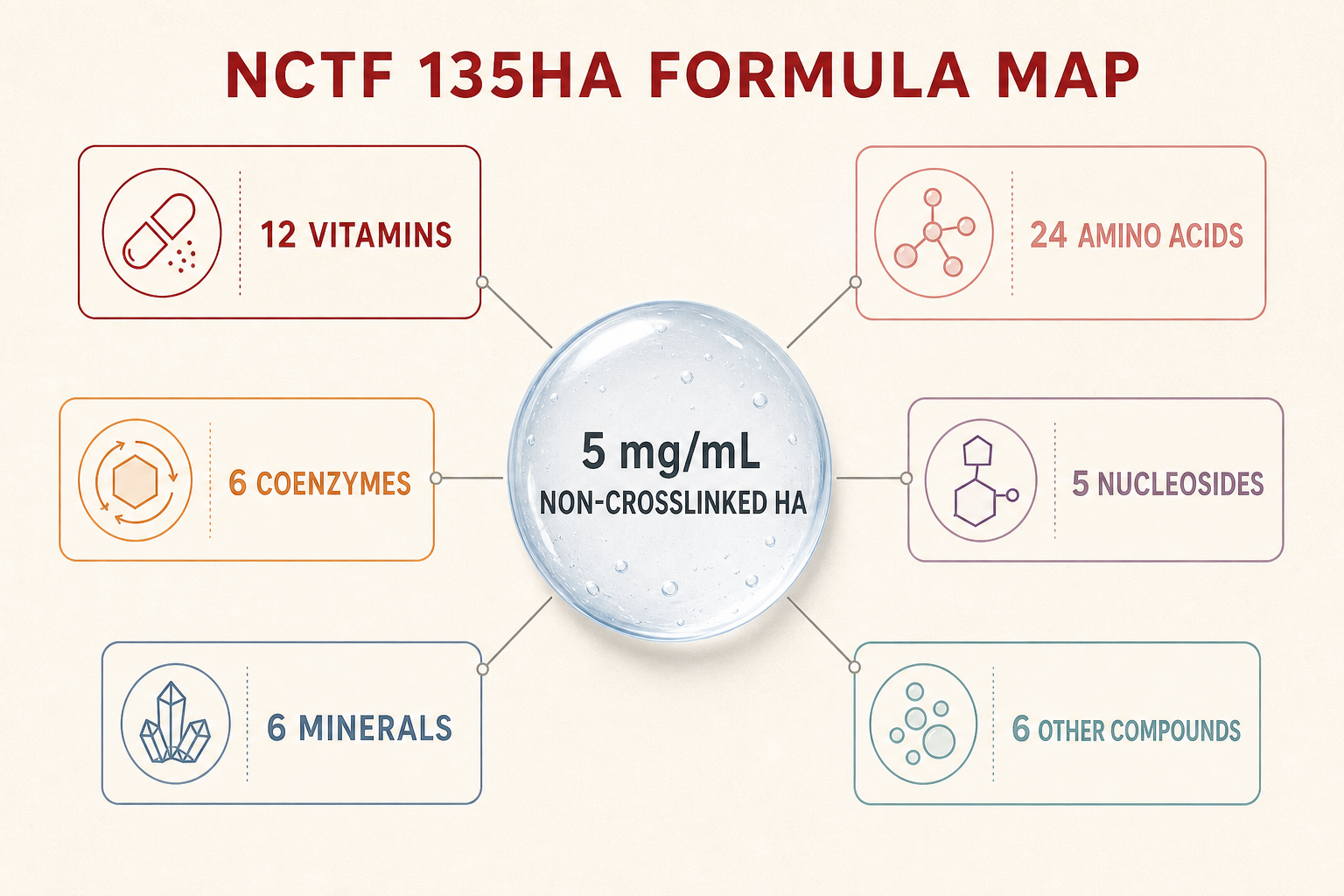
The 2024 paper describes a 3 mL vial with 5 mg/mL of non-crosslinked sodium hyaluronate. That concentration corresponds to 15 mg of HA in a 3 mL vial, consistent with the product description in a 2021 NCTF 135HA paper. This is a composition calculation, not a suggested dose or treatment amount.
The HA sits alongside a polyrevitalizing solution. The complete table in the 2024 paper organizes the non-HA entries into six groups: 12 vitamins, 24 amino acids, 6 coenzymes, 5 nucleosides, 6 minerals and 6 other compounds. The current manufacturer portfolio uses closely related category language but calls the nucleoside group “nucleic acids.” The article preserves that wording difference rather than pretending every source uses one vocabulary.
Complete Ingredient Groups Reported in the 2024 Paper
The table below transcribes the product-specific groups and names reported in the paper. It is a source map, not a substitute for the current label or IFU supplied with a clinic’s exact pack.
| Group | Count | Components reported | What the list cannot prove alone |
|---|---|---|---|
| Vitamins | 12 | Ascorbic acid, biotin, pantothenic acid, folic acid, inositol, nicotinamide, pyridoxine, riboflavin, thiamine, tocopherol, retinol and vitamin B12. | A vitamin name does not establish a patient outcome, indication or superiority. |
| Amino acids | 24 | α-Aminobutyric acid, alanine, arginine, asparagine, aspartic acid, cystine, glutamine, glutamic acid, glycine, histidine, hydroxyproline, isoleucine, leucine, lysine, methionine, ornithine, phenylalanine, proline, serine, taurine, threonine, tryptophan, tyrosine and valine. | Presence does not show how the complete product compares with another formula. |
| Coenzymes | 6 | TPP (cocarboxylase), CoA (coenzyme A), FAD, NAD, NADP and UTP. | The names do not establish a treatment mechanism in an individual patient. |
| Nucleosides | 5 | Deoxyadenosine, deoxycytidine, deoxyguanosine, deoxythymidine and 5-methyl-2′-deoxycytidine. | The group should not be rewritten as PN, PDRN or another nucleotide product class. |
| Minerals | 6 | Calcium chloride, potassium chloride, magnesium sulfate, sodium acetate, sodium chloride and sodium dihydrogenophosphate. | A mineral list does not establish safety, suitability or clinical priority. |
| Other compounds | 6 | Glutathione, polysorbate 80, glucuronic acid, glucuronic acid lactone, glucosamine and dextrose anhydrous. | A familiar component name cannot be turned into a stand-alone efficacy claim. |
Why Do Some Pages Say 55 Ingredients and Others 59?
This is a real documentation conflict, not a detail to hide. At the time of review, the current FillersFairy inventory metadata used “55-ingredient” wording, and similar commercial language appears on other legacy pages. By contrast, the 2024 paper’s six non-HA groups contain 59 individually named entries when their stated counts are added together. The manufacturer portfolio lists the same broad groups without presenting one simple total in the comparison row.
Several factors may produce different headline numbers: a historical formula or document revision, a regional presentation, a different rule for what counts as an “active ingredient,” or inconsistent commercial copy. The available pages do not justify choosing one explanation as fact for every current pack.
NCTF 135HA Pack Format: Separate Vial, Box and Kit Facts
The current FILLMED UK product listing presents an NCTF135HA Pro Pack with five 3 mL vials plus an injecting kit. The manufacturer portfolio also shows a 5 × 3 mL presentation. FillersFairy’s current inventory route uses the same 5 × 3 mL pack signal and can be checked on the NCTF 135HA product page.
That does not mean every photograph, historic brochure or regional listing represents the same kit. Clinics should separate four questions: the volume in each vial, the number of vials, included accessories and the market/version named on the box. A product-family image cannot settle those questions by itself.
| Pack field | What to verify | Do not assume |
|---|---|---|
| Vial volume | 3 mL on the exact NCTF 135HA source and supplied box. | That another NCTF-family item has the same concentration or use status. |
| Vial count | The number in the sealed market-specific pack. | That an old brochure or marketplace photo matches current stock. |
| Kit contents | The current product listing, box insert and received components. | That accessories are universal across countries or pack versions. |
| Traceability | Full name, lot, expiry, seal, invoice, supplier and current IFU. | That a clean product photograph proves authenticity. |
What the Formula Can—and Cannot—Prove
An ingredient fact, a manufacturer description, a market-specific device statement and a study result are four different evidence types. They should not be blended into one claim. The 2024 paper is useful here because it identifies the exact product and provides a complete composition table. Its treatment findings still belong to that study’s design, participants, methods and endpoints.
The 2021 NCTF 135HA paper reviews in vitro, ex vivo and clinical work. These layers are not interchangeable: a cell or tissue finding is not automatically a patient outcome. The paper itself notes, in one ex vivo discussion, that the available data did not show that adding the polyrevitalizing component increased a measured effect compared with pure non-crosslinked HA. That is a useful warning against turning a long ingredient list into an automatic superiority claim.
Evidence levels used in this guide
| Level | Meaning | Use in this article |
|---|---|---|
| A | Current manufacturer page, product document or market-specific IFU. | Primary source for identity, concentration, pack and market wording. |
| B | Product-identifiable peer-reviewed evidence. | Supports the reported formula or a defined study result within stated limits. |
| C | Current FillersFairy inventory fact. | Supports the present catalogue name, pack signal and purchase route only. |
| D | Retailer, clinic or aggregator page. | May reveal a question or conflict but cannot settle a disputed fact. |
Category Selection Map: Compare Product Routes, Not Winners
NCTF 135HA belongs to a polyrevitalizing-complex route: non-crosslinked HA plus multiple named component groups. That makes it different in composition from a plain sodium-hyaluronate route, a PN/PDRN route or a PDLLA-containing route. Difference is not the same as superiority.
- Need a documented multi-component FILLMED formula? Investigate NCTF 135HA, then verify the exact market pack and current IFU.
- Need to investigate a sodium-hyaluronate-only route? Review the exact documentation for a product such as Hyaron; do not assume equal concentration, presentation or status.
- Need a PN/PDRN route? Use the Korean PN and PDRN buyer’s guide. The five nucleosides listed for NCTF 135HA do not make it a PN product.
- Need another Korean multi-ingredient family? The Curenex product-line guide is a separate route with its own product documents; “cocktail” language does not make formulas interchangeable.
- Need a PDLLA-containing route? Start from the exact polymer-containing product and its evidence. Do not infer collagen-stimulator behavior from NCTF’s ingredient list.
The selection question should therefore be: “Which documented product route matches the clinic’s procurement brief and local eligibility?” It should not be: “Which ingredient list sounds most impressive?”
Clinic Verification Checklist
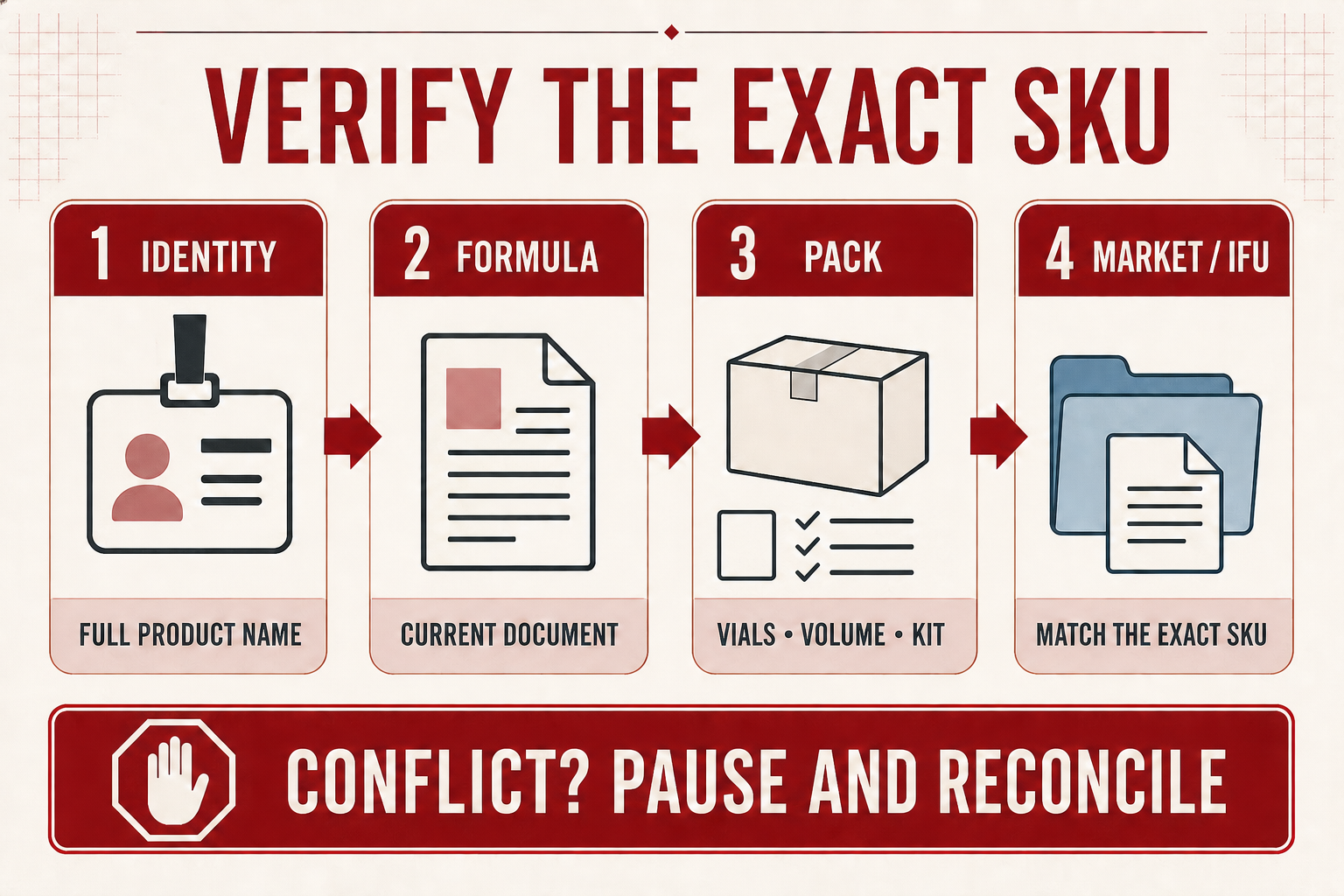
- Read the full product name: distinguish NCTF 135 HA from NCTF 135, BOOST 135 HA and any legacy Filorga/FILLMED naming.
- Identify the document: record the issuer, market, date or revision and exact product named.
- Match the formula: verify HA concentration and the component groups against the current supplied information.
- Match the pack: reconcile vial volume, vial count, kit contents, sealed box and inventory listing.
- Check traceability: retain supplier, invoice, lot, expiry, shipment and receiving information.
- Check destination-market eligibility: do not transfer device wording, conformity or availability from one country to another.
- Pause on conflict: request the current label or IFU. “Not verified yet” is safer than filling a gap with marketing copy.
Safety and Professional-Use Boundary
The reviewed FILLMED UK portfolio presents NCTF 135 HA as an injectable medical device in that market context, while it labels BOOST 135 HA as a sterile cosmetic for topical use. This contrast is precisely why the complete name and local document matter. The wording cannot be exported automatically to another jurisdiction or another NCTF presentation.
This article intentionally excludes dose, injection depth, pattern, device technique and session schedule. Product administration and patient selection belong with appropriately trained, qualified professionals following the exact current IFU and applicable local requirements. Ingredient names and pack photographs are not substitutes for that process.
Frequently Asked Questions
What are the documented NCTF 135HA ingredient groups?
The 2024 product-identifiable paper reports 5 mg/mL non-crosslinked sodium hyaluronate plus 12 vitamins, 24 amino acids, 6 coenzymes, 5 nucleosides, 6 minerals and 6 other compounds. The manufacturer portfolio uses similar categories but calls the nucleoside group “nucleic acids.” Check the current supplied label and IFU for the exact pack.
How much non-crosslinked HA is listed in NCTF 135HA?
The reviewed FILLMED portfolio and 2024 paper list 5 mg/mL. The paper describes a 3 mL vial, which corresponds to 15 mg of HA per vial. That is a composition fact, not a dose or treatment recommendation.
Why do some pages say 55 ingredients and others 59?
Online totals may reflect different document versions, markets, counting methods or inconsistent commercial copy. The 2024 paper lists six non-HA groups whose stated counts add to 59 entries, while some legacy commercial pages use “55 ingredients.” Do not force one total without matching it to the exact current product document.
Is NCTF 135HA a Korean skin booster?
No. The reviewed product paper identifies NCTF 135HA with FILLMED Laboratories in France. It may appear in Korean clinic protocols or comparative skin-booster navigation, but that context does not make the product Korean manufactured.
What pack details should a clinic verify before buying?
Verify the full product name, market/version, 3 mL vial statement, number of vials, included kit components, seal, lot, expiry, invoice, supplier traceability and current IFU. The reviewed UK and FillersFairy routes show a 5 × 3 mL presentation, but regional and historical packs should not be assumed identical.
Sources and Next Step
- FILLMED UK NCTF portfolio — current family naming, concentration, presentation and UK product-category wording.
- FILLMED UK NCTF135HA Pro Pack listing — current UK pack and kit route.
- 2024 Journal of Cosmetic Dermatology paper — product identity, 3 mL vial, 5 mg/mL HA and complete ingredient table.
- 2021 NCTF 135HA evidence review — product description and mixed in vitro, ex vivo and clinical evidence layers.
After reviewing the evidence and exact pack, clinic buyers can continue to the current NCTF 135HA inventory page. That page is the purchase route; this article remains the formula and documentation guide.