Buyer’s Guide · Korean Botulinum Toxin Type A
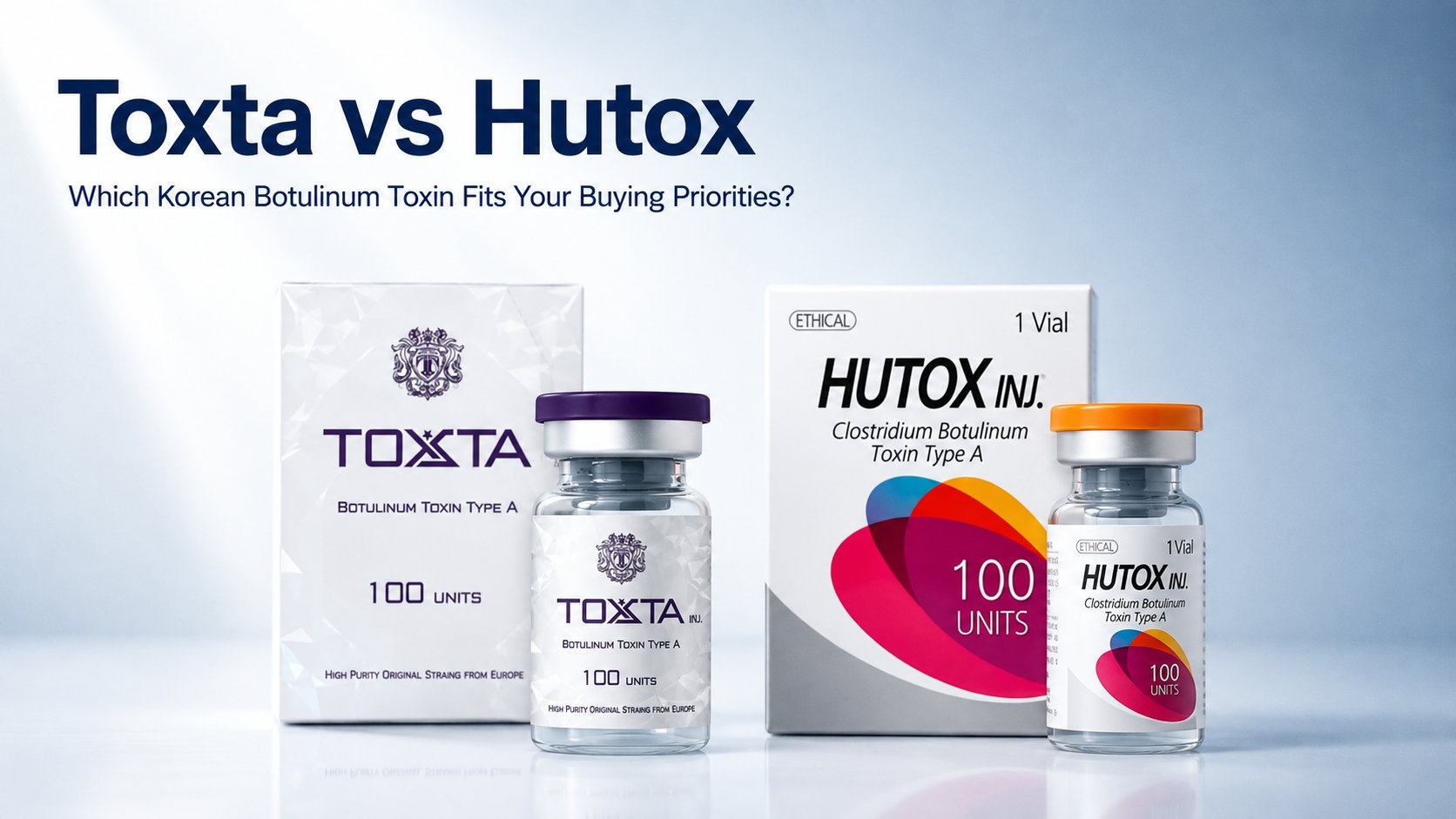
Toxta vs Hutox: Which Korean Botulinum Toxin Fits Your Buying Priorities?
Two value-tier Korean type A brands — vacuum-dried against freeze-dried. Same molecule, different vials, and a few honest differences that decide which one your practice should stock.
01Quick Answer
Read this paragraph; it is the whole comparison in one breath.
Toxta and Hutox are both value-tier Korean botulinum toxin type A products with the same ~99.8% purity claim. The most obvious difference is physical: Toxta is vacuum-dried and arrives as a nearly empty-looking vial with a thin, almost invisible film, while Hutox is a freeze-dried powder with a visible white cake. Realistic expectations for both: onset 3–7 days, full effect by week two, duration 3–6 months. Neither is FDA or CE approved — both are MFDS-approved.
02The #1 Difference — How the Product Arrives
This is the first thing you notice when a box is opened, and it is not a cosmetic detail — it changes how you receive, check and reconstitute the vial.
Vacuum-dried — and it looks empty
Vacuum / negative-pressure drying
An ultra-thin, almost invisible film sits on the inside of the vial. A sealed, untouched vial can genuinely look empty — this is the signature of the process, not a missing dose and not a packaging error.
Hold it to the light at an angle to see the faint film.
Freeze-dried powder
Conventional lyophilization
A visible white powder cake sits at the bottom of the vial — the form most practitioners are used to seeing. Reconstitution behaviour is unmistakable: the powder visibly dissolves.
What you see is what you get — no surprises at intake.
03Who Makes Each One
Both come from KOSDAQ-listed Korean biotech companies that run their own production lines — neither is a contract-filled import.
JETEMA Co., Ltd.
Korean biopharmaceutical company with a dedicated toxin facility. Toxta’s strain is described by JETEMA as a European-origin proprietary strain. The same production platform makes Kaimax, a sister brand sharing the strain and the vacuum-drying process — Toxta is one of two twins, not a one-off.
Huons Biopharma (Huons Global)
Hutox is the English-market export name for the product Korea’s domestic market sells as Liztox — same formulation, different label for international sales. That one fact clears up most of the confusion in seller listings.
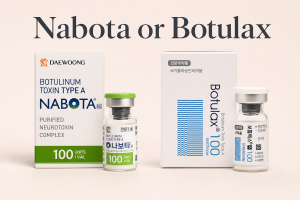
For a field view of where Toxta and Hutox sit among the other Korean botox brands, our eight-brand comparison covers the full lineup side by side.
04What Is Actually In Each Vial
Same active molecule, same excipients, identical purity figure — and one real formulation difference.
Inside both vials: Clostridium botulinum toxin type A, stabilized with human serum albumin (0.5 mg) and sodium chloride. Both labels quote ~99.8% purity.
The difference that actually matters is protein.
Reduced-protein complex
A neurotoxin complex with protein content cut roughly 55% versus conventional formulations (per JETEMA), linked by the manufacturer to lower antibody risk over repeated sessions.
150 kDa core toxin, no complexing proteins
Purified down to the 150 kDa core neurotoxin without complexing proteins — the basis of its “low immunogenicity” positioning.
Both are selling the same story — less protein, less immune stimulation — through different manufacturing routes. And the spec you actually need fits in one line: both come in 100U vials, Toxta also in 200U. Units, not packaging, are the working currency.
05Onset and Results
The realistic window for both products is the same. Anyone promising faster is selling marketing, not pharmacology.
Seller claims diverge most here
Distributors quote anything from 2–3 days to 5–14 days. Treat the optimistic figures as distributor claims — the consistent real-world report is roughly 3–7 days, in line with the rest of the Korean type A field.
Reports cluster at 3–7 days
Consistent with its domestic twin Liztox, which has years of accumulated Korean-market use. Nothing in its published data supports a materially faster onset than Toxta.
06Duration and Treatment Course
Duration is where the gap between honest data and seller copy is widest — for both brands, but especially for Toxta.
3–6 months (mainstream)
Several distributors advertise 6–9 months. The commonly cited clinical figure is closer to four months. If a supplier quotes 6–9 months, ask for the source.
3–6 months (3–4 typical in Korea)
Sits in the same band as Toxta. No credible source puts either brand meaningfully above the other on duration — individual metabolism and muscle mass shift these numbers more than the brand name does.
07Diffusion and Precision
How far the product spreads from the injection point separates product choice by body area.
Narrow — precision-oriented
Tighter diffusion suits precision-critical zones: glabella, periorbital crow’s feet, brow-shaping — where one millimetre of unintended migration shows up as a heavy brow or an asymmetric lift.
Balanced — controlled spread
Enough spread for even coverage across larger zones — forehead, masseter, full-face work — without runaway spread.
08Side Effects and Post-Treatment Protocol
The side effect profile of both is that of botulinum toxin type A generally — and technique matters more than the label on the vial.
What you may see: temporary injection-site redness or swelling that usually resolves within hours, an occasional mild headache for a day or two, and — rare but worth knowing — temporary eyelid or brow heaviness if the product spreads beyond the intended muscle. These risks are operator-dependent far more than brand-dependent.
On antibodies: both market the same theoretical advantage by different routes — Hutox removes complexing proteins entirely, Toxta cuts protein load. The theory is sound, but at cosmetic dosing, real-world antibody failure is rare for either brand.
Post-treatment protocol — applies to both brands:
- 1Stay upright for 4 hours after treatment — no lying down, no face-down positions.
- 2Do not rub, massage or press the area for 24 hours. This is the single most important rule — pressure moves the product.
- 3Avoid heat exposure (sauna, steam room, hot yoga, heavy cardio) for 24–48 hours — heat accelerates circulation and can affect distribution.
- 4Avoid alcohol for 24 hours — it dilates blood vessels and increases bruising risk.
- 5Skip facials, chemical peels and facial massage for 48 hours.
- 6Light exercise after 24 hours; intense training after 48 hours.
- 7For mild headache, paracetamol is acceptable; avoid aspirin and ibuprofen, which thin blood and worsen bruising.
- 8Book a review at day 14 — when full effect is visible and any asymmetry can be corrected with a small top-up.
09Full Comparison Table
Every dimension, side by side. The first row is the difference that matters most.
| Dimension | Toxta (JETEMA) | Hutox (Huons Biopharma) |
|---|---|---|
| Product form | Vacuum-dried — near-empty-looking vial with a thin, almost invisible film | Freeze-dried — visible white powder cake in the vial |
| Manufacturer | JETEMA Co., Ltd. (KOSDAQ) | Huons Biopharma / Huons Global |
| Domestic Korean name | Toxta | Liztox |
| Active ingredient | BoNT-A, European-origin proprietary strain | BoNT-A, BioPure process |
| Purity (manufacturer claim) | ~99.8% | ~99.8% |
| Protein | Reduced-protein complex (~55% lower, per JETEMA) | 150 kDa core toxin without complexing proteins |
| Onset | 3–7 days some distributors claim 2–3 | 3–7 days |
| Duration | 3–6 months some claim 6–9 | 3–6 months |
| Diffusion | Balanced, controlled — suits broader zones | Narrow — suits precision areas |
| Regulatory | MFDS-approved; not FDA/CE approved | MFDS-approved; not FDA/CE approved |
| Shelf life | 36 months from manufacture | Standard Korean-market shelf life |
| Best for | Cost-driven, high-volume buyers; clinics holding slow inventory | Precision facial work; buyers who want the protein-free formulation |
10Price, Supply and Authenticity
The part buyers actually feel — and the part where the market’s biggest traps live.
Price. Both sit in the value tier of Korean toxins, below the better-known Nabota and Botulax price points. Typical retail band: roughly $22–55 per 100U vial, depending on channel and volume. FillersFairy currently lists Hutox 100U at $38.50 and Toxta 100U at $30.50.
Supply. Toxta carries a 36-month shelf life from manufacture — among the longest in the Korean market — reducing write-off risk for clinics that hold stock. Hutox has the longer distribution history and the deeper international channel, which is why you see it more often in wholesale lists.
Verifying authenticity — four checks that take two minutes:
- 1Seal. Sterile-sealed with intact tamper evidence — reject anything pre-opened.
- 2Batch. Batch number on box and vial matches and is traceable to the manufacturer.
- 3Reconstitution behaviour. Hutox shows a visible powder that dissolves clear; Toxta’s near-empty film dissolves to the same clear solution. A product behaving differently than its form promises is a red flag.
- 4Channel. Buy only through authorized cold-chain suppliers. Out-of-band pricing below the band above is the single biggest counterfeit signal in this market.
11Which Brand Fits Which Buyer
Your buying priority decides the pick — not the marketing sheet.
If your priority is unit cost and volume
The 36-month shelf life cuts inventory write-off, and balanced diffusion handles full-face and masseter work cleanly. The one adjustment is staff familiarity — the empty-looking vial takes exactly one unpacking to get used to.
If your priority is precision and the protein story
Glabella, periorbital, brow shaping — or you want the cleaner protein profile (150 kDa, no complexing proteins) and a brand name with broader international recognition, including its Liztox domestic track record.
12FAQ
Which works faster — Toxta or Hutox?
Which lasts longer?
Both claim 99.8% purity. What is the real difference?
Can I switch from Botox or Nabota to these? Are units interchangeable?
Toxta has little public clinical data. Can it be trusted?
How do I verify authenticity?
Is Hutox the same as Liztox?
RReferences
- JETEMA Co., Ltd. Toxta product information — vacuum-dried botulinum toxin type A. 2026.
- Huons Global / Huons Biopharma. Hutox product information — freeze-dried botulinum toxin type A. 2026.
- Ministry of Food and Drug Safety (MFDS), Republic of Korea. Biologic product approval records.
- Carruthers J, Carruthers A. The evolution of botulinum toxin type A for cosmetic applications. J Am Acad Dermatol.
- Naumann M, Jankovic J. Safety of botulinum toxin type A: a systematic review and meta-analysis. Clin Pharmacol Ther.
- International Council for Commonality in Biologicals. Botulinum toxin products: considerations on standardisation and interchangeability. Biologicals.
- FillersFairy. Product pages: Toxta 100U; Hutox 100U. 2026.
Product specifics (unit sizes, pricing, current stock) should be confirmed on the live product pages before ordering. This article is a buyer-side comparison, not clinical guidance; all treatment decisions belong with a qualified practitioner.