Innotox Dosage Guide: Exactly How Many Units for Each Treatment Area
Written by FillersFairy Editorial · Reviewed by FillersFairy Clinical Team · Last updated: 2026-07-02
Quick Answer
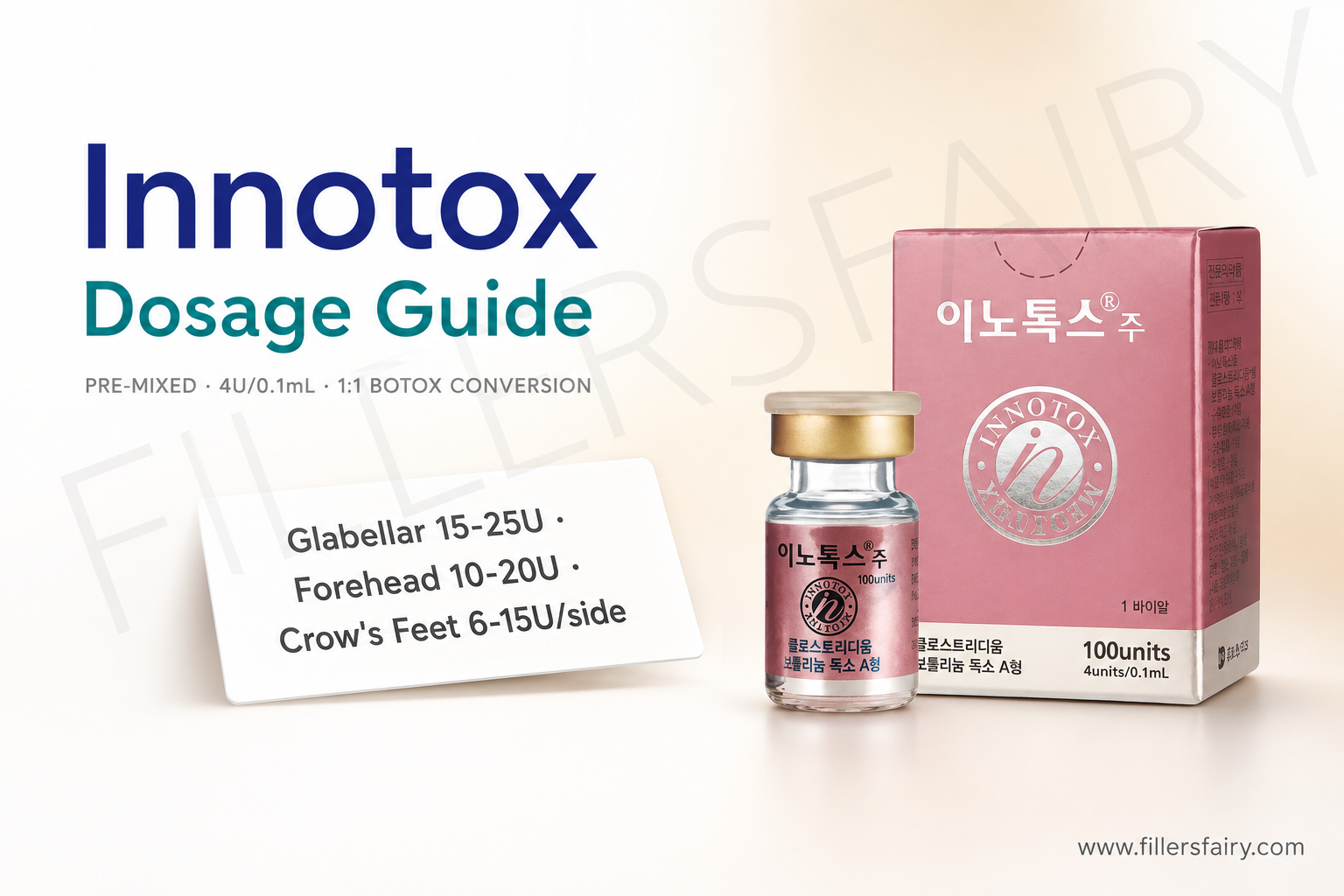
Innotox uses a 1:1 unit conversion to Botox — no dosage recalculation needed. Pre-mixed at 4U per 0.1 mL, the concentration is fixed and consistent for every injection. Standard doses: 15–25U for glabellar lines (5 points), 10–20U for forehead (4–6 points), 6–15U per side for crow’s feet (3–4 points), 20–50U per side for masseter. As a ready-to-inject liquid, Innotox eliminates reconstitution variability — what you draw into the syringe is exactly what the patient receives.
Why Dosing Innotox Is Different — And Easier
Every other botulinum toxin on the market requires practitioners to make a dosing decision before they even see the patient: how much saline to add during reconstitution. This single variable — the dilution ratio — affects the final concentration of every injection.
Innotox removes this variable entirely. The product arrives at a fixed concentration of 4 units per 0.1 mL. No saline. No calculation. No variability between practitioners, between sessions or between clinics. What you draw from the vial is what the patient receives — every time.
For practitioners already familiar with Botox or other BTX-A products, the transition is seamless: 1:1 unit conversion. Twenty units of Innotox produces the same clinical effect as twenty units of Botox. Same injection points, same technique, same dosing guidelines — minus the reconstitution step.
Complete Dosage Chart by Treatment Area
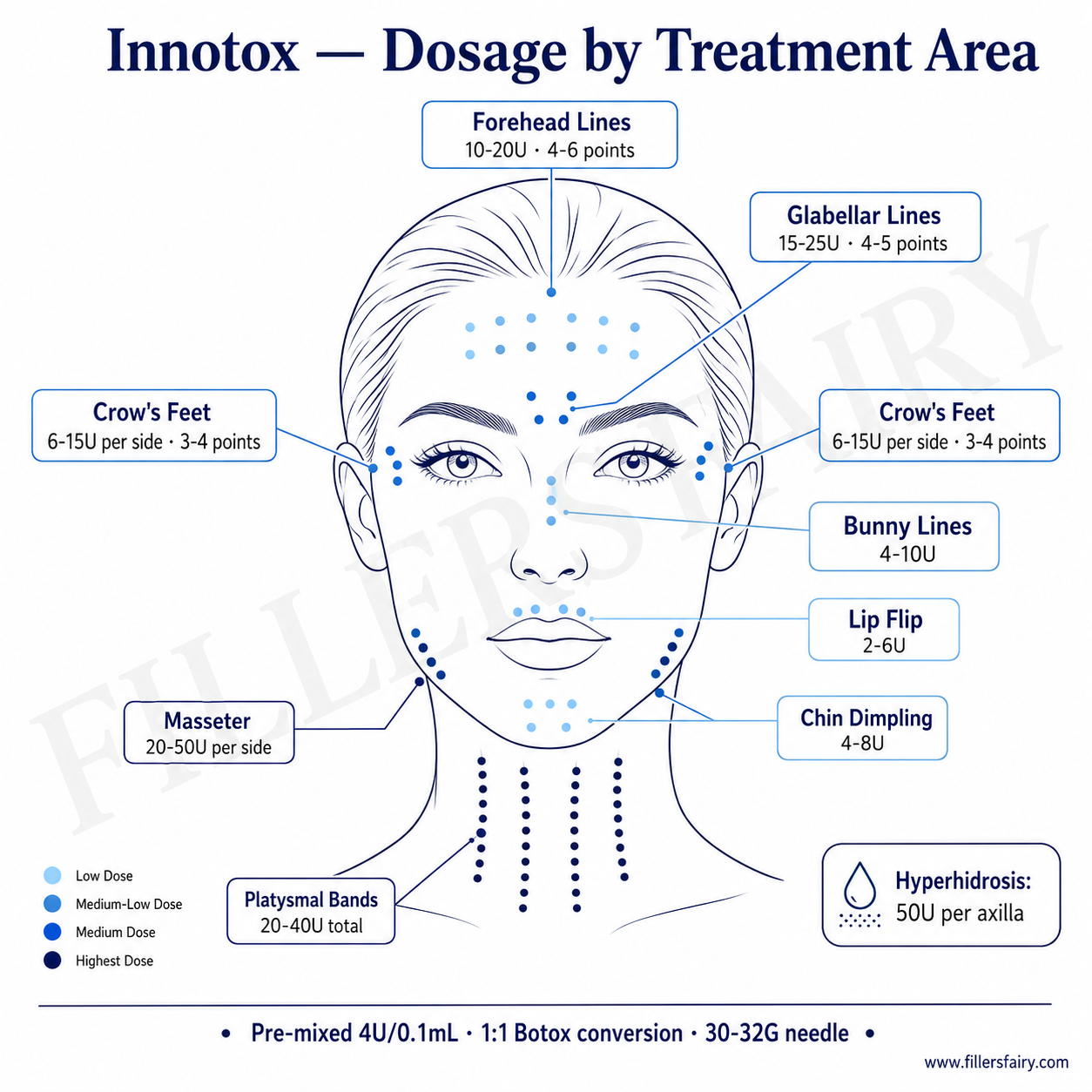
| Treatment Area | Dosage Range | Injection Points | Depth | Clinical Notes |
|---|---|---|---|---|
| Glabellar lines (frown) | 15–25U | 4–5 points | Intramuscular | Corrugator + procerus. Classic 5-point pattern. Inject deeply and symmetrically to avoid asymmetry. |
| Forehead lines | 10–20U | 4–6 points | Superficial IM | Frontalis muscle. Even spacing ~1.5 cm apart. Lower doses preserve natural brow movement. Avoid over-treatment → brow heaviness. |
| Crow’s feet | 6–15U per side | 3–4 per side | Superficial | Orbicularis oculi. Stay lateral to avoid affecting lower eyelid. Superficial placement reduces bruising. |
| Masseter (jawline slimming) | 20–50U per side | 3–5 per side | Deep IM (4–5 mm) | Dose varies significantly with muscle thickness. Bruxism patients may need higher range. Maintenance every 4–6 months. |
| Bunny lines | 4–10U | 1–2 per side | Superficial IM | Nasalis muscle. Small dose, precise placement on nose bridge. |
| Chin dimpling | 4–8U | 1–2 points | Intramuscular | Mentalis muscle. Smooths “orange peel” texture. |
| Lip flip | 2–6U | 2–4 points | Superficial | Orbicularis oris. Very precise dosing — lips are functionally active. Start low. |
| Platysmal bands (neck) | 20–40U total | Along each band | Superficial IM | Inject along prominent bands. Patient selection is key — excessive skin laxity limits results. |
| Hyperhidrosis (axillary) | 50U per axilla | 10–15 per side | Intradermal | Distribute evenly across the hyperhidrotic zone. Results last 6–9 months — longer than cosmetic indications. |
Dosages are clinical ranges based on common practice. Always follow the manufacturer’s IFU and adjust based on individual patient assessment.
Injection Technique Notes
Needle gauge: 30–32G for all facial treatments. Fine gauge minimises discomfort and bruising.
Volume per point: 0.05–0.1 mL per injection site (2–4U per point at Innotox’s 4U/0.1 mL concentration). This delivers precise, controlled amounts without over-diffusion.
Spacing: Maintain 1–1.5 cm between injection points. Even distribution prevents product pooling and asymmetry.
Depth: Match depth to target. Superficial (intradermal/subdermal) for fine lines — crow’s feet, perioral, bunny lines. Deep intramuscular for powerful muscles — glabella, masseter, mentalis.
Angle: 30–45° for most intramuscular injections. Shallower angle for superficial areas to avoid over-penetration.
Pre-marking: Mark injection zones before starting. Ask the patient to animate facial muscles to visualise dynamic zones. Symmetry depends on accurate pre-marking.
Dosage Adjustments by Patient Profile
| Patient Factor | Adjustment | Rationale |
|---|---|---|
| Male patients | Increase 10–15% above standard | Thicker skin and denser muscle fibres require more units for equivalent relaxation. |
| First-time patients | Start at lower end of range | Assess individual response before committing to higher doses. Touch-up at 2 weeks if needed. |
| Repeat patients (1+ year) | May reduce 10–15% | Chronic relaxation causes gradual muscle atrophy — less muscle mass needs fewer units. |
| Athletes / high metabolism | May need higher dose or shorter interval | Higher metabolic rate accelerates toxin clearance. |
| Patients 60+ | Consider reducing dose | Reduced muscle bulk with ageing. Over-treatment risks a “frozen” or heavy appearance. |
Clinical Workflow: From Vial to Injection
This is where Innotox’s liquid format delivers its biggest advantage:
Traditional BTX-A workflow (Botox/Nabota/Botulax): Open vial → calculate saline volume → draw saline → inject saline into vial → swirl gently (don’t shake) → wait → draw reconstituted product → inject patient. Total prep: 5–10 minutes per vial.
Innotox workflow: Open vial → draw product → inject patient. Total prep: under 1 minute.
For a clinic treating 15–20 BTX-A patients per day, the time savings across a full day add up to 1.5–3 hours of practitioner time. At typical hourly rates, this operational efficiency alone can justify the product choice. Check Innotox wholesale pricing →
Post-injection: No massage needed. Advise patient to avoid lying flat for 4 hours, avoid strenuous exercise for 24 hours and avoid pressing the treatment area for 24 hours. Schedule 2-week follow-up for assessment and potential touch-up.
Practitioner Confidence Summary
Innotox dosing is the simplest in the BTX-A category: 1:1 Botox conversion, fixed 4U/0.1 mL concentration, no reconstitution variables. The dosage chart above covers 9 treatment areas with clinical ranges that match established BTX-A protocols. For clinics already experienced with Botox or other toxins, Innotox requires zero protocol change — just skip the reconstitution step. For clinics seeking operational efficiency at wholesale pricing, the time savings compound with every patient. View Innotox product details →
Frequently Asked Questions
How many units of Innotox do I need for forehead?
10–20 units spread across 4–6 injection points, spaced approximately 1.5 cm apart. Start at the lower end (10U) for first-time patients or those wanting natural movement preserved. Higher doses (15–20U) for deeper static lines or male patients.
Is Innotox dosage the same as Botox?
Yes — 1:1 unit conversion. Twenty units of Innotox produces the same clinical effect as twenty units of Botox. The difference is format (liquid vs powder) not potency. No dosage recalculation needed when transitioning patients.
How many units for full-face Innotox treatment?
A typical full-face treatment (glabellar + forehead + crow’s feet) uses 40–60 units total. Adding masseter raises the total to 80–150 units. The exact amount depends on the areas treated and patient-specific factors like muscle mass and gender.
Does Innotox need dilution?
No. Innotox is the world’s first pre-mixed liquid BTX-A. It arrives at a fixed concentration of 4U per 0.1 mL. No reconstitution, no dilution, no saline calculation. Draw from the vial and inject directly.
How long does Innotox take to work?
Onset within 48–72 hours, with full effect visible by Day 7–14. Effects last 3–6 months depending on treatment area and patient metabolism. Masseter treatments may need retreatment every 4–6 months; crow’s feet may last up to 5–6 months.
Related Guides
Disclosure: FillersFairy is a wholesale supplier of Innotox. This article is for educational purposes only and does not constitute medical advice. Dosages should always be determined by the treating practitioner based on individual patient assessment.
References
- Medytox Inc. Innotox product specifications. Liquid BTX-A, 50U/100U vials, KFDA approved.
- Kim JE, et al. “Efficacy and safety of liquid-type botulinum toxin type A for moderate to severe glabellar frown lines.” Plast Reconstr Surg. 2015;135(3):732-741.
- Clinical dosage consensus from DoctorMedica, Medica Depot and peer-reviewed botulinum toxin dosing guidelines.