How Long Does Nabota Last? Duration by Treatment Area and What Affects It
Last updated: July 2026 · Reading time: 6 min
Quick Answer
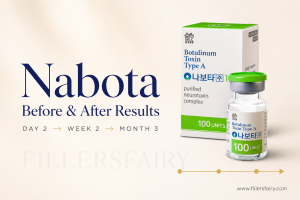
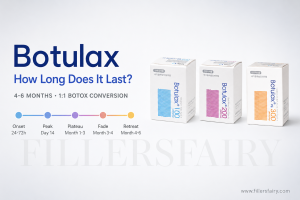
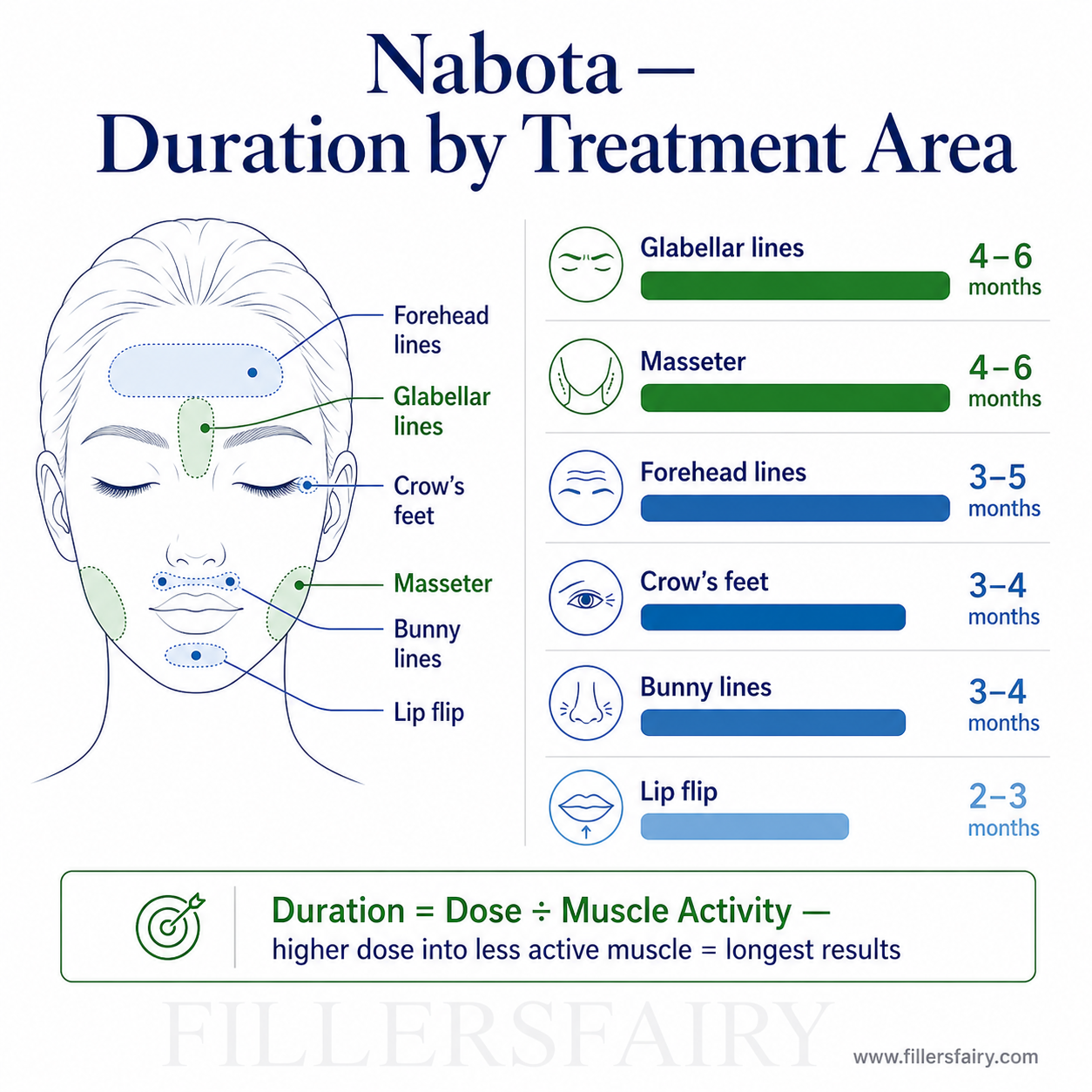
Nabota typically lasts 3–6 months, with duration varying by treatment area, dosage, and individual patient factors. Glabellar (frown) lines hold the longest at 4–6 months. Forehead lines average 3–5 months. Smaller, high-movement areas like lip flip last 2–3 months. Onset is 2–3 days, full effect at Day 10–14. For practitioners planning treatment schedules and patient rebooking cadences, the standard retreatment interval is 3–4 months — proactive clinics send rebooking reminders at Week 10–11 to capture the appointment before the patient fully wears off.
Duration by Treatment Area
“How long does it last?” is the first question every patient asks and the answer practitioners need for accurate treatment planning. The honest response is: it depends on where you inject it.
| Treatment Area | Typical Duration | Typical Dose | Why This Duration |
|---|---|---|---|
| Glabellar lines | 4–6 months | 10–25U | Corrugator and procerus are small, relatively isolated muscles. Higher dose-to-mass ratio = longer duration. |
| Masseter | 4–6 months | 25–50U/side | Large muscle with high dose creates sustained atrophy. Visible slimming takes weeks but lasts longer than cosmetic areas. |
| Forehead lines | 3–5 months | 10–20U | Frontalis is broad and flat. Used frequently in daily expression. Activity returns relatively quickly. |
| Crow’s feet | 3–4 months | 6–15U/side | Orbicularis oculi is thin and highly active. Lower doses in thin skin = earlier return of movement. |
| Bunny lines | 3–4 months | 2–4U | Small dose in nasalis muscle. Effective but shorter-lived due to low unit count. |
| Lip flip | 2–3 months | 2–4U | Orbicularis oris is one of the most active muscles in the face (talking, eating, drinking). Very low dose + constant use = shortest duration. |
| Hyperhidrosis (axillary) | 6–9 months | 50U/side | Targets eccrine sweat glands, not skeletal muscle. Different mechanism, longer duration. |
The pattern is straightforward: duration = dose ÷ muscle activity. High dose into a less active muscle lasts longest. Low dose into a constantly active muscle wears off first.
What Affects How Long Nabota Lasts
Two patients receiving identical Nabota doses in the same area can have different duration outcomes. Understanding the variables helps practitioners set accurate expectations during consultation.
Factors the practitioner controls
Dosage. Higher unit counts produce longer-lasting results. This is the single largest variable within practitioner control. A glabellar treatment with 25U will outlast one with 10U — the tradeoff is a more “frozen” appearance at higher doses.
Injection technique. Precise placement into the target muscle belly delivers the full dose to the motor endplate. Superficial injection or injection into adjacent tissue wastes product and shortens effective duration.
Reconstitution volume. Standard dilution is 2.5 mL saline per 100U vial (yielding 4U per 0.1 mL). Higher dilutions spread the toxin over a larger area but reduce concentration at each injection point, potentially shortening duration. The 1:1 Botox conversion assumes standard dilution.
Factors the patient controls
Muscle mass and strength. Patients with stronger, thicker muscles (common in men and people who clench or grind teeth) metabolise toxin effects faster. Masseter treatments in patients with bruxism may require higher doses for equivalent duration.
Metabolism. Patients who exercise intensely, have higher metabolic rates, or are younger tend to process the toxin faster. Duration for highly active individuals may skew toward the lower end of the range.
Treatment history. First-time patients often report shorter duration than repeat patients. After 3–4 consecutive treatments, many patients notice the effect lasting progressively longer as the target muscle partially atrophies from sustained disuse.
Nabota vs Botox: Does One Last Longer?
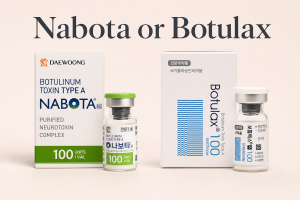
This is the question every clinic buyer asks, and the honest answer is: published data shows no statistically significant difference in duration between Nabota and Botox. Both last 3–6 months depending on the variables discussed above.
| Parameter | Nabota | Botox |
|---|---|---|
| Onset | 2–3 days (faster) | 4–7 days |
| Full effect | Day 10–14 | Day 10–14 |
| Duration | 3–6 months | 3–6 months |
| Unit conversion | 1:1 | Reference |
| Purity | >98.7% (Hi-Pure) | Standard |
The real differentiator between Nabota and Botox is not duration — it’s onset speed (Nabota is 1–2 days faster) and cost (Nabota is significantly less expensive per unit at wholesale). For clinic buyers, duration equivalence combined with a lower price point means the same patient outcome at a better margin.
Rebooking Cadence: The Revenue Optimisation Framework
For clinics building recurring revenue around toxin treatments, the rebooking window is the most important operational metric after patient satisfaction.
The optimal rebooking window for Nabota is Week 10–14 (Month 2.5–3.5). This is when most patients notice the first return of muscle movement but haven’t yet “worn off” completely. Proactive clinics achieve higher retention by reaching out before the patient notices the change:
| Rebooking Strategy | Timing | Action |
|---|---|---|
| Follow-up assessment | Day 14 | Before/after photos. Touch-up if needed. Book next appointment. |
| Proactive reminder | Week 10–11 | SMS/email: “Your Nabota treatment is approaching its renewal window. Book now to maintain your results.” |
| Retreatment | Week 12–16 | Standard retreatment. Adjust dose based on duration feedback from previous cycle. |
Pro tip: Patients who rebook before the toxin fully wears off often need slightly fewer units for the same result, because the muscle hasn’t fully recovered its original bulk. This creates a positive cycle: maintenance patients use less product and last longer, improving both satisfaction and clinic margins.
Can You Extend Nabota’s Duration?
Patients frequently ask if they can make their Nabota last longer. The evidence-based recommendations:
Consistent retreatment schedule. This is the strongest factor. Patients who maintain a regular 3–4 month cycle consistently report longer duration over time as target muscles partially atrophy.
Adequate dosing. Underdosing to “save product” shortens duration and reduces patient satisfaction. The per-unit savings from underdosing are outweighed by the earlier rebooking requirement and lower patient satisfaction scores.
Avoid manipulation. Patients should avoid rubbing, massaging, or applying pressure to treated areas for 4–6 hours post-injection to prevent toxin migration.
Manage expectations about exercise. While there’s limited clinical evidence that exercise significantly shortens toxin duration, intense physical activity increases blood flow and metabolic rate. Some practitioners advise patients to avoid strenuous exercise for 24 hours post-treatment.
Practitioner Confidence Summary
Nabota lasts the same 3–6 months as Botox at the same unit conversion. The difference is economics: equivalent duration at a lower per-unit cost means better margins for the clinic without any sacrifice in patient outcomes. Combined with the faster onset (Day 2–3 vs Day 4–7), Nabota gives practitioners a product that patients see working sooner and that lasts just as long — at a price point that improves every treatment’s contribution to the bottom line.
Frequently Asked Questions
How long does Nabota last compared to Botox?
Both last 3–6 months at equivalent doses. Published clinical data shows no statistically significant difference in duration. The key differences are onset (Nabota is 1–2 days faster) and wholesale cost (Nabota is less expensive per unit).
Does Nabota last longer with repeated treatments?
Many patients and practitioners report progressively longer duration with consistent retreatment over 12+ months. This is likely due to partial muscle atrophy from sustained neuromuscular blockade — the target muscle becomes smaller and weaker, requiring less toxin for the same effect.
Why did my Nabota wear off after only 2 months?
Shorter-than-expected duration usually indicates one of three factors: lower-than-optimal dosing, injection into a high-activity area (like lip flip, which averages 2–3 months), or individual patient factors (high muscle mass, fast metabolism, intense exercise routine). Discuss with your practitioner about dose adjustment for your next session.
How often should I get Nabota treatments?
The standard retreatment interval is every 3–4 months. Most practitioners recommend rebooking when you first notice return of muscle movement, rather than waiting until the effect has fully worn off. Consistent maintenance produces better long-term results.
Is Nabota the same as Jeuveau?
Yes. Same product by Daewoong Pharmaceutical. Nabota is the international brand name; Jeuveau (by Evolus) is the US market name. Both are KFDA and FDA approved. 1:1 unit conversion to Botox.