What Is Innotox? Why Clinics Are Switching to the World’s First Liquid Botulinum Toxin
Last updated: July 2026 · Reading time: 8 min
Quick Answer
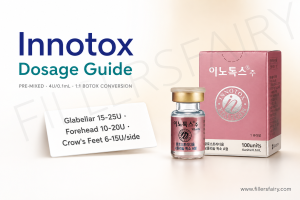
Innotox is the world’s first ready-to-use liquid botulinum toxin type A, manufactured by Medytox Inc. (South Korea) and KFDA approved. Unlike Botox, Nabota, and other botulinum toxins that come as a freeze-dried powder requiring reconstitution, Innotox arrives as a pre-mixed liquid — eliminating dilution errors, contamination risk, and preparation time. Available in 50-unit and 100-unit vials, it uses the same 900 kDa Hall strain toxin as Botox at a 1:1 unit conversion. The albumin-free, animal-free formula stores stably at 2–8°C for up to 36 months. For clinics already using Botox or Nabota, the transition to Innotox requires no new injection skills — just fewer preparation steps.
What Makes Innotox Different From Every Other Botulinum Toxin
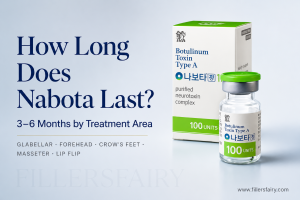
Every botulinum toxin on the market — Botox, Dysport, Xeomin, Nabota — ships as a lyophilized powder that must be reconstituted with saline before each use. This step introduces three variables: dilution accuracy (how much saline, measured correctly?), potential contamination (each reconstitution opens a sterile vial), and preparation time (drawing saline, dissolving powder, checking clarity).
Innotox eliminates all three. The product arrives as a colorless, transparent liquid ready for immediate injection. No mixing, no measuring, no waiting for powder to dissolve. This is not a convenience gimmick — it addresses real clinical risks that practitioners deal with daily.
The Formula: What’s Inside (and What’s Not)
Innotox contains botulinum toxin type A (Hall strain, 900 kDa) stabilized with L-methionine and Polysorbate 20 in phosphate-buffered saline (pH 5.5–6.5). The concentration is standardized at 4 units per 0.1 mL.
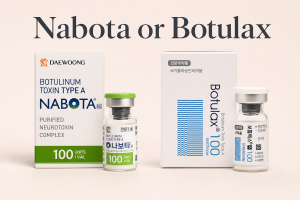
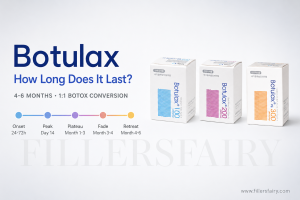
What’s deliberately excluded: Innotox contains no human serum albumin (HSA) — the blood-derived protein used as a stabilizer in Botox, Nabota, and Botulax. It also excludes all animal-derived ingredients. This makes Innotox’s formulation cleaner from both a safety and an ethical standpoint. The absence of albumin eliminates the theoretical risk of blood-borne pathogen transmission and makes the product suitable for patients who decline animal-derived treatments.
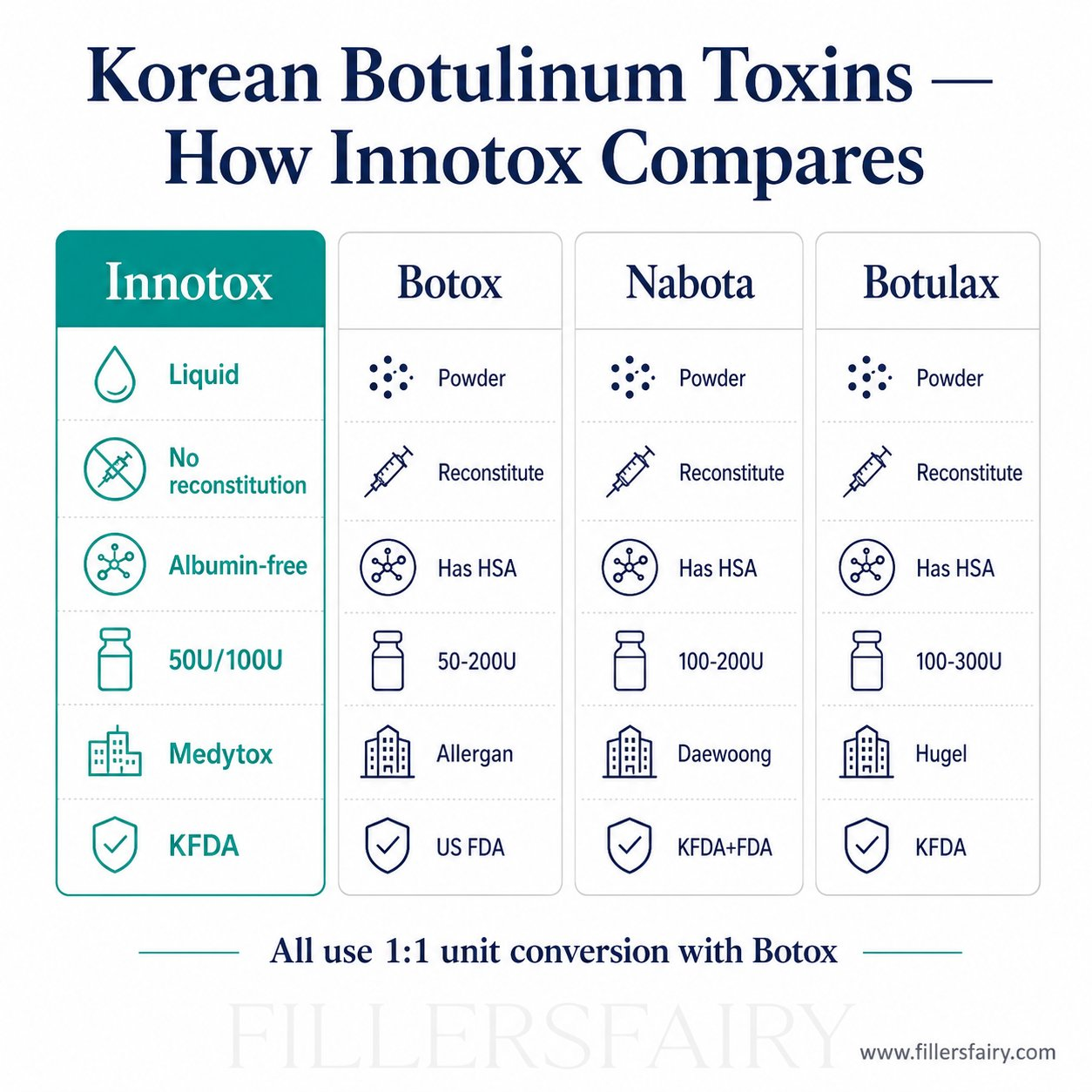
How Innotox Compares to Botox, Nabota, and Botulax
| Feature | Innotox | Botox | Nabota | Botulax |
|---|---|---|---|---|
| Form | Liquid (ready-to-use) | Powder (reconstitute) | Powder (reconstitute) | Powder (reconstitute) |
| Manufacturer | Medytox (Korea) | Allergan (USA) | Daewoong (Korea) | Hugel (Korea) |
| Strain | Hall strain, 900 kDa | Hall strain, 900 kDa | Hall strain, 900 kDa | CBFC26 strain |
| Albumin | None (albumin-free) | 0.5 mg HSA | 0.5 mg HSA | 0.5 mg HSA |
| Available units | 50U, 100U | 50U, 100U, 200U | 100U, 200U | 100U, 200U, 300U |
| Reconstitution | Not needed | Required | Required | Required |
| Unit conversion | 1:1 with Botox | Reference | 1:1 with Botox | 1:1 with Botox |
| Storage | 2–8°C, 36 months | 2–8°C, 36 months | 2–8°C | 2–8°C, 36 months |
| Regulatory | KFDA | US FDA | KFDA + US FDA | KFDA |
The bottom line: Innotox uses the same molecule as Botox (Hall strain, 900 kDa, 1:1 unit conversion) but in a fundamentally different delivery format. Clinics that value preparation speed, dosing consistency, and clean formulation find Innotox compelling. Clinics that need U.S. FDA approval documentation may prefer Nabota (FDA approved as Jeuveau).
Is Innotox Safe? What the Clinical Data Shows
Innotox is an excellent product with a strong safety record. It is manufactured by Medytox Inc. — one of Korea’s leading biopharmaceutical companies and one of the earliest Korean botulinum toxin manufacturers. The product holds KFDA approval and is distributed in markets worldwide.
The safety profile is comparable to Botox — the same mild, predictable reactions that practitioners already manage. Injection-site redness fades in 1–2 hours. Occasional mild headache occurs in a small percentage of patients. Bruising depends on technique and patient factors, not the product.
In the rare cases where complications occur, they are technique-related — not product-related. Eyelid drooping results from incorrect injection placement, asymmetry from uneven dosing, and excessive weakness from overdosing. All are preventable with proper training and all are identical to the risks of any botulinum toxin brand. The product itself works exactly as designed.
How to Use Innotox: The Simplest Protocol in Aesthetics
This is where Innotox truly differentiates itself. The entire preparation process is: remove vial from refrigerator, draw product directly into a syringe, and inject. That is it. No saline measurement, no reconstitution, no waiting for powder to dissolve, no checking for undissolved particles.
Dosing follows the standard 4 units per 0.1 mL concentration — the same as reconstituted Botox at standard dilution. A 30G needle is used for injection. Treatment areas and unit doses are the same as any other botulinum toxin type A: 20 units for glabellar lines (5 injection points), 10–20 units for forehead, 8–12 units per side for crow’s feet. For a full dosing breakdown by treatment area, see the Innotox dosage chart.
Practical Note: Using Innotox with an Insulin Syringe
Practitioners occasionally use insulin syringes (1 mL / 100 IU) for precise micro-dosing. With Innotox at its standard concentration of 4 U per 0.1 mL, the conversion is: 10 IU markings on an insulin syringe = 0.1 mL = 4 units of Innotox. So 5 IU markings = 2 units, 2.5 IU markings = 1 unit. Because Innotox is pre-mixed, this conversion is always consistent — unlike reconstituted products where insulin syringe dosing varies based on how much saline was added.
After opening, Innotox should be used within the treatment session. Store unopened vials at 2–8°C. The product is stable for up to 36 months from manufacture when stored correctly.
Innotox Key Specifications
Manufacturer: Medytox Inc. (South Korea) · Type: Botulinum toxin type A, Hall strain, 900 kDa · Form: Ready-to-use liquid · Vials: 50U and 100U (0.5 mL each) · Concentration: 4 U/0.1 mL · Stabilizers: L-methionine, Polysorbate 20 · Albumin: None · Storage: 2–8°C, 36 months · Needle: 30G · Regulatory: KFDA approved · Unit conversion: 1:1 with Botox
Why Clinics Switch to Innotox
Practitioners who have adopted Innotox consistently point to three operational advantages. First, time savings — eliminating reconstitution saves 3–5 minutes per treatment. In a high-volume clinic doing 15+ toxin treatments per day, this adds up to an extra hour of treatment capacity per week. Second, dosing consistency — pre-mixed liquid means every draw from the vial has identical concentration. With powder reconstitution, slight variations in saline volume create subtle concentration differences between vials. Third, reduced waste — the 50-unit vial option is ideal for small treatments (lip flip, bunny lines, touch-ups) where a full 100-unit vial would leave significant unused product.
For wholesale pricing and sourcing, Innotox is available in both 50U and 100U formats through authorized Korean aesthetic product distributors.
Frequently Asked Questions
Is Innotox the same as Botox?
Same active molecule (botulinum toxin type A, Hall strain, 900 kDa) with 1:1 unit conversion. The key difference is form: Innotox is a ready-to-use liquid, Botox is a freeze-dried powder requiring reconstitution. Clinical effects (onset, duration, results) are comparable.
Does Innotox need to be reconstituted?
No — this is Innotox’s defining feature. It is the world’s first pre-mixed liquid botulinum toxin. Draw directly from the vial into a syringe and inject. No saline, no mixing, no waiting.
How many units are in Innotox?
Innotox is available in 50-unit and 100-unit vials. Both contain 0.5 mL of liquid. The 50U vial is ideal for focused treatments (lip flip, bunny lines), while the 100U vial covers a full upper-face treatment.
Is Innotox FDA approved?
Innotox is KFDA approved and distributed in multiple international markets. It does not currently have U.S. FDA approval. For clinics requiring FDA documentation, Nabota (FDA approved as Jeuveau) is the Korean botulinum toxin with U.S. FDA clearance.
How should Innotox be stored?
Store at 2–8°C (refrigerator). Stable for up to 36 months unopened. Use within the treatment session after opening. Do not freeze. The liquid formula is less temperature-sensitive than reconstituted powder products during brief transport.
How do I measure Innotox units in an insulin syringe?
At Innotox’s standard 4 U/0.1 mL concentration: 10 IU markings on an insulin syringe = 0.1 mL = 4 units of Innotox. So 5 IU = 2 units, 2.5 IU = 1 unit. Because Innotox is pre-mixed, this conversion is always consistent — no variation from reconstitution differences.
Related Guides
- What Is Botulax? — Hugel’s high-volume Korean toxin
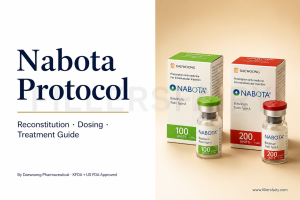
- Nabota Protocol Guide — FDA-approved powder toxin
- Nabota Side Effects — Safety comparison
- Hyaron Injection Protocol — Skin booster technique
Looking to stock Innotox? View Innotox 100U or Innotox 50U in our wholesale catalog.