What Is PN? How Polynucleotide Technology Changed Skin Rejuvenation Forever
Written by FillersFairy Editorial · Reviewed by FillersFairy Clinical Team · Last updated: 2026-07-01
Quick Answer
PN (polynucleotide) is a class of purified DNA fragments extracted from salmon that work by activating adenosine A2A receptors on fibroblasts and providing structural scaffolding within the dermis. Unlike HA boosters that hydrate passively, PN actively instructs skin cells to produce new collagen and elastin — producing gradual, lasting improvement in texture, elasticity and firmness over 2–12 weeks. Rejuran by PharmaResearch created the category in Korea and remains the global reference product. Today, the PN market includes multiple brands at different price points and formulations — from pure PN (Rejuran Healer) to PN + HA hybrids (Rejuran HB, Elaxen PN) to specialised variants for eyes (Rejuran I, Vitaran i, Ami Eyes) and scars (Rejuran S).

What PN Actually Is — The Science Made Simple
Polynucleotide (PN) is not a brand name — it’s a class of biological molecules. Specifically, PN refers to purified chains of deoxyribonucleotides extracted from salmon DNA (typically Oncorhynchus mykiss or Oncorhynchus keta).
Think of DNA as a long twisted ladder. PN products take that ladder, break it into carefully sized pieces and purify them into injectable form. When these DNA fragments are injected into the dermis, they don’t just sit there — they interact with skin cells, triggering biological repair processes that improve skin quality from within.
The key word is “from within.” Unlike HA fillers that add volume or HA boosters that add hydration, PN instructs the skin’s own cells to rebuild. The improvement comes from new collagen and elastin that the patient’s body produces — not from product sitting in the dermis. This is why PN results develop gradually (2–12 weeks) but last much longer (6–12 months) than HA hydration.
How PN Works — Two Mechanisms Working Together
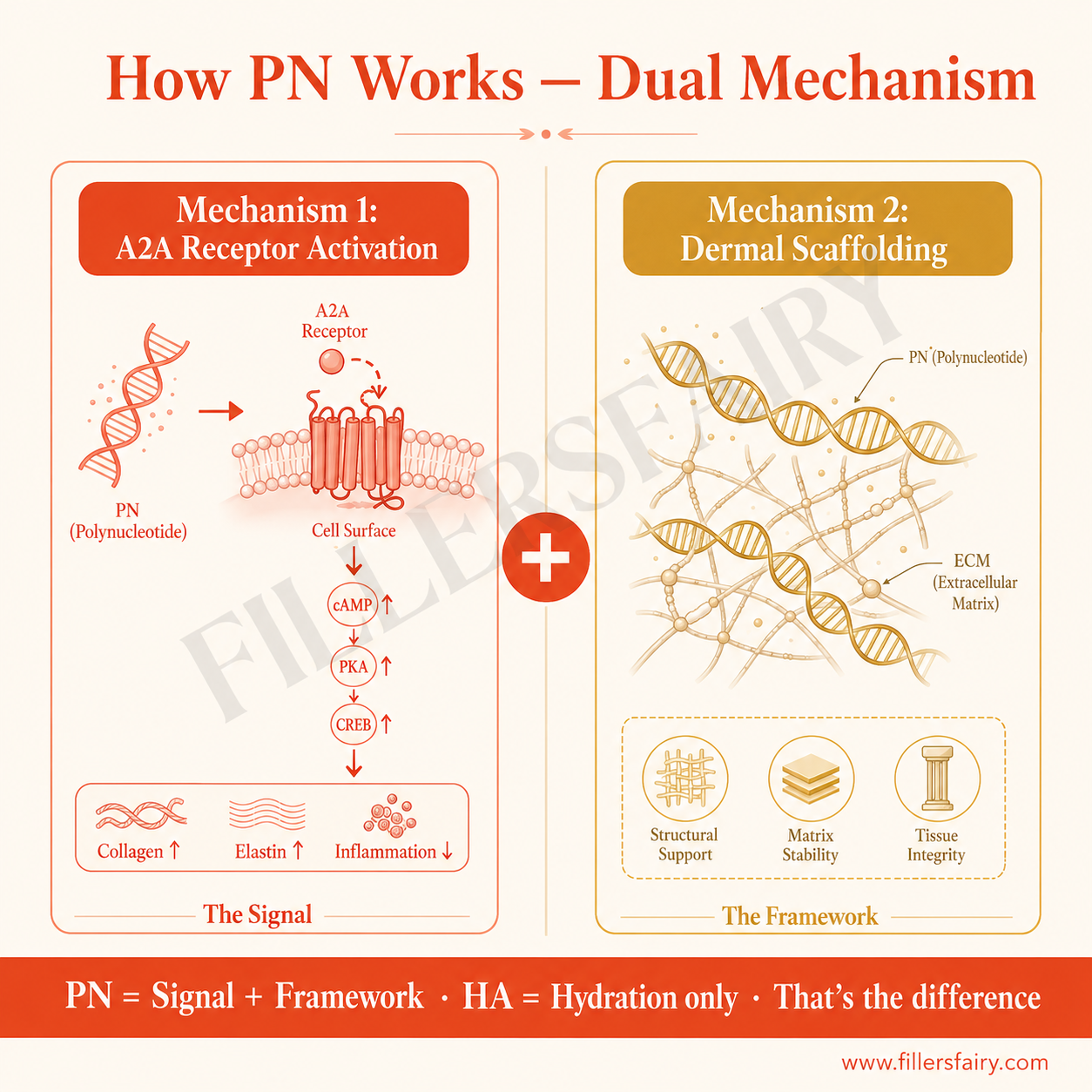
Mechanism 1: A2A Adenosine Receptor Activation
PN fragments bind to adenosine A2A receptors on fibroblasts — the cells responsible for producing collagen and elastin in the dermis. This binding triggers an intracellular signalling cascade (cAMP → PKA) that stimulates fibroblast proliferation and increases collagen and elastin production. A2A activation also suppresses pro-inflammatory cytokines (TNF-α, IL-6) via NF-κB downregulation, reducing chronic low-grade inflammation that accelerates skin ageing.
This mechanism is confirmed experimentally: A2A receptor antagonists (like ZM241385 and DMPX) block PN’s effects, proving the receptor-mediated pathway.
Mechanism 2: Dermal Scaffolding
PN’s larger molecular chains (>1,500 kDa) physically integrate into the extracellular matrix, creating a temporary scaffold that supports tissue remodelling. This scaffold provides structural support during the regenerative phase — like temporary construction framing that holds everything in place while new collagen is being built.
This dual mechanism — biological signalling PLUS structural support — is what makes PN fundamentally different from single-mechanism treatments. HA hydrates. Growth factors signal. PN both signals AND scaffolds.
Why PN Replaced HA as Korea’s Preferred Skin Booster
In a survey of Korean cosmetic physicians, over 88% rated polynucleotide injection as “highly effective” or “effective” for wound healing and skin regeneration. This level of professional endorsement didn’t happen overnight — it came from years of clinical observation that PN consistently outperformed HA boosters for lasting skin quality improvement.
| Feature | HA Skin Boosters | PN Skin Boosters |
|---|---|---|
| Mechanism | Water binding (passive) | A2A receptor activation + scaffolding (active) |
| Onset | Immediate | Gradual (2–4 weeks) |
| Duration | 2–4 months | 6–12 months |
| Source of improvement | Product in dermis | Patient’s own collagen/elastin |
| Best for | Instant glow, entry-level patients | Lasting regeneration, maintenance programmes |
They’re not competitors — they’re layers. Korean clinics start patients with HA boosters (Hyaron) for instant visible results, then progress to PN therapy for lasting regeneration. The HA provides the “gateway” experience; the PN delivers the long-term value. Smart clinics stock both.
What PN Treats
| Concern | How PN Addresses It | Specific Product |
|---|---|---|
| General skin quality | Collagen + elastin stimulation → improved texture, elasticity, firmness | Rejuran Healer, Elaxen PN |
| Under-eye area | Gentle fibroblast activation in thin periocular dermis → reduced dark circles, fine lines | Ami Eyes, Rejuran I, Vitaran i |
| Acne scars | High-viscosity PN injected into scar base → collagen remodelling lifts depressions | Rejuran S |
| Enlarged pores | Increased dermal density → surface skin tightens → pore opening contracts | Rejuran Healer, Puri Hilo PN |
| Post-procedure support | Anti-inflammatory via A2A → NF-κB suppression → faster healing, less redness | Any PN product post-laser or post-microneedling |
PN vs PDRN — Quick Distinction
Both come from salmon DNA. Both activate A2A receptors. The difference is molecular weight and action style:
PN = larger molecules → broader structural support + sustained collagen stimulation → longer-lasting results. Representative: Rejuran.
PDRN = smaller molecules (50–1,500 kDa) → direct targeted A2A activation + stronger anti-inflammatory → faster-acting repair. Representative: Curenex Glow.
For the complete comparison, see our dedicated PN vs PDRN guide.
Korean PN Product Landscape
The PN category has expanded rapidly since Rejuran created it. Here’s the current landscape by use case:
| Use Case | Product | Key Differentiator |
|---|---|---|
| Full face rejuvenation | Rejuran Healer | The original. Pure 2% PN via DOT™ extraction. Gold standard. |
| Elaxen PN | 2% PN + HA + niacinamide. Triple-active in one syringe. 3×2.5mL pack = 1 full course. | |
| Vitaran | 2% PN by BR Pharm. Ionized formulation for reduced injection pain. CE + KFDA + MOCRA. | |
| Puri Hilo PN | PN 25mg + 50kDa HA. PN-HA Synergy Technology™. CE-marked. | |
| Periocular (eye area) | Ami Eyes | PN 1% (20mg/2mL). Specifically formulated for delicate periocular tissue. |
| Rejuran I | DOT™ PN for under-eye. PharmaResearch eye-specific variant. | |
| Vitaran i | 2% PN, 2×1mL periocular format. HP Cell platform. Less injection pain. | |
| Scars | Rejuran S | Higher-viscosity PN. Stays concentrated at scar site for targeted remodelling. |
| Hydration hybrid | Rejuran HB | PN + non-crosslinked HA + lidocaine. “Red Box.” Immediate hydration + regeneration + comfort. |
For a detailed comparison to help you decide which to stock, see our Best Korean PN Skin Boosters for Clinics guide.
Treatment Protocol
Standard course: 3 sessions, spaced 2–4 weeks apart. Results visible from Session 2, with cumulative improvement building over the full course. Maintenance every 4–6 months.
Injection technique: Serial micro-injection (nappage technique) into the superficial to mid-dermis using 30–32G needles. Approximately 0.01–0.02 mL per injection point, placed 5–10 mm apart across the treatment area.
Volume: Full-face treatment typically uses 2–3 mL per session. Eye-area treatments use 0.5–1 mL per session.
Downtime: Minimal. Small papules at injection sites resolve within 24–48 hours. Most patients return to normal activities immediately. No makeup for 12–24 hours post-treatment.
How to Position PN in Your Clinic
Position 1: The upgrade from HA. Patients already receiving Hyaron or other HA boosters are the natural upgrade audience. “You’ve been enjoying the hydration results — would you like to try the treatment that actually stimulates your skin to produce its own collagen? The results last 3–4 times longer.”
Position 2: The “skin quality programme.” Package PN as a 3-session skin quality programme rather than individual treatments. Programme pricing encourages commitment and ensures patients complete the full course for optimal results.
Position 3: Post-procedure add-on. PN’s anti-inflammatory properties (NF-κB suppression) make it an excellent post-laser or post-microneedling treatment. “We add PN after your laser session to speed up healing and boost the collagen response.”
Margin note: PN products at Korean wholesale pricing deliver strong treatment margins. The combination of premium patient pricing + lower product cost creates one of the best margin ratios in the skin booster category. Browse all PN products at wholesale →
Practitioner Confidence Summary
Polynucleotide therapy isn’t a trend — it’s the category that replaced HA as Korea’s preferred skin booster, with 88% of Korean cosmetic physicians rating it highly effective. The mechanism is well-documented (A2A receptor activation + dermal scaffolding), the product range covers every clinical scenario (full face, eyes, scars, hybrids), and results last 6–12 months because they come from biological collagen, not product in the dermis. For clinics, PN represents the sweet spot of regenerative aesthetics: clinically meaningful results, strong patient satisfaction, premium pricing potential and excellent wholesale margins. Start with Rejuran →
Frequently Asked Questions
What is PN in skin boosters?
PN (polynucleotide) refers to purified DNA fragments from salmon that activate A2A adenosine receptors on fibroblasts, stimulating collagen and elastin production. It also provides structural scaffolding in the dermis. Results develop over 2–12 weeks and last 6–12 months — much longer than HA boosters.
Is PN the same as Rejuran?
Rejuran is the leading PN product, but PN is the technology category, not the brand. Other PN products include Vitaran, Elaxen PN, Ami Eyes, Puri Hilo PN and DIVA PN. Rejuran created the category and remains the reference product.
How long do PN results last?
6–12 months after a complete 3-session course. Results persist because they come from collagen and elastin the patient’s own fibroblasts produced — not from product sitting in the skin. Maintenance every 4–6 months sustains the improvement.
Is PN better than HA for skin?
Different purposes. HA hydrates immediately but temporarily (2–4 months). PN regenerates gradually but lastingly (6–12 months). Korean clinics use both: HA for instant glow (Hyaron) and PN for lasting skin quality improvement (Rejuran). They are layers, not alternatives.
What is the best PN skin booster?
Depends on the treatment area. Rejuran Healer for full face. Ami Eyes or Rejuran I for periocular. Rejuran S for acne scars. Elaxen PN for clinics wanting a triple-active (PN + HA + niacinamide) in one syringe. See our complete comparison guide for detailed product-by-product analysis.
Related Guides
Disclosure: FillersFairy is a wholesale supplier of PN skin boosters. This article is for educational purposes only and does not constitute medical advice.
References
- Kim J, et al. “Comparison of Polynucleotide and Polydeoxyribonucleotide in Dermatology.” PMC12388916. 2025.
- JCAS. “Polynucleotides and polydeoxyribonucleotides in dermatology — A narrative review.” 2026.
- Korean cosmetic physician survey — 88% PN efficacy rating for wound healing and regeneration.