Reviewed against publicly available manufacturer information.
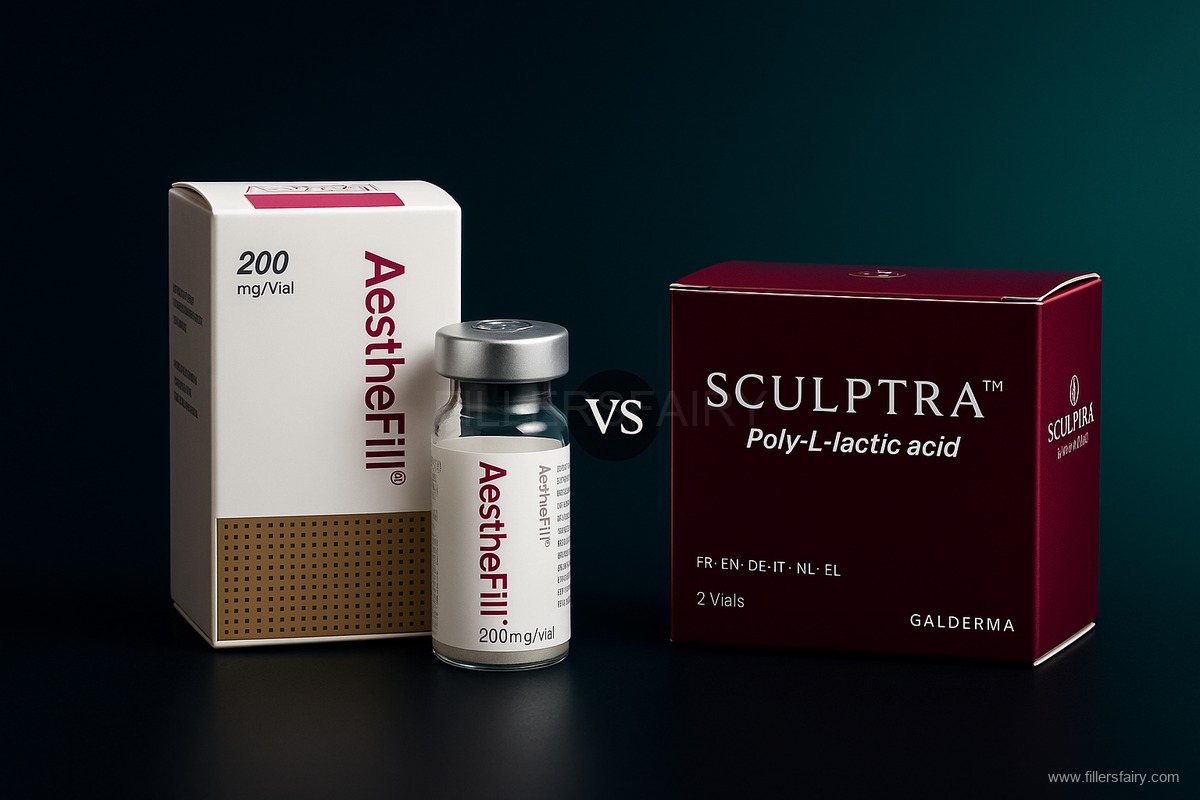
Both AestheFill and Sculptra are poly-lactic acid (PLA) based biostimulatory fillers designed to stimulate neocollagenesis rather than simply adding mechanical volume. The core difference lies in the stereochemistry of their polymers: AestheFill uses PDLLA (poly-D,L-lactic acid), an amorphous copolymer, while Sculptra uses PLLA (poly-L-lactic acid), a semi-crystalline homopolymer.
This molecular distinction affects degradation rate, particle design, reconstitution protocol, and clinical handling — all of which influence practitioner workflow and treatment planning.
How Do PDLLA and PLLA Differ at the Molecular Level?
Poly-lactic acid exists in two stereoisomeric forms. L-lactic acid produces PLLA with a regular chain structure that folds into semi-crystalline regions. D,L-lactic acid — a racemic mixture — produces PDLLA with an irregular chain that cannot crystallize, remaining amorphous.
Why this matters clinically:
- Degradation characteristics: PDLLA generally shows faster hydrolytic degradation characteristics than semi-crystalline PLLA because the amorphous structure allows greater water accessibility. Both ultimately metabolize into lactic acid, then water and CO₂.
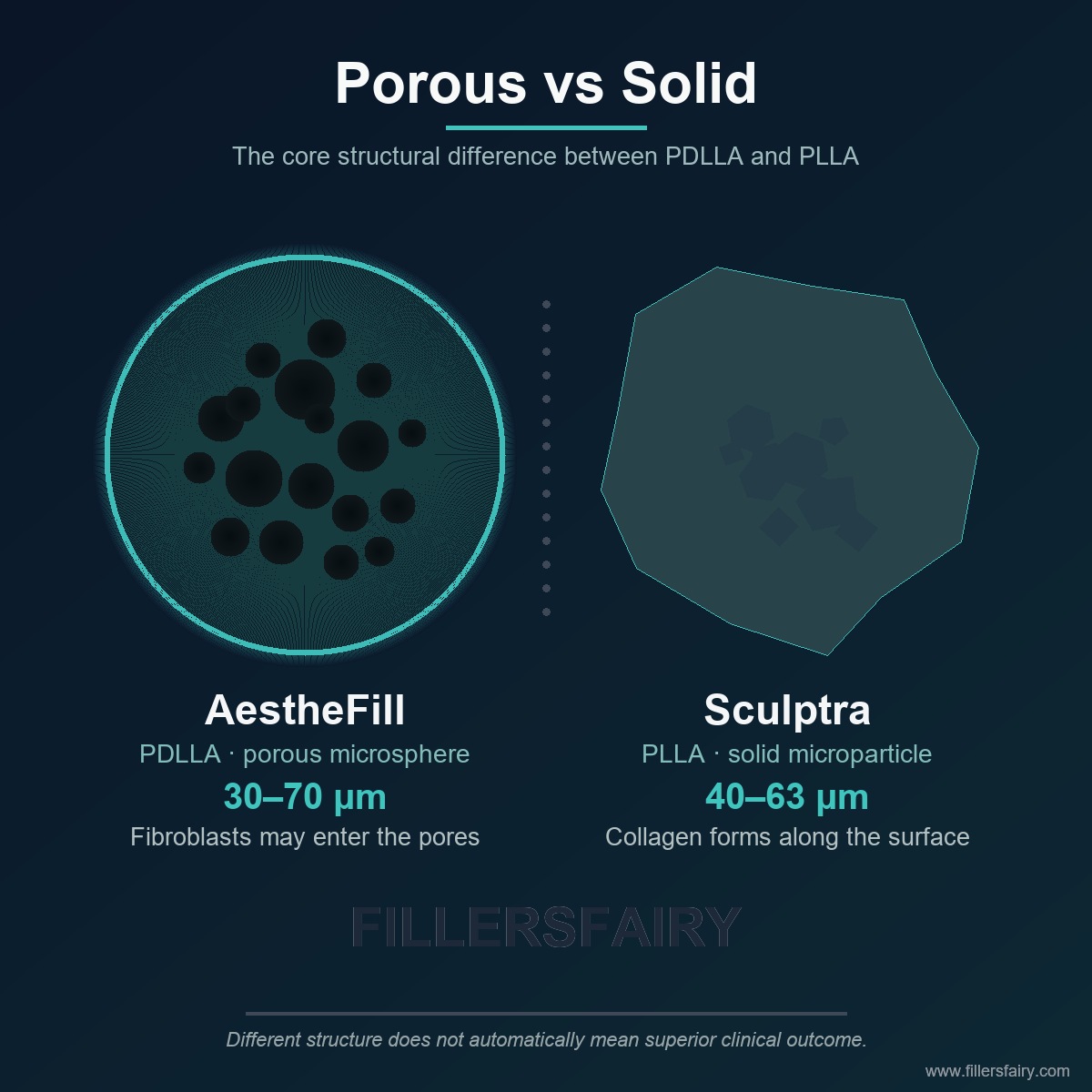
- Particle architecture: AestheFill’s PDLLA porous spherical microspheres measure 30–70 µm in diameter. Sculptra’s PLLA irregular solid microparticles measure 40–63 µm. The different particle designs reflect each manufacturer’s approach to scaffold-tissue interaction.
- Tissue interaction: The porous architecture of AestheFill microspheres is designed to allow fibroblast migration into the microsphere interior, where collagen formation may occur from within the scaffold. Sculptra’s solid microparticles stimulate collagen along the particle surface. Both mechanisms result in neocollagenesis; different structure does not automatically indicate superior clinical outcome.
Formulation and Composition
| Parameter | AestheFill | Sculptra |
|---|---|---|
| Active ingredient | PDLLA (poly-D,L-lactic acid) | PLLA (poly-L-lactic acid) |
| Polymer structure | Amorphous | Semi-crystalline |
| Active per vial | 154 mg | 150 mg |
| Particle type | Porous spherical microspheres | Irregular solid microparticles |
| Particle diameter | 30–70 µm | 40–63 µm |
| Excipients | Sodium carboxymethyl cellulose | Carboxymethylcellulose sodium, mannitol |
| Total vial weight | ~200 mg | 367.5 mg |
| Manufacturer | REGEN Biotech (South Korea) | Galderma (Switzerland) |
Reconstitution and Clinical Handling
Both products are supplied as lyophilized (freeze-dried) powder requiring reconstitution before injection.
AestheFill:
- Standard diluent: 8 mL sterile water for injection (SWFI)
- Optional addition: 2 mL lidocaine for pain reduction
- Reconstitution time: minutes (light circular shaking dissolves the pellet)
- Practitioners may adjust dilution volume depending on injection depth and treatment goals
Practitioner note: AestheFill supports variable dilution protocols ranging from concentrated suspensions for deep structural work to thin suspensions for superficial applications. Refer to the manufacturer’s instructions for use for specific dilution ratios.
Sculptra:
- The current Sculptra prescribing information describes two preparation options:
- 8 mL dilution: allows immediate use after preparation; optionally add 1 mL of 2% lidocaine before injection
- 5 mL dilution: requires at least 2 hours of hydration before use
- Storage after reconstitution: up to 72 hours at 5–30°C
- Prior to the 2021 prescribing information update, the common practice recommendation was 24–48 hours of pre-hydration
Both products now support same-day preparation. AestheFill’s faster dissolution may offer workflow advantages in high-volume clinical settings, though the updated Sculptra preparation protocol has narrowed this difference.
Duration and Treatment Planning
Both manufacturers report results lasting up to 2 years. The biostimulatory mechanism means results develop gradually as new collagen forms around the implanted microspheres, rather than providing immediate volume as with hyaluronic acid fillers.
AestheFill:
- Neocollagenesis reported as active over 24–36 months post-injection (manufacturer data)
- Typically administered in a single session, with follow-up as needed
Sculptra:
- FDA-approved clinical data supports results lasting up to 2 years
- Traditionally administered across 2–3 treatment sessions spaced several weeks apart
- The cheek indication (approved April 2023) expanded the FDA-approved treatment areas
Treatment planning should account for the gradual onset of both products. Practitioners typically schedule follow-up assessments at 4–6 weeks post-treatment to evaluate collagen response before deciding on additional sessions.
Regulatory Status
| Regulatory Body | AestheFill | Sculptra |
|---|---|---|
| US FDA | Not approved as injectable device (PLA raw material holds GRAS status since 1984) | Approved: 2004 (lipoatrophy), 2009 (cosmetic), 2023 (cheek wrinkles) |
| South Korea MFDS | Approved (2014) | Available but not primary market focus |
| CE Mark (Europe) | Obtained April 2021 | Yes |
| Other | 20+ country approvals (manufacturer data) | Global distribution through Galderma |
This regulatory difference is significant for practitioners in different markets. AestheFill is widely available in Asian and European markets with CE and MFDS approval. Sculptra’s FDA clearance provides established regulatory standing in the United States.
When Does Each Product Fit the Treatment Plan?
The choice between AestheFill and Sculptra is often driven by regulatory availability, practitioner familiarity, and specific clinical requirements rather than a clear superiority of one product over the other.
Considerations favoring AestheFill:
- Markets where MFDS/CE approval applies and FDA approval is not required
- Clinical settings prioritizing rapid reconstitution workflow
- Practitioners seeking variable dilution options for different treatment depths
- Cases where the porous microsphere architecture is preferred for collagen integration
Considerations favoring Sculptra:
- US market where FDA approval is required or preferred
- Practitioners with established Sculptra protocols and training
- Cases requiring FDA-documented safety and efficacy data
- The expanded cheek wrinkle indication (April 2023) for specific treatment areas
Both products share the same fundamental mechanism — PLA-based biostimulation for neocollagenesis — and the clinical outcomes for volume restoration and skin quality improvement are comparable in practice.
Which Product Should Clinics Stock?
For clinics building a collagen stimulator portfolio, each product addresses different market positions and regulatory requirements:
AestheFill may fit clinics looking for:
- Korean PDLLA technology with CE and MFDS market access
- Flexible preparation protocols with variable dilution options
- Competitive wholesale pricing for volume-based practices
Sculptra may fit clinics looking for:
- An FDA-approved collagen stimulator with established US protocols
- Long-term brand recognition among patients seeking biostimulation
- Documented clinical data across multiple FDA-approved indications
Many clinics in CE/MFDS markets carry both products to offer patients and practitioners a choice based on individual treatment goals.
→ View AestheFill product details
→ View Sculptra product details
→ Compare PDLLA product types
Frequently Asked Questions
How long do AestheFill and Sculptra results last?
Both manufacturers report results lasting up to 2 years. The biostimulatory mechanism means collagen develops gradually over weeks to months after injection. Duration varies by treatment area, injection technique, patient age, and metabolic rate. Follow-up assessments at 4–6 weeks help determine whether additional treatment sessions are needed.
Can AestheFill and Sculptra be used together or mixed?
AestheFill and Sculptra should not be mixed in the same syringe or injected into the same treatment site simultaneously. If a practitioner determines that both products could address different treatment areas on the same patient, treatments should be planned with adequate intervals between sessions. Always follow each product’s specific instructions for use.
Is AestheFill FDA approved?
AestheFill does not currently hold US FDA approval as an injectable medical device. It is approved by South Korea’s MFDS (2014) and holds a CE Mark for the European market (2021), with regulatory approvals in over 20 countries. The raw material, poly-lactic acid, has held FDA GRAS (Generally Recognized as Safe) status since 1984, but this applies to the polymer class, not to AestheFill as a specific product.
What reconstitution protocol does each product require?
AestheFill reconstitutes in minutes with 8 mL sterile water for injection and optional 2 mL lidocaine. The current Sculptra prescribing information describes two preparation options: an 8 mL dilution that allows immediate use, or a 5 mL dilution requiring at least 2 hours of hydration. Prior to the 2021 update, Sculptra commonly required 24–48 hours of pre-hydration. Both products are now viable for same-day preparation.
How does PDLLA particle porosity affect clinical outcomes compared to solid PLLA particles?
AestheFill’s PDLLA microspheres feature micropores that allow fibroblasts to migrate into the particle interior, potentially creating collagen formation from within the scaffold. Sculptra’s solid PLLA particles stimulate collagen along the particle surface through a foreign body response. Both mechanisms result in neocollagenesis, but the architectural difference may influence the pattern and distribution of new collagen deposition. Direct comparative clinical trial data between the two particle designs is not currently available from either manufacturer.
Related Guides