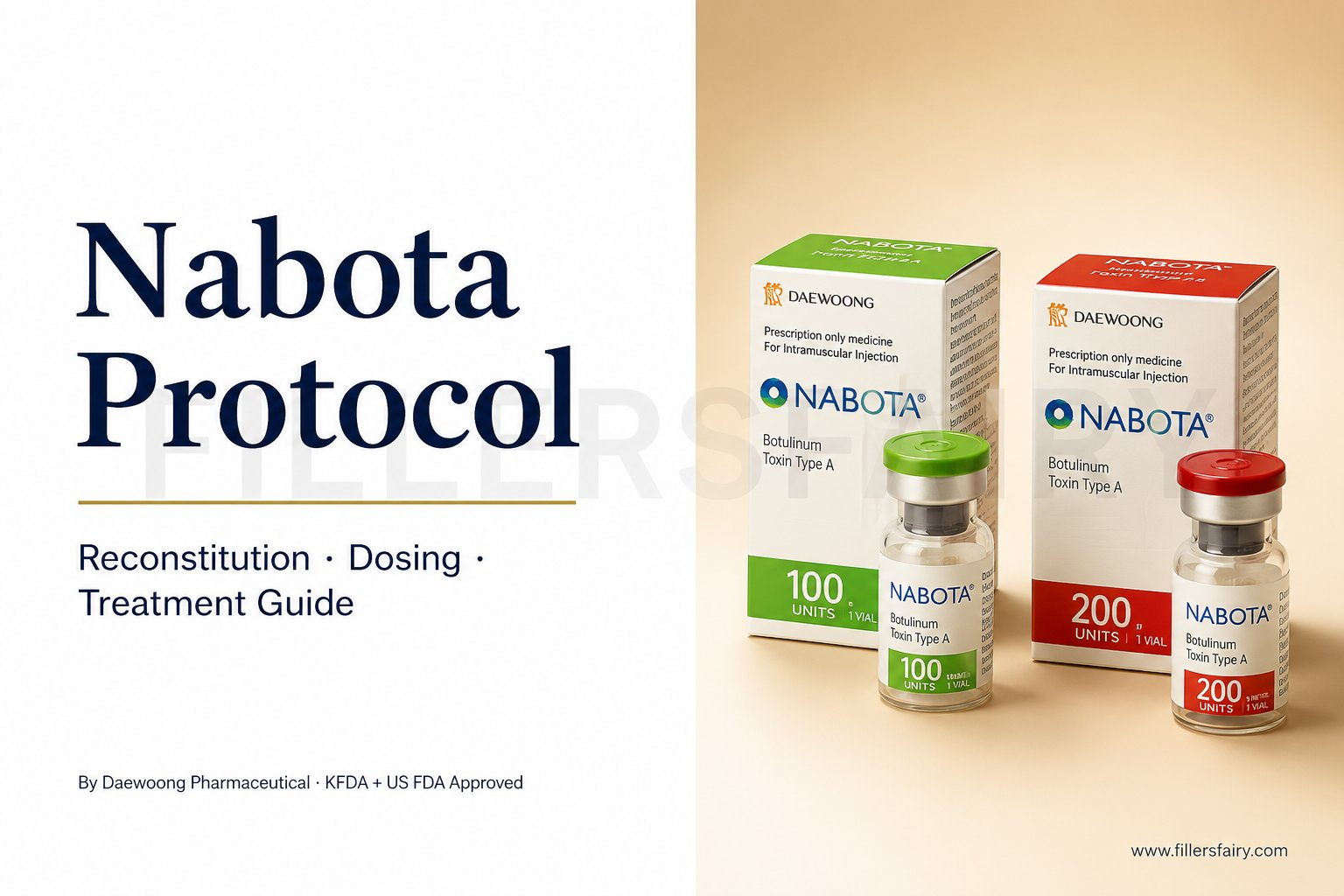
Nabota Protocol: Reconstitution, Dosing, and Treatment Guide for Practitioners
Quick Answer
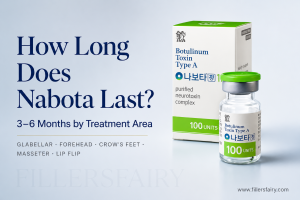
Nabota is a Korean botulinum toxin type A (prabotulinumtoxinA) manufactured by Daewoong Pharmaceutical, available in 100-unit and 200-unit vials. Reconstitute with preservative-free normal saline — standard dilution is 2.5 mL per 100 units (4 U/0.1 mL). Dosing per treatment area mirrors Botox unit-for-unit. The product is KFDA approved and FDA approved (marketed as Jeuveau in the United States). Clinics switching from Botox find the protocol virtually identical — same reconstitution ratios, same dosing, same injection technique — with significant wholesale cost savings.
What Is Nabota? Korean Botulinum Toxin Explained
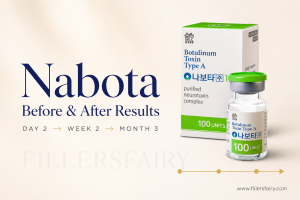
Nabota is a 900 kDa botulinum toxin type A complex — the same molecular type as Botox (onabotulinumtoxinA). It is manufactured by Daewoong Pharmaceutical, one of Korea’s largest and most established pharmaceutical companies, using proprietary purification technology that produces a highly purified neurotoxin complex.
The same active molecule is approved by the U.S. FDA under the brand name Jeuveau (marketed by Evolus Inc.), following Phase III clinical trials involving over 2,000 subjects. Nabota is the Korean brand name (KFDA approved); Jeuveau is the U.S. brand name (FDA approved February 2019) — the molecule (prabotulinumtoxinA, development code DWP-450) is identical. This dual regulatory approval makes Nabota one of the most rigorously validated Korean aesthetic products on the global market, with marketing authorization in over 69 countries.
For practitioners: if you know how to use Botox, you already know how to use Nabota. The reconstitution, dosing, injection technique, onset, and duration are interchangeable. The safety profile is identical.
Reconstitution Protocol
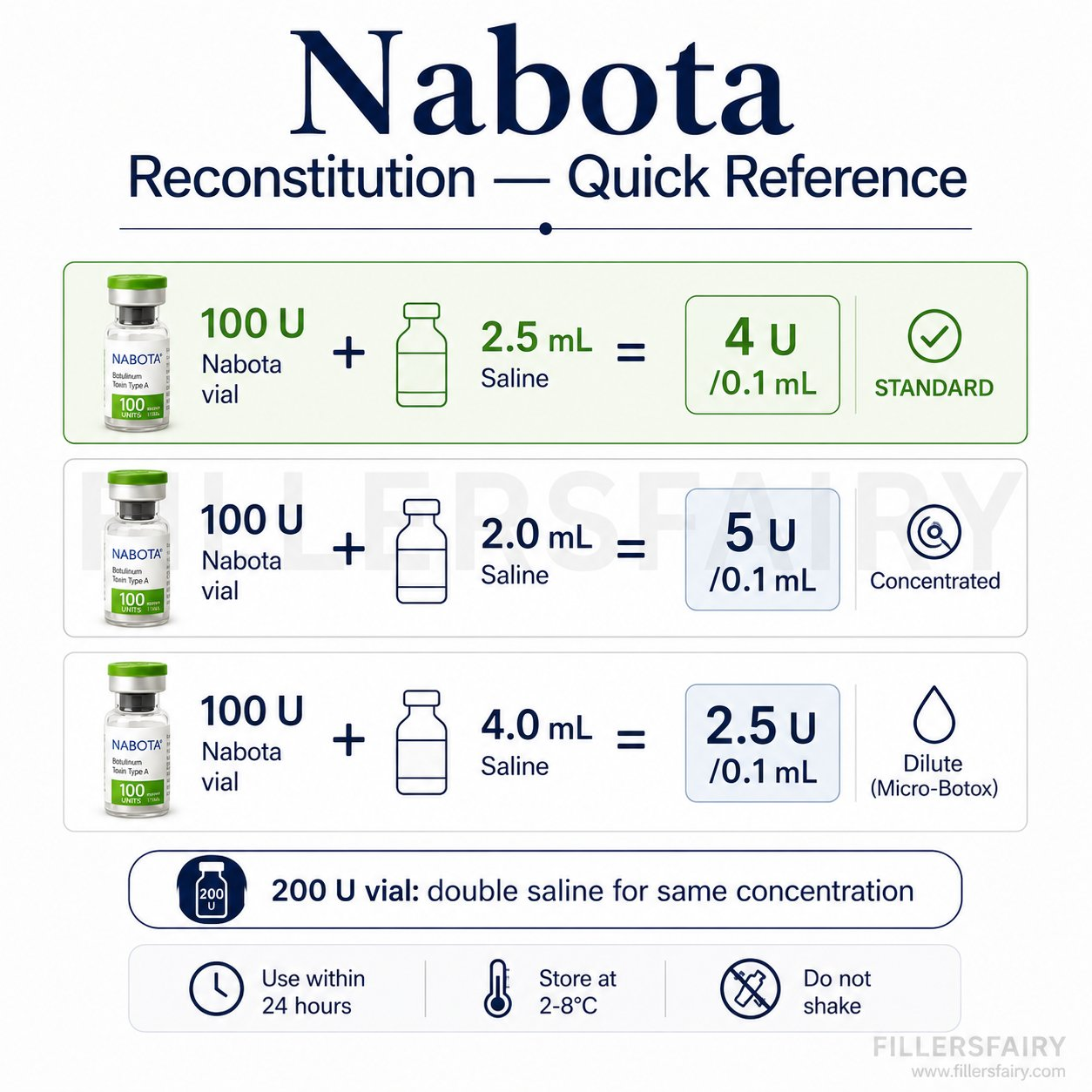
Nabota is supplied as a lyophilized (freeze-dried) powder in vacuum-sealed glass vials. It requires reconstitution with preservative-free 0.9% sodium chloride (normal saline) before use.
| Vial Size | Saline Volume | Resulting Concentration | Best For |
|---|---|---|---|
| 100 units | 2.5 mL | 4 U / 0.1 mL | Standard aesthetic — most common dilution |
| 100 units | 2.0 mL | 5 U / 0.1 mL | More concentrated — smaller volume per point |
| 100 units | 4.0 mL | 2.5 U / 0.1 mL | More dilute — broader spread, micro-Botox technique |
| 200 units | 5.0 mL | 4 U / 0.1 mL | High-volume clinics — same standard concentration |
Reconstitution steps: Remove the vial’s aluminum seal. Clean the rubber stopper with alcohol. Draw the appropriate volume of preservative-free saline into a syringe. Insert the needle through the stopper and inject saline slowly along the vial wall — do not shake or agitate. The vacuum in the vial should pull the saline in; if it does not, the vacuum may have been compromised. Gently swirl to dissolve. The reconstituted solution should be clear and colorless.
Storage: Store at 2–8°C (refrigerator), both before and after reconstitution. Use reconstituted Nabota within 24 hours. Do not freeze. Discard any unused portion after 24 hours.
Dosing by Treatment Area
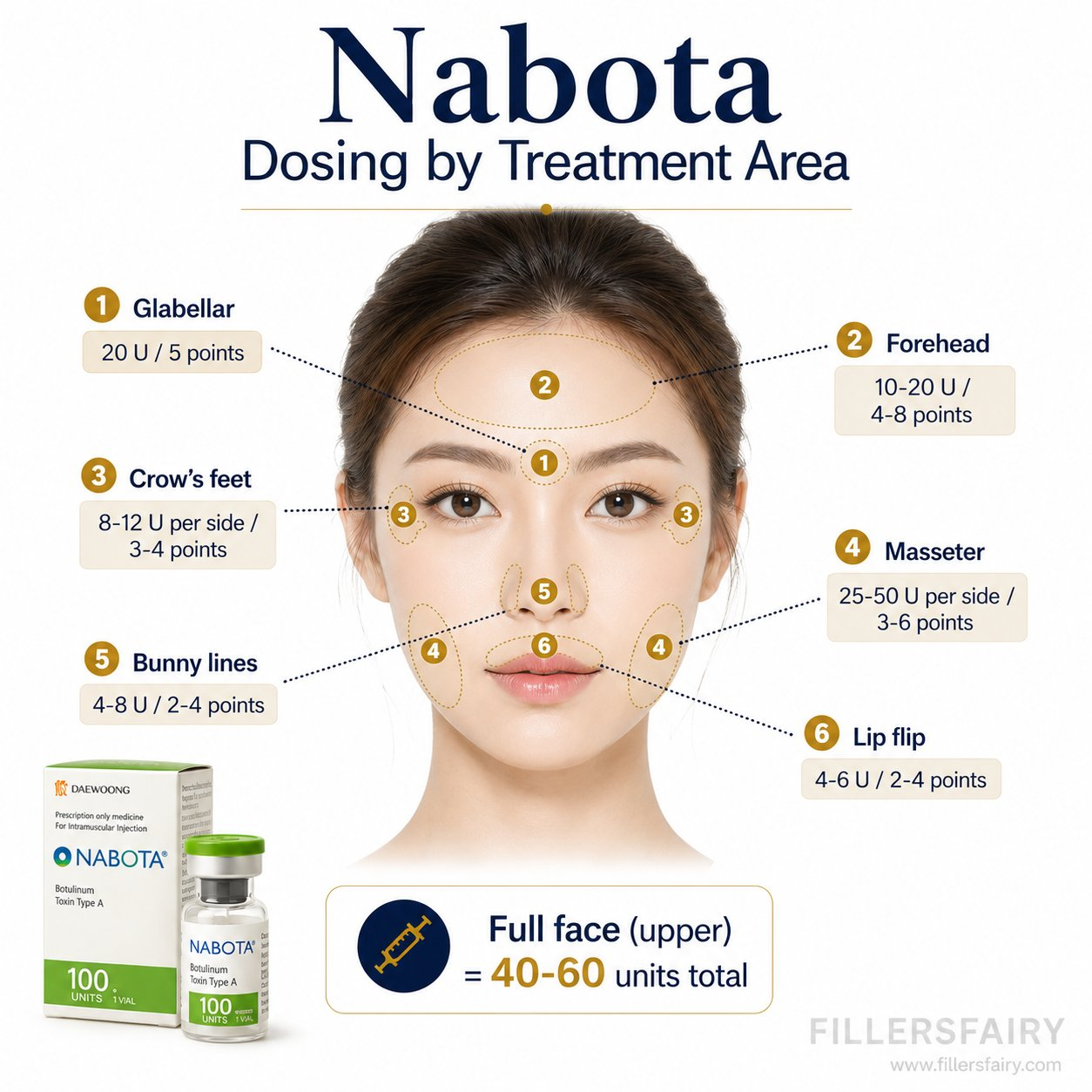
Nabota uses a 1:1 unit conversion with Botox — meaning the same number of units produces the same clinical effect. Practitioners switching from Botox do not need to adjust their dosing protocols.
| Treatment Area | Typical Dose | Injection Points | Notes |
|---|---|---|---|
| Glabellar lines (frown) | 20 U | 5 points | FDA-approved indication for Jeuveau |
| Forehead lines | 10–20 U | 4–8 points | Adjust based on muscle mass — start conservative |
| Crow’s feet | 8–12 U per side | 3–4 points per side | Inject lateral to orbital rim |
| Masseter (jaw slimming) | 25–50 U per side | 3–6 points per side | Intramuscular injection — palpate muscle bulk |
| Bunny lines (nose) | 4–8 U | 2–4 points | Small doses — nasalis muscle is thin |
| Lip flip | 4–6 U | 2–4 points | Very superficial — orbicularis oris border |
A typical full-face aesthetic treatment (glabellar + forehead + crow’s feet) uses approximately 40–60 units. One Nabota 100-unit vial comfortably covers one full-face treatment with reserve, or two focused-area treatments.
100 Units vs 200 Units: Which Vial to Stock
Nabota is available in both 100-unit and 200-unit vial sizes. The choice depends on clinic volume and treatment mix.
100-unit vial is ideal for clinics performing 1–3 botulinum toxin treatments per day. One vial covers a standard full-face treatment. Lower waste risk if patient flow is unpredictable. This is the standard entry point for clinics new to Nabota.
200-unit vial is better for high-volume clinics performing 4+ treatments daily. Better per-unit economics at wholesale. Can be divided into two treatment sessions within the 24-hour reconstitution window. Requires consistent patient scheduling to minimize waste.
Switching from Botox to Nabota: What to Know
The transition from Botox to Nabota is straightforward because the clinical protocol is virtually identical. Practitioners who have already switched consistently report three things: patients cannot tell the difference in results, the side effect profile is the same, and the cost savings are significant.
Practical tips for a smooth transition. Use the same reconstitution ratios and dilutions you currently use with Botox. Apply the same dosing per treatment area — Nabota is a 1:1 unit conversion. Store reconstituted product under the same conditions (2–8°C, use within 24 hours). Start by transitioning your most loyal, flexible patients — they are the best validators. Document outcomes for your first 10–20 patients to build internal confidence before a full switch.
The U.S. FDA approval as Jeuveau provides additional reassurance for patients and practitioners who want regulatory validation beyond KFDA. For wholesale pricing and ordering, Nabota typically offers 30–50% savings versus Botox at comparable treatment outcomes.
How Nabota Compares to Other Korean Brands
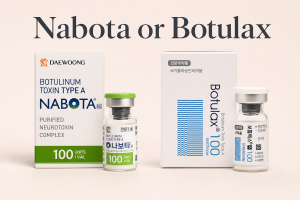
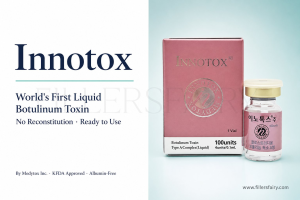
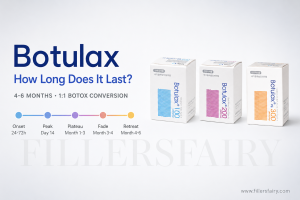
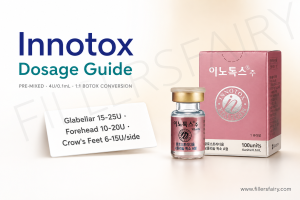
Nabota occupies the premium tier among Korean botulinum toxin products. While Botulax (Hugel’s Letybo) offers a wider format range at a lower per-unit cost, and Innotox eliminates reconstitution entirely with its liquid formulation, Nabota’s Hi-Pure™ Technology and narrower diffusion profile make it the preferred choice for precise facial injections.
For a full side-by-side comparison of all seven major Korean brands, see our Korean Botox brands guide.
Frequently Asked Questions
How do you reconstitute Nabota 100 units?
Add 2.5 mL of preservative-free normal saline to the 100-unit vial. Inject saline slowly along the vial wall — do not shake. Gently swirl to dissolve. This produces a standard concentration of 4 units per 0.1 mL. Use within 24 hours, store at 2–8°C.
Is Nabota the same strength as Botox?
Yes — 1:1 unit conversion. 20 units of Nabota produces the same clinical effect as 20 units of Botox. Both contain the same 900 kDa botulinum toxin type A complex. No dosing adjustment needed when switching.
Is Nabota FDA approved?
Yes. The same molecule is FDA approved under the brand name Jeuveau (prabotulinumtoxinA-xvfs), approved in 2019 for the treatment of moderate to severe glabellar lines. It also holds KFDA approval in South Korea.
How long does Nabota last after reconstitution?
Reconstituted Nabota should be used within 24 hours. Store at 2–8°C (refrigerator) — this applies to both reconstituted and unreconstituted vials. Do not freeze.
How long do Nabota results last on patients?
Nabota results typically last 3–4 months for standard aesthetic treatments (glabellar, forehead, crow’s feet), comparable to Botox. Masseter treatments may last longer (4–6 months) due to the larger muscle mass and higher dosing. Individual variation in metabolism affects duration.
Related Guides
- Nabota Side Effects: Is It Safe? — Safety guide
- Hyaron Injection Protocol — Skin booster technique
- Why Clinics Choose Curenex Glow — PDRN booster
- How Does Ami Eyes Work? — PN eye treatment