Hyaron Injection: How to Get the Best Results — Complete Treatment Protocol
Last updated: July 2026 · Reading time: 7 min
Quick Answer
Hyaron is a prefilled sodium hyaluronate injection (non-crosslinked HA, 25 mg/2.5 mL = 10 mg/mL) designed for superficial intradermal delivery using the nappage or microdroplet technique. Each prefilled syringe contains 2.5 mL — enough for a full-face treatment. The injection protocol targets the papillary dermis at 1–2 mm depth, distributing small volumes (0.02–0.05 mL per point) across treatment zones. Hyaron can also be delivered via microneedling for broader coverage with less practitioner time. A standard course is 3 sessions spaced 2–4 weeks apart, with results lasting 3–4 months on the face.
What Is Hyaron Sodium Hyaluronate?
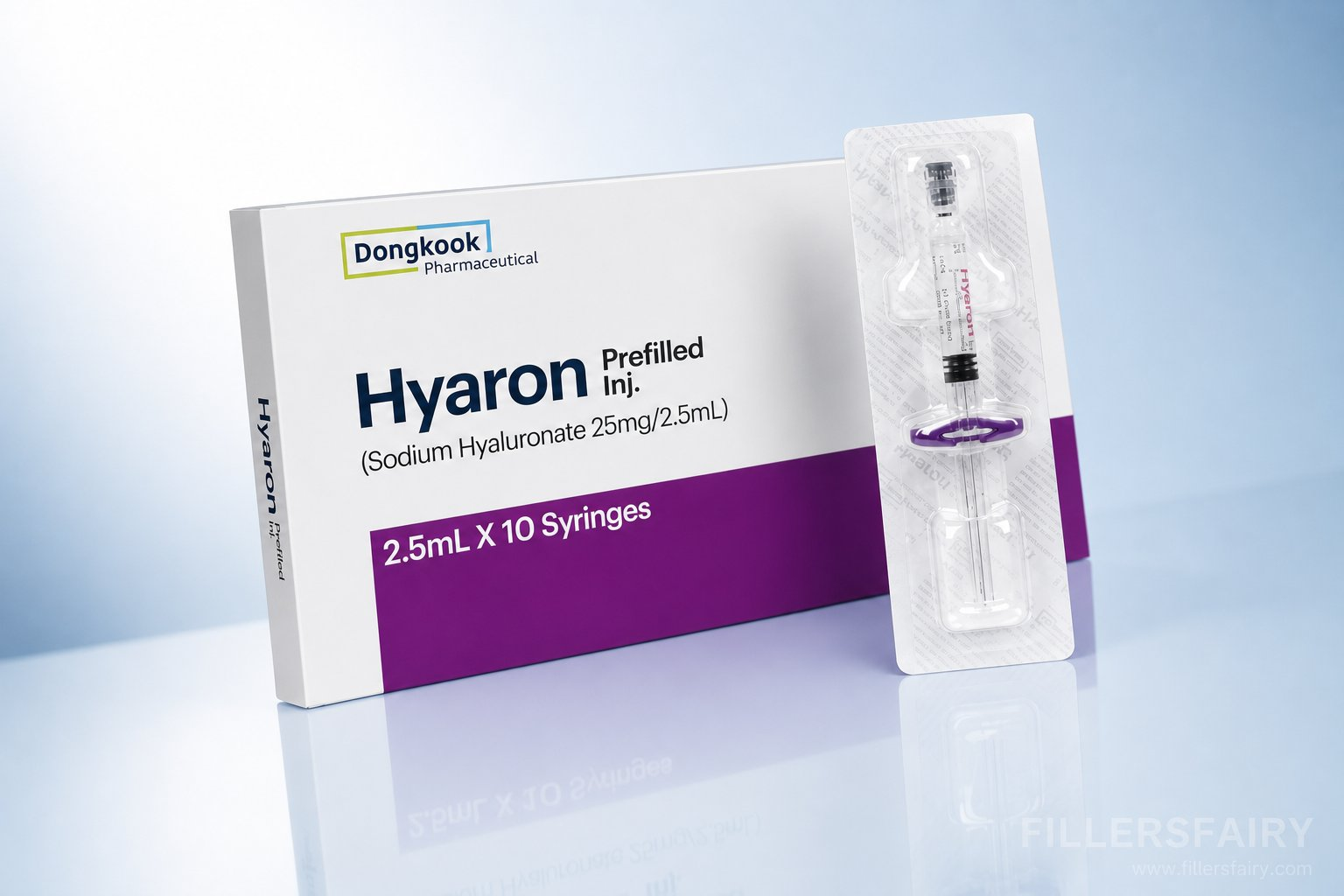
Hyaron contains non-crosslinked sodium hyaluronate at a concentration of 10 mg/mL (25 mg total per 2.5 mL syringe) — identical in molecular structure to the hyaluronic acid naturally present in human skin. The molecular weight is approximately 1,000 kDa, and the solution is isotonic with human tissue. “Non-crosslinked” means the HA molecules are free-form rather than chemically bonded together, which is what distinguishes Hyaron from volumizing fillers like Juvederm or Restylane.
This distinction matters for two reasons. First, non-crosslinked HA is metabolized faster than crosslinked HA — it hydrates and conditions the skin rather than adding structural volume. Second, it has a much gentler side effect profile because there are no chemical cross-linking agents (like BDDE) for the body to react to.
Hyaron comes in a prefilled syringe format, eliminating the need for reconstitution and reducing preparation time. Each syringe is single-use and ready for immediate injection — simply attach a needle and begin.
Injection Technique: Nappage vs Microdroplet
Two primary techniques are used for Hyaron injection. Both deliver excellent results when performed correctly — the choice depends on practitioner preference, treatment area, and patient skin type.
Nappage technique. Multiple rapid superficial injections (0.02–0.03 mL per point) placed 5–10 mm apart across the treatment zone. The needle enters the papillary dermis at approximately 1 mm depth at a 15–30° angle. This technique covers large areas efficiently and creates an even distribution of HA. It is the most common approach for full-face Hyaron treatments.
Microdroplet technique. Slightly larger deposits (0.03–0.05 mL per point) placed at fewer injection points with wider spacing. The product is injected perpendicular to the skin at 1–2 mm depth. This technique allows more precise control over product distribution and works well for targeted areas like the under-eye or upper lip.
Both techniques produce visible papules at injection points immediately post-treatment — this is normal and expected. Papules flatten within 24–48 hours as the HA disperses and integrates into the surrounding tissue.
Treatment Zone Protocol: Where and How Much
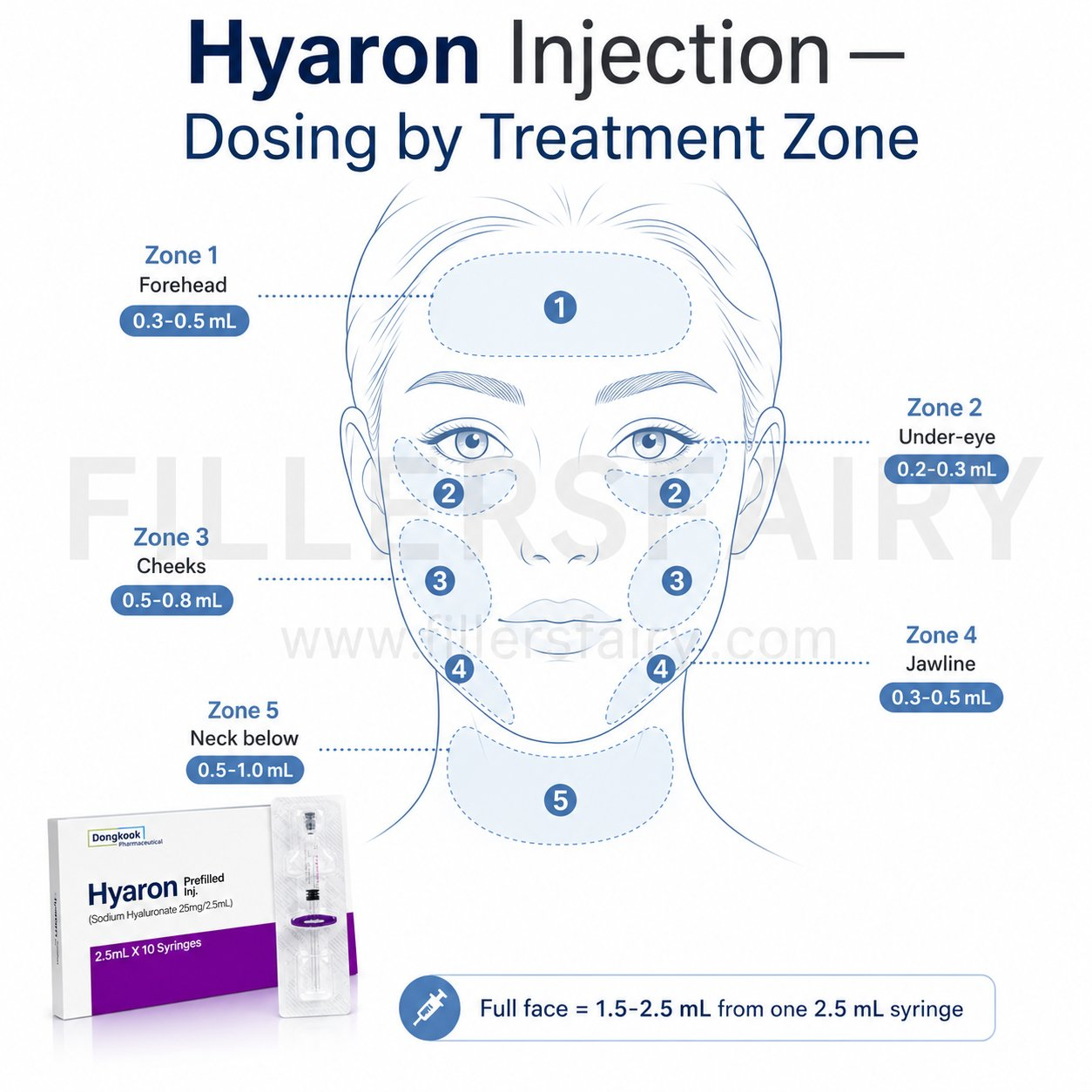
| Treatment Zone | Volume per Session | Injection Depth | Key Considerations |
|---|---|---|---|
| Forehead | 0.3–0.5 mL | 1 mm | Thin skin — use lighter deposits, more points |
| Cheeks | 0.5–0.8 mL | 1–2 mm | Largest zone — even spacing gives best glow result |
| Under-eye | 0.2–0.3 mL | 1 mm max | Most delicate area — fewest points, gentlest deposits |
| Jawline / chin | 0.3–0.5 mL | 1–2 mm | Thicker skin — can tolerate slightly larger deposits |
| Neck / décolletage | 0.5–1.0 mL | 1 mm | Thin, sun-damaged skin responds dramatically to hydration |
| Hands | 0.3–0.5 mL/hand | 1 mm | Dorsal hand only — avoid tendons and veins |
A full-face treatment typically uses 1.5–2.5 mL of the 2.5 mL syringe. The remaining product can be applied to the neck or other areas if the patient wants broader coverage.
Can Hyaron Be Used with Microneedling?
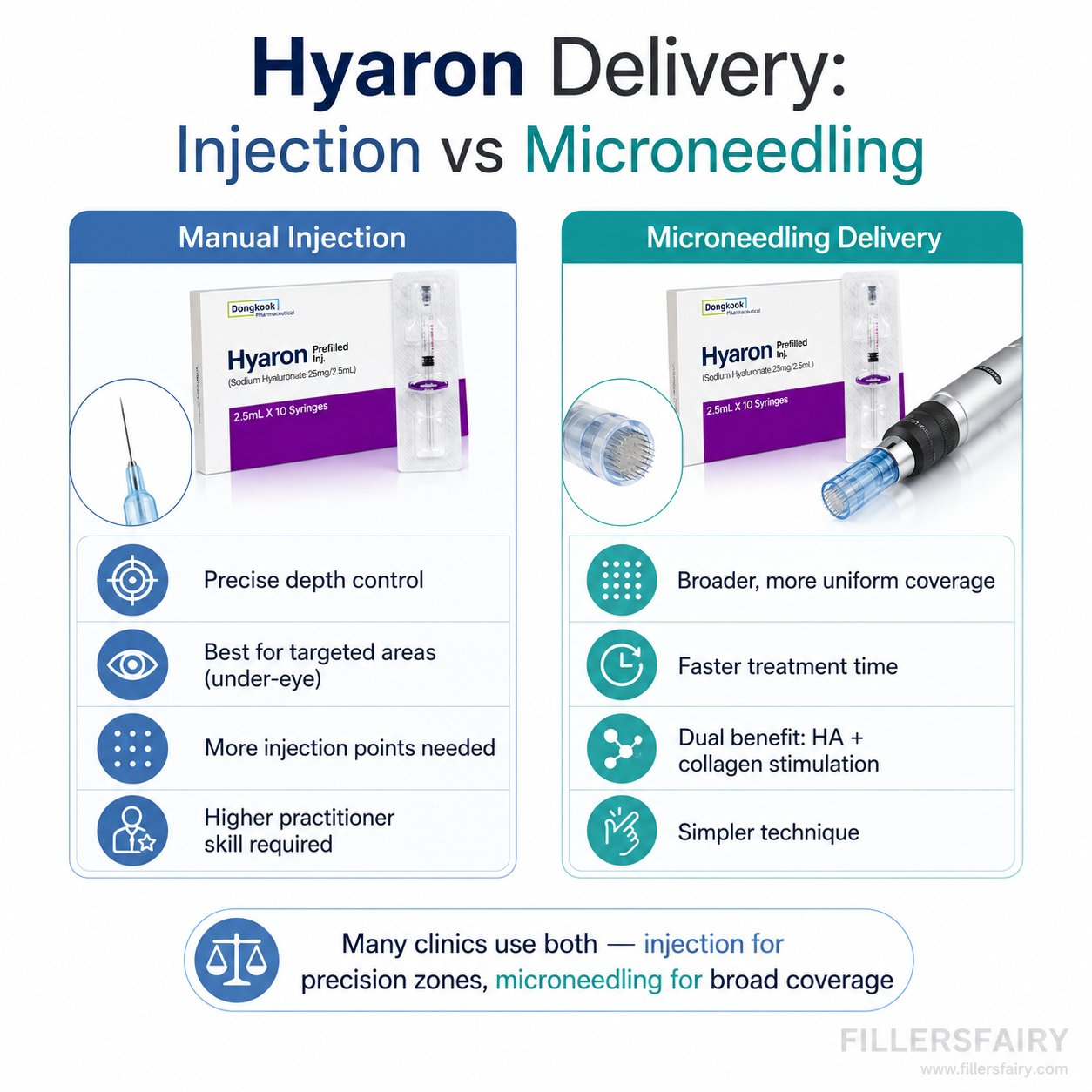
Yes — Hyaron is compatible with microneedling delivery, and many clinics use this approach as an alternative or supplement to manual injection. The non-crosslinked HA is applied to the skin surface and driven into the dermis through microneedle channels created by a dermaroller or pen device at 0.5–1.0 mm depth.
Microneedling delivery offers several advantages. It covers broader areas more uniformly than point-by-point injection. Treatment time is typically faster. Patients who are uncomfortable with multiple injections may prefer the microneedling approach. It also creates the controlled micro-trauma that stimulates the skin’s own collagen production — providing a complementary mechanism alongside Hyaron’s hydration.
The trade-off: microneedling delivers less product to a precise depth compared to direct injection. For targeted areas like the under-eye, manual injection gives more control. For general facial hydration and glow, microneedling provides excellent results with simpler technique. Many practitioners use a hybrid approach — manual injection for precision zones, microneedling for broad coverage.
Treatment Course and Maintenance Schedule
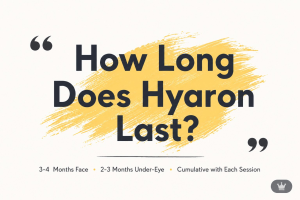
The standard Hyaron protocol follows a structured course. The initial course is 3 sessions spaced 2–4 weeks apart — this builds cumulative hydration in the dermis. A single standalone session provides temporary improvement (2–3 weeks), but the cumulative approach is what produces the lasting before-and-after transformation that patients notice and value.
After the initial course, maintenance sessions every 3–4 months sustain results. Patients who combine Hyaron with PN-based treatments like Rejuran or PDRN boosters like Curenex Glow may extend their Hyaron maintenance interval because the regenerative treatments provide structural support between hydration sessions.
Common Practitioner Questions About Hyaron Injection
Can I mix Hyaron with other products in the same syringe?
This is not recommended. Hyaron is formulated as a ready-to-use prefilled syringe at an optimized concentration. Mixing with other products changes the concentration and viscosity, which can affect injection behavior and results. If combining treatments, administer each product separately.
What needle gauge should I use for Hyaron?
30G needles are standard for Hyaron injection. The product does not include needles — practitioners supply their own. The non-crosslinked HA has low viscosity and flows easily through 30G needles, allowing precise superficial placement with minimal trauma. For microneedling delivery, 0.5–1.0 mm needle depth is typical.
Is Hyaron the same as a HA filler?
No. Hyaron contains non-crosslinked sodium hyaluronate — it hydrates and conditions the skin. HA fillers (Juvederm, Restylane) contain crosslinked HA that adds physical volume. Different products, different purposes, different injection depths. Hyaron goes superficial (1-2 mm dermis), fillers go deep (subcutis or supraperiosteal).
Can I use Hyaron for microneedling at home?
Hyaron is a medical-grade injectable product designed for professional use only. It should be administered by trained practitioners in a clinical setting — either by direct injection or professional-grade microneedling devices. Home microneedling does not achieve the consistent depth needed for effective dermal delivery.
How does Hyaron compare to Rejuran for injection?
Similar injection technique (superficial intradermal), but different active ingredients and mechanisms. Hyaron delivers non-crosslinked HA for immediate hydration. Rejuran delivers polynucleotides for collagen stimulation. Hyaron is faster-acting (instant glow), Rejuran is longer-lasting (6-12 months). Many clinics use both in alternating protocols — Hyaron for quick hydration, Rejuran for structural improvement.
Related Guides
- What Is Hyaron? Filler vs Skin Booster — Hub
- Hyaron Side Effects — Recovery guide
- How Long Does Hyaron Last? — Duration guide
- Hyaron Before and After — Results expectations
- How Does Ami Eyes Work? — PN periorbital treatment