Need help? Write to us [email protected]
Experience the Magic of FillersFairy – Shop Now for Your Beautiful Surprise!

- DERMAL FILLER
- Replengen
- UnionFill
- Flawless
- Belotero
- Tesoro
- Restylane
- Lip Star
- Youthfill
- Bellast
- Bonetta Dermal Filler
- Celosome
- Chaeum
- Dermalax
- E.P.T.Q
- Elasty
- Ellanse
- Elravie
- Helene
- Hyaldew
- HYALMASS Dermal Filler
- Juvederm
- Kairax
- Manla Kar
- Monalisa
- Neuramis
- Regenovue plus
- Rejeunesse Dermal Fillers Collection
- Revitrane
- Revolax
- Sosum
- Starfill
- Stylage
- Vom
- Yvoire
- LEXYAL
- Teosyal Redensity 2
- BODY FILLER
- SKIN BOOSTER
- HYALMASS Skin Booster
- Vitaran
- Tesoro Collegan
- Puri Heal Glow
- Restylane Vital
- Profhilo
- Hanheal Exosome
- Puri Heal Lucent
- Puri Heal Revital NAD+
- AMI Tone Up
- NCTF 135HA
- Recell PDRN
- DIVA EYE PN
- DIVA FACE PN
- AMI NAD+
- NadReju
- Miracle Touch BR
- Miracle Touch Up
- Regenovue Aqua Shine Plus
- Hyalace
- Elaxen PN
- PuriColl
- Rejeunesse Sparkle
- ASCE+ IRLV
- Puri Eyes
- Ami Eyes
- ASCE Plus SRLV
- Celosome Aqua
- Curenex Glow
- Cytocare
- Exo-one
- Hyaron
- Juvederm Skinvive
- Kiara Reju
- Lapuroon
- Puri Hilo PN
- Puri Pdrn
- Purilips
- Rejuran
- Revitrane HA20
- Sardenya Exoprime
- Save B32
- Save B32SP
- 2XSOME Dual-Exosome
- Hyalmass Aqua Exosome
- Richesse Collafilo
- P198 Filcore
- AMI Skin Booster
- INNOAESTHETICS Skin Boosters
- Mesoestetic x.prof 014
- Elravie Re2O
- Teosyal Redensity 1
- BOTULINUM TOXIN
- FAT DISSOLVING
- HAIR TREATMENT
- IV THERAPY
- NUMBING CREAM
- PLLA / PCL / CaHA
- CONSUMABLES
- THREAD
- AESTHETIC COSMETICS
- PEELING
- DEVICE
- Peptides
+1(912)5047648
- DERMAL FILLER
- Replengen
- UnionFill
- Flawless
- Belotero
- Tesoro
- Restylane
- Lip Star
- Youthfill
- Bellast
- Bonetta Dermal Filler
- Celosome
- Chaeum
- Dermalax
- E.P.T.Q
- Elasty
- Ellanse
- Elravie
- Helene
- Hyaldew
- HYALMASS Dermal Filler
- Juvederm
- Kairax
- Manla Kar
- Monalisa
- Neuramis
- Regenovue plus
- Rejeunesse Dermal Fillers Collection
- Revitrane
- Revolax
- Sosum
- Starfill
- Stylage
- Vom
- Yvoire
- LEXYAL
- Teosyal Redensity 2
- BODY FILLER
- SKIN BOOSTER
- HYALMASS Skin Booster
- Vitaran
- Tesoro Collegan
- Puri Heal Glow
- Restylane Vital
- Profhilo
- Hanheal Exosome
- Puri Heal Lucent
- Puri Heal Revital NAD+
- AMI Tone Up
- NCTF 135HA
- Recell PDRN
- DIVA EYE PN
- DIVA FACE PN
- AMI NAD+
- NadReju
- Miracle Touch BR
- Miracle Touch Up
- Regenovue Aqua Shine Plus
- Hyalace
- Elaxen PN
- PuriColl
- Rejeunesse Sparkle
- ASCE+ IRLV
- Puri Eyes
- Ami Eyes
- ASCE Plus SRLV
- Celosome Aqua
- Curenex Glow
- Cytocare
- Exo-one
- Hyaron
- Juvederm Skinvive
- Kiara Reju
- Lapuroon
- Puri Hilo PN
- Puri Pdrn
- Purilips
- Rejuran
- Revitrane HA20
- Sardenya Exoprime
- Save B32
- Save B32SP
- 2XSOME Dual-Exosome
- Hyalmass Aqua Exosome
- Richesse Collafilo
- P198 Filcore
- AMI Skin Booster
- INNOAESTHETICS Skin Boosters
- Mesoestetic x.prof 014
- Elravie Re2O
- Teosyal Redensity 1
- BOTULINUM TOXIN
- FAT DISSOLVING
- HAIR TREATMENT
- IV THERAPY
- NUMBING CREAM
- PLLA / PCL / CaHA
- CONSUMABLES
- THREAD
- AESTHETIC COSMETICS
- PEELING
- DEVICE
- Peptides
English
English
Korean Botox Brands: Nabota, Botulax, Innotox & More
What Is Korean Botox — and Why Is the U.S. Market Paying Attention?
Korean botox refers to botulinum toxin type A products manufactured in South Korea — a country that has become the world’s most competitive neurotoxin market. Unlike in the U.S., where Allergan’s Botox dominates with roughly 70% market share, South Korea’s aesthetic clinics choose from over half a dozen domestically produced BTX-A formulations competing on onset speed, format convenience, pricing, and diffusion characteristics.
In 2025–2026, two developments pushed Korean botox from niche interest into mainstream U.S. conversation:
- Hugel’s Letybo received FDA approval in February 2024 (BLA 761225), making it the second Korean-origin neurotoxin available in the U.S. market — following Daewoong’s Jeuveau (FDA-approved 2019, marketed by Evolus).
- Wholesale pricing shifted practitioner economics: Korean neurotoxins such as Botulax and Nabota cost approximately $200–$300 per 100-unit vial at comparable international market pricing, compared to $500–$600+ for branded Western products — a 40–60% difference that reshapes clinic procurement decisions.
This guide covers all seven major Korean botox brands available in 2026. For each brand, we cover what it is, who makes it, what format it comes in, its regulatory standing, and how it compares to the alternatives. This is not a dosing or reconstitution guide — for clinical protocols, see each product’s prescribing information.
The Three Formats: Why It Matters Before You Compare Brands
Before diving into individual brands, understand the three manufacturing formats. This single variable affects preparation time, cold-chain requirements, and clinical workflow more than most practitioners realize.
| Format | What It Looks Like | Preparation | Products That Use It |
|---|---|---|---|
| Liquid | Clear solution, ready to draw | None — inject directly | Innotox |
| Vacuum-Dried | Thin transparent film — vial appears nearly empty | Add sterile saline, swirl gently | Nabota |
| Freeze-Dried (Lyophilized) | Visible white powder cake | Add sterile saline, swirl gently | Botulax, Wondertox, Liztox, Toxta, Rentox |
What this means in practice: Liquid Innotox eliminates reconstitution entirely — no dilution variability, roughly 5–10 minutes saved per vial. Vacuum-dried and freeze-dried products both require saline reconstitution; the difference is visual (practitioners opening a vacuum-dried vial for the first time often think it’s empty — it isn’t). All reconstituted products should be used within 24 hours per manufacturer labelling.
The 7 Major Korean Botox Brands in 2026
Table of Contents
Toggle1. Nabota (Daewoong Pharmaceutical)
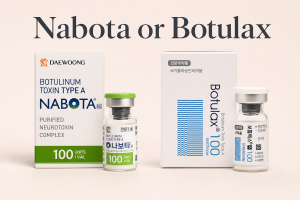
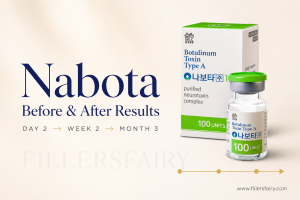
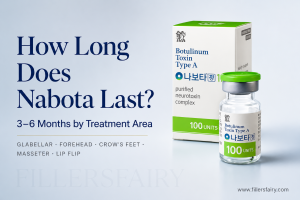
Manufacturer: Daewoong Pharmaceutical (established 1945, one of South Korea’s top three pharma companies)
Active ingredient: PrabotulinumtoxinA (wild-type strain, 900 kDa complex)
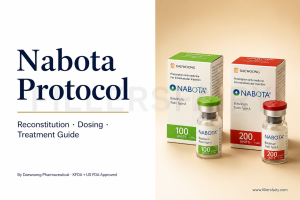
Format: Vacuum-dried powder — requires reconstitution. Available in 100-unit and 200-unit vials.
U.S. regulatory status: Daewoong manufactures Jeuveau (prabotulinumtoxinA-xvfs), which received FDA approval in 2019 for the treatment of moderate-to-severe glabellar lines in adults. Jeuveau is marketed in the U.S. by Evolus. Note: FDA approval applies to Jeuveau specifically; Korean-market Nabota SKUs are not automatically covered by this approval.
Manufacturing distinction: Nabota is produced using Hi-Pure™ Technology, a proprietary purification process designed to yield a high-purity neurotoxin with minimal accessory proteins. This aligns with the clinical observation that Nabota has a narrower, more localized diffusion profile compared to some competitors — making it a preferred option among practitioners for precise facial injections where spread to adjacent muscles must be minimized (e.g., brow lifts, crow’s feet, and targeted glabellar corrections).
How it positions against other Korean brands: Nabota occupies the premium tier among Korean neurotoxins. It typically commands the highest per-unit price in the Korean BTX-A category, justified by FDA-adjacent credibility (through Jeuveau), a well-documented clinical trial portfolio, and international brand recognition. Patients who travel internationally sometimes prefer Nabota/Jeuveau specifically because it is the most likely Korean brand to be available in their home country.
Best suited for: Practices seeking a Korean neurotoxin with maximum regulatory recognition; practitioners prioritizing diffusion precision for delicate facial zones; patients who value brand-name recognition comparable to Western products.
For practitioner-focused product information, see our Nabota protocol guide.
2. Botulax / Letybo (Hugel Pharma)
Manufacturer: Hugel Inc. (KOSDAQ-listed, the largest Korean botulinum toxin company by domestic market share)
Active ingredient: LetibotulinumtoxinA (CBFC26 strain, 900 kDa complex)
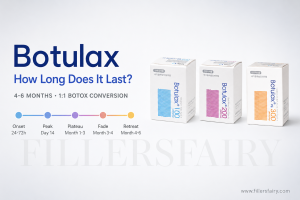
Format: Freeze-dried powder. Available in 100-unit, 200-unit, and 300-unit vials — the widest size range of any Korean BTX-A product. The 300-unit format is unique in the market.
U.S. regulatory status: Hugel’s Letybo (letibotulinumtoxinA-wlbg) received FDA approval in February 2024 (BLA 761225) for glabellar lines. Letybo is also approved in the EU, China, and multiple Asian and Middle Eastern markets. Botulax is the Korean domestic-market version of the same manufacturer’s toxin.
Clinical profile: Botulax has a reputation for strong muscle-relaxing potency and a relatively wider diffusion pattern compared to Nabota. This makes it especially effective for larger muscle groups — masseter (jaw slimming), trapezius (shoulder contouring), and gastrocnemius (calf reduction) are among its most common body-contouring applications. For facial wrinkles, it performs comparably to other Korean BTX-A products, with typical onset observed at 3–5 days.
How it positions against other Korean brands: Botulax occupies the volume + value tier. Its 300-unit vial enables high-dose treatments without opening multiple vials, reducing per-unit waste and cost. Among Korean toxins with an FDA-approved U.S. counterpart, Botulax/Letybo typically carries the lowest per-unit wholesale price — making it the go-to choice for high-throughput clinics and large-area body treatments.
Best suited for: High-volume practices; masseter and body-contouring procedures; clinics that value having an FDA-approved manufacturer at a competitive price point; practices treating patients who plan international touch-ups in Letybo-approved markets (U.S., EU, China).
3. Innotox (Medytox)
Manufacturer: Medytox Inc. (South Korea’s first company to develop a domestic botulinum toxin product)
Active ingredient: Botulinum toxin type A (Hall strain, 900 kDa complex)
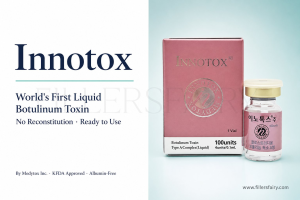
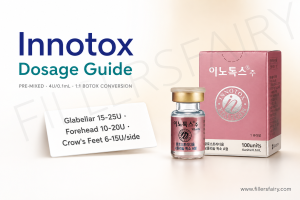
Format: Liquid — the only ready-to-use Korean BTX-A. Available in 50-unit and 100-unit vials. No reconstitution required.
U.S. regulatory status: Innotox itself is not FDA-approved. Medytox has had a complex regulatory history with the U.S. market; the company’s previous U.S. partnership was terminated, and Medytox is currently developing new international pathways. In the Korean domestic market, Innotox remains widely used and MFDS-approved.
What makes it different: Innotox’s liquid formulation is a genuine innovation in the botulinum toxin category. It eliminates reconstitution entirely — meaning no dilution errors, no saline compatibility concerns, and zero preparation time beyond drawing from the vial. The stabilizer system (L-methionine + Polysorbate 20) is free of human serum albumin (HSA) and animal-derived components, which matters for patients with specific allergy histories or preferences.
Clinically, Innotox is described as having a smooth, moderate diffusion pattern that produces natural-looking results — patients retain more dynamic facial movement compared to stronger-paralyzing formulations. This makes it particularly popular for preventative anti-aging treatments in younger patients (late 20s to early 30s) and for anyone seeking subtle rejuvenation rather than a “frozen” appearance.
Trade-off: The liquid format requires strict cold-chain maintenance (2–8°C) throughout shipping and storage. Powder formats may tolerate short temperature excursions better. The 100-unit maximum vial size also means multiple vials are needed for large-area treatments.
Best suited for: Clinics prioritizing workflow efficiency; preventative Botox in younger patients; HSA-free preference; subtle, natural-looking results where full muscle paralysis is not the goal.
4. Wondertox (Chong Kun Dang Pharmaceutical)
Manufacturer: Chong Kun Dang Pharmaceutical (established 1941, one of Korea’s oldest and largest pharma companies)
Active ingredient: Botulinum toxin type A (900 kDa complex)
Format: Freeze-dried powder. Available in 100-unit and 200-unit vials. Standard HSA + NaCl excipients.
U.S. regulatory status: Not FDA-approved. MFDS-approved for the Korean market.
Why it’s on the list: Wondertox benefits from the institutional credibility of Chong Kun Dang, a publicly listed pharmaceutical giant with over 80 years of manufacturing history. Among practitioners who value manufacturer pedigree, Wondertox carries weight simply by association with one of Korea’s most established drug companies.
Clinically, Wondertox performs in the mid-range of the Korean BTX-A spectrum: onset at approximately 3–5 days, duration comparable to the category average, and a diffusion profile that neither skews unusually narrow nor wide. It is not the fastest, the longest-lasting, or the most specialized — but it is consistent, and the 200-unit format offers per-unit cost savings for practices treating multiple areas per session.
Best suited for: Practices seeking a reliable, middle-of-the-road Korean neurotoxin from a major pharmaceutical manufacturer; multi-area facial treatments where the 200-unit vial economics work in the clinic’s favor.
5. Liztox / Hutox (Huons Biopharma)
Manufacturer: Huons Biopharma (subsidiary of Huons Global, KOSDAQ-listed)
Active ingredient: Botulinum toxin type A (900 kDa complex)
Format: Freeze-dried powder. Available in 100-unit and 200-unit vials. Stabilized with 0.5 mg HSA.
U.S. regulatory status: Not FDA-approved. MFDS-approved for the Korean market. Exported internationally under the Hutox brand name.
Manufacturing distinction: Liztox is produced using the BioPure™ Extraction Process, which the manufacturer states achieves 99.8% purity — among the highest documented purity levels in the Korean BTX-A category. Higher purity means fewer accessory (complexing) proteins in the final product. The theoretical advantage: accessory proteins may act as antigens that contribute to neutralizing antibody formation over repeated treatments, so removing more of them could reduce the risk of secondary non-response — though the clinical significance of purity differences at this level remains debated and independent comparative data are limited.
Market positioning: Liztox/Hutox sits in the accessible value tier — priced competitively, widely distributed internationally, and positioned as a straightforward Korean BTX-A without premium branding. It is commonly used in package pricing and bulk treatment plans where cost-per-unit is a primary consideration.
Best suited for: Cost-sensitive practices; patients with longer treatment histories where antibody formation is a theoretical concern (though clinical evidence is product-specific); clinics in markets where Hutox has established distribution.
6. Toxta (JETEMA)
Manufacturer: JETEMA Co., Ltd. (KOSDAQ-listed)
Active ingredient: Botulinum toxin type A (proprietary strain)
Format: Freeze-dried powder. Available in 100-unit and 200-unit vials. Stabilized with 0.5 mg HSA.
U.S. regulatory status: Not FDA-approved. MFDS-approved for the Korean market.
What to know: JETEMA is a publicly traded Korean biopharmaceutical company whose production platform also manufactures the sister brand Kaimax, positioned differently in the market. Toxta itself is the more widely distributed brand and is frequently described by international suppliers as a “reliable workhorse” — not the newest, not the most feature-rich, but consistent and straightforward.
Clinical data specific to Toxta is less widely published than for the top-tier Korean brands (Nabota, Botulax, Innotox). In practice, Toxta is used for the same standard facial aesthetic indications — glabellar lines, forehead lines, crow’s feet — and is generally selected based on availability and pricing rather than a unique clinical selling point.
Best suited for: Practices in markets where Toxta has strong distributor presence; clinics seeking a straightforward, budget-conscious Korean BTX-A option.
7. Rentox / ReNTox (Pharma Research Bio)
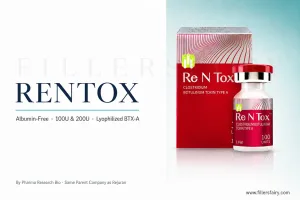
Manufacturer: Pharma Research Bio (a newer-generation Korean biotech entrant)
Active ingredient: Botulinum toxin type A
Format: Freeze-dried powder. Available in 100-unit and 200-unit vials.
U.S. regulatory status: Not FDA-approved. MFDS-approved for the Korean domestic market.
Market context: Rentox (sometimes styled as ReNTox) is the newest entrant among the seven brands covered here. Pharma Research Bio is a relative newcomer compared to established manufacturers like Daewoong, Hugel, and Medytox. As a later-generation product, Rentox competes primarily on price accessibility — it is typically positioned below the mid-tier in wholesale cost, making it an option for clinics that want to offer a Korean BTX-A at the lowest possible per-unit cost.
Because Rentox has a shorter market history, long-term clinical data, published head-to-head studies, and real-world longevity data are less extensive than for brands like Nabota or Botulax. Practitioners adopting Rentox typically do so based on favorable initial clinical experience, supplier availability, and procurement economics rather than an extensive evidence base.
Best suited for: Early-adopter clinics evaluating newer Korean BTX-A options; practices prioritizing lowest per-unit cost; markets where Rentox distribution has recently expanded.
Side-by-Side Comparison: All 7 Brands at a Glance
| Brand | Manufacturer | Format | Sizes (Units) | Stabilizer | U.S. FDA Connection | Diffusion Profile | Price Tier |
|---|---|---|---|---|---|---|---|
| Nabota | Daewoong | Vacuum-dried | 100 / 200 | HSA | ✅ Jeuveau (2019) | Narrow, localized | Premium |
| Botulax | Hugel Pharma | Freeze-dried | 100 / 200 / 300 | HSA 0.5 mg | ✅ Letybo (2024) | Wider, strong | Value |
| Innotox | Medytox | Liquid | 50 / 100 | L-methionine + Polysorbate 20 | ❌ | Smooth, moderate | Mid-Premium |
| Wondertox | Chong Kun Dang | Freeze-dried | 100 / 200 | HSA + NaCl | ❌ | Moderate | Mid |
| Liztox | Huons Biopharma | Freeze-dried | 100 / 200 | HSA 0.5 mg | ❌ | Moderate | Value |
| Toxta | JETEMA | Freeze-dried | 100 / 200 | HSA 0.5 mg | ❌ | Moderate | Budget |
| Rentox | Pharma Research Bio | Freeze-dried | 100 / 200 | — | ❌ | Under evaluation | Budget |
All products MFDS (KFDA) approved for the Korean market. Potency units are product-specific per each manufacturer’s labelling and should not be assumed interchangeable. Storage: 2–8°C for all products listed.
Korean Botox vs. American Botox (Allergan): Key Differences
Patients and practitioners considering Korean botulinum toxin brands inevitably compare them against Allergan’s Botox (onabotulinumtoxinA) — still the dominant U.S. product by market share. Here is an apples-to-apples breakdown:
| Dimension | Korean Botox (Brand-Dependent) | Botox (Allergan) |
|---|---|---|
| Unit economics | $200–$300 per 100U vial (wholesale, typical) | $500–$600+ per 100U vial |
| Onset speed | Some brands (Nabota) report 2–3 days; others 3–5 days | Typically 3–7 days |
| Diffusion control | Varies: Nabota narrow, Botulax wider, Innotox moderate | Moderate, well-characterized |
| Formulation formats | Liquid (Innotox) + powder options | Powder only (100U, 200U) |
| FDA approval | 2 manufacturers with FDA-approved U.S. products | Original FDA approval 2002 |
| Global recognition | Growing rapidly; Letybo approved in U.S., EU, China | Universal, 90+ countries |
| Clinical trial volume | Growing but variable by brand | Extensive, decades of data |
The bottom line: The clinical effect — inhibition of acetylcholine release at the neuromuscular junction — is the same mechanism across all botulinum toxin type A products. The differences lie in manufacturing, excipients, format convenience, and price. For a typical glabellar/forehead/crow’s-feet treatment in a reputable clinic, the brand choice is less clinically significant than the injector’s skill, accurate dosing, and proper product handling.
Pricing: What Patients and Practices Can Expect
U.S. Consumer Pricing (Per Treatment Area, 2026 Estimates)
| Treatment Area | Typical Unit Range | Korean Toxin (Estimated) | Botox/Jeuveau (Estimated) |
|---|---|---|---|
| Glabellar lines | 20–25 units | $200–$350 | $350–$500 |
| Forehead lines | 10–20 units | $150–$300 | $250–$400 |
| Crow’s feet (both sides) | 12–24 units | $180–$350 | $300–$500 |
| Masseter (both sides) | 40–80 units | $400–$800 | $700–$1,200 |
Ranges are estimates and vary by geographic market, clinic pricing model, and practitioner experience. Korean-toxin pricing assumes the clinic stocks Korean products and passes savings to the patient — not all U.S. clinics do.
International Perspective
In Seoul, Gangnam-district clinics offer Korean botox for $80–$200 per facial area (25–50 units) using domestic brands — a 60–80% discount relative to comparable U.S. pricing. In the EU and UK, Letybo and Nabota/Jeuveau availability varies by country; where approved, they typically price at a 20–40% discount to Botox.
How to Choose: A Decision Framework by Goal
| If Your Priority Is… | Consider… | Because… |
|---|---|---|
| FDA-track-record reassurance | Nabota (Jeuveau) or Botulax (Letybo) | Only two Korean manufacturers with FDA-approved U.S. products |
| Fastest clinic workflow | Innotox | No reconstitution; draw and inject |
| Large-area body treatments | Botulax 300U | Only brand with a 300-unit vial |
| Precision for delicate facial zones | Nabota | Narrow, localized diffusion pattern |
| Lowest per-unit cost | Botulax, Liztox, Rentox | Value-tier and budget-tier pricing |
| Natural, subtle results | Innotox | Smooth, moderate diffusion preserves facial dynamics |
| HSA-free / animal-component-free | Innotox | L-methionine + Polysorbate 20 stabilizer system |
| Manufacturer with 80+ years of pharma history | Wondertox (Chong Kun Dang) | Institutional credibility of a major legacy pharma company |
Common practice: Most international clinics stock 2–3 Korean brands — typically one premium option with FDA connections (Nabota or Botulax/Letybo) plus one value-tier or convenience-focused option (Innotox for workflow speed, or Liztox/Toxta for cost flexibility). Stocking all seven is unnecessary.
Safety, Legality, and What to Ask Your Provider
Is Korean Botox Legal in the U.S.?
The question has a two-part answer:
- FDA-approved products available in the U.S.: Jeuveau (Nabota’s U.S. counterpart, since 2019) and Letybo (Botulax’s U.S. counterpart, since 2024) are FDA-approved and can be legally prescribed and administered by licensed U.S. practitioners.
- Korean-market SKUs: Nabota, Botulax, Innotox, Liztox, and other Korean-market-labelled products are not individually FDA-approved and cannot be legally imported or administered in the U.S. outside of specific regulatory pathways.
Practitioners outside the U.S. should verify regulatory status in their jurisdiction — approval in South Korea (MFDS) does not automatically extend to other countries.
Counterfeit Risk
Counterfeit botulinum toxin is a documented global problem. In 2024–2025, the U.S. CDC reported clusters of botulism-like illness linked to counterfeit or improperly handled neurotoxin products. Two safeguards:
- Verify the source: Purchase only through authorized, licensed pharmaceutical distributors with documented supply-chain verification.
- Check the packaging: Legitimate Korean BTX-A products include holographic seals, lot numbers traceable to the manufacturer, and MFDS registration markings. If the price is dramatically below market — particularly for “too good to be true” online offers — investigate the supply chain before purchasing.
Questions to Ask Your Provider (If You’re a Patient)
- “Which specific brand and manufacturer are you using today?”
- “How many units are you administering to each area?”
- “Is this product stored refrigerated (2–8°C) and within its expiration date?”
- “If I travel internationally, is this brand available in my destination country?”
Frequently Asked Questions
Q: Which Korean botox brand is the best?
There is no single “best” Korean botulinum toxin — all seven brands act through the same biological mechanism (acetylcholine release inhibition) and are MFDS-approved. The right brand depends on your priorities: FDA-track-record reassurance (Nabota, Botulax), workflow speed (Innotox), body-contouring capability (Botulax 300U), or cost (Liztox, Toxta, Rentox). Most clinics stock 2–3 brands to cover different clinical scenarios.
Q: Is Korean botox as effective as American Botox?
Yes. Head-to-head studies in Korean dermatology literature show all licensed Korean botulinum toxin type A products are clinically effective for cosmetic indications. Differences in onset speed, longevity, and diffusion are typically modest in well-conducted comparisons. For standard glabellar, forehead, and crow’s-feet treatments, outcomes depend more on injector skill and accurate dosing than on brand selection.
Q: Can I switch from Botox (Allergan) to a Korean brand?
Many patients switch without issue. However, potency units are product-specific — Botox units, Jeuveau units, and Botulax units are defined by each manufacturer using different assays and are not directly interchangeable. Your practitioner should dose the Korean product according to its own labelling, not by converting from your previous Botox dose.
Q: How much cheaper is Korean botox compared to Botox?
At wholesale, Korean neurotoxins typically cost 40–60% less per 100-unit vial than branded Allergan Botox. At the consumer level, savings depend on whether the clinic passes through the difference — some do (pricing Korean-toxin treatments 20–40% lower), others maintain Botox-comparable pricing while capturing the margin.
Q: Is Innotox better because it doesn’t need to be mixed?
“Innotox is more convenient” is accurate — eliminating reconstitution saves time and removes dilution variability. “Innotox is more effective” is not supported by evidence. The liquid format is a convenience advantage, not a potency advantage. For large-area treatments (masseter, calves), Innotox’s 100-unit maximum vial size becomes a limitation.
Q: Are Korean botox brands safe?
All seven brands covered here are MFDS (Korean FDA) approved and manufactured in regulated pharmaceutical facilities. The safety profile of botulinum toxin type A is well-established across decades of clinical use. The primary safety concerns with Korean BTX-A products are the same as with any neurotoxin: counterfeit products, improper storage (breaking cold chain), and administration by unlicensed providers. Choose a licensed clinic and verified supply chain, and the safety profile is comparable to Western products.
Disclaimer: : This article is for educational and informational purposes only. It does not constitute medical advice, legal advice, or regulatory guidance. Botulinum toxin products are prescription medicines that should only be administered by licensed healthcare professionals. Regulatory status information is current as of the publication date and may change. Potency units are product-specific per each manufacturer’s labelling and are not interchangeable. Verify all products’ regulatory compliance in your jurisdiction before clinical use. FillersFairy is a wholesale supplier of Korean botulinum toxin products; this article does not constitute a product endorsement or recommendation for any specific clinical application.*
References
- U.S. FDA. JEUVEAU (prabotulinumtoxinA-xvfs) prescribing information. Approved 2019.
- U.S. FDA. LETYBO (letibotulinumtoxinA-wlbg) prescribing information. BLA 761225. Approved February 2024.
- Daewoong Pharmaceutical. Nabota product specifications. MFDS approved.
- Hugel Pharma. Botulax product specifications. MFDS approved.
- Medytox Inc. Innotox product specifications. MFDS approved.
- Chong Kun Dang Pharmaceutical. Wondertox product specifications. MFDS approved.
- Huons Biopharma. Liztox product specifications. MFDS approved.